
Melbourne Auction Clearance Rates: What the Latest Figures Mean
Melbourne’s auction clearance rate for the week ending 24 October 2026 sat in the mid-50s per cent on most preliminary measures. Domain recorded 54% from 691 reported results, while Cotality reported 54.8%. Victoria’s own final figures from the state’s industry body ran higher. That gap is not an error. It comes from who counts what, and when. This guide gives you the latest numbers, explains why they differ, and shows what they can and cannot tell you about a property you are thinking of buying.
WealthstackerPut Auction Headlines in ContextWealthStacker helps you assess property decisions with automated valuations, AI tools and personalised modelling for rentvesting or buying strategies.Explore WealthStackerTL;DR
- The latest preliminary Melbourne clearance rates range from 54% to 58.5%, depending on the data provider and how it counts.
- Final figures for Victoria, which count only reported results, usually come in higher than preliminary Melbourne numbers.
- Melbourne is not one market: results in the week to 24 October 2026 ranged from 44.0% in the South East to 63.9% in the North East.
- A clearance rate describes the whole city’s weekend. It does not tell you what a specific home is worth or whether it suits your goals.
- Use the headline as context, then check suburb data, your borrowing capacity and your own numbers before you bid.
Table of Contents
- The latest Melbourne clearance rates
- Why the numbers never agree
- Melbourne is several markets, not one
- What changed in Victoria: reserve price disclosure
- How to read a clearance rate
- If you are buying: using the data at the auction
- If you are investing: what the rate does not tell you
- Run your own numbers before auction day
- Keeping tabs on clearance rates without the noise
- FAQ
- Sources
The latest Melbourne clearance rates
Several organisations publish a Melbourne number every weekend, and they rarely match. Here is what the main ones showed for the most recent week at the time of writing.
| Provider | Area | Rate | Basis |
|---|---|---|---|
| Domain | Melbourne | 54% | Preliminary, 691 reported results, week ending 24 October 2026 |
| Cotality | Melbourne | 54.8% | Weekly figure reported 26 October 2026 |
| My Housing Market | Melbourne | 58.5% | Weekly, week ending 24 October 2026 |
| REA Group | Victoria | 62.8% | Preliminary, 236 sales from 376 reported results, week ending 24 October 2026 |
| REIV | Victoria | 69% | Final, 336 reported auctions, week ending 18 October 2026 |
The REIV figure covers an earlier week, so do not read it as a like-for-like comparison with the 24 October numbers. It does show the typical shape: a final, reported-results-only number for the state lands well above a preliminary city number published on Sunday night.
These figures change every Saturday, so treat the table as a snapshot. For the current week, go to the live pages from Domain and REIV.
Why the numbers never agree
A clearance rate is the share of auctions that ended in a sale out of the auctions counted. Everything interesting happens in the phrase “auctions counted”.
Preliminary versus final
Preliminary figures are published on Saturday night or Sunday, when some agents have not yet reported. Those results get filled in or revised over the following days, and the final number is usually different. Revisions can be large. In July 2026, PropTrack recorded an initial 56.2% clearance rate that was revised down to 51.2% by Monday, according to a media report on a Melbourne weekend. Check any such headline against its source page before relying on it, but the lesson stands: a Sunday number is a first draft.
Reported versus scheduled
Some providers count every scheduled auction and treat unreported ones as not sold. Others count only auctions where a result was reported. Reporting-only figures, like REIV’s, tend to look stronger because an unreported auction is more likely to be a pass-in that the agent would rather not publicise. That is one reason the REIV and Domain numbers differ even for the same weekend.
Geography and property type
“Melbourne” can mean the greater metropolitan area, “Victoria” includes regional centres, and some series split houses from units. Always check which area and which dwelling types a number covers before you compare it with another one.
Sample size
The Domain figure above rests on 691 reported results, and the REIV figure on 336. That is plenty for a citywide rate. It is thin for a single region or suburb, where one or two auctions can swing the percentage by several points.
Melbourne is several markets, not one
The citywide figure hides wide differences. Regional results for the week ending 24 October 2026 had the North East at 63.9% and the South East at 44.0%, a gap of almost 20 percentage points in the same weekend. A buyer in one part of the city faced a very different contest from a buyer in another.
That matches a broader pattern. One broker commentary noted that inner and middle-ring suburbs have kept attracting genuine buyer competition even with interest rates high. If you are looking in the outer south-east, a 54% city figure may overstate what you will face. If you are looking in a leafy inner suburb, it may understate it.

Price level matters too. The same weekly report put the median price for houses sold at auction in Melbourne at $1,254,000. That is a median of sold auctions, not of all houses, and it is skewed toward the suburbs and property types that tend to go to auction.
What changed in Victoria: reserve price disclosure
Sellers in Victoria must now disclose their reserve price at least seven days before the auction. Cotality linked the shortfall in Melbourne auction volumes partly to weaker selling conditions and partly to these transparency rules.
Two effects are worth keeping in mind:
- Fewer surprises for buyers. If the reserve is known a week out, you can judge before auction day whether the property is realistically within reach.
- Possible changes in how sellers behave. Some sellers may avoid auction or price differently when the reserve is public. One agent quoted by realestate.com.au said the share of auctions moving to private sale fell from 11.8% to 10.5% after the changes.
Because the rules changed the way auctions are set up, comparing today’s clearance rate with figures from earlier years is less clean than it looks. A 54% now does not necessarily mean the same thing as a 54% before reserve disclosure.
How to read a clearance rate
There is no single magic number, but there are rough ways to think about the range. Treat these as rules of thumb for reading headlines, not as official thresholds.
- Roughly 70% and above: typically described as a strong seller’s market, with multiple bidders and little room to negotiate.
- Around 60%: a market where most auctions work, but a meaningful share pass in and buyers have some leverage afterwards.
- Low 50s and below: a softer market. More properties are passed in, and negotiation after the auction is a realistic path.
Volume matters as much as the percentage. A high rate on few auctions can reflect only the strongest listings coming forward, while a middling rate on high volume can mean sellers are testing a market that is not rewarding them. One analyst’s caution fits here: steady headline figures can hide weaker conditions on the ground, such as lower open home attendance and fewer active bidders.
It also helps to look at how a property sold, not just whether it did. Sales before auction can point to genuine competition from buyers who would rather pay up front than risk losing on the day. A sale at auction with one bidder is a different signal.
If you are buying: using the data at the auction
A clearance rate is context. Your decision is about one property, so the useful questions are local.
- Find the suburb’s own results. Look at the past several weeks of sales for similar homes in that suburb, not just the citywide number.
- Read the reserve disclosure. In Victoria you can see the seller’s reserve a week out, so you know whether you are in range before you attend.
- Set a ceiling price in advance. Work backwards from your borrowing capacity, deposit, stamp duty and buffer. Auctions are built to push people past their number.
- Plan for a pass-in. If the property is passed in, the highest bidder usually gets the first chance to negotiate with the vendor. In a softer market, that conversation is where buyers have the most leverage.
- Do your checks first. Auctions are unconditional, so building and pest inspections, contract review and finance approval need to be done before the day, not after.
First-time buyers should also check which grants and concessions apply before they set a ceiling, because they change the cash you need. Our guide to first home buyer grants covers what is on offer. If you are weighing an investment purchase, the differences in owner-occupier versus investor loans affect both your rate and your borrowing capacity.
If you are investing: what the rate does not tell you
Investors often read clearance rates as a verdict on the whole market. They are a narrower signal: how many sellers and buyers met at a price this weekend, in the segment of the market that uses auctions.
What a clearance rate cannot show you:
- Rental yield and rental growth. A suburb can clear 70% of its auctions and still deliver thin yield. For that side, see our look at what the data says on rental growth.
- Supply pressure. Auction volumes reflect what sellers chose to list, not the pipeline of new dwellings. Our explainer on supply and demand in the Australian property market shows why that matters.
- Where you are in the cycle. A single week is noise. Rates read better as a trend against the stages of the property market cycle.
- Your own returns. Whether a purchase works depends on your costs, your loan, your tax position and your holding period. It does not depend on how many bidders turned up on Saturday. Our piece on real estate ROI benchmarks explains how to measure that.
A softer market does create openings for investors with finance ready: more pass-ins, longer negotiation windows and less pressure. But it also means lower confidence among other owners and sometimes slower price growth. Model both outcomes before you commit.
Run your own numbers before auction day
The weekly clearance rate answers a market question. The question that decides whether you win or regret a purchase is a personal one: what can you afford, and how does buying compare with renting and investing elsewhere?
WealthStacker is built for that second question. You can get free automated quarterly property valuations, estimate your borrowing power, and run 15-year scenarios that compare buying with rentvesting, so you see the likely effect on your net worth before you set a ceiling price.
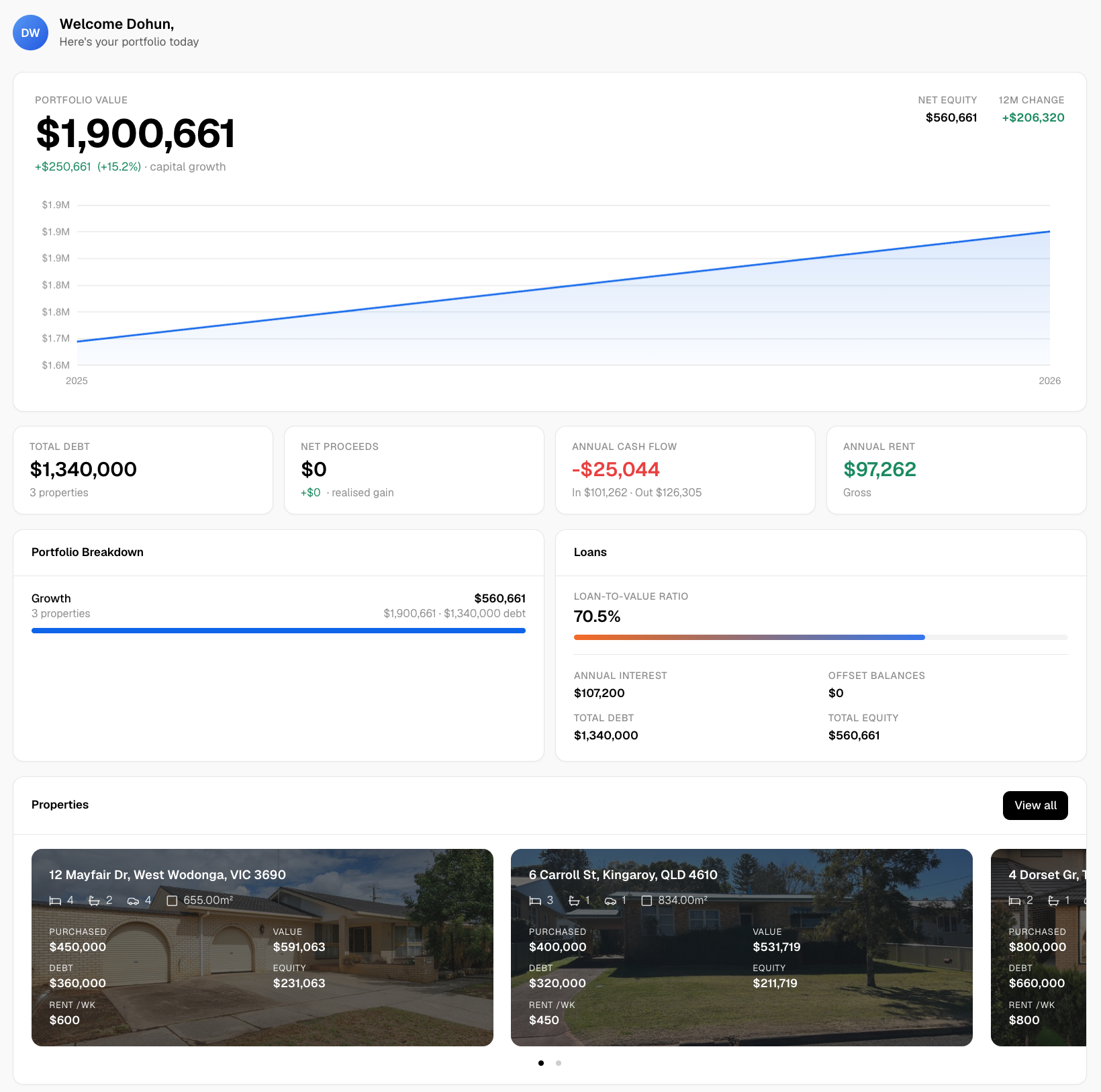
If you are preparing for a Melbourne campaign, join WealthStacker and model your options first. You can also look at the WealthStacker toolkit to see how the valuations, planners and market research tools fit together.
Keeping tabs on clearance rates without the noise
A short routine beats checking every headline:
- Look once a week, on Monday or later. Preliminary Sunday figures get revised. Waiting a day or two gives you a steadier number.
- Note the source and basis each time. Write down whether it is preliminary or final, and whether it covers Melbourne or Victoria. Compare like with like.
- Track a four-week trend. One strong or weak weekend means little. A month of movement in one direction means more.
- Pair the citywide number with your region. Regional splits, such as the 19.9-point gap between the North East and South East in late October 2026, tell you more than the single city line.
- Check the volume. Compare the number of reported results with recent weeks. A rate on 300 auctions and a rate on 700 are not equally informative.
If you plan to borrow against existing equity to fund a purchase, add the rules to your reading too: our guide on modelling APRA buffers and tax risk before borrowing home equity sets out what to check before the market moves your plans.
FAQ
What is the latest Melbourne auction clearance rate?
For the week ending 24 October 2026, Domain reported a preliminary 54% and My Housing Market reported 58.5%. The difference comes from counting methods. For the current week, check the live Domain or REIV results pages.
What is the auction clearance rate in Victoria?
REIV reported a 69% final clearance rate for the week ending 18 October 2026, covering 336 reported auctions. The following week, REA Group showed a preliminary 62.8% for Victoria. Preliminary and final numbers are not directly comparable.
Why do clearance rates change after the weekend?
Preliminary rates are published before every agent has reported a result, so they get revised as late results arrive. One Melbourne weekend in July 2026 was first reported at 56.2% and revised to 51.2%. Final figures that count only reported results can sit higher again.
Does a low clearance rate mean I can pay less?
Not automatically, but it often gives you more room to negotiate after a pass-in. The outcome depends on the suburb, the property and how many other buyers are active. Check recent sales for similar homes nearby and speak to a licensed agent or a buyer’s advocate about your target property.
Sources
- Domain: Melbourne real estate auction results
- My Housing Market: National Auction Report, 24 October 2026
- Broker News: Auction volumes jump but clearance rates slip below 50%
- REIV: Latest auction results
- realestate.com.au: Melbourne sellers blamed for auction woes
- Integrated Finance Group: Weekend auction results, 11 to 12 October 2026