
Owner-occupier vs investor loans: what buyers need to know
An owner-occupier loan is a mortgage for the home you live in. An investor loan is for a property you rent out. That single difference in purpose drives almost every other contrast between them: the interest rate you pay, how much you can borrow, and what you can claim at tax time.
Three differences matter most before you go any further:
- Interest rate: Investor loans typically carry a premium above equivalent owner-occupier variable rates, and wider still on fixed or interest-only products.
- Tax treatment: Investment loan interest is generally tax-deductible against rental income; owner-occupier interest is not. Owner-occupiers instead receive a capital gains tax (CGT) exemption on their principal place of residence (PPOR) when they sell.
- Borrowing power: Lenders apply stricter serviceability rules to investor applications, including shading rental income to roughly 70–80% of its expected value, which reduces maximum loan size compared with an owner-occupier assessment.
The investor premium is structural, not temporary. APRA risk-weight requirements and lender funding economics mean investors will almost always pay more. Treat that premium as a permanent line item when you model any investment purchase.
Table of Contents
- What is an owner-occupier loan and how does it work in Australia?
- What is an investor loan and how does it work in Australia?
- How much more do investor loans cost, and why?
- How lenders assess owner-occupier vs investor applications
- P&I vs interest-only, fixed vs variable: which features suit each loan type?
- What costs and fees should you budget for beyond the interest rate?
- Tax treatment: interest deductibility, negative gearing and CGT
- How to apply: step-by-step checklist and realistic timeline
- How to choose the right loan and the questions to ask a broker
- Modelling owner-occupier vs investor outcomes: a worked scenario
- Short verdict and clear next steps
- Key takeaways
- Wealthstacker helps you compare owner-occupier and investor outcomes
- Authoritative Australian sources and further reading
What is an owner-occupier loan and how does it work in Australia?
An owner-occupier home loan is issued for a property you intend to occupy as your principal place of residence. Lenders verify this through a combination of your stated intent at application, your address on utility bills, council rates notices, and sometimes a statutory declaration. The classification matters because lenders price and assess owner-occupier loans differently from investor products.
Common structures and features:
- Principal and interest (P&I): The standard structure for owner-occupiers. Each repayment reduces both the loan balance and the interest owed, building equity steadily over a 25–30 year term.
- Fixed vs variable: Fixed rates offer repayment certainty for 1–5 years; variable rates move with the cash rate and typically allow unlimited extra repayments.
- Offset accounts: A transaction account linked to the loan. Every dollar sitting in offset reduces the balance on which interest is calculated, effectively earning the loan rate tax-free.
- Redraw facilities: Allow you to access extra repayments you have already made. Less flexible than offset for day-to-day use but available on most variable products.
- Guarantor options: A parent or close relative can guarantee part of the loan, helping first-time owner-occupiers avoid Lenders Mortgage Insurance (LMI) or borrow at a higher LVR.
Owner-occupiers can generally borrow up to 95% of the property’s value (LVR), and government schemes such as the First Home Guarantee allow eligible first-time buyers to purchase with a 5% deposit without paying LMI, with the government guaranteeing the remaining 15%.
| Feature | Owner-occupier loan | Investor loan |
|---|---|---|
| Typical maximum LVR | Up to 95% (with LMI or guarantee) | Commonly 80–90% |
| Interest rate | Lower (standard variable) | Higher by 30–35bp+ |
| Interest deductibility | No | Yes (against rental income) |
| CGT exemption on sale | Yes (PPOR) | No |
| Offset account | Widely available | Available but less tax-efficient for some structures |
| Repayment type | Usually P&I | P&I or interest-only |
What is an investor loan and how does it work in Australia?
An investor loan is issued for a property you genuinely intend to rent out or that is already tenanted. The classification is based on purpose, not ownership structure. If you buy a property and a tenant moves in on settlement day, it is an investment loan from the start. If you buy a home, live in it, then later decide to rent it out, you must notify your lender so the loan can be reclassified at investor rates.
Lenders treat rental income as a secondary income source, not a guaranteed salary. Most shade it to 70–80% of the expected rent when calculating your borrowing capacity. A property generating $2,400 per month in rent might count as only $1,680–$1,920 toward your serviceability assessment. That gap is why investors often find their maximum loan size lower than they expect.
Key features investors commonly use:
- Interest-only (IO) repayments: Popular in the early years of an investment because they keep monthly outgoings lower and maximise the deductible interest component. IO periods typically run 1–5 years before the loan reverts to P&I.
- Separate loan accounts: Keeping investment debt in a separate account from any owner-occupier debt makes it far easier to substantiate deductions with the ATO.
- No offset on IO loans: An offset account on an interest-only investor loan can complicate deductibility. Some accountants advise against it; confirm the structure with your accountant before applying.
- Equity from an existing PPOR: Many investors use the equity built in their owner-occupied home as the deposit for an investment property. This avoids LMI on the investment loan but increases total debt and means lenders will stress both loans together.
Rental income shading is not negotiable. Even if a property has a strong rental history, lenders apply a haircut to protect against vacancy. Lenders commonly count only around 80% of expected rental income toward serviceability, which materially reduces the maximum loan size compared with an owner-occupier assessment.
Typical LVR for investor loans sits at 80–90%, meaning a deposit of at least 10–20% is standard. Borrowing above 80% LVR as an investor is possible but attracts higher LMI premiums than the equivalent owner-occupier scenario.

How much more do investor loans cost, and why?
The rate premium investors pay is not a lender quirk. It is built into the system by APRA’s capital adequacy requirements, which require banks to hold more regulatory capital against investor mortgages than against owner-occupier loans. Higher capital requirements translate directly into higher funding costs, and lenders pass those costs on.
Through mid-2026, the spread between standard variable owner-occupier and investor rates sits at roughly 30–35 basis points across major lenders. Fixed investor products and interest-only investor loans often carry a wider spread of 40–45bp. Add the IO surcharge of roughly 20–30 basis points on top of the investor variable rate and an investor choosing IO pays a meaningful premium over an owner-occupier on P&I.
Worked repayment example:
Assume a $600,000 loan over 30 years.
| Scenario | Rate assumption | Monthly repayment (P&I) |
|---|---|---|
| Owner-occupier variable | 6.20% | — |
| Investor variable | 6.55% (30bp premium) | — |
| Investor IO | 6.75% (30bp + 20bp IO) | — |
The IO repayment looks lower month-to-month, but the investor is not reducing the $600,000 principal at all during the IO period. After five years of IO, the P&I repayments on the remaining balance jump sharply.
Pro Tip: Model the IO-to-P&I switch before you commit to an interest-only period. The repayment increase when IO expires can be significant, especially if rates have risen in the interim.
How lenders assess owner-occupier vs investor applications
Serviceability is the lender’s calculation of whether you can afford the loan if rates rise. APRA requires lenders to add a minimum 3 percentage point buffer above the product rate when assessing capacity. On a 6.55% investor variable rate, the assessed rate is at least 9.55%. That alone can reduce the maximum loan size by tens of thousands of dollars compared with what the advertised rate implies.

For investors, the calculation is further compressed by rental income shading. Say you earn $90,000 salary and expect $24,000 per year in rent. The lender counts roughly $16,800–$19,200 of that rent (70–80%), not the full $24,000. Your assessed income for serviceability purposes is therefore $106,800–$109,200, not $114,000.
Document checklist for owner-occupier applications:
- Two most recent payslips and a letter of employment confirming income and tenure.
- Last two years of tax returns and ATO Notices of Assessment (self-employed applicants).
- Three months of bank statements showing savings and living expenses.
- Evidence of genuine savings (typically 5% held for at least three months).
- Proof of address (utility bills, council rates) confirming the property will be your PPOR.
- Contract of sale and evidence of deposit funds.
Document checklist for investor applications:
- All of the above income and savings documents.
- Rental appraisal letter from a licensed property manager confirming expected weekly rent.
- Existing tenancy agreement (if the property is already tenanted).
- Last two years of tax returns showing any existing rental income and deductions.
- Statements for all existing investment loans and owner-occupier debt.
- Evidence of deposit source, including equity statements if using PPOR equity.
Pro Tip: Get a rental appraisal from a local property manager before you apply. Lenders will not accept your own rent estimate; they need a signed letter from a licensed agent.
Lenders also want to see that your combined debt position is manageable. If you are using equity from your owner-occupied home to fund the investment deposit, the lender will stress both loans simultaneously at the 3% buffer rate. Understanding your borrowing capacity before you make an offer is worth doing early.
P&I vs interest-only, fixed vs variable: which features suit each loan type?
The repayment structure you choose shapes your cashflow, equity position, and tax outcome over years, not just months.
Principal and interest vs interest-only:
P&I is the default for owner-occupiers. Every repayment chips away at the principal, building equity and reducing the total interest paid over the life of the loan. For a first-time owner-occupier, P&I is almost always the right call.
Interest-only is a deliberate cashflow tool for investors. During the IO period, repayments are lower, and the entire payment is interest, which is deductible. The trade-off is that the loan balance does not shrink. Many experienced investors plan to switch to P&I after 5 years, once the property has appreciated and rental income has grown. Modelling that transition is worth doing before you commit.
Fixed vs variable:
- Owner-occupiers often fix a portion of their loan when rates are expected to rise, locking in certainty on their largest household expense.
- Investors weighing fixed rates need to account for break costs if they sell or refinance during the fixed period, which can be substantial.
- Variable rates allow unlimited extra repayments and are generally more flexible for investors who want to redraw equity later.
- Splitting the loan (part fixed, part variable) is a common middle ground for both owner-occupiers and investors.
Offset and redraw:
An offset account on an owner-occupier P&I loan is one of the most tax-efficient savings tools available in Australia. Every dollar in offset saves interest at the loan rate, with no tax on that saving. For investors, the picture is more nuanced. Parking personal savings in an offset account on an investment loan reduces the deductible interest, which may not be the outcome you want. Keeping investment and personal finances in separate accounts is cleaner for both tax and compliance purposes.
Pro Tip: If you have both an owner-occupier loan and an investor loan, put your savings offset against the owner-occupier debt first. That interest is not deductible, so reducing it saves you more after tax.
What costs and fees should you budget for beyond the interest rate?
Interest is the biggest number, but it is not the only one. Several upfront and ongoing costs differ meaningfully between owner-occupier and investor purchases.
Lenders Mortgage Insurance (LMI):
LMI protects the lender, not you, when you borrow above 80% LVR. For owner-occupiers, LMI kicks in above 80% LVR and can be avoided entirely through government guarantee schemes for eligible first-home buyers. For investors, LMI premiums are typically higher than owner-occupier equivalents at the same LVR, and many lenders cap investor LVR at 80–90%, meaning a 20% deposit is the practical standard. LMI on a $600,000 investor loan at 90% LVR can run to several thousand dollars.
Upfront fees:
- Application or establishment fee: $0–$600 depending on the lender and product.
- Valuation fee: $200–$600 for a standard residential valuation; some lenders waive this.
- Conveyancing and legal fees: typically $1,000–$2,500.
- Stamp duty: calculated on the purchase price and varies by state. Investment properties do not attract the first-home buyer stamp duty concessions available to owner-occupiers in most states.
Ongoing fees:
- Annual package fee: $300–$400 per year on packaged loans, which typically bundle a discounted rate with offset and credit card features.
- Monthly account-keeping fees: common on basic variable products without a package.
Costs checklist when comparing loan offers:
- Comparison rate (includes fees and interest, expressed as an annual percentage).
- LMI premium at your intended LVR.
- Annual package fee vs standalone product fee.
- Break costs on fixed-rate products.
- Discharge fee at loan end or refinance.
Investors sometimes capitalise upfront fees into the loan rather than paying them from cash, which is permissible but increases the loan balance and the deductible interest calculation. Confirm the treatment with your accountant.
Tax treatment: interest deductibility, negative gearing and CGT
This is where the two loan types diverge most sharply, and where getting the structure wrong costs real money.
The core rule: Investment loan interest and holding costs are generally deductible against rental income. Owner-occupier interest is not deductible, but owner-occupiers receive a CGT exemption on their PPOR when they sell. These are not equivalent benefits; which one is more valuable depends on your holding period, the property’s growth, and your marginal tax rate.
Negative gearing occurs when your deductible expenses (interest, rates, insurance, depreciation, property management fees) exceed your rental income. The resulting loss can be offset against your other income, reducing your overall tax bill. For an investor on a high marginal rate, this can make a negatively geared property more attractive on an after-tax basis than the gross yield suggests.
Capital gains tax: When an investor sells, any capital gain is assessable income. Properties held for more than 12 months attract a 50% CGT discount for individuals, meaning only half the gain is added to your taxable income. Owner-occupiers selling their PPOR pay no CGT at all, provided they have lived in the property continuously and have not used it to produce income.
Record-keeping matters. The ATO requires investors to keep receipts and records for all deductible expenses for five years after lodging the relevant tax return. Depreciation schedules (prepared by a quantity surveyor) are a common source of additional deductions that many investors miss.
Pro Tip: Keep your investment loan account completely separate from personal accounts. Mixing personal and investment transactions in the same account is one of the most common reasons the ATO disallows deductions. Clean separation makes your accountant’s job easier and your deductions bulletproof.
For a detailed breakdown of record-keeping requirements, the ATO’s rental income and deductions guidance is the primary source. See the useful sources section below.
How to apply: step-by-step checklist and realistic timeline
The application process follows the same broad steps for both loan types, but the paperwork differs and the reclassification risk is unique to investors.
Application flow and typical timeframes:
- Pre-approval (1–5 business days): Submit income, savings, and liability documents. The lender assesses serviceability and issues a conditional approval valid for 90 days. For investors, include the rental appraisal at this stage.
- Property offer and contract exchange (1–14 days after finding a property): Once your offer is accepted, the contract of sale triggers the formal application. Finance clauses typically allow 14–21 days for unconditional approval.
- Valuation (2–5 business days): The lender orders a valuation of the property. For investment properties, the valuer may also comment on rental yield, which can affect the lender’s rental income assessment.
- Unconditional approval (3–10 business days after valuation): The lender issues formal approval. Any outstanding conditions (insurance, additional documents) must be satisfied before settlement.
- Settlement (typically 30–90 days after exchange): Funds are transferred, title changes hands, and the loan is drawn down.
Owner-occupier specific documents:
- Proof of residency intent (statutory declaration if required).
- Evidence of genuine savings held for at least three months.
- First-home buyer grant or scheme documentation if applicable.
Investor specific documents:
- Signed rental appraisal from a licensed agent.
- Existing tenancy agreement (if tenanted at purchase).
- Two years of tax returns showing rental income history (for existing investors).
- Equity statements if using PPOR equity as deposit.
Reclassification risk: If you buy a property as owner-occupied and later move out and rent it, you must notify your lender. Failing to do so can breach your loan contract and trigger reclassification at investor rates, or in serious cases, the lender calling the loan. The notification process is straightforward; the consequences of not doing it are not.
How to choose the right loan and the questions to ask a broker
The decision between owner-occupier and investor financing is not really a product decision. It is a purpose decision. The loan type follows from what you intend to do with the property.
Decision framework:
- If you will live in the property as your main residence, you need an owner-occupier loan. Full stop.
- If you will rent it out from day one, you need an investor loan.
- If you buy as owner-occupier and later rent it out, notify your lender and have the loan reclassified.
- If you are rentvesting (renting where you live, buying an investment elsewhere), the purchase is an investor loan regardless of your personal rental situation.
Questions to ask your broker or lender:
- What is the current investor rate premium above your best owner-occupier variable rate?
- What IO surcharge applies, and is it on top of the investor premium?
- What percentage of rental income do you count toward serviceability?
- At what LVR does LMI apply for investors, and what is the premium at 80% vs 90%?
- How do you assess existing owner-occupier debt when I apply for an investor loan?
- What is the assessed serviceability rate (product rate plus buffer) you will use?
Red flags to watch for:
- A lender or broker who cannot tell you the exact rental income shading percentage they use.
- Rental yield assumptions in a serviceability model that are materially above current market rents for the suburb.
- Opaque fee structures where the comparison rate is not disclosed upfront.
- A broker who recommends an IO investor loan without discussing the P&I reversion and its impact on cashflow.
For scenario modelling before you speak to a broker, Wealthstacker’s investment property forecasting tools let you test different rate and repayment assumptions across a 15-year horizon before you sit down with a lender.
Modelling owner-occupier vs investor outcomes: a worked scenario
Numbers on paper are one thing. Seeing them play out over five years is another. Here is a compact scenario you can reproduce in Wealthstacker or adapt to your own numbers.
Scenario assumptions:
- Purchase price: $750,000
- Deposit: $150,000 (20% LVR, no LMI for either scenario)
- Loan amount: $600,000
- Owner-occupier rate: 6.20% P&I
- Investor rate: 6.55% P&I (30bp premium)
- Investor IO rate: 6.75% IO for years 1–5, then P&I on remaining balance
- Expected rent: $2,800/month; lender counts $2,240 (80% shading)
- Marginal tax rate for investor: 37%
Five-year outcomes (approximate):
| Scenario | Monthly repayment | Loan balance at year 5 | Equity built (excl. growth) | Tax saving (investor) |
|---|---|---|---|---|
| Owner-occupier P&I | — | — | — | Nil |
| Investor IO | — | $600,000 | Nil | — |
The investor IO scenario has the lowest monthly outgoing but builds zero equity through repayments. The tax saving partially offsets the higher rate, but the investor is entirely reliant on capital growth to build wealth. The owner-occupier builds equity steadily and pays no CGT on sale.
Modelling the investor premium and IO surcharge into your scenarios is not optional. Mortgage experts recommend including the structural investor premium and IO surcharge rather than base advertised rates, to avoid over-leveraging on assumptions that will not hold.
When you run this in Wealthstacker’s 15-year investment modeller, you can layer in automated quarterly valuations, suburb-level growth assumptions, and borrowing-power estimates to see how the scenarios diverge over a longer horizon. The rentvesting modelling guide walks through a comparable scenario for buyers who rent where they live and invest elsewhere.
For cashflow-based qualification tools, a DSCR calculator can illustrate how debt-service coverage ratios work in other markets; note that Australian lenders use serviceability buffers rather than DSCR methodology, so treat it as a conceptual reference only.
Short verdict and clear next steps
When owner-occupier financing is the right choice:
- You are buying a property to live in as your main residence.
- You want to maximise borrowing power (owner-occupier serviceability rules are more generous).
- You want the CGT exemption on eventual sale.
- You are a first-time buyer accessing government guarantee schemes.
When investor financing is appropriate:
- You are buying a property to rent out, whether or not you own a home to live in.
- You want to claim interest and holding costs as tax deductions.
- You are rentvesting and the investment property is not your PPOR.
- You are using equity from your owner-occupied home to fund the purchase.
Three immediate next steps:
- Model both scenarios using conservative rate assumptions (include the 30–35bp investor premium and the 3% APRA buffer). Wealthstacker’s free toolkit is a practical starting point.
- Talk to a mortgage broker who can run a full serviceability assessment across multiple lenders and tell you exactly how rental income shading affects your maximum loan size.
- Prepare your documents for pre-approval: two years of tax returns, three months of bank statements, payslips, and a rental appraisal if you are buying an investment property.
When to escalate to an accountant or financial adviser: Before settlement, not after. The loan structure, ownership entity, and IO vs P&I choice all have tax consequences that are much harder to unwind once the loan is drawn down. An accountant can confirm whether negative gearing makes sense at your marginal rate and whether a trust or company structure is worth considering.
This article is general information only, not financial or tax advice. Confirm your specific circumstances with a licensed mortgage broker, accountant, or financial adviser before making any borrowing decisions.
Key takeaways
Owner-occupier loans offer lower rates and CGT exemption on sale; investor loans carry a structural rate premium but allow interest deductibility against rental income, and the two loan types are assessed under materially different serviceability rules.
| Point | Details |
|---|---|
| Rate premium is structural | Investor variable rates run roughly 30–35bp above owner-occupier equivalents; IO investor loans add a further 20–30bp surcharge. |
| Rental income is shaded | Lenders count only 70–80% of expected rent toward serviceability, reducing maximum investor loan size. |
| Tax treatment diverges sharply | Investor interest is deductible; owner-occupiers get a CGT exemption on their PPOR instead. |
| Reclassification is a legal obligation | Notify your lender if you move out and rent your owner-occupied property; failure can breach your loan contract. |
| Wealthstacker models both scenarios | Use Wealthstacker’s free 15-year modeller and borrowing-power estimator to compare owner-occupier and investor outcomes before speaking to a broker. |
Wealthstacker helps you compare owner-occupier and investor outcomes
Choosing between an owner-occupier and investor loan involves rate premiums, serviceability buffers, rental income shading, and tax effects that interact differently for every buyer. Running those numbers manually is slow and easy to get wrong.
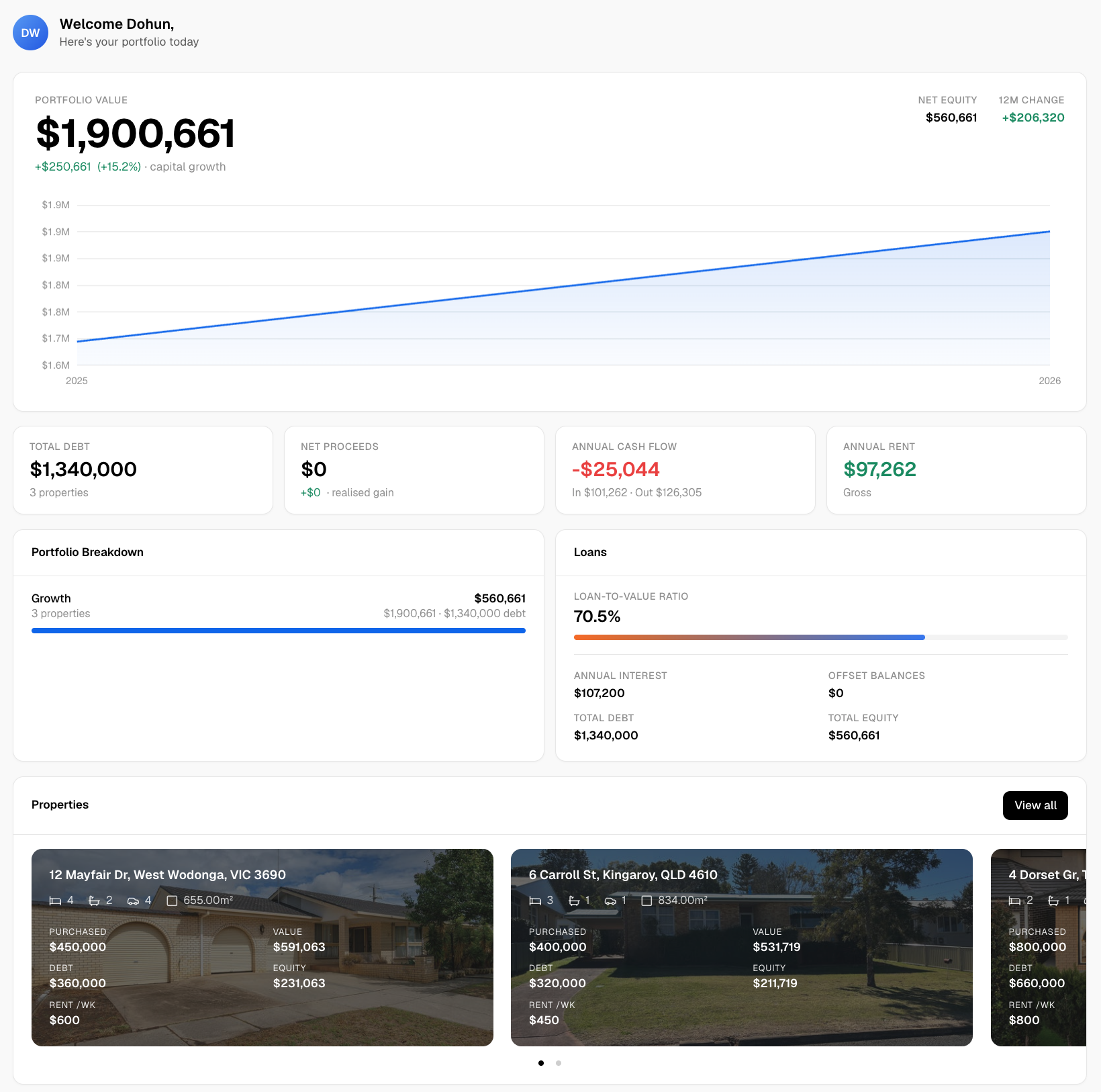
Wealthstacker’s free toolkit brings the key inputs together in one place: automated quarterly property valuations, a 15-year investment modeller, borrowing-power estimations, and an AI-powered assistant that answers property finance questions in plain language. You can model an owner-occupier purchase against an investor scenario side by side, adjust the rate premium and IO assumptions, and see how equity and net worth diverge over time.
The free plan covers scenario modelling and suburb research. When you are ready to go deeper, the premium tools add portfolio tracking and goal planning across multiple properties.
When the model points you toward a decision, take it to a licensed mortgage broker and your accountant. Wealthstacker gives you the numbers; a broker and accountant confirm whether they hold in your specific situation.
Start modelling your scenarios for free at Wealthstacker.
Authoritative Australian sources and further reading
The sources below are the primary references for the rules and figures in this article. Each one answers a specific question you may want to verify directly.
-
Choosing a home loan — Moneysmart.gov.au: ASIC’s consumer guidance on loan types, repayment structures, and comparison rates. Start here if you want a regulator-backed overview of P&I vs IO and how to read a comparison rate.
-
Rental properties — ATO: The ATO’s primary guidance on what rental income to declare, which expenses are deductible, and how to calculate CGT on an investment property sale. Essential reading before you lodge a return with rental income.
-
Capital gains tax — ATO: Explains the PPOR CGT exemption, the 12-month discount rule, and how partial exemptions apply if you have rented out your main residence at any point.
-
APRA prudential standards — APRA.gov.au: The source of the capital requirements that drive the investor rate premium. Useful if you want to understand why lenders price investor loans higher at a regulatory level.
-
Owner-occupied vs investment property — Canstar: Practical consumer explainer on reclassification obligations and what happens if you fail to notify your lender when occupancy changes.
-
Automated property valuation models — Wealthstacker: Explains how automated valuation models work and how Wealthstacker uses them for quarterly property valuations in the free toolkit.
-
AI tools in property valuation — Wealthstacker: Covers how AI-driven valuation tools improve accuracy for investors tracking portfolio values over time.