
First home buyer grants 2026: what’s actually on offer
Three federal programmes matter most in 2026: the Help to Buy shared equity scheme, the Australian Government 5% Deposit Scheme, and the First Home Super Saver Scheme. Layer state grants and stamp duty concessions on top, but check two things before anything else: the minimum deposit your chosen scheme actually requires, and the property price cap for your state or territory, because missing either one voids your application before it starts.
TL;DR:
- The Help to Buy scheme allows a government stake of up to 40% for new builds, but it cannot be combined with other shared equity or guarantee programs.
- The 5% Deposit Scheme requires a minimum 5% deposit and now has no income caps or waitlists since October 2025, making it more accessible.
- State grants vary significantly, with Queensland’s $30,000 grant expiring on June 30, 2026, and stamp duty concessions differ by state, often requiring residency for at least 12 months.
- Eligibility hinges on residency, prior ownership, deposit size, and the contract date, which can affect eligibility if delayed or mismatched with rules.
- Buyers should verify property price caps and eligibility criteria before making an offer, as improper applications are the main cause of rejection, and scheme rules may change annually.
Table of Contents
- First home buyer grants 2026: the federal programmes explained
- State grants and stamp duty concessions across Australia
- Eligibility checklist before you apply for anything
- Applying step by step: who to contact and when
- Planning ahead: what stacking actually gets you long term
- Tax and reporting: what you actually owe on a grant
- Why applications get rejected and how to avoid it
- What’s changing for the 2026 grant year
- Sources
First home buyer grants 2026: the federal programmes explained
Most of the confusion around first home buyer grants 2026 comes down to people mixing up three schemes that work in completely different ways. One gives you equity, one removes an insurance cost, and one helps you save. None of them hand you free cash the way a state grant does.
Help to Buy is a shared equity deal. You buy with a 2% deposit and the government chips in the rest of the difference, up to 30% for an existing home or 40% for a new build. You still hold sole title to the property, but the government owns a slice of it, which comes with income limits: individual applicants are capped at moderate income limits and joint applicants or single parents face higher limits, as of 1 July 2026. Only 10,000 places are released each year, so timing your application matters.
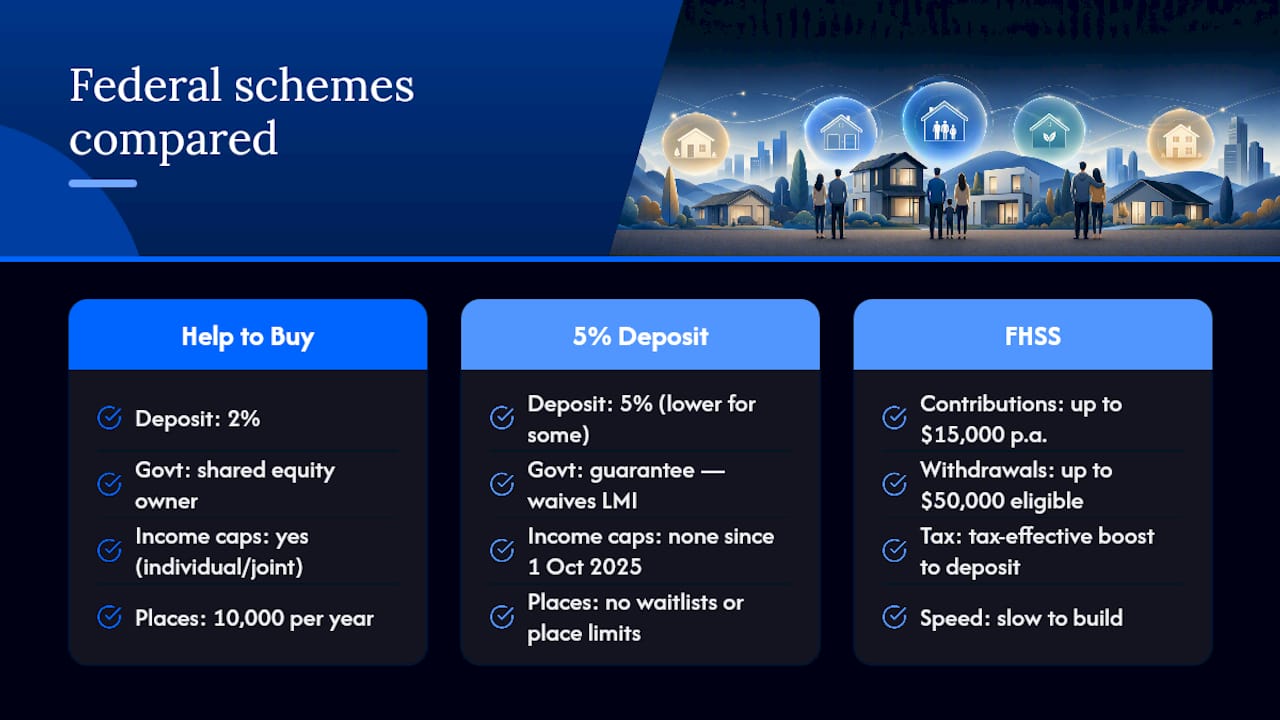
The Australian Government 5% Deposit Scheme (formerly branded the Home Guarantee Scheme) works differently again. It’s a guarantee, not a grant. You buy with a 5% deposit, or a lower amount if you’re an eligible single parent or guardian, and the government guarantees the rest so your lender waives Lenders Mortgage Insurance. Since 1 October 2025, there are no income caps, no waitlists, and no place limits on the first home guarantee, which is a genuine shift from how the scheme ran previously.
The First Home Super Saver Scheme (FHSS) sits alongside both. You make voluntary contributions to your super, up to $15,000 per financial year, and later withdraw up to $50,000 of eligible contributions per person to boost your deposit. It’s slow to build but tax-effective, and it stacks well with either of the schemes above.
Here’s where the fine print bites: Help to Buy cannot be combined with other Australian Government shared equity or guarantee schemes, but you can generally still claim a state FHOG and stamp duty concessions alongside it.
State grants and stamp duty concessions across Australia
Federal schemes get most of the headlines, but the actual cash payment, the First Home Owner Grant, still comes from your state or territory, and the amounts vary enormously.
Queensland is worth flagging specifically. A time-limited $30,000 grant expires 30 June 2026 and reverts to the standard $15,000 afterwards, so anyone signing a Queensland contract close to that date needs to check which side of it they land on.
Stamp duty concessions run on a separate track from the grants above, and the mechanics differ by state:
- NSW and Victoria offer full or partial exemptions below set property value thresholds, phasing out as price rises.
- Queensland and South Australia apply concessional rates on a sliding scale tied to purchase price.
- The ACT skips a grant entirely and instead runs an ongoing stamp duty concession as its primary first buyer incentive.
- Most states require the property to be your principal place of residence for a minimum period, commonly 12 months, to keep the concession.
Eligibility checklist before you apply for anything
Officials and lenders run through the same checklist every time, so run it yourself first.
- Residency and age — you generally need to be an Australian citizen or permanent resident aged 18 or over.
- Prior ownership — you and your partner must not have owned residential property in Australia before, though some states carve out exceptions for previous owners who lost a home through relationship breakdown.
- Deposit minimum — 2% for Help to Buy and eligible single parents under the 5% Deposit Scheme, 5% for everyone else under that guarantee.
- Extra funds on hand — you’ll still need to prove you can cover stamp duty, conveyancing, and building inspections, none of which the low deposit schemes cover.
- Income caps — only Help to Buy still applies these; the 5% Deposit Scheme dropped its income test in October 2025.
- Contract date versus settlement date — many FHOGs and concessions are assessed at contract signing, not settlement, so a delayed contract can push you into a different rule set entirely.
Pro Tip: Check the contract date rule for your specific state before you sign anything. Some jurisdictions assess eligibility on the date the contract is exchanged, not when you settle, so a builder’s delay or a slow conveyancer can change what you’re entitled to.
Applying step by step: who to contact and when
Getting the paperwork right matters more than getting it fast, but you still need to move within the right windows.
- Step 1: Check eligibility on the official scheme pages and confirm the property sits under your state’s price cap before you make an offer.
- Step 2: Contact a participating lender for Help to Buy or the 5% Deposit Scheme early. Not every bank offers these products, and pre-approval conversations take longer than a standard loan.
- Step 3: Gather your documents: photo ID, evidence of savings history, the contract of sale with clear settlement dates, and income statements.
- Step 4: Lodge your FHOG or stamp duty concession claim with your state revenue office, whether that’s Victoria’s or Queensland’s, and keep every lodgement confirmation.
Timing again: always check whether your state assesses eligibility at contract date or settlement, because the two can fall in different grant periods entirely.
Planning ahead: what stacking actually gets you long term
A guarantee and a grant are not the same financial event, and mixing them up in your planning leads to bad decisions. Help to Buy hands you real equity assistance, but the government’s share has to be bought back eventually, at market value, whenever you sell or refinance out of the scheme.
A shared equity buyback calculated at market value means your net gain from ten years of capital growth can look very different once the government’s percentage comes off the top. Modelling that scenario before you sign is far cheaper than discovering it at settlement.
What doesn’t stack: Help to Buy with any other federal shared equity or guarantee product, as the Help to Buy customer guide makes clear.
Pro Tip: Run the buyback numbers before you commit to shared equity. Wealthstacker’s scenario planner lets you compare a Help to Buy buyback cost against a straight purchase or a rentvesting path, using the same quarterly valuation data that tracks your actual property’s growth. If you’re weighing shared equity against other co-ownership structures, this comparison of shared equity and shared ownership is worth a read too.
Tax and reporting: what you actually owe on a grant
State FHOG payments are not taxable income. You don’t declare them on your tax return, and they don’t affect your Medicare levy or family assistance calculations. The same applies to stamp duty concessions, since a concession is a reduction in tax owed, not a payment received.
Help to Buy is a different story, because the government’s equity stake isn’t a grant at all. When you eventually sell or buy out the government’s share, that transaction can trigger capital gains considerations depending on how long you’ve held the property and whether it’s remained your main residence throughout. Keep records of your original contract price, any capital improvements, and the buyback settlement figures, because you’ll need them if your accountant has to work through the capital gains position later.
FHSS withdrawals carry their own reporting quirk. Where things get messy is when contributions exceed the annual cap; excess amounts are taxed differently and can eat into the deposit boost you were counting on. It pays to check your contribution history before you apply for release, not after.
Why applications get rejected and how to avoid it
The single biggest cause of rejection is applying under the wrong scheme rules for your property type. A buyer assumes their established home qualifies for a new-build-only FHOG, lodges the paperwork, and gets knocked back weeks later.

Income cap breaches trip up Help to Buy applicants regularly, particularly couples who don’t realise a recent pay rise or bonus pushed them over the $165,000 joint threshold for the relevant financial year. Prior ownership is the other frequent stumbling block: co-borrowers sometimes forget that a property owned years ago, even briefly, or even overseas in some state rules, can disqualify the whole application.
Price cap misses are avoidable but common. Always confirm the property price caps for your specific postcode before making an offer, not after.
Documentation gaps cause delays more often than outright rejections. Missing proof of savings history, an unsigned contract page, or a settlement date that doesn’t match what the lender submitted can push an approval back by weeks. Lodge everything as a complete package, and keep copies of every confirmation the state revenue office sends you.
What’s changing for the 2026 grant year
That single change opened the guarantee to a far wider pool of buyers than in previous years, including people who’d been locked out by income tests on earlier versions of the scheme.
Help to Buy’s income caps update again from 1 July 2026, rising modestly to reflect wage growth, so it’s worth rechecking the current threshold if you were excluded in a prior year. Queensland’s grant reduction from $30,000 back to $15,000 on 30 June 2026 is the clearest state-level change to watch, and anyone negotiating a Queensland contract near that date should get written confirmation of which rate applies before signing.
Beyond those two confirmed shifts, state governments regularly revise price caps and concession thresholds in their state budgets, typically handed down around May or June each year. Check your state revenue office directly rather than relying on last year’s figures, because a cap that applied in 2025 may already be outdated by the time you’re ready to buy.
If you want a clearer picture of how these schemes affect your long-term position rather than just your deposit, Wealthstacker’s modelling tools let you run your actual numbers, borrowing power, buyback costs, and rentvesting comparisons, using quarterly property valuations rather than guesswork. It’s free to start, and it beats discovering the trade-offs after you’ve already signed.