
Interest Rate Stress Testing: 8 Checks for Australian Borrowers
Interest rate stress testing measures how rate shocks and yield-curve shifts change a bank’s economic value and earnings, and whether households can still afford their loans. APRA requires banks to run multiple sudden-rate scenarios, while the RBA’s scenario analysis shows a minority of borrowers face real cash-flow strain.
TL;DR:
- APG 117 recommends at least six rate shocks covering curve shape and short rate moves, alongside measures of economic value and net interest earnings.
- Borrowers should add three percentage points to their current rate and separately test a further 50 basis point increase alongside the lender’s assessment rate.
- The RBA estimated income shortfalls affected 25–50% of higher loan to income borrowers, versus 5–13% of variable rate owner occupiers, depending on expense assumptions.
- A negative monthly surplus signals pressure, not inevitable default; compare any shortfall with liquid savings, since households may adjust spending, work, or sell assets.
- Rerun your test quarterly and after rate resets, job changes, a new child, vacancy, or new debt; include loans, essential costs, and liquid savings.
WealthstackerTest Your Property Plans Against Rate ChangesWealthStacker’s personalised property modelling helps you assess buying and rentvesting strategies alongside your broader wealth plans.Explore WealthStacker
Table of Contents
- What interest rate stress testing is: IRRBB, EVE and NII explained
- How regulators and banks build stress tests: APRA and RBA practice
- Which scenarios matter: parallel, steepener, flattener, short-rate shocks and customer behaviour
- How stress-test results affect bank capital, earnings and lending decisions
- What stress testing means for borrowers: affordability, APRA buffers and vulnerability factors
- How to run a practical stress test on your mortgage or household budget: a step-by-step checklist
- Limits and common misunderstandings about stress tests
- How should you fold interest rate stress testing into a property investment decision?
- What does an illustrated case study of a stressed property investment look like?
- How does stress testing change forecasts of property value fluctuations?
- Can AI and personalised modelling tools make stress testing more accurate?
- How should you read stress test results when choosing between rentvesting and buying?
- How often should you recalibrate your stress test?
- How we help you model scenarios and estimate borrowing power
- FAQ
- Sources
What interest rate stress testing is: IRRBB, EVE and NII explained
Interest rate risk in the banking book, usually shortened to IRRBB, is the risk to a bank’s capital and earnings when rate movements hit the positions it holds for the long term. APRA’s description of IRRBB frames it exactly that way: loans, deposits and bonds sit on the books for years, and each reprices on its own schedule. A stress test asks what happens to those positions when rates jump or fall sharply, rather than waiting to find out.
Two measures sit at the centre. Economic value of equity (EVE) takes the present value of every expected cash flow from the banking book, then asks how much that value moves under each rate shock. It is a long-run lens: a bank holding lots of fixed-rate mortgages funded by short-term deposits will see EVE fall when rates rise, because the fixed income stream becomes less valuable against a higher discount rate. Net interest income (NII) is the shorter-run view. It asks how much interest the bank will actually earn minus what it pays out over the next year or so.
The two can point in opposite directions. APRA’s supervisory logic makes this explicit: a bank can gain interest income in one period while its economic value or capital position weakens. That is why APRA’s framework requires stress testing to measure effects on both the economic value of the banking book and net interest earnings. Looking at only one would give a false sense of safety.
Why does ‘rates up’ tell an incomplete story? Because the shape of the yield curve and the timing of repricing matter as much as the direction. Picture a bank whose deposits reprice quickly but whose loans are fixed for a longer term. A rate rise squeezes it immediately, even though the asset side looks healthy on paper. Reverse the mismatch and a rate fall hurts instead. Customer behaviour adds another layer: borrowers who refinance early, depositors who shift into term accounts, and households who pay down loans faster than scheduled all change the cash-flow pattern the model assumed.
For you as a borrower or investor, the practical point is that bank stress tests are not an abstract regulatory exercise. The outputs shape how much capital a bank holds, how it prices loans and how tightly it sets lending standards. Understanding the logic helps you read changes in lending conditions as consequences of a testing framework rather than as arbitrary tightening.

How regulators and banks build stress tests: APRA and RBA practice
APRA’s revised IRRBB requirements became effective on 1 October 2025, and they required banks to update internal risk models, behavioural assumptions, governance and reporting, as APRA’s finalisation notice sets out. APS 117 is the binding standard for authorised deposit-taking institutions, and APRA’s IRRBB hub pulls together the reporting standard (ARS 117.1), the practice guide and the steps banks needed to complete before commencement.
The supervisory expectations break down into a few core demands:
- Multiple sudden-rate scenarios, not a single headline shock.
- Measurement of effects on both economic value and net interest earnings.
- Bank policies, limits and board reporting that visibly reflect stress-test results.
- Behavioural assumptions that are documented, justified and kept current.
- Regular reporting to APRA through the prescribed return.
Governance is where many of the real differences between banks show up. A model is only as good as its assumptions, so banks need independent validation of how they treat non-maturity deposits, early loan repayments and customers’ tendency to switch products. The board has to see the results in a form it can act on, and limits need to be set so that a breach triggers a response rather than a footnote. Frequency matters too: a test run once a year and filed away tells you little about conditions that change quarter to quarter.
The RBA approaches the question from the household side. In its March 2024 scenario analysis, the Bank modelled a higher-for-longer path that included a further 50 basis point increase. The results are model estimates under specified scenarios, not forecasts for every borrower and not a default rate.
Earlier RBA work used the same logic. Its October 2022 illustrative analysis estimated that just over half of variable-rate owner-occupier borrowers would see spare cash flow fall by more than 20%, with around 15% seeing it turn negative. The RBA cautioned that the analysis was uncertain and that this group represented around two-fifths of outstanding housing credit.
Put the two perspectives side by side and you get the full picture. APRA tests whether the bank can absorb rate shocks. The RBA tests whether households can absorb them. The bank’s resilience and the borrower’s resilience are linked, but they are measured with different tools, and a healthy result on one side does not guarantee comfort on the other.
Which scenarios matter: parallel, steepener, flattener, short-rate shocks and customer behaviour
APG 117 recommends that a prudent bank include at minimum six interest-rate shocks, and it expects scenarios covering changes in the level, slope and shape of the yield curve as well as customer behaviour. The six are:
- Parallel up: every maturity rises by the same amount.
- Parallel down: every maturity falls by the same amount.
- Steepener: short rates fall or hold while long rates rise.
- Flattener: short rates rise while long rates fall or hold.
- Short-rate up: the front end of the curve jumps.
- Short-rate down: the front end of the curve drops.
Each exposes a different weakness. A parallel rise is the simplest to explain, but it is only one scenario. A flattener punishes a bank that funds itself short and lends long, because its funding costs climb while its long-dated asset yields barely move. A steepener can do the opposite, lifting the value of what the bank earns on long-term lending relative to its funding. Short-rate shocks test the front end, where deposit repricing and variable-rate loan resets happen first.
Customer behaviour then reshapes every result. Deposit repricing is the classic case: when rates rise, some depositors chase better returns and move money out of low-rate accounts, forcing the bank to pay more or lose funding. Prepayments work the other way on the asset side. If rates fall, borrowers refinance or pay down faster, shortening the life of loans the bank was counting on. Hedging mismatches complete the trio: a hedge that covers the wrong tenor or the wrong repricing basis can leave a bank exposed precisely when it thought it was protected.
This is why behavioural assumptions deserve as much scrutiny as the shocks themselves. How quickly do borrowers refinance? How much redraw do they use? What share of deposits is sticky? Change those inputs and the same rate shock produces a different answer. As the APRA practice guide emphasises, deposit repricing, prepayments and duration mismatch change results materially.
Pro Tip: When you stress your own loan, borrow the logic: test a parallel rise, then separately test a case where only your variable rate moves and your savings earn less than you assumed.
How stress-test results affect bank capital, earnings and lending decisions
A stress test is only useful if the result changes behaviour. When a shock shows EVE falling sharply, or NII weakening for a sustained stretch, a bank has to respond. It may hold more capital against the exposure, shorten the duration of its assets, add or restructure hedges, or reprice products so that margins recover. Where the results point to losses on loans, provisioning decisions come into play as well.
APS 117 is explicit that bank policies, limits and board reporting should reflect stress-test results. In practice that means a bank cannot run a scenario, note an uncomfortable number and carry on. Limits are calibrated to the outcomes, and breaches escalate to senior management and the board.
The counter-cyclical capital buffer is part of the wider backdrop. APRA’s December 2023 macroprudential update maintained the buffer at 1% of risk-weighted assets and noted that recent stress tests showed resilience. The buffer is a lever that regulators can adjust as conditions change, and it sits alongside the bank-specific requirements that follow from IRRBB results.
The balance-sheet channels are worth naming concretely:
- Duration mismatch: assets that reprice slowly against liabilities that reprice quickly squeeze margins when rates rise.
- Hedging shortfalls: hedges that do not match the tenor or basis of the exposure leave residual risk.
- Deposit repricing: depositors demanding higher rates lift funding costs faster than loan yields adjust.
These channels explain why lending conditions shift even when a bank is profitable today. A stress result that shows vulnerability to a flattening curve may lead a bank to favour shorter fixed terms, tighten pricing on certain products or ration growth in segments that consume the most capital. For you, that can show up as a changed rate on offer, a tougher serviceability assessment or a smaller approved loan amount.
None of this means a bank is in trouble. Stress testing is routine, and APRA said in December 2023 that results showed resilience. But it does mean lending appetite is partly a function of what the tests reveal, and that explains why borrowers sometimes find policy shifting underneath them without any change in their own circumstances.
What stress testing means for borrowers: affordability, APRA buffers and vulnerability factors
For households, the stress test arrives as a serviceability assessment. APRA’s guidance describes a 3 percentage-point buffer applied to the loan rate being paid, ignoring limited honeymoon discounts, and it points to testing both advertised or discounted rates and the lender’s assessment rate. Lenders also apply interest-rate floors, which means the assessed rate can sit well above what you will actually pay on day one. The result is a lower assessed borrowing capacity than a simple repayment calculation would suggest.

APRA frames the buffer as a resilience measure, not a guarantee. As its housing lending standards guidance makes clear, passing a lender’s test does not remove the need for your own conservative scenarios.
The RBA adds the evidence on who is actually vulnerable. In its October 2023 analysis of household financial stress, the Bank estimated that scheduled mortgage payments for variable-rate borrowers rose by between 30% and 50% after the first cash-rate increase in May 2022.
Around 5% of borrowers had insufficient income for essential expenses and scheduled payments under the RBA’s baseline HEM model. That is a model estimate at then-current rates, and it says nothing about how many of those households ended up in arrears.
The more telling finding is who sits in that group. The same RBA analysis found estimated income shortfalls affected about 25–50% of higher loan-to-income borrowers and 15–32% of high loan-to-value borrowers, compared with 5–13% of all variable-rate owner-occupier borrowers, depending on essential-expense assumptions. High-LVR borrowers generally had smaller savings buffers, which raised their vulnerability even when the repayment shock was similar. Leverage, in other words, is a better warning signal than the headline rate alone.
A cash-flow shortfall is also not the same as default. The RBA’s March 2024 modelling tests whether minimum repayments plus essential expenses exceed income, then whether liquid savings run out. Households with shortfalls may avoid arrears by cutting spending, increasing work, drawing on savings or selling assets. Two households with identical loans can have very different outcomes, because affordability should be judged after essential living costs and against liquid savings, not from the repayment alone.
What can you do with this?
- Refinance: moving to a lower rate or a longer term can restore spare cash flow, though a longer term costs more interest overall.
- Use redraw carefully: redraw can cushion a bad month, but it also reduces the buffer you were counting on.
- Sell or restructure: for some households, selling an asset or consolidating debt is the sound response.
- Trim discretionary spending early: small cuts made before a shortfall appears work better than large cuts made after.
Our own guide on how APRA’s 3% buffer and debt-to-income concepts work in a borrower context walks through the serviceability logic in more detail, and the debt-to-income explainer shows why high loan-to-income households sit at the sharp end of these results.
How to run a practical stress test on your mortgage or household budget: a step-by-step checklist
You do not need a bank’s model to run a sensible test. You need honest inputs and a few disciplined scenarios. Existing debt is the easiest failure point to miss, so every loan goes in. APRA expects lenders to investigate current rate, remaining term, outstanding balance, redraw availability and delinquency on existing commitments, and a personal test should do the same, as APRA’s guidance indicates.
- Gather your inputs. Collect your current rate, loan balance, remaining term, every other debt (cards, car loans, personal loans, buy-now-pay-later), your liquid savings and any available redraw.
- Set essential expenses realistically. Use your actual spending on groceries, utilities, transport, insurance and childcare rather than an optimistic figure. Benchmarks like HEM can help as a cross-check.
- Calculate your current spare cash flow. Take after-tax income, subtract essential expenses and all scheduled debt repayments. This is your starting buffer.
- Apply a buffer to your rate. Add 3 percentage points to the rate you are actually paying, mirroring the APRA buffer. Test both your discounted rate and the rate the lender would assess.
- Add a higher-for-longer case. Layer a further 50 basis point rise on top, as the RBA did in its scenario work, and see how spare cash flow responds.
- Recalculate repayments and spare cash flow. Work out the new monthly repayment, then the new spare cash flow after essentials and other debts.
- Count your months of cover. Divide liquid savings by any monthly shortfall. If savings run out in a few months, the scenario is uncomfortable even if you never default.
- Check sensitivity. Rerun with lower income, higher essentials and no redraw. If the answer flips from fine to failing, you have found your weak point.
Pro Tip: Test the discounted rate and the lender’s assessment rate separately. A loan that survives one but fails the other tells you exactly how much room you really have.
Treat the outcome as information, not a verdict. If spare cash flow stays positive across your scenarios, you have headroom. If it turns negative in the buffered case, you have time to act through refinancing, paying down higher-cost debt or building savings before conditions change.
Limits and common misunderstandings about stress tests
A stress test is a scenario tool, not a forecast. Nobody in a regulator’s office or a bank’s treasury is predicting that rates will move by exactly the amounts in the shock set. The tests ask a conditional question: if this happened, how exposed would we be? The answers depend heavily on pass-through assumptions, such as how fast a cash-rate change reaches loan rates, and on behavioural assumptions, such as how borrowers and depositors react.
Data limits matter too. Models are only as good as the information feeding them, and some segments, small-business lending among them, are harder to measure than residential mortgages. Model validation has its own limits: a model can be internally consistent and still miss a behaviour that has never been observed in the data it was built from.
It also helps to read official findings with proportion. The RBA’s October 2023 review of household and business finances concluded that most Australian households remain well placed to manage higher rates given labour-market strength and savings buffers, even though many face a squeeze on budgets. APRA’s December 2023 statement likewise said stress tests showed resilience. The sensible reading is that system-level risk looks modest while a subset of households, typically highly leveraged with thin savings, carries most of the vulnerability.
Two misunderstandings are common. The first is treating a cash-flow shortfall as a default: it is a warning that a household has to adapt, not a prediction that it will fail. The second is treating a passed lender test as proof of safety. Your own circumstances, such as variable income or a dependent about to start school, may not be captured by the lender’s assessment.
How should you fold interest rate stress testing into a property investment decision?
For an investor, the test belongs before the offer, not after settlement. Start with the purchase price, the deposit, the loan size and the expected rent, then run the full cost of holding the property through your rate scenarios: loan repayments, rates, insurance, maintenance, property management and vacancy. The question is whether the property can carry itself, and your wider finances, if the rate on the loan is 3 percentage points higher than you are paying today.
Investors face an extra wrinkle: leverage across a portfolio. Each additional loan reduces the capacity for the next one and raises the sensitivity of total cash flow to any single rate move. Our explainer on portfolio LVR for Australian investors shows why the combined position matters more than any one loan. Run the stress test on the whole portfolio, not property by property.
A useful discipline is to set a decision rule in advance. For example, you might commit to buying only if spare cash flow remains positive in the buffered scenario and your savings can cover any shortfall. A rule fixed before you fall in love with a property is harder to rationalise away.
What does an illustrated case study of a stressed property investment look like?
Take an illustrative investor, with every figure here assumed for the purpose of the example and not drawn from market data.
Now apply the 3 percentage-point buffer. At the higher rate, annual interest on the same loan would rise, reducing her spare cash flow. If her rent and other income do not rise, that $1,250 a month comes straight out of spare cash flow. Her liquid savings can cover the shortfall for a limited time before the buffer is gone.
That limited time changes the decision. If that feels like too little time given her job security and the chance of vacancy, she has several options: put in a larger deposit, choose a cheaper property, fix part of the loan, or build a larger savings reserve before buying. A second investor with the same loan but more savings has a longer period of cover and a very different risk profile, even though the headline loan is identical. That echoes the RBA’s point that two households with the same loan can have very different stress outcomes.
How does stress testing change forecasts of property value fluctuations?
Stress testing does not forecast property prices. It tells you how your finances respond to a rate shock, and that response matters because rate rises tend to coincide with weaker borrowing capacity across the market. If lenders assess borrowers at a higher buffered rate, the pool of buyers who can afford a given price narrows, and prices can come under pressure.
What stress testing improves is your range of outcomes. Instead of relying on one price path, you build several: a base case, a rate-shock case in which values soften, and a severe case in which values fall and you must also refinance at a higher rate. In each, you check whether your loan-to-value ratio stays within what your lender will tolerate and whether you could refinance if you needed to.
The practical use is protective. A property bought at a high LVR with thin savings is the most exposed to a combined shock of higher rates and softer values, which is precisely the high-LVR group the RBA identified as most vulnerable. Treat price forecasts as uncertain inputs and let the stress test tell you how much uncertainty your finances can survive.
Can AI and personalised modelling tools make stress testing more accurate?
Spreadsheets are where most personal stress tests go wrong. Inputs go stale, formulas break and the scenarios never get rerun. Software that holds your loans, savings, income and property valuations in one place removes much of that friction, and automation keeps the inputs current so the test reflects today and not last year.
Personalised modelling adds something generic calculators cannot: your own numbers across several scenarios at once. Instead of a single repayment figure, you see how spare cash flow, months of savings cover and net worth change as the rate path moves. AI-assisted tools can also help you ask better questions, such as what happens to your position if rates rise 50 basis points and a tenant leaves in the same quarter.
A caution applies, as with any model. A tool is only as good as its assumptions, and you should know what it assumes about rate pass-through, expenses and property values. Use it to speed up the arithmetic and widen the range of scenarios you check, then apply your own judgement to the result. Accuracy comes from good inputs and honest assumptions, not from the sophistication of the interface.
How should you read stress test results when choosing between rentvesting and buying?
Rentvesting means renting where you want to live while owning an investment property elsewhere. Buying means owning the home you live in. Stress testing lets you compare them on the same footing: which strategy holds up better when rates rise?
Run both through identical scenarios. For buying, the stress is your repayment at the buffered rate against your income and essentials. For rentvesting, you stress two things at once: the investment loan at the buffered rate and your rent, which may rise independently of interest rates. The question for each is how many months of cover your savings give you if cash flow turns negative.
Read the results for resilience, not just return. A strategy that looks better on projected wealth but fails the buffered test with thin savings is the riskier choice. A strategy with slightly lower projected wealth that stays cash-flow positive through every scenario may suit you better, particularly if your income is variable. Our guide to client borrowing capacity and property assessment covers the borrowing side of that comparison in more depth.
How often should you recalibrate your stress test?
A stress test is a snapshot, so refresh it on a schedule. Quarterly is a sensible rhythm for most households and investors: often enough to catch material changes, infrequent enough to stay manageable. Banks themselves treat frequency as a governance question, and the logic carries over to personal finance.
At each review, update the same short list: your rate and balance, your income and essential expenses, your savings, any new debt, and your property values. Then revisit the scenarios. If the cash rate has moved, or the outlook has shifted, reset your shock sizes to match. Our piece on modelling the RBA rate outlook explains how rate changes can alter borrower projections.
Recalibrate immediately, not just quarterly, when something material changes: a fixed-rate term ending, a job change, a new child, a tenant leaving or a new loan. Record your results each time. A short history shows whether your buffer is growing or shrinking, and it turns stress testing from a one-off exercise into a habit that protects you before conditions force the issue.
How we help you model scenarios and estimate borrowing power
Everything above comes down to running scenarios repeatedly with current numbers. That is what we built our toolkit to do. At WealthStacker we offer:
- Free automated quarterly property valuations, so your inputs stay current without effort.
- Borrowing power estimations, so you can see how a rate buffer changes what you can borrow.
- Scenario modelling that compares rentvesting and buying side by side.
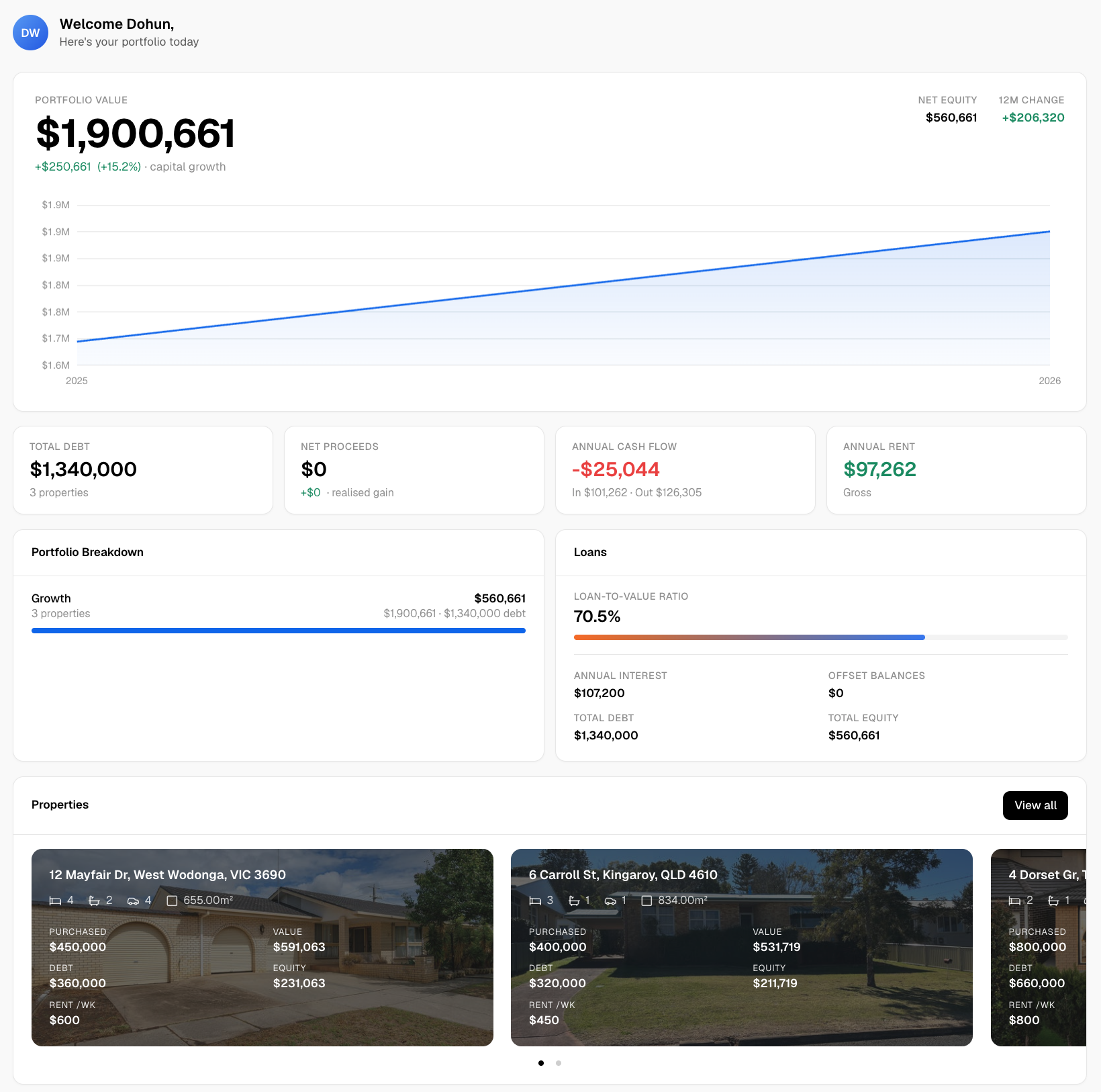
Those features line up with the checklist in this article: automated inputs replace stale spreadsheets, buffered scenarios show your headroom, and personalised forecasts show how your net worth moves under each path. You can start with our free toolkit, or join the waitlist for our advanced modelling tools to run these tests on your own numbers.
This article is general information, not a substitute for advice from a qualified financial advisor. Consult a qualified financial professional about your own circumstances before acting on anything here.
FAQ
What does an interest rate stress test actually measure?
It measures how rate shocks change a bank’s economic value and net interest earnings, and how well households can keep paying their loans. APRA’s framework requires both measures. The result shows exposure under a defined scenario, not a prediction.
Does passing a lender’s serviceability test mean I can afford the loan?
Not necessarily. APRA describes its buffer as a resilience measure, not a guarantee, and says passing a lender’s test does not remove the need for your own conservative scenarios, as its housing lending guidance explains. Check your own essentials and savings against a higher rate.
Is a cash-flow shortfall the same as defaulting on a mortgage?
No. A shortfall means minimum repayments plus essential expenses exceed income. Households can often avoid arrears by cutting spending, working more, using savings or selling assets, as the RBA’s scenario analysis notes.
Which scenarios should a bank test?
APG 117 suggests a prudent bank includes at least six shocks: parallel up and down, steepener, flattener, and short-rate up and down. It also expects banks to consider yield-curve shape and customer behaviour.
How often should I rerun my own stress test?
Quarterly suits most people, plus any time something material changes, such as a rate reset, a job change or new debt. Updating inputs regularly keeps the result relevant to your actual position.
Sources
- 4.1 Focus Topic: Scenario Analysis of the Resilience of Mortgagors and Businesses to Higher Inflation and Interest Rates | Financial Stability Review – March 2024 | RBA
- APS 117 Interest Rate Risk in the Banking Book | APRA
- APG 117 Interest Rate Risk in the Banking Book | Prudential Handbook