
Client borrowing capacity property assessment: 2026 guide
TL;DR:
- In 2026, borrowing capacity is determined by stress-tested serviceability and a debt-to-income ratio cap, reducing maximum loans by 12-20% from 2024 levels. Lenders assess income, expenses, debts, and property security using specific criteria, which greatly influence approved loan amounts. Understanding and aligning with lender policies can significantly increase borrowing power before property purchase.
Client borrowing capacity property assessment is the calculation of how much a lender will approve you to borrow, based on your income, expenses, existing debts, and the security property, using 2026 lending criteria. The industry term for this process is serviceability assessment, and understanding it is the difference between making a confident offer and being caught short at settlement. In 2026, two hard constraints govern every loan decision: a stress-tested serviceability calculation and a debt-to-income (DTI) ratio cap. Borrowing capacity is approximately 12–20% lower than 2024 levels because of these tests. Whether you are buying your first home or adding to an existing portfolio, knowing exactly how lenders calculate your borrowing power is the foundation of every sound property decision.
What key financial factors determine your borrowing capacity?
Lenders assess your borrowing capacity by examining four categories: income, living expenses, existing debts, and the security property. Each category carries more weight than most borrowers expect.

Income types lenders accept
Lenders count salary, wages, bonuses, rental income, and some forms of self-employment income. Not all income is treated equally. Bonuses and overtime are typically shaded to 50–80% of their stated value. Rental income is discounted by 20% to account for vacancies and maintenance costs. A property earning $600 per week is assessed at $480 per week for serviceability purposes. That gap compounds across a portfolio.
Living expenses and the HEM benchmark
Lenders compare your declared living expenses against the Household Expenditure Measure (HEM), a benchmark derived from Australian Bureau of Statistics data. They use whichever figure is higher. If you declare $3,000 per month but HEM for your household type is $3,800, the lender uses $3,800. This protects lenders from borrowers who understate spending.
Existing debts and credit card limits
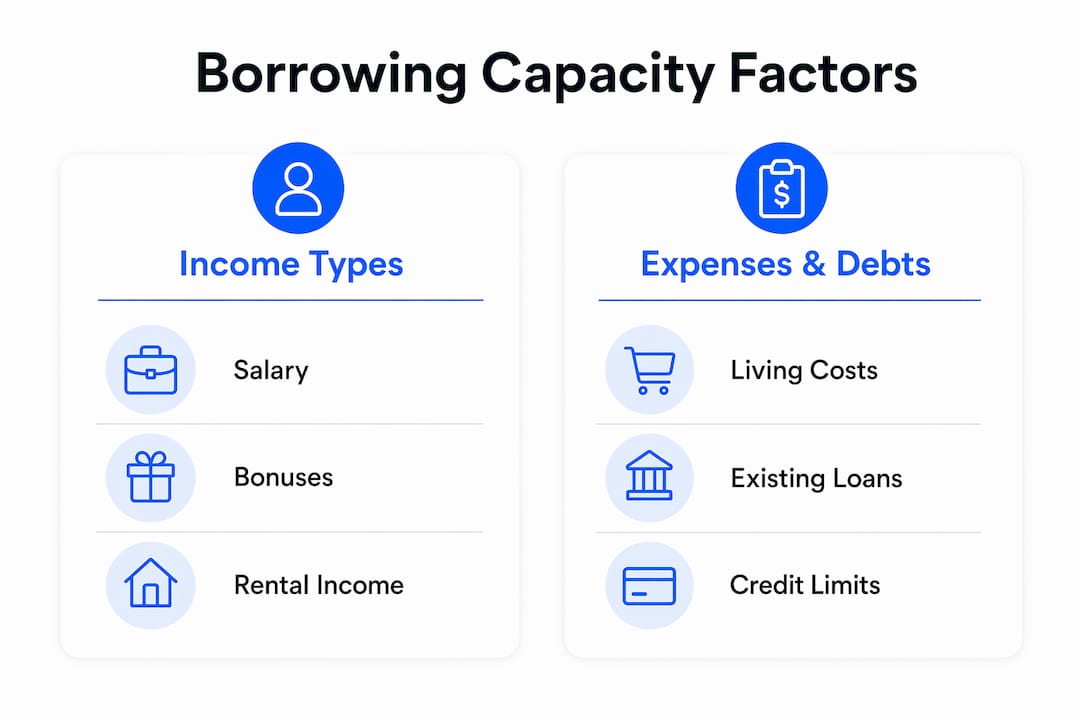
Every existing loan reduces your assessed surplus income. HECS/HELP debt is included as a monthly repayment obligation. Credit card limits count as full liabilities, even if you pay the balance in full each month. A $20,000 credit card limit is treated as a $20,000 debt. Reducing or cancelling unused credit cards before applying is one of the fastest ways to lift your borrowing power.
Pro Tip: Cancel or reduce credit card limits at least 30 days before lodging a loan application. Lenders pull your credit file at assessment, and the limit reduction needs to be reflected in your credit report.
How do lenders apply serviceability tests and DTI ratios in 2026?
Two calculations determine your maximum loan amount. Your actual borrowing capacity is the lower of the two results.
The serviceability calculation
Lenders apply a stress test rate of roughly 3% above the actual loan rate. If the current rate is 6.2%, your repayments are assessed at approximately 9.2%. This tests whether you can still service the loan if rates rise sharply. The lender then calculates your net monthly surplus after all expenses and debt repayments at the stress-tested rate. That surplus is capitalised into a maximum loan amount.
The DTI ratio cap
The Australian Prudential Regulation Authority (APRA) applies a practical ceiling of 6 times your gross income as the maximum loan amount. A borrower earning $120,000 gross per year faces a DTI ceiling of $720,000, regardless of what the serviceability calculation produces. Many lenders apply this cap strictly in 2026 as part of updated macroprudential settings.
How the two constraints interact
The table below shows how the two limits interact for a single borrower:
| Gross annual income | Serviceability max loan | DTI cap (6×) | Actual borrowing limit |
|---|---|---|---|
| $80,000 | $520,000 | $480,000 | $480,000 |
| $120,000 | $800,000 | $720,000 | $720,000 |
| $160,000 | $1,050,000 | $960,000 | $960,000 |
The DTI cap bites hardest for higher earners with lean expenses. The serviceability test bites hardest for borrowers with large existing debts or high living costs. Knowing which constraint applies to you tells you exactly where to focus your improvement efforts.
How do lender policies create big differences in borrowing capacity?
The same borrower can receive loan approvals that differ by $50,000 to $100,000 depending on which lender assesses the application. That is not a rounding error. It reflects genuine policy differences between institutions.
The main sources of variation include:
- Rental income shading: Some lenders shade rental income to 80%, others to 75% or even 70%. On a $50,000 annual rental income, the difference between 80% and 70% shading is $5,000 of assessed income, which flows directly into borrowing capacity.
- HEM benchmarks: Lenders use different versions of HEM calibrated to postcode, household size, and income band. A lender using a lower HEM benchmark for your profile will assess a higher surplus and approve a larger loan.
- HECS/HELP treatment: Some lenders apply a flat monthly repayment figure for HECS/HELP debt. Others calculate it as a percentage of gross income. The difference can shift your assessed surplus by hundreds of dollars per month.
- Discretionary spending: Lenders vary in how they treat declared discretionary spending such as dining, subscriptions, and travel. Some add it directly to HEM. Others cap the combined figure.
Property valuation and LVR limits add another layer of constraint. A borrower with income to service a $1,000,000 loan may be capped at $500,000 if the lender applies a maximum 50% LVR to the security property. This is common for high-density apartments or properties in postcodes flagged as higher risk. Understanding how LVR limits affect lending is as important as understanding income serviceability.
Pro Tip: Before lodging a formal application, ask a broker to run your file through at least three lenders using their actual policy settings. The variation in results will tell you which lender is best positioned for your financial profile.
The comparison below shows how two lenders might assess the same client:
| Assessment factor | Lender A | Lender B |
|---|---|---|
| Rental income shading | 80% | 75% |
| HEM benchmark (couple, metro) | $3,600/month | $4,100/month |
| HECS/HELP treatment | Flat $400/month | 7% of gross income |
| Resulting max loan | $720,000 | $640,000 |
Matching your financial profile to the right lender policy is not luck. It is strategy. Matching client details to lender policies can increase borrowing power by significant amounts without changing a single dollar of income or debt.
How to assess and improve your borrowing capacity before applying
A structured approach to your own borrowing power assessment takes the guesswork out of property decisions. Follow these steps before lodging any application.
-
Gather your financial documents. Collect two years of tax returns, three months of payslips, three months of bank statements, and a list of all debts including credit cards, personal loans, car loans, and HECS/HELP balances. Lenders will request all of this. Having it ready speeds up assessment and reduces errors.
-
Run a borrowing capacity calculator. Use an online borrowing power calculator to get a baseline figure. Input your gross income, living expenses, and all debts. Understand that these tools use generic assumptions. They give you a direction, not a precise approval figure.
-
Apply the stress test yourself. Take your estimated loan amount and calculate repayments at your expected rate plus 3%. If those repayments consume more than 30–35% of your net income, most lenders will reduce the approved amount. Adjust your target loan size accordingly.
-
Reduce liabilities before applying. Cancel unused credit cards. Pay down personal loans. Avoid taking on new debt in the three months before application. Each $10,000 reduction in credit card limits can add approximately $30,000–$50,000 to your borrowing capacity depending on the lender’s model.
-
Assess your property choice for LVR impact. A property with a strong independent valuation in a high-demand suburb will attract a more favourable LVR than a high-density apartment in an oversupplied postcode. Your rental yield and capital growth profile affects both the lender’s risk assessment and your long-term serviceability.
-
Consult a lending strategist or mortgage broker. A broker with access to multiple lender panels can run your file through actual policy settings and identify which lender will approve the most for your profile. This step alone can recover $50,000–$100,000 in borrowing capacity that a single-lender approach would miss.
Pro Tip: If you are building a portfolio while renting, your borrowing capacity assessment needs to account for how each new property affects the next application. Model the sequence before you buy.
What are the most common misconceptions about borrowing capacity?
Most borrowers and some first-time investors carry at least one false assumption into their property assessment. These misconceptions cost money.
-
“My repayments are what the lender assesses.” Lenders assess repayments at the stress-tested rate, not the actual rate. If you calculate affordability at 6.2% and the lender assesses at 9.2%, your approved loan will be materially lower than you expect.
-
“Investment properties always increase my borrowing capacity.” Existing investment properties can reduce borrowing capacity because the debt service cost at the 3% buffer often outweighs the rental income contribution. A $600,000 investment loan assessed at 9.2% produces a monthly repayment obligation that most rental incomes cannot offset after shading.
-
“I only owe what I spend on my credit card.” Lenders treat the full credit card limit as a liability. A $15,000 limit with a $500 balance is still a $15,000 liability in the lender’s model.
-
“My borrowing capacity is fixed.” Borrowing capacity changes monthly as lenders update HEM benchmarks, rate buffers, and DTI limits. A pre-approval from three months ago may no longer reflect your actual approved amount. Reassess before making any offer.
-
“Rental income is counted in full.” Most lenders apply 80% rental income shading as standard. Some apply less. Counting 100% of rental income in your own calculations will produce an inflated borrowing estimate.
The single most expensive mistake in property investment is confusing what you think you can borrow with what a lender will actually approve. Run the numbers with real lender policy settings before you make an offer.
Key takeaways
Accurate borrowing capacity assessment requires applying real lender policy settings, not generic calculator outputs, to your specific financial profile.
| Point | Details |
|---|---|
| Two constraints govern every loan | Borrowing capacity is the lower of the serviceability calculation and the 6× gross income DTI cap. |
| Stress test adds 3% to your rate | Lenders assess repayments at roughly 3% above the actual rate, which significantly reduces the approved loan amount. |
| Rental income is shaded to 80% | Most lenders count only 80% of rental income, so model your numbers on the shaded figure, not the gross rent. |
| Lender policies vary by up to $100,000 | The same borrower can receive approvals differing by $50,000–$100,000 across lenders due to policy differences. |
| Credit card limits reduce borrowing power | Full credit card limits count as liabilities regardless of the balance, so reduce limits before applying. |
How Wealthstacker supports your property investment decisions
Understanding your borrowing power is only the first step. Tracking how each property purchase affects your overall financial position is where most investors lose visibility.
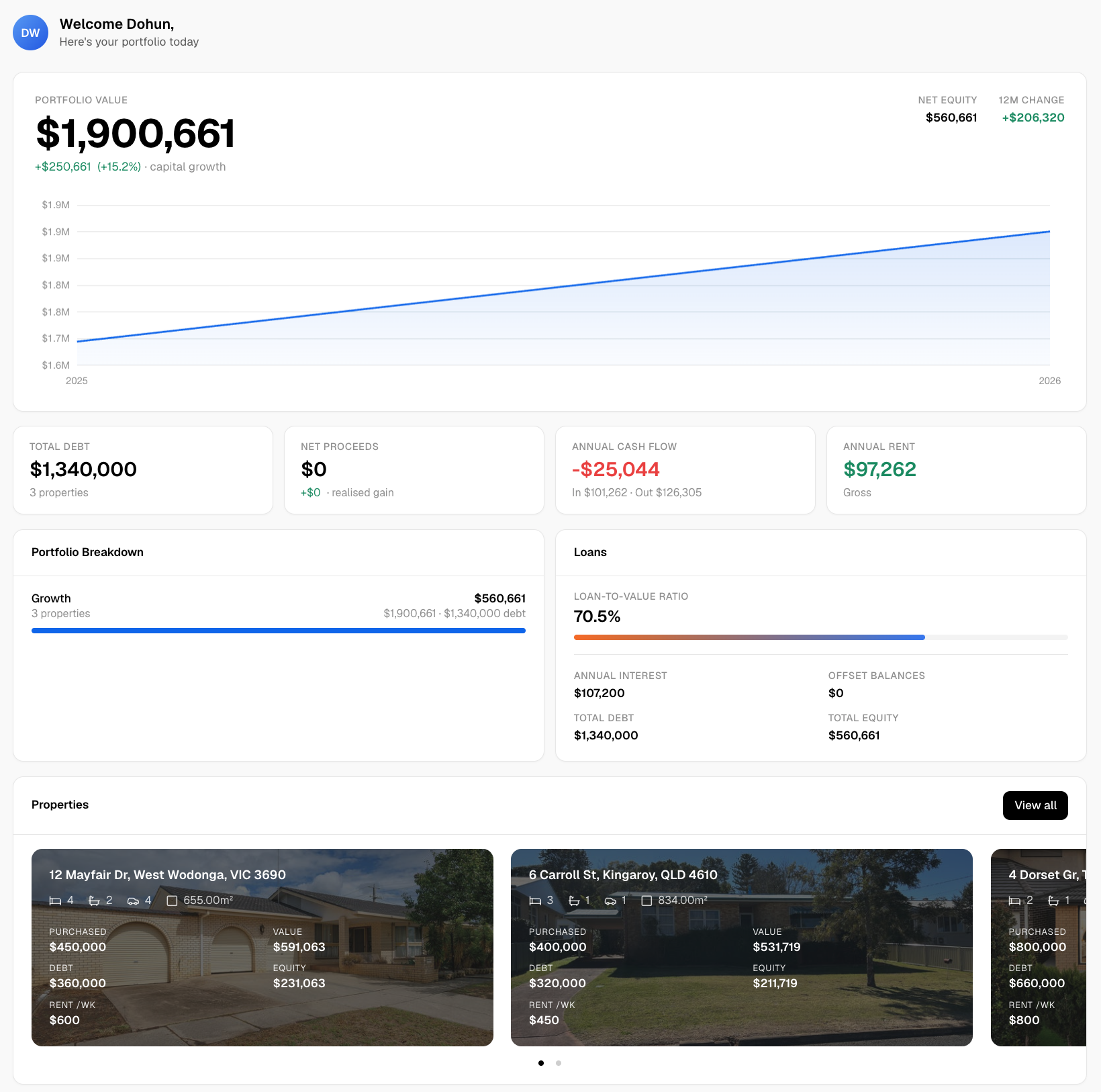
Wealthstacker is built for exactly this problem. The Wealthstacker property investment app provides automated quarterly property valuations at no cost, real-time net worth modelling, and personalised path planning for both rentvesting and direct buying strategies. You can model how a new acquisition affects your borrowing capacity, compare rentvesting versus buying scenarios side by side, and track your portfolio’s performance against your wealth targets. For first-time buyers and experienced investors alike, Wealthstacker turns a complex financial picture into a clear, current view of where you stand and where you are headed.
FAQ
What is borrowing capacity in property investment?
Borrowing capacity is the maximum loan amount a lender will approve based on your income, expenses, existing debts, and the security property. It is calculated using a stress-tested interest rate and a DTI ratio cap of 6 times gross income.
How much does a credit card limit reduce my borrowing power?
Lenders treat the full credit card limit as a liability, not just the balance. A $20,000 limit can reduce your borrowing capacity by $60,000–$100,000 depending on the lender’s model and your income level.
Why does rental income not count in full for borrowing capacity?
Most lenders shade rental income to 80% to account for vacancy periods and maintenance costs. A property earning $600 per week is assessed at $480 per week for serviceability purposes.
Can borrowing capacity change between pre-approval and settlement?
Yes. Borrowing capacity changes monthly as lenders update their HEM benchmarks, rate buffers, and DTI settings. Always reassess your capacity before making a formal offer, especially if your pre-approval is more than 60 days old.
Why do different lenders offer different loan amounts for the same borrower?
Lenders apply different policies on rental income shading, HEM benchmarks, and debt treatment. These differences can produce loan approvals varying by $50,000–$100,000 for the same borrower. Matching your financial profile to the right lender policy is the most direct way to maximise your approved amount.