
APRA 3% Buffer & 6× DTI: Test Aussie Mortgage Limits with WealthStacker
In Australia, your “mortgage credit score” isn’t a single number from a bureau. It’s your borrowing power, the amount a lender calculates you can safely repay after stress-testing your income, debts, and living costs against a buffer rate well above what you’ll actually pay. The single biggest lever here is APRA’s 3% serviceability buffer, which typically cuts your assessed capacity by 15% to 20%. Run a proper calculator and check your credit limits before you apply.
TL;DR:
- Borrowing capacity is reduced by about 15-20% due to the 3% APRA serviceability buffer, which stress-tests your income against higher rates.
- Unused credit card limits, HECS/HELP debt, buy now pay later accounts, dependants, and irregular income can significantly lower your borrowing power.
- Factors such as a debt-to-income ratio above six times and recent applications for new credit also restrict approval chances, especially since lenders cap high ratios at 20% of approvals.
- Estimating your real borrowing capacity requires detailed documentation like recent payslips, bank statements, and credit limits, as lenders scrutinize these closely.
- Improving your capacity involves paying down or closing unnecessary credit accounts, stabilizing income proof, and modeling scenarios with tools that match lender buffer and assessment methods.
Table of Contents
- What lenders mean by borrowing power and serviceability
- The factors that quietly shrink your borrowing capacity
- What the APRA buffer and DTI cap actually mean in dollars
- Estimating your real borrowing power before you talk to a lender
- How to lift your assessed borrowing power before you apply
- Documents lenders commonly ask for
- Model your numbers before you talk to a broker
- Sources
What lenders mean by borrowing power and serviceability
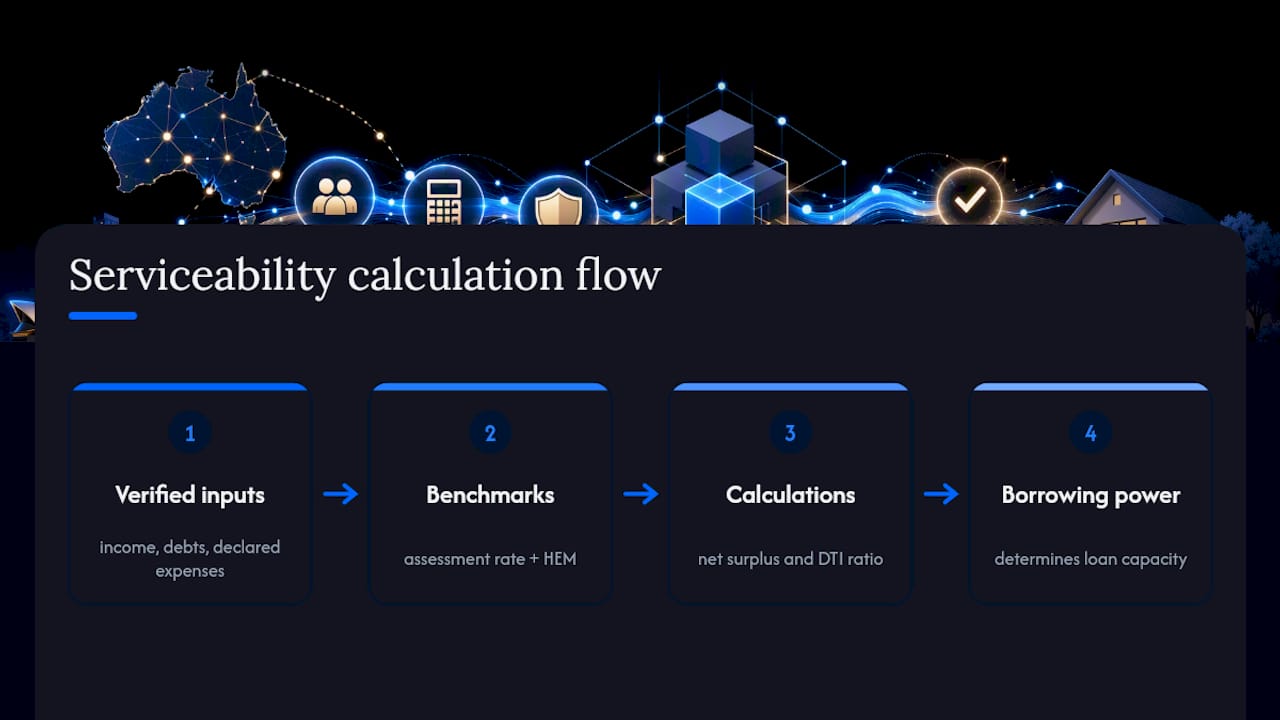
Borrowing power is what’s left after a lender subtracts your living expenses and debt repayments from your income, then tests the result against a repayment rate you’ll never actually pay. It’s not a credit score in the bureau sense. It’s a serviceability calculation built from your income, your existing debts, your declared expenses, and the proposed loan repayment.
Under APRA and ASIC’s responsible lending expectations, lenders must verify what you tell them rather than take it on faith, which is why payslips and bank statements get such close scrutiny. Three numbers drive the outcome: the assessment rate (your loan’s interest rate plus the buffer), your net surplus after all commitments, and your debt-to-income ratio. Lenders also lean on the Household Expenditure Measure (HEM) as a minimum living-cost benchmark, even if your actual spending is lower.
The factors that quietly shrink your borrowing capacity
Two applicants earning identical salaries can walk away with very different loan offers, and the gap usually comes down to debts most people don’t think twice about.
- HECS/HELP debt: compulsory repayments are deducted from net income before serviceability is calculated, and a $50,000 balance can strip tens of thousands of dollars from your borrowing capacity depending on your income and the lender’s policy.
- Credit card limits: lenders assess roughly 3% of your total approved limit as a monthly commitment, whether or not you carry a balance.
- Buy now, pay later: treated as an active debt in most serviceability models, even with a $0 balance.
- Dependants: each child pushes your HEM benchmark higher, which lowers the surplus available for loan repayments.
- Irregular income: bonuses, overtime, and commissions are typically shaded to around 80% of face value unless you can show a consistent two-year history.
Pro Tip: A $20,000 credit card limit you never use can cost you as much borrowing power as an extra $600 a month in rent, purely because the lender assumes you could max it out tomorrow.
Self-employed applicants face the toughest scrutiny of all. Lenders generally want two years of tax returns before they’ll count business income at face value, and inconsistent year-on-year earnings get averaged down.
What the APRA buffer and DTI cap actually mean in dollars
It tests you at 9%, and that gap is what typically shaves 15% to 20% off your maximum loan size.
Since February 2026, APRA has also capped how much high-leverage lending banks can write: no more than 20% of a bank’s new approvals can sit at a debt-to-income ratio of six times income or above. If your loan would push you past that 6× mark, some lenders may simply have less room on their books to approve it, regardless of your income.
| Factor | Effect on borrowing capacity |
|---|---|
| 3% serviceability buffer | Reduces maximum loan size by roughly 15–20% |
| DTI at 6× income or more | Capped at 20% of a bank’s new approvals |
| National average new loan | $735,000 (ABS, March 2026) |
That $735,000 average new owner-occupier loan is a useful yardstick. If a calculator puts you well under it on a solid income, debt is probably the culprit, not your earnings.
Estimating your real borrowing power before you talk to a lender
Online calculators are a starting point, not a verdict. They ask for a handful of numbers and spit out a range. Actual lenders dig much deeper, which is why two calculators can give you two very different figures.
Gather these before you run any estimate:
- Recent payslips or two years of tax returns if self-employed
- Total limits on every credit card, not just balances owed
- Your HECS/HELP balance
- Monthly living expenses, or a HEM proxy if you haven’t tracked them
- Number of dependants
The gap between a quick online estimate and what a lender actually offers usually comes down to exactly the deductions covered above: card limits, HECS, and how conservatively your income gets treated. Every lender runs its own risk model, so shopping around, or using a broker, can surface a materially higher figure than your first quote suggests.
Pro Tip: Run your numbers through a scenario tool before you approach a broker. Turning up with a realistic figure, rather than a hopeful one, saves everyone time. Wealthstacker’s borrowing power estimator and portfolio modelling tools let you test how a lower card limit or a cleared BNPL balance shifts your capacity, using the same buffer logic lenders apply.
How to lift your assessed borrowing power before you apply
Most of the moves that matter take weeks, not months, but timing them badly can cost you.
- Reduce or close unused credit cards. Lenders assess the limit, not the balance, so closing an unused card is more effective than simply paying it off. Do this at least two months before applying, because bureau updates and lender checks take time to catch up.
- Pay down or consolidate BNPL and personal loans. Every open BNPL account counts against you even at a zero balance, so closing accounts you don’t use is worth more than the balance suggests.
- Stabilise your income evidence. If you’re self-employed or on commission, start collecting the paperwork now, tax returns, contracts, letters confirming ongoing allowances, so a lender can count more of that income rather than shading it.
- Hold off on new credit. Applying for a car loan or another card in the months before your mortgage application adds fresh commitments right when you’re trying to maximise capacity.
- Model your loan term before committing. Stretching from 25 to 30 years can lift serviceability, but run the long-term cost trade-off first rather than assuming longer is automatically better.
Some lenders will disregard small HECS balances under specific conditions, which is another reason comparing lenders matters if your HELP debt is modest.
Documents lenders commonly ask for
Verification is thorough by design, and having your paperwork ready before you apply speeds everything up considerably.
- Recent payslips and an employment confirmation letter
- Two years of tax returns and financials if you’re self-employed
- Three to six months of bank statements
- Statements for every existing loan and credit card, showing limits, not just balances
- Evidence of other income, such as rental statements
- Details of dependants and ongoing care costs
Pro Tip: Reconcile any odd or large one-off transactions in your bank statements before you submit them. An unexplained $3,000 deposit or a string of Buy Now Pay Later debits is one of the most common reasons lenders ask for more information mid-application. Keep everything in a single dated folder so nothing needs chasing twice.
Model your numbers before you talk to a broker
Wealthstacker gives you a free way to test these numbers before a lender does. The platform’s borrowing power estimator applies the same buffer logic and debt treatment lenders use, so you can see how closing a card or clearing a BNPL balance shifts your real capacity, not just a rough guess.
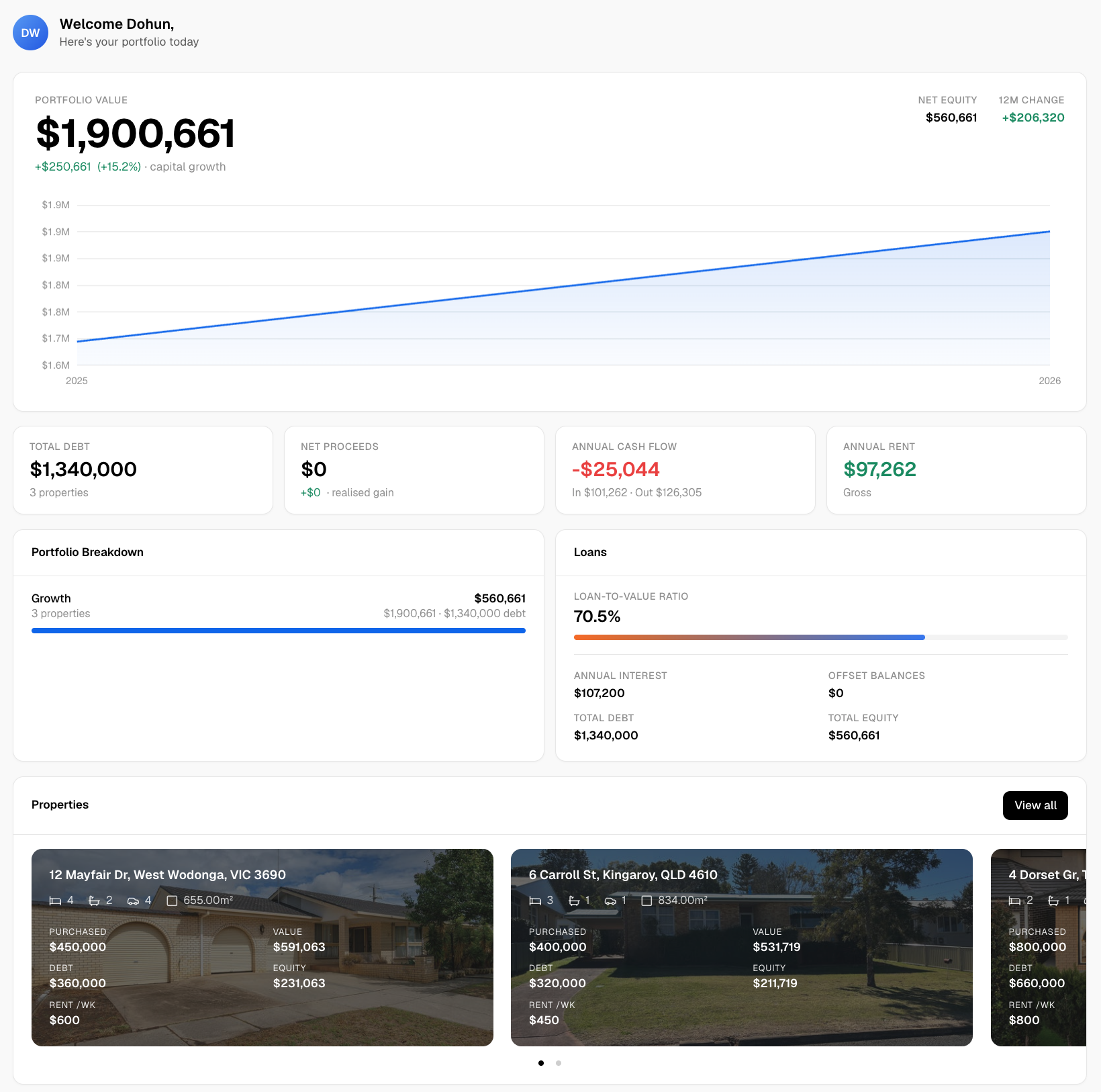
Beyond the estimator, Wealthstacker runs automated quarterly property valuations at no cost, so your numbers stay current without you chasing an agent for an appraisal. Its scenario modelling lets you compare buying against rentvesting over a 15-year horizon, and you can export a shareable report to hand straight to a broker, which cuts down the back-and-forth of a first meeting considerably.
To use it properly, pull together your payslips, card limits, and HECS balance, run a couple of scenarios against different loan sizes and rates, and generate a report before you book a broker appointment. If you’re still building your deposit, Wealthstacker’s budget planning guide is a good companion piece for getting there faster. Head to Wealthstacker to run your own numbers and see where you actually stand.
Sources
- What determines your home loan borrowing power? 2026 guide | Mozo
- Mortgage Macroprudential Policies | Financial Stability Review – October 2021 | RBA
- Home loan serviceability explained | Savings