
Debt-to-income ratio Australia: the 2026 APRA limit explained
Your debt-to-income (DTI) ratio is total debt divided by gross annual income, and from 1 February 2026, APRA’s new DTI limit restricts authorised deposit-taking institutions (ADIs) to writing no more than 20% of new owner-occupier loans and 20% of new investor loans at a DTI of 6 times income or higher. If your combined debts would exceed six times your gross income, you are now in the segment lenders must actively manage.
- The 6× threshold is the line APRA draws. A borrower earning $120,000 a year who takes on $720,000 or more in total debt sits at exactly 6×.
- The 20% aggregate cap means each ADI can still approve high-DTI loans, but only up to that share of new lending in each category.
- Most owner-occupiers with modest existing debt are unlikely to feel the change directly. Investor borrowers carrying multiple properties, or anyone with significant personal debt alongside a large new mortgage, face the tightest practical constraints.
Reuters reported that a small but notable share of new loans across the sector sat at or above the 6× threshold at the time of APRA’s announcement, with investor loans carrying a higher share above this level.
Key takeaways
| Point | Details |
|---|---|
| The 6× DTI threshold | Total debt at or above 6× gross annual income triggers APRA’s cap and lender scrutiny. |
| APRA’s 20% aggregate cap | ADIs may write up to 20% of new owner-occupier and 20% of new investor loans above the threshold, effective 1 February 2026. |
| What counts in the calculation | Credit card limits (full amount), existing mortgages, personal loans, and the new loan all feed into total debt; gross pre-tax income is the denominator. |
| Highest-impact actions | Reduce credit card limits, document all income sources, and ask a broker about lender quota availability before applying. |
| Wealthstacker as a modelling step | Use Wealthstacker’s free borrowing power estimator to run DTI scenarios before approaching a lender; confirm all figures with a licensed credit provider. |
Table of Contents
- What is the debt-to-income ratio and why do lenders use it?
- What did APRA change in 2026 and who does it affect?
- How to calculate your DTI ratio: PAYG and self-employed examples
- Which income and debts do lenders typically count?
- What is a good DTI ratio for an Australian mortgage?
- How does your DTI affect your borrowing limit and loan eligibility?
- Practical steps to lower your DTI before you apply
- Estimate your borrowing power and run DTI scenarios with Wealthstacker
- Model your DTI before your next loan application
- Sources
What is the debt-to-income ratio and why do lenders use it?
The DTI formula is straightforward: total debt ÷ gross annual income. Total debt includes the new loan you are applying for plus every existing debt obligation you carry. Gross annual income is your pre-tax earnings before any deductions.
A quick example: a borrower with a $600,000 mortgage application, a $20,000 car loan, and a $10,000 personal loan carries $630,000 in total debt. On a $120,000 gross income, that is a DTI of 5.25×.
Lenders use DTI because it captures something that serviceability tests and LVR calculations miss on their own.
- LVR (Loan to Value Ratio) measures the loan against the property’s value. It tells a lender about collateral risk but says nothing about whether the borrower can sustain repayments if rates rise.
- Serviceability buffers (currently a 3% buffer above the loan rate, per APRA guidance) test whether a borrower can meet repayments at a higher rate. They are income-sensitive but do not directly measure the total debt stack.
- DTI captures the full debt burden relative to income. A borrower can pass a serviceability test and still carry so much debt that any income shock, redundancy, illness, or rate spike, creates serious stress.
The formal regulatory home for DTI in Australia sits in APS 220 Credit Risk Management Attachment C and reporting standard ARS 223.0, which set out how ADIs must measure, report, and manage DTI exposures.
What did APRA change in 2026 and who does it affect?
APRA’s announcement is the most significant borrower-based macroprudential tool activated in Australia since the serviceability buffer changes of 2021. The policy is precise in its scope.
The limits apply to new loans funded, not to existing loan books.
APRA framed this as a pre-emptive guardrail rather than an emergency brake. The intent is to prevent that share from growing unchecked as property prices and borrowing volumes rise.
Scope and exclusions matter here. Not every residential loan counts toward the cap:
- Bridging loans for owner-occupiers are excluded. If you are selling one property and buying another simultaneously, the short-term bridging debt does not push you over the cap. MoneySmart’s bridging finance guidance explains how these facilities work for borrowers unfamiliar with the structure.
- Loans for the purchase or construction of new dwellings are also excluded. This carve-out is deliberate: APRA did not want the DTI cap to suppress new housing supply.
- Smaller ADIs receive proportionate treatment, recognising that a rigid 20% cap could distort lending at institutions with small loan books.
The full implementation detail sits in APS 220 Attachment C and ARS 223.0. The APRA macroprudential policy page lists this alongside other active tools, including the serviceability buffer and countercyclical capital buffer.
Internationally, the IMF and BIS have long advocated borrower-based measures of this type. BIS research on borrower-based macroprudential tools explains why an aggregate share cap, rather than a hard single-borrower limit, gives regulators a more flexible guardrail: lenders retain discretion on individual files while the system-level exposure is contained.
| Policy element | Detail |
|---|---|
| Effective date | 1 February 2026 |
| DTI threshold | 6× (total debt ÷ gross annual income) |
| Aggregate cap | 20% of new owner-occupier loans; 20% of new investor loans |
| Applies to | ADIs (authorised deposit-taking institutions) |
| Excluded loans | Bridging loans (owner-occupier); new dwelling purchase or construction |
| Regulatory reference | APS 220 Attachment C; ARS 223.0 |
APRA’s announcement notes that investor lending carries a higher share of loans above the 6× line, which is why investors face the most direct practical pressure from the cap.
How to calculate your DTI ratio: PAYG and self-employed examples
Step 1: Identify your total debt
Total debt includes every credit obligation you carry, plus the new loan you are applying for:
- The proposed new home loan amount
- Outstanding balance on any existing mortgages
- Car loans and vehicle leases (outstanding balance)
- Personal loans (outstanding balance)
- Credit card limits (most lenders use the full approved limit, not the current balance)
- Any other ongoing credit facilities
Step 2: Identify your gross annual income
For PAYG borrowers, gross annual income is your pre-tax salary plus any regular, documented additional income such as overtime, bonuses, or allowances that your employer confirms in writing.
For self-employed borrowers, lenders typically average the last two years of net profit (after adding back non-cash deductions such as depreciation) from your tax returns or BAS statements. Some lenders will use the lower of the two years if income has declined.
Step 3: Divide and compare
DTI = Total debt ÷ Gross annual income
Worked example: PAYG borrower
| Item | Amount |
|---|---|
| Proposed home loan | $600,000 |
| Existing car loan | $20,000 |
| Credit card limit | $10,000 |
| Total debt | $630,000 |
| Gross annual income | $120,000 |
| DTI | 5.25× |
This borrower sits below the 6× threshold. They have some room, but adding another $102,000 in debt would push them to exactly 6×.
Worked example: self-employed borrower
| Item | Amount |
|---|---|
| Proposed home loan | $720,000 |
| Existing business vehicle lease | $20,000 |
| Credit card limit | $10,000 |
| Total debt | $720,000 |
| Year 1 net profit (add-backs applied) | $120,000 |
| Year 2 net profit (add-backs applied) | $120,000 |
| Averaged gross income used | $120,000 |
| DTI | 6× |
This borrower is above 6×. Their application falls into the segment APRA’s cap governs.
A note on lender variability: these examples use common assumptions, but lenders differ. Some use minimum credit card repayments rather than full limits. Some include HECS/HELP debt; others do not. A pre-approval estimate from a bank’s online calculator and a formal credit assessment can produce different DTI figures for the same borrower.
Which income and debts do lenders typically count?
Standard inclusions
- Existing mortgages: full outstanding balance, including investment loans
- The new loan being applied for: always included in total debt
- Car loans and personal loans: outstanding balances
- Credit card limits: most lenders count the full approved limit, not the current balance, because the limit represents potential debt
- Buy now pay later (BNPL): increasingly treated as an ongoing liability by major lenders, particularly where repayments are regular and documented
- Vehicle leases: counted as a debt obligation
Tricky items worth knowing
HECS/HELP debt sits in a grey zone. Some lenders include it in DTI calculations; others treat it separately because repayments are income-contingent and automatically deducted. Ask your lender or broker directly how they handle it, because the difference on a $50,000 HECS balance can shift your DTI meaningfully.
Business debts with personal guarantees are typically included. If you have signed a personal guarantee on a business loan, that liability appears in your DTI calculation even if the business is servicing it.
Tax arrears and child support are assessed case by case. Lenders treat ongoing obligations differently from one-off liabilities, and undisclosed arrears discovered during credit checks can trigger a decline regardless of DTI.
Documentation lenders will ask for:
- PAYG borrowers: two recent payslips, most recent group certificate or PAYG payment summary, and a letter of employment confirming any variable income
- Self-employed borrowers: two years of personal and business tax returns, ATO notices of assessment, and BAS statements; some lenders also require an accountant’s letter
- Rental income: a current lease agreement and rental statements from your property manager
- Investment income: dividend statements, trust distributions, or managed fund statements
Pro Tip: Cancel or reduce credit card limits you are not using before you apply. A $20,000 card you never touch still adds $20,000 to your total debt in most lenders’ DTI calculations.
What is a good DTI ratio for an Australian mortgage?
There is no single “good” DTI that applies universally, but lenders and APRA’s own policy signal clear bands.
- Under 4×: strong position. Lenders treat this as low risk, and you are unlikely to face any DTI-related friction in the approval process.
- 4× to 6×: the typical range for most Australian borrowers. Applications in this band proceed through standard assessment, though lenders may scrutinise the composition of the debt more carefully toward the upper end.
- 6× and above: the APRA-flagged zone. Lenders can still approve loans here, but only within the 20% aggregate cap. Some lenders apply internal thresholds lower than 6× for manual review, meaning a DTI of 5.5× might trigger additional scrutiny at certain institutions.
Lender variation is real and worth understanding. A non-bank lender that is not an ADI sits outside APRA’s cap entirely, though it still applies its own credit policies.
Investors carry structurally higher DTIs because they often hold multiple properties with associated debt. Reuters’ coverage of APRA’s announcement noted that investor loans had a higher proportion above the 6× threshold compared to the overall sector share, which was lower.
Understanding the difference between owner-occupier and investor loans matters here, because lenders price and assess them differently even before DTI enters the picture.
How does your DTI affect your borrowing limit and loan eligibility?
DTI feeds into underwriting as one of several filters, but it can be the binding constraint when it sits near or above 6×.
The typical flow looks like this: a lender receives your application, runs a DTI calculation, and simultaneously runs a serviceability assessment. If DTI is below 6×, the file moves through standard processing.
Typical lender responses for high-DTI applications:
- Manual review: a credit analyst assesses the file individually rather than relying on automated scoring. This adds time and introduces subjectivity.
- Higher deposit requirement: some lenders require a lower LVR (more equity) to offset the higher debt burden.
- Loan amount reduction: the lender may approve a smaller loan than requested, bringing the DTI below their internal threshold.
- Higher interest rate margin: some lenders price high-DTI loans at a premium to reflect the additional risk.
- Decline: if the lender’s quota is exhausted or the DTI significantly exceeds 6×, the application may be declined outright.
The quota effect is worth understanding. A broker who monitors lender capacity across multiple ADIs can redirect that application to an institution with available quota.
For investors, the leverage and property wealth relationship becomes more constrained under this framework.
Practical steps to lower your DTI before you apply
The most effective moves target either the numerator (total debt) or the denominator (gross income). Here are the highest-impact actions, roughly in order of ease and speed.
-
Reduce or cancel credit card limits. This is the fastest lever. A $30,000 combined credit card limit adds $30,000 to your total debt in most DTI calculations. Reducing limits or closing unused cards takes days and can shift your DTI by 0.2× or more depending on your income.
-
Pay down personal loans and car loans. Reducing outstanding balances directly lowers total debt. Prioritise the loans with the highest balances relative to their remaining term.
-
Document all income sources. Overtime, rental income, dividends, and secondary employment all count if you can evidence them. A borrower who earns $10,000 a year in rental income but has not declared it to their lender is leaving capacity on the table.
-
Delay new borrowing. Any new credit facility opened in the months before application adds to your total debt. Avoid car loans, personal loans, or new credit cards in the six months before you apply.
-
Consolidate debts where it genuinely reduces measured obligations. Rolling multiple small debts into a single lower-rate loan can reduce the total outstanding balance and simplify the lender’s assessment. Be cautious: consolidation that extends the term may not reduce the DTI if the outstanding balance stays the same.
-
Time your application around income evidence. If you received a pay rise or bonus recently, apply after you have two payslips at the new rate. For self-employed borrowers, lodging your most recent tax return before applying means lenders use your latest (and ideally higher) income figure.
Pro Tip: Ask a broker to run your application against multiple lenders before you formally apply. A formal credit enquiry affects your credit file; a broker’s preliminary assessment does not. Knowing which lenders have available high-DTI quota before you apply saves both time and credit score impact.
For a detailed look at how regulatory changes affect borrowing capacity assessments, Wealthstacker’s 2026 guide covers the full picture.
Estimate your borrowing power and run DTI scenarios with Wealthstacker
Wealthstacker’s toolkit lets you model DTI scenarios before you speak to a lender, which means you walk into that conversation knowing your numbers rather than discovering them.
Features you can use directly for DTI planning:
- Borrowing power estimator: input your income, existing debts, and proposed loan amount to see an estimated maximum loan and your approximate DTI.
- Scenario modelling: adjust variables (deposit size, income, credit card limits, rental income) and see how each change shifts your estimated DTI and borrowing capacity. This is where the 15-year investment modelling becomes useful for comparing rentvesting and buying paths under different DTI constraints.
- Quarterly automated valuations: keeping your property valuations current matters for DTI because the loan balance is fixed but the equity position changes. Updated valuations feed into more accurate portfolio-level assessments.
- AI investment assistant: ask scenario questions in plain language and get modelled outputs rather than generic answers.
Running a simple DTI scenario takes three steps:
- Enter your gross annual income and all existing debt balances (including credit card limits).
- Enter the proposed loan amount you are considering.
- Review the estimated DTI output and adjust variables to see what changes bring you below 6×.
Wealthstacker models estimates only. The figures it produces are planning tools, not credit assessments. Confirm any borrowing decision with a licensed credit provider or mortgage broker. Wealthstacker is not a lender.
Model your DTI before your next loan application
Knowing your DTI before you apply is the difference between a confident conversation with a lender and an unexpected decline. Wealthstacker’s free toolkit gives you the scenario modelling, borrowing power estimates, and quarterly property valuations to run those numbers yourself, at no cost, before you commit to anything.
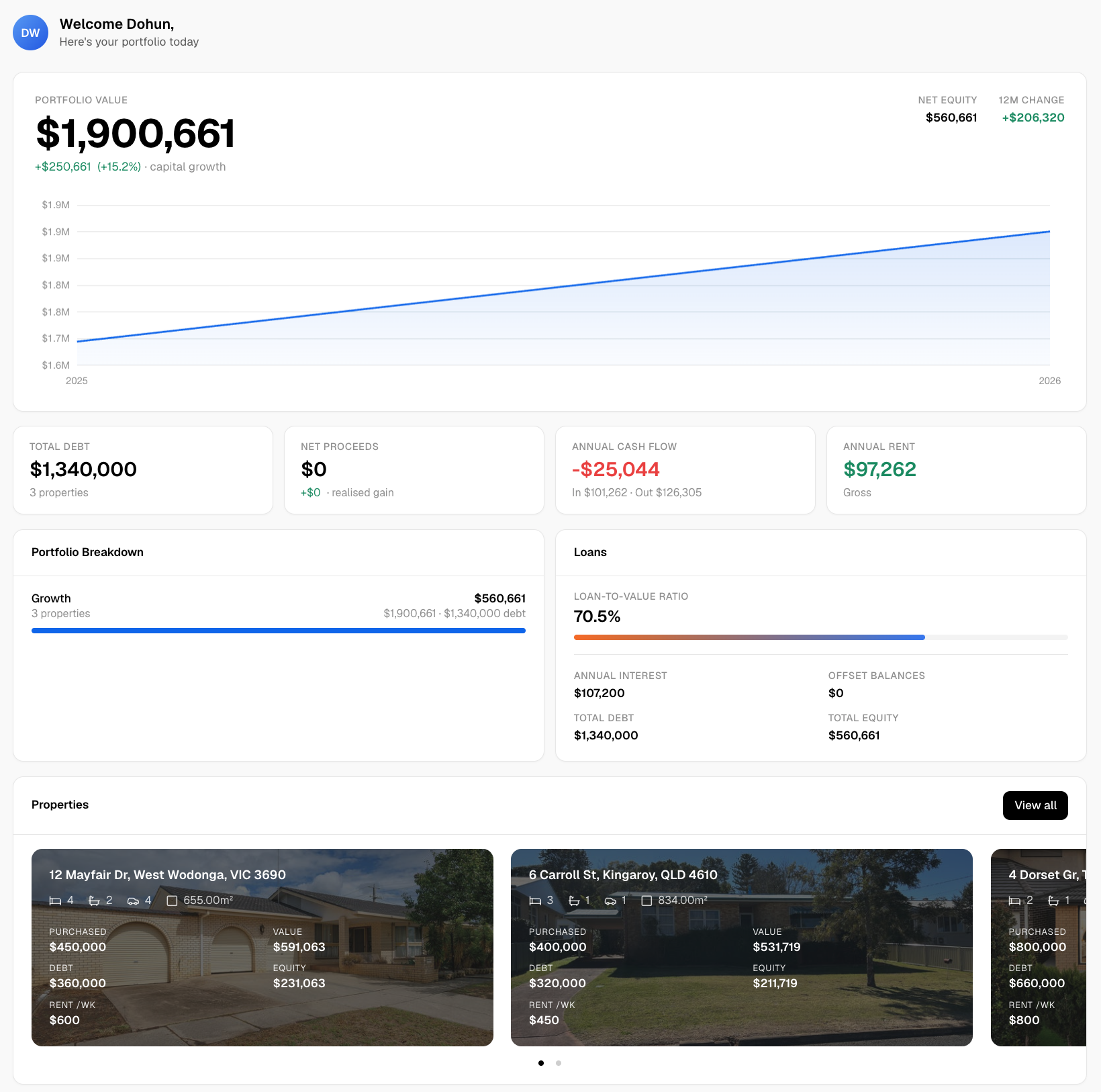
The platform’s borrowing power estimator lets you test different income levels, debt configurations, and deposit sizes side by side. The portfolio dashboard tracks your property values and debt positions over time, so you always know where your DTI sits relative to the 6× threshold. For investors managing multiple properties, the portfolio performance metrics tools give you a consolidated view of how each asset affects your overall borrowing position.
Wealthstacker is an estimator, not a lender. Use it to prepare, then confirm your figures with a credit provider or broker before you apply.
Start modelling your DTI for free at Wealthstacker.
Sources
These are the primary sources worth bookmarking if you want to go deeper than this article.
This article provides general information only and is not financial or credit advice. Confirm your specific borrowing position with a licensed credit provider, mortgage broker, or financial adviser before making any lending decisions.
This article is general information, not a substitute for advice from a qualified financial advisor. Consult a qualified financial professional about your own circumstances before acting on anything here.