
Why strategic property selection saves time: a practical guide
A clear, criteria-driven property selection process shaves weeks from research and due diligence by eliminating unsuitable markets and properties before you spend a single hour analysing them. The mechanism is simple: a defined buy box converts a market of thousands of listings into a shortlist of five to ten, and a repeatable decision process means you never rebuild your analysis from scratch.
The time savings are not marginal. A tax-aware buy box that filters on land ratios and depreciable basis can create differences of tens of thousands of dollars in year-one after-tax returns between two properties with identical gross revenue. Without that filter, you spend weeks on due diligence for deals that fail the moment you run the post-tax numbers.
Three things you can do in the next 48 hours:
- Set three non-negotiable filters (price band, minimum yield, property type) and apply them to your current watchlist. Archive anything that fails.
- Write a one-line scorecard: list five criteria, assign a pass/fail to each, and decide your minimum pass count before you will spend more than 30 minutes on a property.
- Put two suburbs on watch using free suburb data tools and commit to tracking only those two for the next 90 days.
Table of Contents
- Why strategic property selection saves time: the core mechanisms
- How to define a strategy that shortens the path to your next offer
- How modelling and simple decision tools speed your choices
- What to check first when screening suburbs and markets
- A compact due-diligence checklist that prevents rework
- Who you need on your short list and how they save you time
- How Wealthstacker cuts weeks from the selection process
- How to set review cycles so future decisions get faster
- The verdict and your next three steps
- Sources
Why strategic property selection saves time: the core mechanisms
The time savings from a deliberate selection approach come from three concrete places: narrowing scope, preventing rework, and compressing decisions.
A pre-defined buy box does the first job. Instead of scanning every listing in a city, you apply your filters and reduce thousands of options to a handful worth opening. A buy box also breaks analysis paralysis by turning every first review into a binary: does this deal fit the criteria or not? If not, you pass immediately. No extended deliberation, no “let me just check one more thing.” That single behavioural shift recovers hours per week for active investors.
Preventing rework is the second mechanism. Most wasted time in property investing comes from advancing a deal through multiple stages, only to discover a fatal flaw that was detectable at the start. A land ratio below your threshold, a yield that only works pre-tax, a suburb with a deteriorating supply pipeline. Layering a tax filter over your buy box forces early elimination of listings that look attractive on gross revenue but fail on post-tax returns, saving weeks of analysis on deals that were never viable.
The third mechanism is decision compression. When your criteria are written down and your scoring is repeatable, you stop re-litigating the same questions every time a new property appears. Predictable markets, reusable checklists, and a standing team of advisers mean each new deal moves faster than the last.
Statistic callout: Two properties with identical gross rental revenue can differ significantly in year-one after-tax returns when their land ratios and depreciable bases diverge. Filtering on those variables before listing review eliminates the need to run full due diligence on the lower-performing option.
Pro Tip: Write your buy box as a one-page document and date it. Every time you feel tempted to “bend the rules” for an interesting property, re-read the document. The discipline of returning to a written standard is what prevents the slow drift back into reactive searching.
How to define a strategy that shortens the path to your next offer
The goal here is a written buy box you can apply in under five minutes per listing. Work through these steps once and you will not need to rebuild your framework for each acquisition cycle.
-
Clarify your capital, leverage tolerance, and time budget. Know your deposit capacity, your maximum loan-to-value ratio, and how many hours per week you can realistically allocate to property research. A time budget of four hours per week demands a much tighter buy box than 20 hours.
-
Set your investment objective and horizon. Are you targeting cash flow, capital growth, a rentvesting strategy, or a short-term flip? Each objective produces different filters. A rentvesting approach prioritises yield and tenant demand; a growth strategy prioritises land content and infrastructure pipeline. Mixing objectives without a clear primary goal is one of the fastest ways to waste time on unsuitable listings.
-
Apply technical filters. Set a price band (hard upper and lower limits), a minimum gross yield, a minimum land-to-total-value ratio, and a property type restriction. These four filters alone will eliminate the majority of listings before you read a single description.
-
Add operational constraints. Decide whether you will self-manage or use a property manager, whether short-term rental is permitted in your target area, and what your tolerance is for local council regulation. Operational friction compounds over time; filtering it out early keeps your ongoing time cost low.
-
Write decision rules and deadlines. Decide what percentage of your scorecard criteria a property must meet before you advance it to full due diligence. Four out of five? All five? Also set a time limit: if a lead has been open for more than two weeks without advancing, archive it. Open leads that never close are a hidden time drain.
A simple scorecard template: list your five criteria in a column, mark each as Pass or Fail, and set a threshold (e.g. minimum four passes to proceed). One line per property, five seconds to score, immediate decision. That is the entire tool.
How modelling and simple decision tools speed your choices
Running two rapid scenarios per property takes roughly 20 minutes and eliminates the need for extended analysis on most listings.
Calculate your debt service coverage ratio (DSCR). If DSCR falls below 1.1, the property fails under conservative assumptions and you archive it.
Scenario B (base case): Use median comparable rents, standard vacancy for the suburb, and the same borrowing cost. Calculate year-one post-tax economic return, accounting for depreciation and land ratio. If the post-tax return does not meet your threshold, archive.
The outputs that matter most to time-to-decision are DSCR pass/fail, year-one post-tax economic return, and an estimated capex requirement from a quick visual inspection or building report summary. Everything else is detail you only need if the property passes those three tests.
Repeatable forecasting methods reduce the subjective rework that slows decisions. When your model is standardised, you are not rebuilding assumptions from scratch each time. You are plugging in new inputs and reading the output.
| Decision output | Threshold (example) | Action if failed |
|---|---|---|
| DSCR (conservative scenario) | Below 1.1 | Archive immediately |
| Year-one post-tax return | Below your minimum % | Archive |
| Estimated capex | Exceeds 5% of purchase price | Escalate for inspection or archive |
| Land-to-total-value ratio | Below your minimum threshold | Archive |
A compact scoring matrix that flags rejects automatically means you spend your analytical time only on properties that have already passed the mechanical tests. Automated valuations, available through tools like Wealthstacker, remove the need to manually estimate current market value for each candidate, cutting one of the most time-consuming steps in early-stage screening.
What to check first when screening suburbs and markets
Choosing the market before the property creates repeatability. Once you know a suburb well, every subsequent property in that suburb takes a fraction of the time to evaluate because you already understand the demand drivers, the rental profile, and the regulatory environment.
Limit yourself to two to four suburbs at any one time. More than that and your research becomes shallow across all of them, which defeats the purpose.
Check these in order:
- Demand drivers first. What is pulling tenants or buyers to this area? Employment nodes, infrastructure projects, university catchments, lifestyle amenity. If you cannot name two concrete demand drivers, move on.
- Supply pipeline second. Check development application data and building approvals for the suburb. A strong demand story is undermined by a large apartment pipeline delivering in the next 18 months.
- Price-to-rent reality. Run the gross yield calculation against current asking rents and asking prices. If the yield does not meet your filter before you even open the listing, the suburb fails your screen.
- Tenant profile fit. Does the likely tenant profile match your property type and management model? A suburb dominated by student renters requires a different management approach than one with long-term family tenants.
- Regulatory risk. Check local council short-term rental rules, zoning overlays, and any pending heritage or flood designations. Regulatory friction discovered late costs time and money.
A compact due-diligence checklist that prevents rework
The purpose of a due-diligence checklist is not thoroughness for its own sake. It is to find the deal-killers as fast as possible so you stop spending time on properties that will not proceed.
Pre-inspection checks (do these before booking anything):
- Title search: confirm ownership, encumbrances, and easements. A title issue discovered after a building inspection wastes the inspection fee and the week it took to get there.
- Land ratio scan: calculate land value as a percentage of total purchase price using council rates notices or a quick automated valuation. If it falls below your threshold, archive.
- Comparable rents: pull three to five comparable active rentals in the same suburb and property type. If median comparable rent does not support your yield filter, archive.
- Quick cost estimate: look at listing photos for obvious deferred maintenance (roof condition, gutters, paint, flooring). A rough capex estimate at this stage is not precise, but it tells you whether a building inspection is worth ordering.
Decision triggers: if land ratio is below your threshold OR DSCR under conservative assumptions is below 1.1, convert the lead to “archive” without further work. If both pass, advance to full due diligence. This binary keeps you from spending partial effort on half-dead leads, which is where most investors lose time.
When dealing with agents and vendors, avoid re-opening assumptions you have already tested. State your position once, in writing, and do not revisit it unless new material information emerges. Agents who sense indecision will slow the process; a clear, documented position keeps negotiations moving.
Who you need on your short list and how they save you time
A standing team of trusted professionals is one of the most underrated time-saving strategies in property investment. When you have a relationship with a lender, conveyancer, valuer, property manager, and a reliable trades contact, each new acquisition moves faster because you are not starting from zero.
The essential contacts and what they do for your timeline:
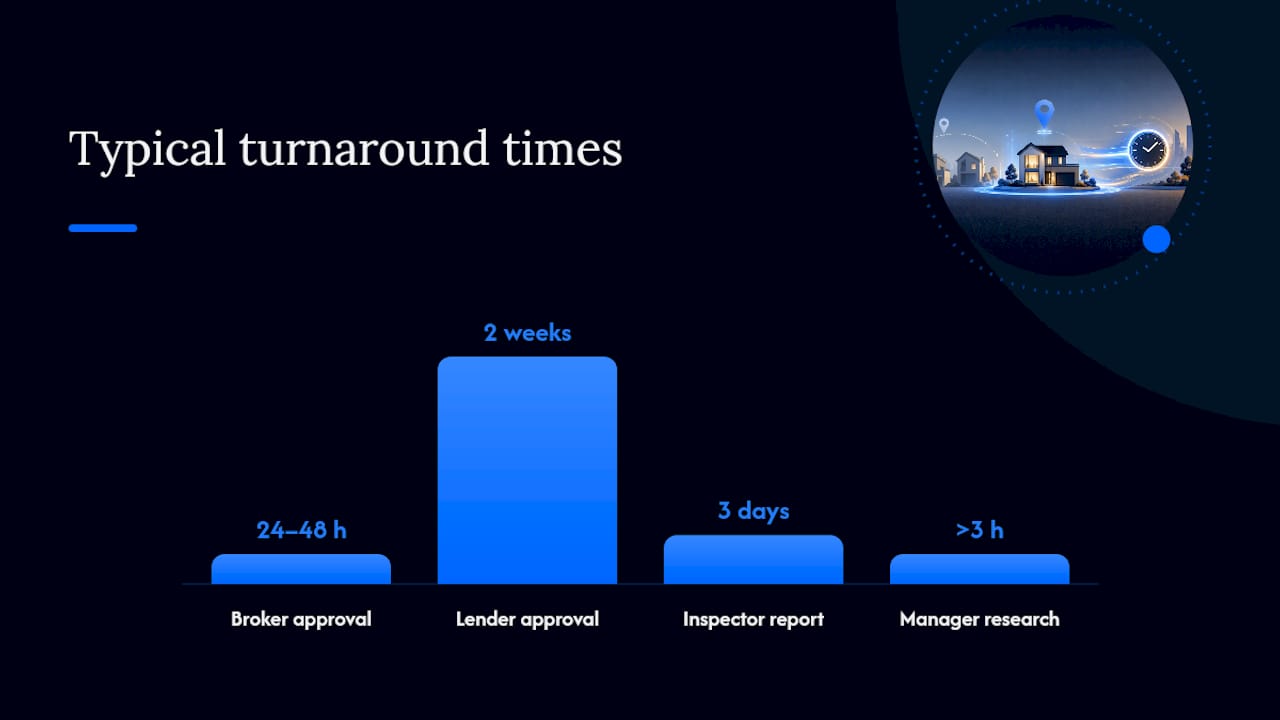
- Mortgage broker or lender: a pre-approval in place before you find a property means finance is not the bottleneck. A broker who knows your file can turn around a conditional approval in 24–48 hours rather than two weeks.
- Conveyancer or solicitor: a conveyancer who has seen your standard contract terms before can review a new contract in hours, not days. Brief them once on your typical deal structure and they will flag deviations rather than starting from scratch each time.
- Property manager: the right property manager gives you local rental market intelligence that no data portal can match. Ask them one question before you buy: “What is the current vacancy rate for this property type in this suburb, and how long does it typically take to place a tenant?” Their answer tells you more than three hours of online research.
- Building inspector: a trusted inspector who knows your standards will prioritise your jobs and give you a verbal summary within hours of inspection, rather than a written report three days later.
- Trades contact: a reliable plumber and electrician who can give you a quick verbal estimate for obvious repairs saves the delay of waiting for formal quotes before you can model capex.
Building management automation and vendor systems early keeps the time required to run multiple properties flat as your portfolio grows. Investors who scale while working full-time set up their management infrastructure before the second acquisition, not after.
60-second briefing template for any new professional: “I am looking at [property type] in [suburb], purchase price around [range], targeting [yield or growth objective]. My timeline to exchange is [X weeks]. Can you confirm your availability and give me a rough [fee/timeline/estimate] for this type of job?”
That single paragraph gets you comparable, decision-ready responses from multiple professionals without a phone tag cycle.
How Wealthstacker cuts weeks from the selection process
The workflow from market filter to offer-ready position typically takes weeks when done manually. With the right tooling, the same workflow compresses to days.
Here is how a two-property buy box example plays out using Wealthstacker’s toolkit:
Stage 1: Market filter (Day 1). Apply your suburb watchlist and technical filters using Wealthstacker’s market research tools and hazard/risk overlays. A list of 1,000 listings in your target area narrows to 20–30 that meet your price band, property type, and risk profile. Time saved: several hours of manual portal searching.
Stage 2: Automated valuation (Day 1–2). For each shortlisted property, Wealthstacker’s free automated quarterly valuations give you a current market value estimate without a manual comparable sales analysis. You are not pulling sold data from three different portals and averaging it yourself. The output is immediate and standardised.
Stage 3: Scenario modelling (Day 2–3). Run your two rapid scenarios (conservative and base case) using Wealthstacker’s 15-year investment modelling tools. The platform models both rentvesting and buying scenarios, so if your strategy involves holding an investment property while renting your own home, you can compare the net worth trajectories side by side. The model outputs DSCR, post-tax return, and a 15-year wealth projection. Two properties that passed the initial filter might produce materially different 15-year outcomes; the model surfaces that difference in minutes rather than after a spreadsheet rebuild.

Stage 4: Offer-ready position (Day 3–5). With valuations confirmed, scenarios modelled, and your scorecard complete, you brief your broker and conveyancer using the 60-second template. Because your analysis is standardised and documented, the briefing takes minutes and your advisers have everything they need to move quickly.
Wealthstacker’s decision shortcuts framework covers the standardised scorecards and forecasting approaches that underpin this workflow. The platform’s AI-powered investment chat assistant also reduces the back-and-forth with advisers by answering common modelling and strategy questions directly, so you are not waiting on a callback to resolve a question that has a clear answer.
Start building your buy box with Wealthstacker’s free toolkit today.
Wealthstacker gives you automated quarterly valuations, 15-year scenario modelling, borrowing power estimates, and suburb research tools at no cost. When you are ready to go deeper, the premium plan adds portfolio dashboards, goal planners, and lender referral access.
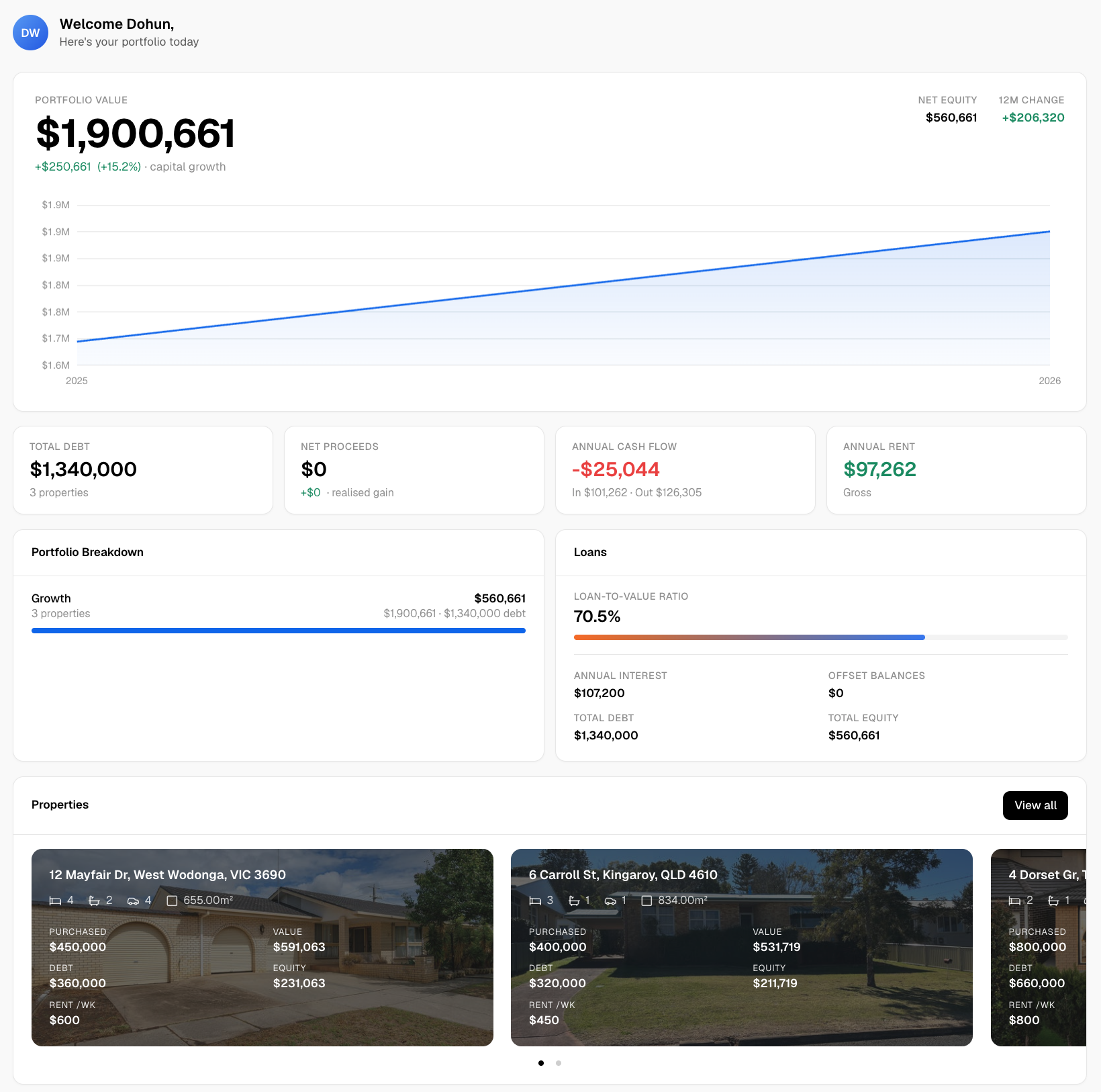
Try Wealthstacker free and run your first property scenario in under 20 minutes.
How to set review cycles so future decisions get faster
The buy box you write today will not be the right buy box in two years. Markets shift, your capital position changes, and you learn from each acquisition. The goal is a review cadence that keeps your criteria current without triggering a full rebuild every time you want to buy.
| Review type | Frequency | What to check | Owner |
|---|---|---|---|
| Market scan | Quarterly | Vacancy rates, new supply pipeline, comparable rents in watched suburbs | Investor |
| Buy box review | Annually | Price band, yield threshold, land ratio minimum, operational constraints | Investor + adviser |
| Scorecard calibration | After each acquisition | Which criteria predicted the outcome, which were noise | Investor |
| Team review | Annually | Response times, quote accuracy, relationship quality for each professional | Investor |
The quarterly market scan takes 30–60 minutes if your suburb list is limited to two to four areas. You are checking whether your watched suburbs still meet your demand-driver criteria, not re-researching the entire market.
The annual buy-box review is where you make deliberate changes. Update your price band to reflect current market levels, adjust your yield threshold if interest rates have moved, and reconsider any operational constraints that have changed.
Pro Tip: Version your buy box. Save each annual revision as a dated document (e.g. “Buy Box v3 — March 2026”) and keep the previous versions. When a deal feels like it almost fits, you can check whether it would have passed an earlier version of your criteria. That comparison often reveals whether you are genuinely updating your strategy or just bending the rules for a specific property.
Repeatable forecasting approaches mean your model inputs update without a full rebuild. Standardised assumptions, saved in a consistent format, let you re-run scenarios in minutes when market conditions shift.
The verdict and your next three steps
A defined buy box, repeatable modelling, and a standing team of advisers are the three components that convert property investing from a time-intensive search into a repeatable process. The first acquisition under a written strategy takes effort to set up. The second takes noticeably less time. By the third, the process runs itself.
Your next three steps:
- Set your filters today (30 minutes). Write your five buy-box criteria, assign pass/fail thresholds to each, and apply them to your current watchlist. Archive anything that fails. Expected outcome: a shortlist of two to five properties worth further analysis.
- Run one scenario this week (20 minutes). Take the top property from your shortlist and run the conservative scenario: lower-end rent, 10% vacancy, your actual borrowing cost. Calculate DSCR. If it fails, archive and move to the next. If it passes, run the base-case scenario and check post-tax return.
- Brief two advisers in the next two weeks (15 minutes each). Use the 60-second briefing template to contact your mortgage broker and conveyancer. Confirm their availability and get a timeline for their part of the process. Having both briefed before you find the right property means finance and legal are not the bottleneck when you need to move.
30–90 day timeline: weeks one to two, buy box written and shortlist filtered; weeks three to four, scenarios modelled and advisers briefed; weeks five to eight, active due diligence on shortlisted properties; weeks nine to twelve, offer submitted on the strongest candidate. That is a realistic path from reading this article to an offer, for an investor who commits to the process.
For a broader view of property investment strategy types and how each affects your time commitment, Wealthstacker’s strategy guide covers the full range from passive holds to active rentvesting.
Key takeaways
A defined buy box, combined with rapid scenario modelling and a standing adviser team, is the most direct way to reduce the time from market research to offer in property investing.
| Point | Details |
|---|---|
| Buy box narrows scope fast | Three to five hard filters reduce thousands of listings to a manageable shortlist before you spend analysis time. |
| Tax filters prevent rework | Filtering on land ratio and post-tax return early eliminates deals that fail after weeks of due diligence. |
| Repeatable modelling compresses decisions | Standardised scenarios (DSCR, post-tax return, capex) produce pass/fail outputs in under 20 minutes per property. |
| A standing team removes bottlenecks | Pre-briefed brokers, conveyancers and inspectors cut days from each acquisition cycle. |
| Review cycles keep the process improving | Quarterly market scans and annual buy-box reviews mean each future decision is faster than the last. |
Sources
For quick action (tools and templates):
- The Tax-Optimized STR Buy Box: How to Filter 10,000 Listings Down to the 5 Worth Analyzing | Overline
- Analysis Paralysis? How to Actually Pick a Property - Graystone Investment Group
- Market First Real Estate: Pick the Right Market
- Staystra
For strategy and objective setting:
For deeper study (frameworks and tax considerations):