
Why rental yield matters to property investors
TL;DR:
- Rental yield measures a property’s annual rental income relative to its value and gauges income efficiency. Understanding the difference between gross and net yield helps investors assess true returns after expenses and risks. Balancing rental income with capital growth and managing costs enhances long-term investment resilience.
Rental yield is defined as the annual rental income a property generates expressed as a percentage of its total value, and it is the single most direct measure of a property’s income efficiency. For Australian real estate investors, understanding why rental yield matters is not optional. It determines whether a property funds itself, drains your cash flow, or builds genuine long-term wealth. This article covers the difference between gross and net yield, how yield interacts with capital growth, what yield signals about investment risk, and how to use it as a practical screening tool for smarter property selection.
Why rental yield matters to investors: the core metric
Rental yield is the starting point for every serious property investment analysis. It tells you, at a glance, how hard your money is working relative to the asset’s price. A property worth $600,000 generating $30,000 in annual rent produces a gross yield of 5%. That number alone, however, tells only part of the story.

Yield matters because it directly connects to cash flow, which is the lifeblood of any investment portfolio. A property with strong yield can service its own mortgage, cover expenses, and leave money in your pocket. A property with weak yield forces you to top it up from your salary every month. Over a portfolio of three or four properties, that difference becomes the gap between financial freedom and financial stress.
The rental income significance extends beyond monthly cash flow. Yield is also a risk indicator, a financing tool, and a portfolio sustainability measure. Investors who ignore it in favour of chasing suburb price growth often find themselves holding assets they cannot afford to keep.
What is the difference between gross and net rental yield?
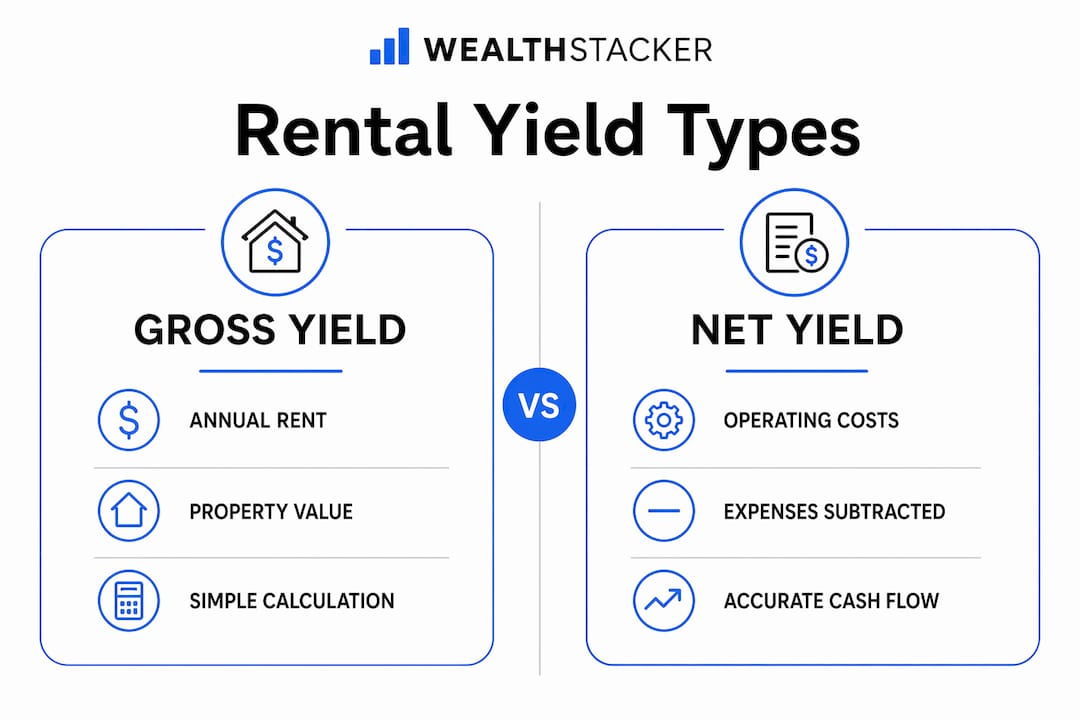
Gross rental yield is the simpler of the two figures. You divide annual rent by the property’s purchase price and multiply by 100. It is useful for quick comparisons between properties but dangerously incomplete for real decision-making.
Net rental yield accounts for the actual costs of owning and managing the property. Operating expenses typically consume 35–45% of gross rent, covering property management fees, council rates, insurance, maintenance, and landlord insurance. That means a property showing a 6% gross yield might deliver only 3.3–3.9% in net yield once real costs are factored in. That gap changes the entire investment case.
Experienced investors use the 50% Rule as a quick sanity check. It assumes operating expenses consume roughly half of gross rent. If a property cannot clear that test, it is a signal to dig deeper before committing. Properties with a large gap between gross and net yield often reveal hidden risks like deferred maintenance, high vacancy rates, or structural issues that are not obvious upfront.
Pro Tip: Always run your investment analysis on net yield, not gross yield. Net yield is the residential equivalent of the commercial cap rate and gives you a far more accurate picture of real-world returns.
| Metric | What It Measures | When to Use It |
|---|---|---|
| Gross Yield | Annual rent divided by property value | Initial screening and quick comparisons |
| Net Yield | Gross yield minus operating expenses | Real investment decisions and cash flow analysis |
| 50% Rule | Assumes 50% of gross rent covers expenses | Sanity check before detailed due diligence |
Net yield combined with financing metrics better predicts actual cash flow and portfolio performance than gross yield alone. Treat gross yield as the headline and net yield as the truth.
How does rental yield compare to capital growth?
Rental yield and capital growth are not competing forces. They are complementary levers, and the best investors understand when to pull each one.
Rental yield delivers ongoing cash flow. Capital growth delivers asset appreciation over time. The challenge is that these two outcomes rarely peak in the same property or the same suburb at the same time. High-growth suburbs in Sydney or Melbourne often carry gross yields of 2–3%, meaning investors subsidise the property from their own income while waiting for the asset to appreciate. Regional or outer-suburban markets may offer yields of 5–7% with more modest growth prospects.
| Strategy | Yield Profile | Growth Profile | Best Suited To |
|---|---|---|---|
| High yield, lower growth | 5–7% gross | Moderate | Income-focused or self-funded investors |
| Low yield, high growth | 2–3% gross | Strong | Long-term wealth builders with strong income |
| Balanced approach | 4–5% gross | Moderate to strong | Most investors building a diversified portfolio |
Tax changes in Australia are shifting investor focus toward rental income over speculative capital growth. Adjustments to negative gearing rules and capital gains tax concessions have made reliable rental income a more dependable foundation for portfolio sustainability. Investors who built strategies entirely around capital growth are now reassessing their exposure.
The rental yield vs capital growth question does not have a universal answer. It depends on your tax position, borrowing capacity, time horizon, and how many properties you hold. What is clear is that balancing rental income with capital appreciation produces a more resilient investment strategy than chasing either metric in isolation.
What impact does rental yield have on investment risk?
High rental yield acts as a financial buffer during market downturns. A property that generates strong income relative to its costs does not force you to sell when prices fall. High-yield properties provide a safety net during downturns by being self-sustaining, reducing the risk of forced sales at the worst possible time.
The concept of positive leverage is central to this. Positive leverage occurs when your net rental yield exceeds your mortgage interest rate. At that point, your tenants are effectively paying down your debt faster than the interest accumulates. That is a fundamentally different financial position from a negatively geared property where you are topping up the shortfall from your salary each month.
Consider the practical difference. A property with a 6.5% net yield against a 6% mortgage rate is positively leveraged. The rent covers the loan, the expenses, and leaves a surplus. A property with a 3% net yield against the same 6% mortgage rate requires you to fund the 3% gap personally. Across a portfolio of four properties, that gap compounds quickly.
“When net rental yield exceeds your mortgage interest rate, the asset effectively subsidises itself. Tenants pay down your debt while you hold the asset.” — Ahmed Elbatrawy
The risks of chasing high yield without scrutiny are real. Properties in areas with high vacancy rates, declining populations, or poor infrastructure can show attractive gross yields that collapse into negative net yields once costs and vacancies are accounted for. Leveraging rental income effectively requires understanding the local rental market, not just the headline number.
Pro Tip: Target mid-market properties in areas that attract nurses, teachers, and young professionals. These tenants have reliable income, stable rental patterns, and lower vacancy risk than luxury or low-income market segments.
How should investors interpret rental yield figures?
Rental yield figures require context to be useful. A 7% gross yield in a mining town with 15% vacancy is not the same as a 5% gross yield in a stable regional city with a growing healthcare sector. The number alone tells you nothing without understanding what sits behind it.
Here is how to read yield figures with more precision:
- Yield on cost vs yield on market value. Yield on cost uses your original purchase price as the denominator. Yield on market value uses the current assessed value. As property prices rise, your yield on market value falls even if rent stays the same. Both figures are useful, but for different purposes. Yield on cost tracks your original investment performance. Yield on market value tells you what the property would return if you bought it today.
- Watch the gross-to-net gap. A large gap between gross and net yield indicates high operating costs or vacancy risk. If a property shows 8% gross but only 3.5% net, something is consuming the income. Find out what before you buy.
- Net yield significantly below gross yield may indicate structural issues like frequent vacancies or expensive maintenance that are not obvious upfront.
- Align yield targets with your strategy. An investor building a passive income portfolio needs a different yield threshold than an investor focused on long-term capital growth. Know your number before you screen properties.
Rental yield only captures income relative to value, separate from capital growth and tax effects. Use it as one input in a broader analysis, not as the sole decision criterion.
Pro Tip: Run a sensitivity analysis on your net yield. Model what happens if rent drops 10% or vacancy extends to eight weeks. If the property still works at those numbers, you have a resilient asset.
What steps can investors take to improve rental yields?
Improving rental yield is not just about finding a better suburb. It is about actively managing both sides of the yield equation: income up, costs down.
- Increase rent where the market supports it. Research comparable rentals in the area and review your rent annually. A property sitting $50 per week below market rate is leaving $2,600 per year on the table. Cosmetic renovations, updated kitchens, and modern bathrooms consistently support higher rents in most markets.
- Reduce property management costs. Management fees vary from 6–12% of rent depending on the agent and location. Switching to a more competitive manager or self-managing in familiar markets can meaningfully lift net yield.
- Select markets with strong rental demand. Areas near hospitals, universities, and major employment hubs carry structurally lower vacancy rates. Lower vacancy means more consistent income and fewer weeks of zero rent dragging down your annual return.
- Consider property upgrades for pro-forma yield improvements. Adding a granny flat, converting a garage to a studio, or splitting a large property into dual occupancy can significantly increase rental income without a proportional increase in property value.
- Balance yield focus with tax and growth impacts. A renovation that lifts rent by $100 per week but costs $40,000 takes over seven years to recoup on yield alone. Factor in depreciation benefits, capital growth impact, and your marginal tax rate before committing.
Building a portfolio while renting is one strategy where yield optimisation becomes especially critical, since your investment property must carry more of its own weight without a primary residence offsetting costs.
Track your rental yield with Wealthstacker
Understanding rental yield is one thing. Tracking it accurately across a growing portfolio is another challenge entirely.
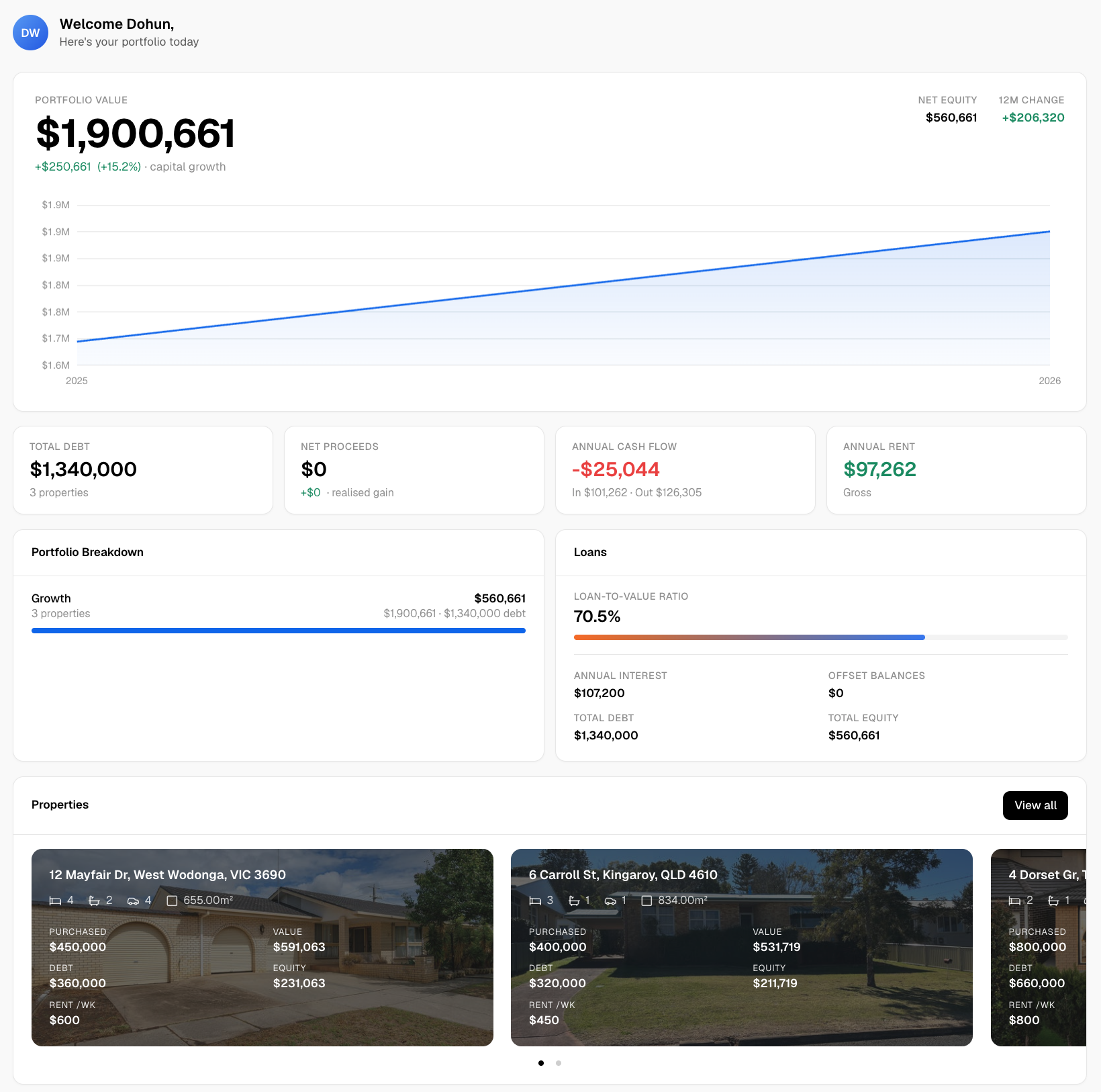
Wealthstacker is built for Australian property investors who want real numbers, not estimates. The platform calculates net rental yields automatically, models cash flow scenarios, and provides automated quarterly property valuations at no cost. You can compare yield against capital growth projections, assess your borrowing power, and model the impact of rent increases or expense changes in real time. Whether you are evaluating your first investment property or managing a multi-asset portfolio, Wealthstacker’s property investment tools give you the data to make decisions with confidence. Stop guessing at your returns and start measuring them.
FAQ
What is rental yield in property investment?
Rental yield is the annual rental income a property generates expressed as a percentage of its value. It is the primary metric for assessing a property’s income efficiency and cash flow potential.
What is the difference between gross and net rental yield?
Gross yield divides annual rent by property value. Net yield subtracts operating expenses first. Operating expenses typically consume 35–45% of gross rent, making net yield the more accurate figure for investment decisions.
What is considered a good rental yield in australia?
A net yield above your mortgage interest rate is the key threshold. Properties achieving 5–6% gross yield in stable rental markets with low vacancy rates are generally considered solid performers for most Australian investors.
How does rental yield affect my ability to grow a portfolio?
Strong rental yield creates positive leverage, where tenant rent covers loan repayments and expenses. This reduces reliance on personal income to fund the portfolio and accelerates debt paydown, making it easier to borrow for additional properties.
Can a property have high yield but still be a poor investment?
Yes. Higher gross yield properties often carry higher expenses or vacancy risk. A property showing 9% gross yield in a high-vacancy market may deliver 3% net yield after costs, making it a weaker performer than a stable 5% gross yield asset in a strong rental market.
Key takeaways
Rental yield is the most direct measure of a property’s income efficiency, and net yield is the only figure that reflects what an investment actually returns after real-world costs.
| Point | Details |
|---|---|
| Net yield over gross yield | Operating expenses consume 35–45% of gross rent, so always analyse net yield for accurate returns. |
| Positive leverage threshold | Net yield exceeding your mortgage rate means tenants effectively fund your debt repayment. |
| Yield and growth are complementary | Balance rental income with capital growth based on your tax position, strategy, and time horizon. |
| High yield needs scrutiny | A large gross-to-net gap signals hidden costs, vacancy risk, or market distress worth investigating. |
| Yield is one input, not the answer | Rental yield captures income relative to value but excludes capital growth, tax effects, and financing impacts. |