
Why investment property beats paying rent in 2026
Investment property ownership builds long-term wealth more effectively than paying rent by combining rental income, capital growth, and tax advantages that renters simply cannot access. Every rent payment you make funds your landlord’s mortgage, not yours. Understanding why investment property beats paying rent is the first step toward redirecting that money into an asset that works for you. Platforms like Wealthstacker, research from Fidelity, and analysis by Tailwind Economics all point to the same conclusion: property ownership, held over the right time horizon, is one of the most reliable paths to financial security available to ordinary Australians.
Why investment property beats paying rent: income and equity
The core financial difference between owning an investment property and renting is straightforward. Rent payments are a pure expense. Mortgage payments, by contrast, build equity with every instalment.
Leverage amplifies this advantage significantly. A $50,000 deposit can control a $250,000 property, meaning you receive capital growth on the full asset value, not just your initial outlay. If that property rises 10% in value, you gain $25,000 on a $50,000 investment. No share portfolio or savings account delivers that kind of return on a small starting position.
Rental income adds another layer. When your tenants’ rent covers your mortgage repayments and holding costs, the property effectively pays for itself while you accumulate equity. Over time, rising rents increase your cash flow while your mortgage balance falls. That combination is the engine behind rental property financial benefits that renters never experience.

The table below shows how the two paths compare across key financial measures.
| Factor | Renting | Investment Property Ownership |
|---|---|---|
| Monthly payment builds equity | No | Yes, via mortgage amortisation |
| Asset appreciation | None | Full property value growth |
| Leverage on initial capital | Not available | Typically 4:1 or 5:1 |
| Rental income stream | None | Yes, covers holding costs |
| Tax deductions available | None | Depreciation, interest, expenses |
Pro Tip: Use Wealthstacker’s free quarterly valuation tool to track your property’s equity position in real time, so you always know exactly where you stand.
What tax benefits do investment properties offer?
Tax treatment is one of the most underappreciated investment property advantages available to Australian property investors. Renters pay tax on their full income with no property-related offsets. Investors do not.
Depreciation over 27.5 years reduces your taxable rental income without any cash outlay. This is a non-cash deduction, meaning you claim it on paper while your property continues to generate real income. Over a decade, depreciation alone can shelter tens of thousands of dollars from the tax office.
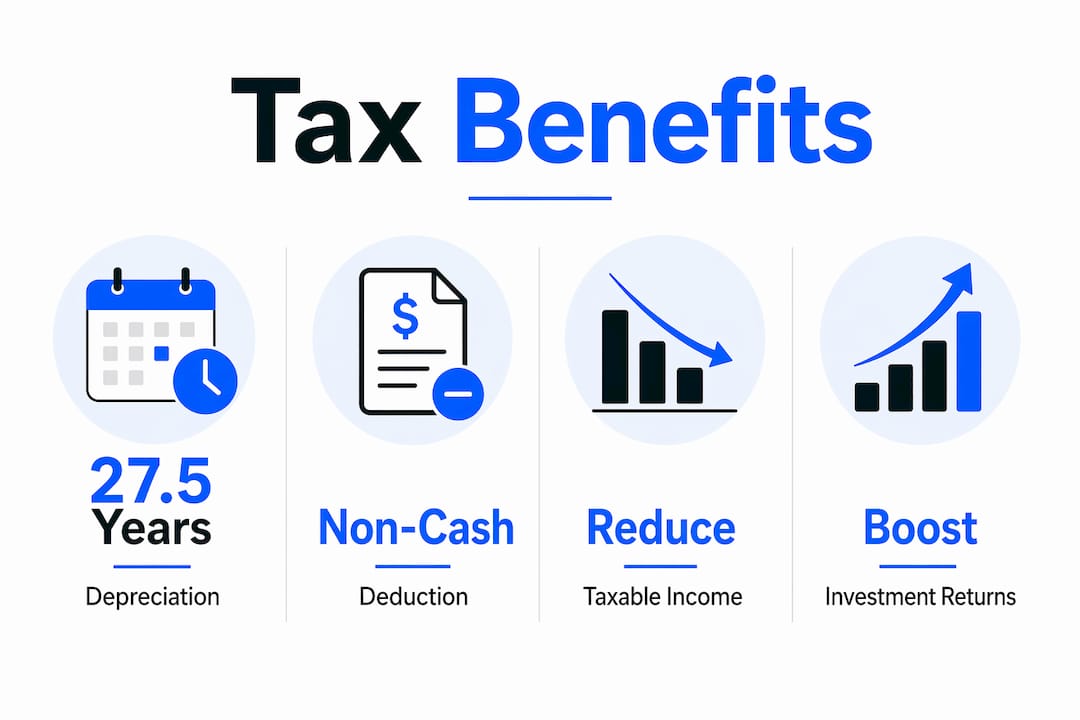
Interest on your investment loan is fully deductible against rental income. So are property management fees, council rates, insurance, repairs, and maintenance. These deductions reduce the net cost of holding the property, making the real after-tax return considerably higher than the headline numbers suggest.
Capital gains tax deferral through mechanisms like 1031 exchanges in the US context, or strategic timing of sales in Australia, allows investors to reinvest proceeds and compound growth without an immediate tax hit. Renters have no equivalent tool. Here is a summary of the key tax advantages investors hold over renters:
- Depreciation deductions reduce taxable income each year without a cash cost
- Loan interest is fully deductible against rental income
- Property expenses including management fees, insurance, and repairs are deductible
- Capital gains tax concessions apply to properties held longer than 12 months
- Negative gearing allows losses to offset other taxable income in Australia
No renter accesses any of these benefits. The tax system is structurally designed to reward property ownership, and that reality does not change regardless of market conditions.
Does property protect you against inflation better than renting?
The answer is yes, and the mechanism is direct. A fixed-rate mortgage locks your principal and interest repayments at today’s cost. Inflation rises around you, but your mortgage payment stays the same.
Renters face the opposite situation. As inflation pushes up property values and landlord costs, rents increase. The renter’s disposable income shrinks while the investor’s cash flow grows. That divergence compounds over a decade into a significant wealth gap between the two groups.
Property values themselves tend to rise with inflation. Bricks and mortar are a real asset, and rental income typically rises in line with broader price increases. An investor holding a property for 15 years benefits from three simultaneous inflation effects: a fixed mortgage cost, rising rental income, and an appreciating asset. A renter experiences only one: rising costs.
This is why Fidelity identifies investment property as one of the most reliable inflation hedges available to individual investors. The combination of income growth and asset appreciation creates a compounding buffer that cash savings and most share portfolios cannot replicate over the same period.
When does renting make more financial sense?
Renting is not always the wrong choice. The honest answer on investing vs renting depends heavily on your time horizon and local market conditions.
Transaction costs total 8–13% of a property’s value when you account for stamp duty, conveyancing, agent commissions, and loan fees. Those costs take years to recover. Buying a home is generally the better financial decision for time horizons over seven years. Renting is often more cost-effective for periods under three to four years. If you expect to relocate within two years, renting preserves flexibility and avoids a costly transaction loss.
Price-to-rent ratios also vary sharply by location. A ratio below 15 favours buying. A ratio above 23 suggests renting or a rentvesting strategy may deliver better returns. In high-ratio markets like inner Sydney or Melbourne, rentvesting, where you rent where you live and invest where the numbers work, is a legitimate and often superior approach.
The deeper issue is behavioural. Renters who invest their savings can theoretically match property ownership returns. In practice, most do not. Mortgage amortisation is a forced savings mechanism. It builds equity by default, regardless of discipline or market distraction. Most people who rent and plan to invest the difference spend the difference instead.
Understanding investment property loan options early in your planning process helps you assess whether the numbers stack up in your target market before you commit.
Pro Tip: Before deciding between renting and buying, calculate your local price-to-rent ratio and use Wealthstacker’s modelling tools to compare your projected net worth across both paths over a 10-year horizon.
Hidden ownership costs are real and worth factoring in. Maintenance, taxes, and insurance average over $15,900 annually for a typical homeowner. That figure adds more than $1,300 per month beyond the mortgage, which extends the financial breakeven point. First-time investors who ignore these costs often find their early returns disappointing. Budget for them from day one.
Key takeaways
Investment property beats paying rent because equity accumulation, tax advantages, and inflation protection compound over time in ways that rent payments structurally cannot match.
| Point | Details |
|---|---|
| Equity builds automatically | Every mortgage repayment reduces your loan balance and grows your ownership stake. |
| Tax advantages favour investors | Depreciation, deductible expenses, and capital gains concessions reduce your net holding cost. |
| Inflation works for you, not against you | Fixed mortgage costs and rising rents increase investor cash flow over time. |
| Time horizon is critical | Buying outperforms renting financially for horizons beyond seven years due to transaction costs. |
| Behavioural discipline matters | Mortgage amortisation builds wealth by default; most renters do not invest savings consistently. |
The uncomfortable truth about renting long-term
I have spent years watching people delay property investment while waiting for the “right time.” The right time rarely arrives on its own. Markets do not pause for personal readiness.
What I have observed consistently is that the renters who eventually build wealth are not the ones who timed the market perfectly. They are the ones who bought something, held it, and let compounding do its work. The investors who struggled were usually those who underestimated the management demands of owning a rental. Property is not truly passive income. Tenant relations, maintenance calls, and vacancy periods require real attention. First-timers who treat it as a set-and-forget asset often get a rude shock in year two.
The other pitfall I see repeatedly is over-leveraging early. Leverage is powerful, but leverage also increases risk when cash flow is tight. Buying within your serviceability limits and holding a cash buffer for repairs is not conservative thinking. It is how experienced investors stay in the game long enough to benefit from compounding.
My honest view is this: the should I invest in real estate question is almost always answered by your time horizon and your willingness to manage the asset properly. If both are in order, the financial case for property over renting is strong and well-supported by the data. Wealthstacker’s rental yield vs capital growth analysis is a good starting point for understanding which type of return to prioritise in your target market.
— Dohun
Start tracking your property wealth with Wealthstacker
If you are ready to move from renting to investing, the next step is understanding your numbers with precision.
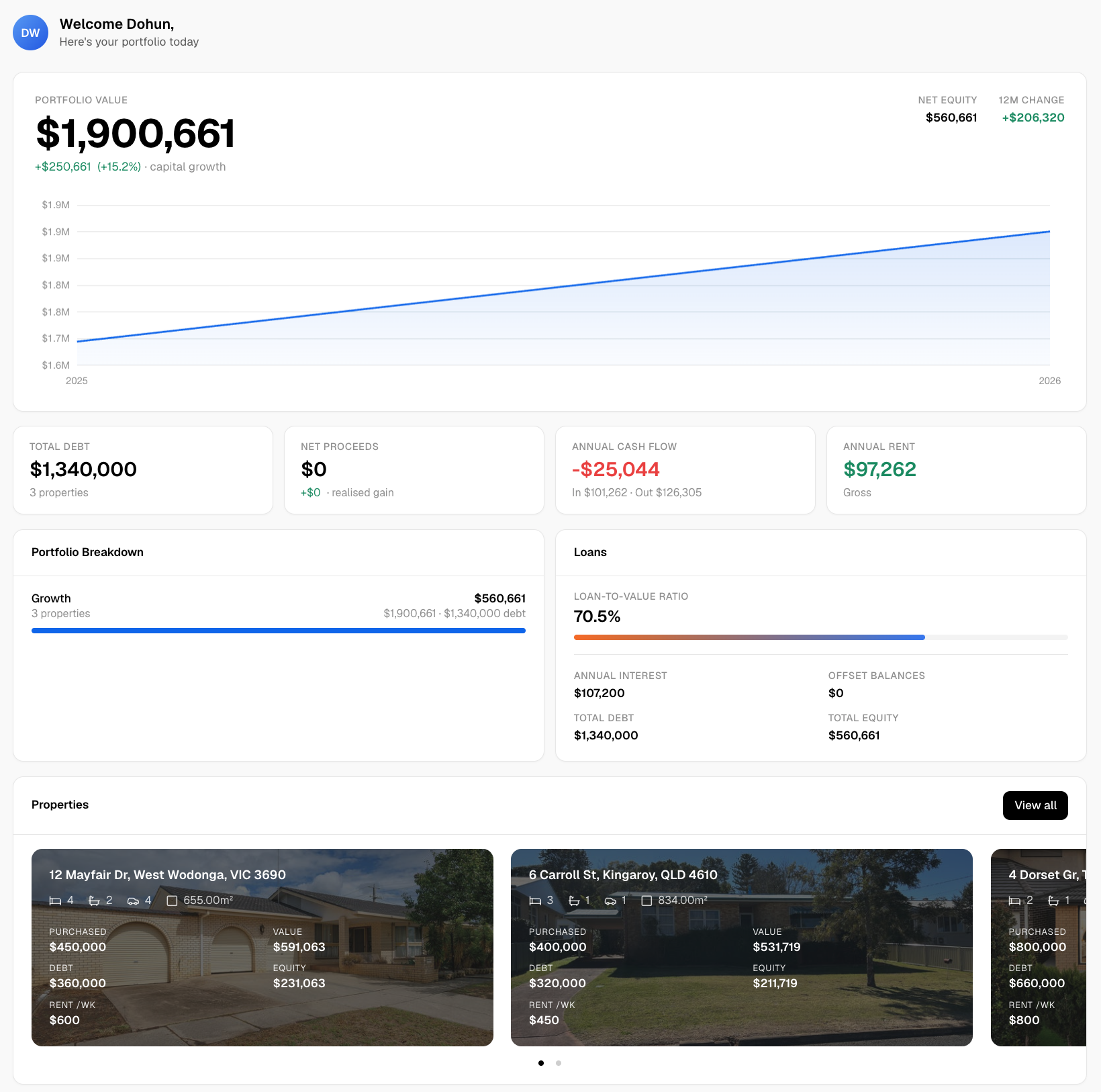
Wealthstacker is built specifically for renters and first-time investors who want to compare strategies before committing. The platform provides automated quarterly property valuations at no cost, AI-powered modelling for both rentvesting and direct ownership paths, and real-time net worth projections based on your actual borrowing capacity. You can see exactly how your wealth position changes under different scenarios before you sign anything. For anyone serious about using property to build financial security, Wealthstacker’s investment toolkit is the clearest starting point available in Australia right now.
FAQ
Does buying an investment property always beat renting financially?
Buying outperforms renting financially for time horizons beyond seven years. For shorter periods, high transaction costs of 8–13% of property value make renting the more cost-effective choice.
What is the biggest tax benefit of owning an investment property?
Depreciation is the most powerful tax benefit. It reduces your taxable rental income each year without any cash outlay, sheltering income from tax over the full life of the property.
What is rentvesting and is it a good strategy?
Rentvesting means renting where you live and buying an investment property where the numbers work. It suits markets with price-to-rent ratios above 23, where buying to live is expensive but investing elsewhere remains viable.
How does a fixed-rate mortgage protect against inflation?
A fixed-rate mortgage locks your repayment amount while rents and property values rise around it. This means your real cost of ownership falls over time while your rental income and asset value increase.
What hidden costs should first-time investors budget for?
Maintenance, council rates, and insurance average over $15,900 annually beyond the mortgage. Budgeting for these from the outset prevents cash flow surprises in the first years of ownership.