
What is a property valuation? your 2026 guide
TL;DR:
- A property valuation is a professional estimate of a property’s market value determined at a specific time. It differs from asking or sale prices and is crucial for financial decisions like lending or refinancing. Licensed valuers use inspection, comparable data, and recognized methods, ensuring accuracy that algorithms cannot replace.
A property valuation is a professional, evidence-based estimate of a property’s market value at a specific date. It is not the same as the asking price, the sale price, or the figure a free online tool generates in seconds. Market value is defined as the price a property should achieve within a 12-month period under normal market conditions. That distinction matters enormously when you are buying, selling, refinancing, or building a portfolio. A licensed valuer produces this figure using physical inspection, comparable sales data, and recognised assessment methods. No algorithm replaces that process when real money is on the line.
What is a property valuation and why does it matter?
A property valuation, also called a property appraisal, is the formal process of determining what a property is worth at a given point in time. The result is a professional opinion, not a guaranteed sale price. Licensed valuers in Australia are bound by standards set by bodies such as the Australian Property Institute (API), which means their reports carry legal and financial weight.
The difference between a valuation and a price is not academic. Banks base lending decisions on the valuation figure, not on what a buyer agreed to pay. If you offer $950,000 for a property but the bank’s valuer assesses it at $880,000, your lender will only finance against the lower figure. That gap comes out of your pocket.
Online automated valuation models (AVMs) such as those offered by CoreLogic or Domain provide useful ballpark figures for personal research. They are not substitutes for a licensed appraisal when a financial or legal decision depends on the outcome. Licensed appraisals are recommended for any financial or legal use; online estimators suit informal equity tracking only.
Who needs a property valuation and when?
Property valuations serve a wide range of purposes across different audiences. The type of valuation you need depends entirely on why you need it.
Common reasons to obtain a valuation include:
- Mortgage lending and refinancing: Lenders require a formal valuation before approving or adjusting a home loan. Understanding how mortgage refinancing works makes clear why an accurate valuation is the foundation of any refinancing decision.
- Buying or selling property: Sellers use valuations to set realistic asking prices. Buyers use them to avoid overpaying.
- Investment analysis: Investors need current market values to calculate rental yields, assess capital growth, and model portfolio performance.
- Taxation and legal matters: Capital gains tax calculations, deceased estates, family law settlements, and stamp duty assessments all require formal valuations.
- Insurance: Replacement cost valuations protect owners from being underinsured.
Pro Tip: If you are refinancing to access equity, order your valuation before approaching lenders. A higher valuation directly increases the equity you can draw on, and knowing the figure in advance lets you negotiate from a position of strength.
First-time homebuyers typically encounter valuations as part of the mortgage approval process. Real estate investors use them quarterly to track portfolio performance. Financial advisors rely on them to model net worth and borrowing capacity accurately. Each group needs a different level of detail, but all three depend on the same underlying principle: a defensible, evidence-based figure.
How do professionals determine property value?
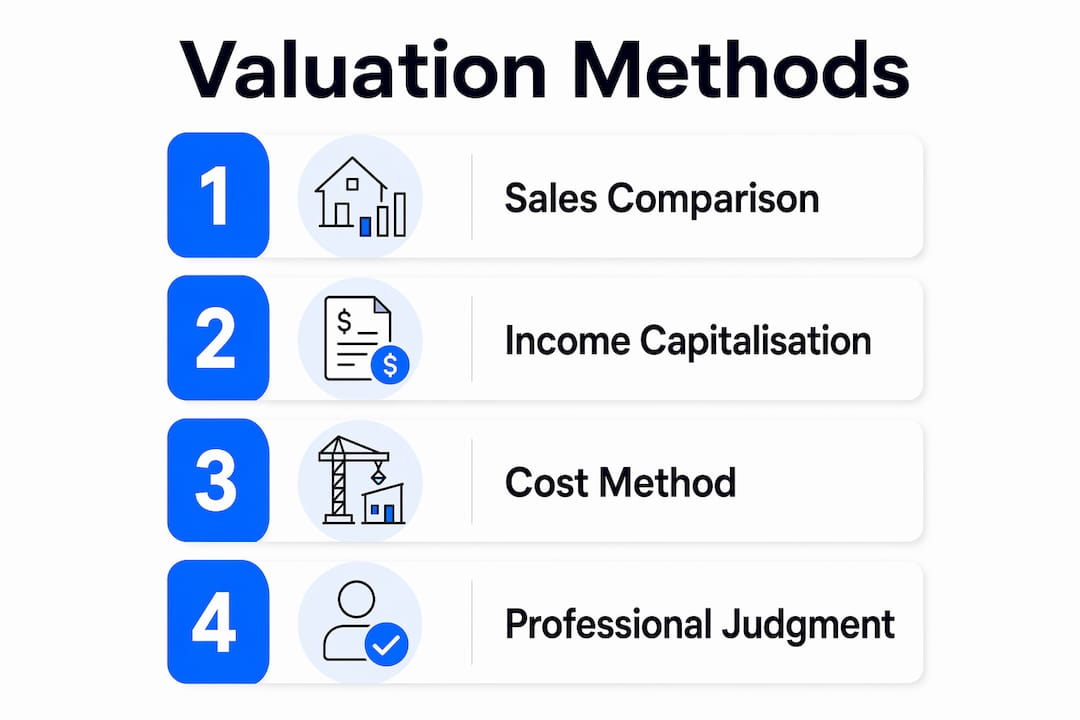
Professional valuers use three core approaches to assess a property. Valuers must apply judgement to select the right model, because no single method suits every property type or market condition.

| Approach | Best Used For | How It Works |
|---|---|---|
| Sales Comparison | Residential properties | Compares the subject property to recent sales of similar properties in the same area, adjusting for differences in size, condition, and features |
| Income Capitalisation | Investment and commercial properties | Converts the property’s income stream into a capital value using a market-derived capitalisation rate |
| Cost Method | New builds, unique properties, or where sales data is scarce | Estimates the cost to replace or reproduce the improvements, then adds land value and adjusts for depreciation |
The sales comparison approach
The sales comparison approach is the most widely used method for residential property in Australia. A valuer identifies three to five comparable sales within a defined radius and time period, then makes adjustments for differences. A property with a pool, an extra bedroom, or a north-facing aspect will be adjusted upward or downward relative to each comparable. The result is a bracketed value range, not a single precise number.
The income capitalisation approach
The income capitalisation approach suits investment properties where rental income is the primary driver of value. A valuer determines the property’s net annual income, then divides it by a capitalisation rate derived from comparable investment sales. For example, a property generating $52,000 net annual rent in a market where similar assets trade at a 5.2% cap rate would be valued at $1,000,000. This method is standard for commercial offices, retail centres, and residential investment blocks.
The cost method
The cost method is used when comparable sales are scarce or when the property has unique features that make direct comparison unreliable. A valuer estimates the current cost to construct the improvements, deducts depreciation for age and condition, and adds the assessed land value. This approach is common for heritage buildings, specialised industrial facilities, and newly constructed homes.
Pro Tip: Ask your valuer which approach they weighted most heavily and why. A valuer who cannot explain their methodology clearly is a red flag. The best reports show all three approaches and explain the reasoning behind the final reconciled figure.
A physical property inspection by a registered valuer identifies condition issues and risks that no data model can detect. Structural defects, illegal additions, and drainage problems all affect value and only become visible on site.
What affects property value and why valuations vary?
Several factors drive the outcome of any property assessment. Understanding them helps you interpret a valuation report and anticipate where your property sits in the market.
Key determinants of property value include:
- Location: Proximity to schools, transport, employment hubs, and amenity drives demand. Flood zones, flight paths, and industrial neighbours suppress it.
- Land size and configuration: Larger lots with development potential command premiums. Irregular shapes or steep gradients reduce usable area and value.
- Property condition and improvements: A well-maintained property with updated kitchens, bathrooms, and building fabric achieves higher values than a comparable property in poor condition.
- Market conditions: Rising interest rates, low stock levels, and economic confidence all shift the market. A valuation is a snapshot in time, not a permanent figure.
- Documentation: Accurate valuations depend on official documents including construction drawings, land register extracts, and insurance records. Most owners overlook these, but they reveal restrictions, easements, and encumbrances that directly affect value.
Valuations from different valuers or different methods can produce different figures. Wide valuation ranges above 5% typically signal a property with unique features, insufficient comparable sales, or a rapidly shifting market. That spread is not an error. It reflects genuine uncertainty in the data.
The gap between value and price also matters in practice. A property can sell above its assessed value in a competitive auction. That does not mean the buyer overpaid in an emotional sense, but it does mean the bank will not fund the full purchase price. Understanding this distinction protects buyers from unexpected shortfalls at settlement.
How to use a property valuation effectively
Getting a valuation is only useful if you know how to apply the result. Follow these steps to extract maximum value from the process.
-
Define the purpose before you commission the report. A clearly defined scope of work is required by professional standards. Tell your valuer whether the report is for mortgage lending, a private sale, a tax assessment, or investment analysis. The intended use shapes the methodology and the level of detail required.
-
Gather your documentation in advance. Collect your certificate of title, council rates notice, any building approvals, and recent comparable sales in your area. Handing these to your valuer upfront reduces delays and improves accuracy.
-
Triangulate across at least three methods. Triangulating three valuation methods and targeting a value range within 5% is industry best practice for reliable results. If your valuer only uses one approach, ask why.
-
Compare the valuation to recent comparable sales yourself. Use CoreLogic, the Australian Property Monitor, or your state’s land titles office to verify that the comparables your valuer selected are genuinely similar. Errors in comparable selection are the most common source of valuation disputes.
-
Revisit valuations regularly if you hold investment property. Market conditions shift. A valuation from 18 months ago may no longer reflect your borrowing capacity or your portfolio’s true net worth. Quarterly updates are the standard for active investors.
-
Know when to use a formal report versus a market analysis. A comparative market analysis (CMA) prepared by a real estate agent is useful for setting a sale price. It is not a licensed valuation and carries no weight with lenders or courts. Use the right tool for the right purpose.
When refinancing, the valuation figure directly determines how much equity you can access. Comparing a refinance versus a second mortgage requires an accurate current valuation as the starting point for any cost comparison.
Key takeaways
A property valuation is the single most important number in any real estate financial decision, and professional assessment always outweighs automated estimates when money is at stake.
| Point | Details |
|---|---|
| Valuation versus price | Banks lend against the valuation figure, not the sale price, so a gap between the two affects your finance approval. |
| Three core methods | Sales comparison, income capitalisation, and cost method each suit different property types and purposes. |
| Documentation matters | Land titles, construction plans, and insurance records directly affect valuation accuracy and should be prepared in advance. |
| Scope of work first | Define the intended use of the valuation before commissioning a report to get a result that is fit for purpose. |
| Triangulate for reliability | Results within a 5% range across three methods indicate a defensible, reliable valuation. |
Track your property’s value with Wealthstacker
Knowing your property’s value once is useful. Knowing it every quarter is a genuine investment advantage.
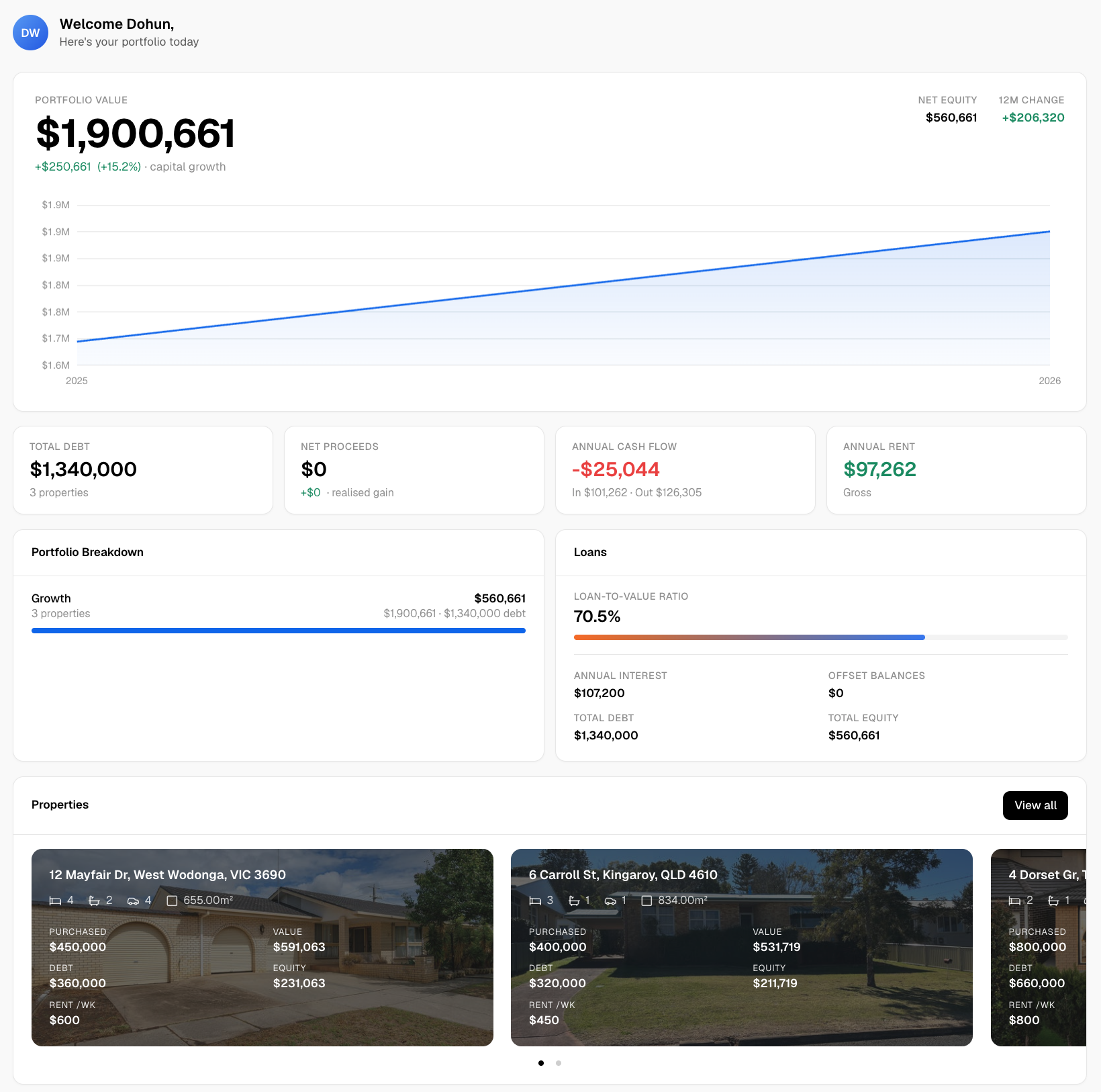
Wealthstacker provides automated quarterly property valuations at no cost, so your portfolio data stays current without the expense of repeated formal reports. The platform combines AI-driven valuation modelling with personalised wealth forecasting, letting you see how your property assets contribute to your net worth in real time. Whether you are assessing borrowing capacity, comparing a rentvesting strategy against outright ownership, or planning your next acquisition, Wealthstacker gives you the numbers you need before you need them. Explore the Wealthstacker property investment app to see how automated valuations fit into a broader investment strategy.
FAQ
What is the difference between a valuation and an appraisal?
In Australia, the terms are often used interchangeably, but a formal valuation is produced by a licensed valuer and carries legal and financial weight. A real estate agent’s appraisal is an informal market opinion used to guide sale pricing.
How long does a property valuation take?
A standard residential valuation typically takes two to five business days from inspection to report delivery. Complex or commercial properties may take longer depending on the availability of comparable data.
Can a property valuation be challenged?
Yes. If you believe a valuation contains errors in comparable selection or fails to account for recent improvements, you can request a review or commission a second independent valuation for comparison.
How often should investors update their property valuations?
Active investors should update valuations at least annually, and quarterly if they are planning to refinance, acquire additional properties, or restructure their portfolio. Market conditions shift faster than most owners realise.
Why does my bank’s valuation differ from what i paid?
Banks rely on professional valuations to manage lending risk, not on the agreed sale price. If the market moved quickly or you paid a premium at auction, the bank’s assessed value may be lower than your purchase price.