
What is a property portfolio strategy? 2026 guide
TL;DR:
- A property portfolio strategy is a systematic framework that aligns asset selection, market timing, and financing to meet your financial goals and risk profile. It replaces reactive buying with a deliberate plan that builds long-term wealth while reducing poor decision risks. Effective diversification across asset classes and local markets enhances stability, and strategic sequencing of acquisitions ensures sustainable portfolio growth.
A property portfolio strategy is a systematic framework that coordinates asset selection, market selection, acquisition timing, and finance structure to match your income, borrowing capacity, and risk tolerance. Most investors buy properties reactively, chasing headlines or hot tips. A deliberate portfolio strategy replaces that with a plan that connects every purchase to a clear financial outcome. The result is a portfolio built for long-term wealth accumulation rather than short-term excitement. Understanding this framework is the first step toward making property investment work on your terms.
What is a property portfolio strategy and why does it matter?
A property portfolio strategy is the difference between owning a collection of properties and running a coordinated investment business. Without one, each purchase sits in isolation. With one, every acquisition feeds into a broader plan that balances cash flow and capital growth according to your stage of wealth building.
The strategy matters because property is inherently illiquid. Unlike shares, you cannot sell half a house when you need cash. Real estate functions independently of stock market cycles and serves as a volatility hedge, but transaction delays and costs make poor decisions expensive to reverse. A clear strategy reduces the number of poor decisions you make.
Australian investors also face specific constraints. Borrowing capacity, land tax thresholds, and serviceability buffers set by the Australian Prudential Regulation Authority all shape what you can buy and when. A property investment strategy accounts for these constraints from the start, rather than discovering them after you have already committed to a purchase.
A property investment plan sits underneath the portfolio strategy. The plan documents your goals, timelines, and financial position. The strategy is the method you use to execute that plan across multiple assets and market cycles.
What are the key components of a property portfolio strategy?
Four building blocks form the foundation of any property portfolio strategy. Each one affects the others, and ignoring any one of them creates gaps that compound over time.
- Asset selection: The type of property you buy determines its role in the portfolio. Residential property delivers reliable tenancy demand. Commercial assets offer longer leases and higher yields. Industrial property provides low-maintenance income. Each asset type carries different vacancy risk, capital requirements, and growth profiles.
- Geographic market selection: National property headlines are almost useless for investment decisions. Successful investors focus on granular supply, demand, and sales data at the suburb or region level. A market with strong employment growth, low vacancy rates, and limited new supply is a better target than a capital city riding a media cycle.
- Acquisition timing: Buying at the wrong point in a market cycle locks in poor entry prices and reduces your equity buffer. Timing does not mean predicting the market. It means identifying suburbs where fundamentals are strengthening before prices fully reflect that shift.
- Finance structuring: Loan-to-value ratios, interest rate buffers, and cross-collateralisation decisions all affect your ability to buy the next property. Poor finance structuring is the most common reason investors stall after their second or third purchase.
These four elements interact directly. A strong asset in a weak market underperforms. A well-timed purchase with poor finance structuring creates cash flow stress. Your borrowing capacity shapes which markets and asset types are even available to you.
Pro Tip: Review your finance structure after every acquisition, not just before. Lenders assess serviceability differently as your portfolio grows, and what worked for property two may block property four.

How does diversification reduce risk in a property portfolio?
Diversification is the practice of spreading capital across asset types, markets, and strategies so that a downturn in one area does not collapse the whole portfolio. Professional portfolio management applies risk allocation by diversifying across 3 to 5 asset classes and geographic markets to reduce correlation risk and enhance stability. That principle applies equally to individual investors.
Correlation risk is the key concept here. If all your properties are residential houses in the same city, they will all respond to the same economic pressures at the same time. A rate rise, a local employer closing, or an oversupply of new builds hits every asset simultaneously. Spreading across asset classes and regions breaks that correlation.
| Diversification dimension | Low diversification risk | High diversification risk |
|---|---|---|
| Asset class | Mix of residential, commercial, industrial | All residential houses |
| Geography | Multiple states or regions | Single suburb or city |
| Strategy | Buy-and-hold plus specialised rental | Single strategy only |
| Tenant profile | Mix of individual and business tenants | Identical tenant type across all |
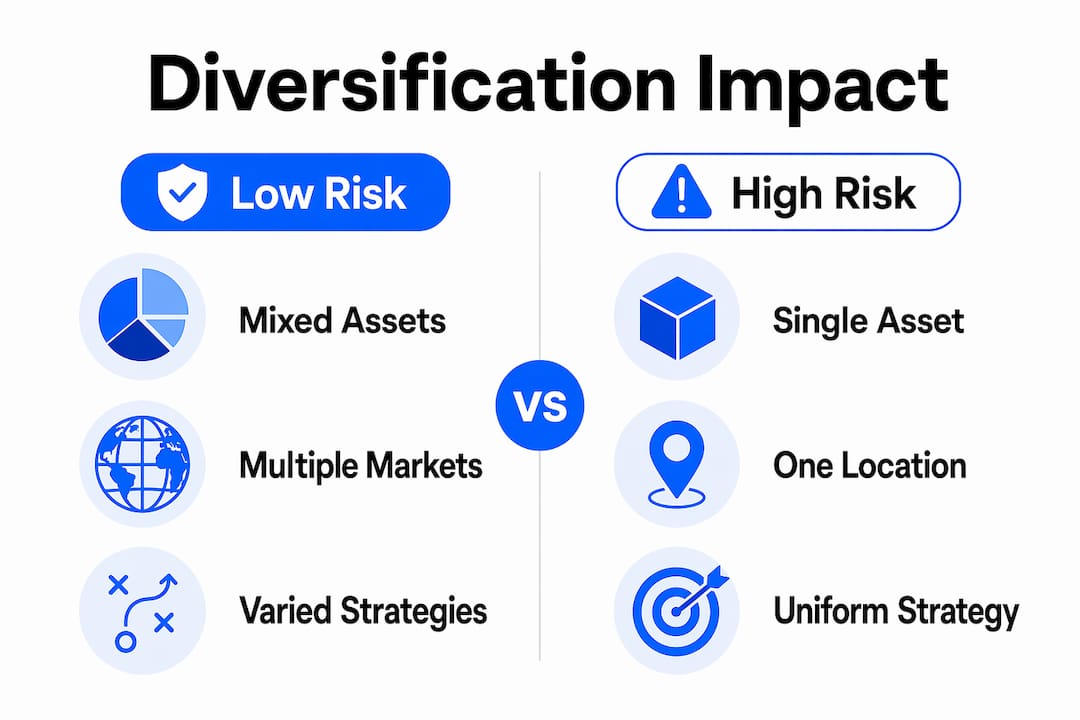
A mix of investment strategies also reduces risk. Buy-and-hold properties provide stable equity growth. Specialised rental niches such as mid-term furnished rentals or build-to-rent assets generate higher cash flow. Combining both means your portfolio earns income while it grows.
Pro Tip: Diversifying property investments does not mean buying anything in multiple places. Each asset still needs to meet your acquisition criteria. Diversification is about spreading quality, not spreading risk by buying lower-quality assets in more locations.
What are the common property portfolio strategies?
Three dominant approaches shape how Australian investors build portfolios. Each has distinct trade-offs in workload, capital, and return profile.
-
Long-term buy-and-hold. This is the most widely used approach. You buy quality assets in strong markets and hold them for 10 years or more, allowing equity to compound through capital growth. The operational workload is low. The main risk is choosing assets that grow slowly or not at all, which ties up capital without reward. This strategy suits investors who prioritise stability and have reliable income to service loans during flat market periods.
-
BRRRR (Buy, Rehab, Rent, Refinance, Repeat). This approach accelerates portfolio growth by recycling equity. You buy an undervalued property, renovate it to increase its value, rent it out, refinance against the new valuation, and use the released equity to fund the next purchase. The operational workload is high. You need reliable tradespeople, accurate renovation budgets, and lenders willing to refinance at improved valuations. BRRRR suits investors with time, project management skills, and access to short-term capital.
-
Specialised rental niches. Mid-term rentals, co-living arrangements, and build-to-rent assets generate higher cash flow than standard residential leases. Higher income improves serviceability, which helps with borrowing for subsequent purchases. The trade-off is management complexity. These strategies require active oversight, specific property configurations, and tenant management that standard property managers may not handle well.
Choosing between these approaches depends on your personal goals, available time, and financial capacity. A range of investment strategy types exists beyond these three, but most individual portfolios are built on one primary approach with elements of the others layered in as the portfolio matures.
How do you sequence acquisitions for sustainable portfolio growth?
Sequencing is the most underrated skill in real estate portfolio planning. Most investors focus on finding the right property. Experienced investors focus on buying properties in the right order.
Successful portfolio building relies on sequencing acquisitions so that cash flow, equity growth, and tax profiles enable subsequent purchases. Miss the funding plan and you stall. The first property needs to support the conditions that make the second property possible, and so on.
Practical sequencing principles include:
- Deploy capital in phases. Phased capital deployment over 12–24 months reduces the risk of buying multiple assets at a valuation peak. Spreading purchases across time also reduces cash drag from capital sitting idle.
- Define your acquisition criteria before you search. Strategy-first means setting your criteria and funding plan before evaluating any property. This prevents you from bending your rules for a property you have fallen in love with.
- Stress-test your finance assumptions. Stress-testing mortgage payments and calculating true operating costs, including vacancy and maintenance, prevents forced sales. Model your portfolio at interest rates 2–3 percentage points above current rates to see whether you can still hold every asset.
- Account for true holding costs. Vacancy periods, maintenance, property management fees, insurance, and rates all reduce net income. Ignoring these costs is a frequent cause of portfolio failures, particularly when interest rates rise.
- Maintain a cash buffer. A minimum of three to six months of holding costs in accessible savings protects you from forced sales during market downturns or unexpected vacancies.
Pro Tip: Build your portfolio acquisition sequence on a spreadsheet before you buy anything. Map out the equity, cash flow, and borrowing capacity position after each purchase. If the numbers do not work on paper, they will not work in practice.
What role does local market analysis play in portfolio strategy?
Real estate is a hyper-local asset class. A suburb two kilometres from a high-growth area can deliver flat returns for a decade. National property market data tells you almost nothing useful about what will happen in the specific street where you are considering a purchase.
Top investors ignore national market headlines and focus on hyper-local supply, demand, and sales activity. The metrics that matter at the local level include:
- Days on market: Falling days on market signals rising buyer competition and strengthening prices.
- Vacancy rates: Rental vacancy below 2% in a suburb indicates strong tenant demand and supports rent growth.
- New supply pipeline: A large volume of approved developments signals future oversupply, which suppresses both rents and capital growth.
- Infrastructure investment: Confirmed government spending on transport, hospitals, or schools drives long-term demand in surrounding suburbs.
- Employment base: Suburbs with diverse local employment are more resilient than those dependent on a single industry or employer.
Portfolio balance requires selecting the right assets timed to market cycles. Buying into a suburb at the peak of a media-driven frenzy, rather than when fundamentals are quietly strengthening, reduces your margin of safety and your long-term return. Use investment property forecasting methods to assess local market trajectories before committing capital.
Ongoing monitoring matters as much as the initial analysis. Markets shift. A suburb that looked strong in january may face new supply approvals by july. Review your market assumptions at least twice a year and adjust your acquisition targets accordingly.
Wealthstacker and your property portfolio strategy
Building a property portfolio strategy on paper is one thing. Tracking it across multiple assets, markets, and finance structures is another challenge entirely.
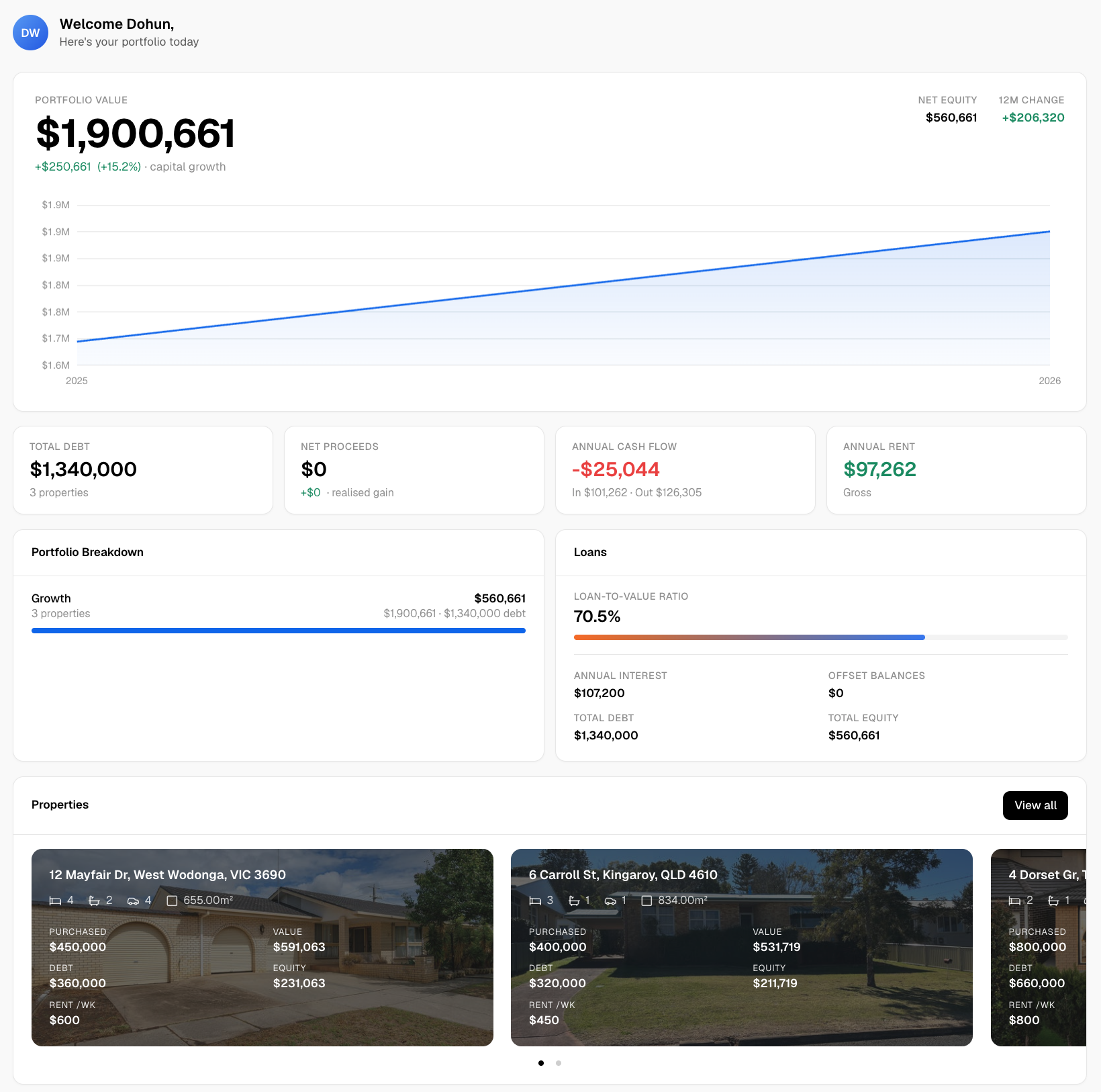
Wealthstacker is a property investment app and portfolio tracker built for Australian investors who want clarity on where their portfolio stands and where it is headed. The platform provides automated quarterly valuations at no cost, so your portfolio data stays current without manual effort. Wealthstacker’s AI tools model both rentvesting and buying strategies, letting you assess your net worth position in real time and test different acquisition sequences before committing capital. For investors building their first or fifth property, tracking your portfolio with Wealthstacker replaces guesswork with data. You can assess borrowing capacity, model future acquisitions, and keep your strategy on track as markets and your financial position evolve.
Key takeaways
A property portfolio strategy is a coordinated framework that connects asset selection, market analysis, acquisition sequencing, and finance structuring to build long-term wealth through property.
| Point | Details |
|---|---|
| Define strategy before buying | Set acquisition criteria and a funding plan before evaluating any property opportunity. |
| Diversify across multiple dimensions | Spread capital across asset classes, geographic markets, and rental strategies to reduce correlation risk. |
| Sequence acquisitions deliberately | Each purchase should strengthen the cash flow and equity position that enables the next one. |
| Stress-test your finance assumptions | Model holding costs and mortgage payments at higher interest rates to avoid forced sales. |
| Use local data, not national headlines | Focus on suburb-level vacancy rates, days on market, and supply pipelines for accurate timing decisions. |
FAQ
What is a property portfolio strategy in simple terms?
A property portfolio strategy is a structured plan that guides which properties you buy, where, when, and how you finance them. It connects each acquisition to your personal financial goals and risk tolerance.
How many properties do I need for a portfolio strategy?
A portfolio strategy applies from your first investment property. The strategy defines how your first purchase sets up the conditions for your second, and so on through each stage of growth.
What is the BRRRR strategy in property investing?
BRRRR stands for Buy, Rehab, Rent, Refinance, Repeat. It is an approach that recycles equity from renovated properties to fund subsequent purchases, accelerating portfolio growth compared to standard buy-and-hold.
How does diversification help a property portfolio?
Diversifying property investments across asset classes and geographic markets reduces correlation risk. A downturn in one market or asset type does not drag down the entire portfolio when assets are spread across different locations and property types.
How do I start building a property portfolio strategy?
Start by documenting your income, borrowing capacity, and risk tolerance. Then define your acquisition criteria, target markets, and preferred investment approach before evaluating any specific property.