
What is a limited recourse borrowing arrangement for an SMSF?
A limited recourse borrowing arrangement (LRBA) is a loan structure where your SMSF borrows to buy a single asset held in a separate holding trust, and if the fund defaults, the lender can only claim that asset, not the rest of your super. Three things matter immediately: the legal basis sits in sections 67A and 67B of the Superannuation Industry (Supervision) Act 1993 (SISA); property and shares are the most common LRBA assets; and the lender’s recourse is capped at the LRBA asset itself. There’s a fourth thing you can’t ignore: from 10 August 2026, the ATO restricts LRBAs for real property to business real property only, with contracts already exchanged before that date grandfathered under the old rules.
Key Takeaways
An LRBA works because it lets an SMSF borrow against a single asset while legally shielding the rest of the fund from lender recourse, provided the holding trust, documentation, and repayment flows stay compliant.
| Point | Details |
|---|---|
| Core legal structure | Lender recourse is limited to the single asset held in a separate holding trust under SISA ss.67A and 67B. |
| 2026 property change | From 10 August 2026, new LRBAs for real property apply only to business real property; earlier contracts are exempt. |
| Repairs versus improvements | Borrowed funds can cover repairs and maintenance but never improvements while the loan is active. |
| Related-party rates | Safe-harbour rates for 2026 sit at 8.85% for residential and 9.35% for commercial related-party loans. |
| Biggest audit trigger | Paying loan repayments from a personal account instead of the SMSF’s own account draws immediate scrutiny. |
Table of Contents
- How does a limited recourse borrowing arrangement actually work?
- What legal requirements make an LRBA compliant?
- Which assets can an LRBA actually buy?
- What are the benefits and risks of a limited recourse borrowing arrangement?
- Who lends for LRBAs and what terms should you expect?
- What should trustees check before entering an LRBA?
- What happens legally when the LRBA loan is paid off?
- What compliance mistakes trigger ATO scrutiny on LRBAs?
- How can trustees model LRBA scenarios before committing?
- Where can trustees read the primary LRBA rules?
- Frequently asked questions about limited recourse borrowing arrangements
- Sources
How does a limited recourse borrowing arrangement actually work?
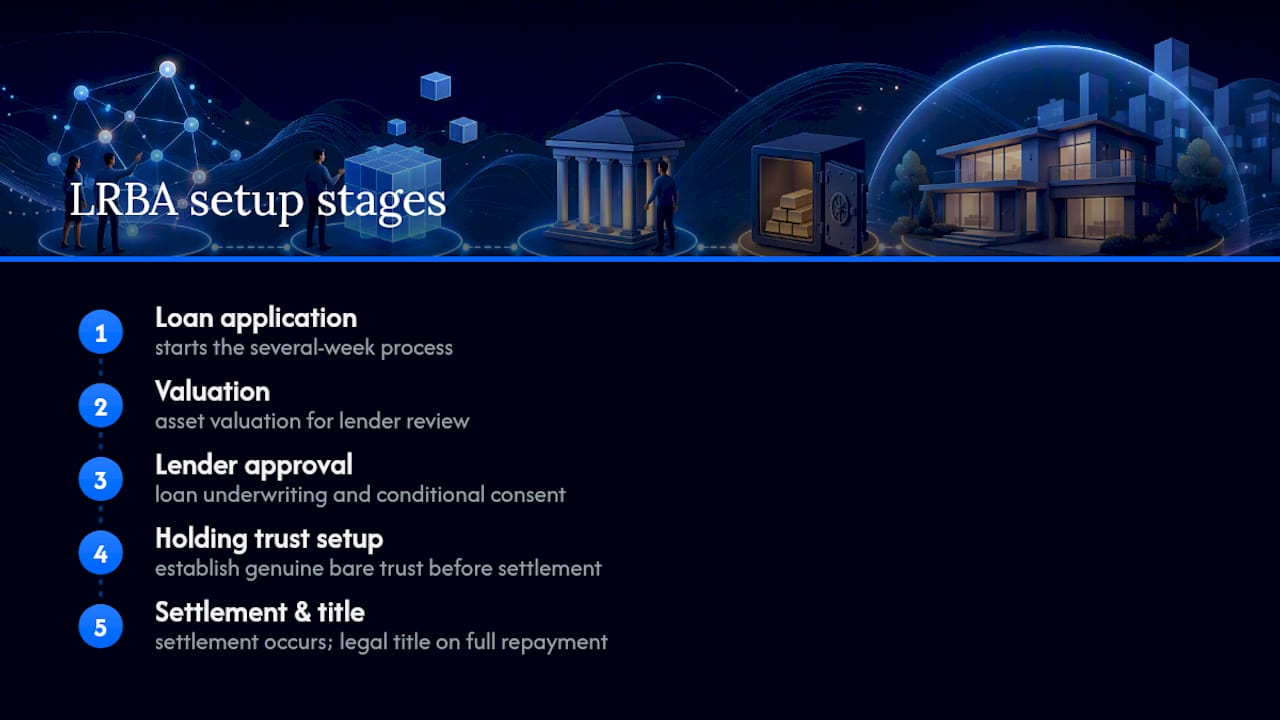
The mechanics follow a fixed sequence, and skipping a step is where trustees get into trouble.
- Loan approval. A lender, often a bank or specialist SMSF lender, assesses the fund’s cash flow and approves finance for one specific asset.
- Holding trust purchase. A separate holding (bare) trust, distinct from your SMSF’s own trust deed and assets, takes legal title to the asset.
- Beneficial interest. Your SMSF holds beneficial interest in the asset from settlement, even though the holding trust is the legal owner on paper.
- Repayments. Every loan repayment and asset expense must flow from the SMSF’s own bank account, never a personal or business account.
- Legal title transfer. Once the loan is fully repaid, legal title moves from the holding trust to the SMSF.
The holding trust exists purely to insulate the rest of the fund from the loan. Lenders typically build in milestones, valuation, formal loan approval, then settlement, followed by ongoing servicing checks. That separation between legal and beneficial ownership is the entire point of the structure.
What legal requirements make an LRBA compliant?
Compliance hinges on a handful of statutory tests, and missing even one can unwind the whole arrangement.
- The loan must fund a single acquirable asset (or a permitted collection of identical assets, like a parcel of shares in one company).
- That asset sits in a separate trust, held on behalf of the SMSF.
- The SMSF holds beneficial interest in the asset throughout the arrangement.
- The lender’s recourse is limited to the asset itself, with no other charge over any other fund asset.
- Replacing the asset is tightly restricted under section 67B, and only in narrow circumstances.
SMSFR 2012/1 is the ruling that unpacks what counts as a “single acquirable asset,” when a replacement asset is still treated as the same asset, and how the ATO distinguishes repairs from improvements. Beyond the statute, your trust deed must actually authorise borrowing, your investment strategy needs to reflect the LRBA, and you need an independent valuation plus a paper trail showing the trustees resolved to enter the arrangement. Recordkeeping isn’t optional here. It’s the evidence an auditor will ask for first.
Which assets can an LRBA actually buy?
A “single acquirable asset” means one asset, or a collection of identical assets like shares in the same company, that the fund treats as one unit for LRBA purposes. Assets with separable titles, like a block of land with multiple lots, generally don’t qualify as a single asset.
- Borrowed funds can pay for the purchase, repairs and maintenance.
- Borrowed funds cannot pay for improvements that change the asset’s character while the loan is still running.
- From 10 August 2026, the ATO limits LRBAs used to buy real property to business real property only. Residential property purchases under new LRBAs fall outside this rule after that date.
- Contracts exchanged before 10 August 2026 keep operating under the previous rules.
What are the benefits and risks of a limited recourse borrowing arrangement?
The upside is leverage. An LRBA lets your fund acquire an asset it couldn’t otherwise afford outright, while the lender’s recourse stops at that one asset, protecting the rest of the fund’s balance if things go wrong. Industry commentary points to property remaining a common LRBA asset precisely because gearing amplifies long-term returns when the numbers work.
The risks sit on the other side of the same ledger:
- Concentration risk. One large asset can dominate the fund’s balance, leaving little room for diversification.
- Cash flow strain. Loan repayments must come from the SMSF account, so a vacancy or rate rise hits the fund directly.
- Audit risk. LRBAs draw close ATO scrutiny, and errors around repairs versus improvements are a frequent trigger.
- Related-party loan scrutiny. Loans from members or associates face extra terms.
Pro Tip: Model at least six months of zero rental income before you sign anything. If the fund can’t cover repayments and expenses through that stretch, the LRBA is too tight for comfort.
Who lends for LRBAs and what terms should you expect?
Major banks have largely retreated from SMSF lending, leaving specialist SMSF lenders as the main source of finance, and their criteria are stricter than a standard investment loan. Expect lower loan-to-value ratios, higher documentation demands, and closer scrutiny of the fund’s liquidity.
Related-party loans carry their own rules. Terms must be arm’s length, and the ATO’s safe-harbour rates for 2026 sit at 8.85% for residential property and 9.35% for commercial. Deviate from these without justification and you’re inviting a review.
A related-party loan priced below market and unsecured beyond the LRBA asset is one of the clearest signals the ATO looks for during an SMSF audit.
Before signing, query any personal guarantees, cross-security over other fund assets, or encumbrances that extend beyond the single acquirable asset. Those clauses defeat the whole purpose of limited recourse.
- Confirm no personal guarantee is attached to the loan.
- Check the loan doesn’t cross-secure against other fund assets.
- Verify the interest rate matches or exceeds the safe-harbour benchmark for related-party loans.
What should trustees check before entering an LRBA?
A short governance pass before signing catches most problems early.
- Confirm the trust deed explicitly permits borrowing.
- Commission an independent market valuation of the asset.
- Get loan approval conditional on the fund’s actual financial documents.
- Update the investment strategy to reflect the new asset and its risk profile.
- Run cash flow modelling that includes a downside scenario.
Gather these documents before settlement: the trust deed clauses authorising borrowing, the loan contract, the holding trust deed, the valuation report, and trustee meeting minutes recording the resolution. Lenders typically issue conditional approval first, then move to settlement, with legal title transferring only once the loan is fully repaid.
What happens legally when the LRBA loan is paid off?
Once the final repayment clears, legal title moves from the holding trust to the SMSF, and the fund becomes both legal and beneficial owner.
- Check state-specific stamp duty implications on the transfer.
- Update the fund’s asset register and notify your SMSF auditor.
- Confirm the asset is free of any remaining charge.
- Improvements that were off-limits during the LRBA become permitted once the fund owns the asset outright.
What compliance mistakes trigger ATO scrutiny on LRBAs?
The ATO treats LRBAs as high risk, and most breaches trace back to a handful of avoidable errors.
- Paying loan instalments or expenses from a personal account instead of the SMSF’s own account.
- Treating the holding trust as anything other than a bare custodian.
- Using borrowed funds for improvements rather than repairs while the loan is still active.
- Weak recordkeeping, missing minutes, or no independent valuation on file.
Pro Tip: Keep a dedicated folder, physical or digital, with every LRBA document from day one: valuation, loan contract, trust deed, and minutes. Auditors ask for this bundle, and scrambling to assemble it after the fact is a red flag in itself.
Related-party terms and in-house asset rules get particular attention, so document why the arrangement satisfies both before you sign.
How can trustees model LRBA scenarios before committing?
Before you commit fund capital to an LRBA, run the numbers under a few different conditions, not just the best-case one.
- Loan size and interest rate, including the safe-harbour rate if it’s a related-party loan.
- Expected rental income against a realistic vacancy allowance.
- Ongoing maintenance budget, separate from any improvement spend.
- Member contribution scenarios that could top up cash flow during a shortfall.
Pro Tip: Stress-test the fund against 6 to 12 months of zero rental income before deciding. If repayments and expenses can’t be covered through that gap without breaching the fund’s minimum reserve, the arrangement needs restructuring or a smaller loan.
Wealthstacker’s automated quarterly valuations and 15-year modelling tools let you run these borrowing power and cash flow scenarios against real market data, rather than guesswork, before you approach a lender.
Where can trustees read the primary LRBA rules?
Go straight to the primary sources before acting on any LRBA decision.
- ATO: rules for entering an LRBA for the statutory basis.
- ATO: changes to LRBAs for the 10 August 2026 property restriction and safe-harbour rates.
- SMSFR 2012/1 for the ruling defining single acquirable assets and replacement rules.
- MLC’s LRBA guide and BT Professional’s LRBA guidance for practitioner examples of setup and common pitfalls.
Frequently asked questions about limited recourse borrowing arrangements
What is a limited recourse borrowing arrangement in plain terms? It’s a loan your SMSF takes out to buy one asset, where the lender can only seize that asset if the fund defaults, not the rest of the super balance.
Is recourse borrowing the same as a normal investment loan? No. Recourse borrowing explained simply: a standard loan lets a lender chase all your assets on default, while an LRBA restricts that recourse to the single acquirable asset held in the holding trust.
Can an SMSF use an LRBA to buy a house to live in? No. LRBA-purchased property must be an investment held for the fund’s retirement purpose, and from 10 August 2026, new real property LRBAs are limited to business real property.
What happens if the holding trust isn’t set up as a genuine bare trust? The arrangement can be invalidated, which risks the fund’s compliant status and can trigger significant tax and regulatory consequences.
How long does an LRBA usually take to set up? Expect several weeks from loan application to settlement, covering valuation, lender approval, and holding trust establishment, with legal title only transferring once the loan is fully repaid.
This article is general information, not a substitute for advice from a qualified financial advisor. Consult a qualified financial professional about your own circumstances before acting on anything here.
Sources
- About LRBAs
- Changes to limited recourse borrowing arrangements
- SMSFR 2012/1 (ATO ruling) — LRBA concepts
- Guide to LRBAs (MLC adviser guide)
- BT Professional — SMSF limited recourse borrowing arrangement rules