
What does rental appraisal mean for investors?
TL;DR:
- A rental appraisal is a professional estimate of a property’s achievable market rent, used for investment and lending decisions. It directly influences loan eligibility, income modelling, and deal evaluation by providing realistic rent figures based on recent lease data. Investors can improve appraisal outcomes by preparing comparable rental data and timing appraisals during strong market conditions.
A rental appraisal is a professional estimate of the market rent a property can achieve, used by investors and lenders to assess income potential and financing feasibility. Unlike the rental income you report on a tax return, which reflects amounts actually received, a rental appraisal estimates what the property should earn based on current market conditions. For investors, understanding what does rental appraisal mean goes beyond a simple number. It shapes deal screening, loan qualification, and long-term portfolio strategy. Standard appraisal forms like Form 1007 and Form 1025 are the industry tools lenders use to document these estimates for single-family and small multi-unit properties respectively.
How does rental appraisal affect property investment decisions?
A rental appraisal is the foundation of realistic income modelling for any investment property. Investors who rely on their own rent estimates, or on asking rents from listing sites, frequently overstate what a property will earn. A professional appraisal corrects that by anchoring assumptions to closed lease transactions in the same market.

Screening deals without appraisal data creates blind spots. Metrics like the Gross Rent Multiplier are useful for quick comparisons, but they are insufficient without appraisal validation. A GRM calculation built on inflated rent assumptions will make a mediocre deal look attractive.
Here is where rental appraisals directly influence investment analysis:
- Deal screening: Appraisal rent sets a realistic income ceiling before you commit to due diligence costs.
- Cash flow modelling: Accurate rent figures feed into net operating income calculations, which drive yield and return projections.
- Financing eligibility: Lenders use appraised rent, not your projections, to determine how much they will lend.
- Negotiation leverage: A low appraisal rent on a vendor’s asking price can justify a lower purchase offer.
Pro Tip: Never build your investment model on asking rents from online listings. Appraisers use closed leases, and lenders follow the appraiser. Build your model the same way.
The gap between perceived achievable rent and appraiser-supported rent can be significant, particularly in markets where vacancy is low and landlords are quoting optimistic figures. Grounding your analysis in appraisal data protects you from overpaying and over-borrowing.
What role does rental appraisal play in loan underwriting for investors?
Rental appraisal is decisive in how lenders assess investor loans, particularly Debt Service Coverage Ratio (DSCR) loans. A DSCR loan qualifies the property on its rental income rather than the borrower’s personal income. That makes the appraised market rent the single most important number in the deal.
The mechanics work like this:
- Leased property: The lender takes the lower of the actual lease rent or the appraiser’s market rent estimate. If your tenant pays $2,200 per month but the appraiser estimates market rent at $1,950, the lender uses $1,950.
- Vacant property: The lender relies entirely on the appraiser’s market rent estimate. There is no lease to fall back on.
- DSCR calculation: The lender divides the monthly rental income by the monthly debt obligation. A ratio below the lender’s threshold, commonly 1.0 or higher, can result in loan denial.
- Property condition: DSCR loans require properties to be in good condition. Properties needing structural repairs often fail to qualify, regardless of the rent estimate.
- Appraisal discrepancies: When the appraised rent comes in lower than expected, it can reduce the loan amount offered or trigger a full loan rejection.
Understanding your borrowing capacity before you apply means knowing what rent figure the appraiser is likely to assign, not what you hope to achieve.
Pro Tip: Before the appraiser visits, prepare a rental comp package. Gather three to five recently closed lease agreements for comparable properties in the same suburb. Present these to the appraiser or your broker. This reduces the risk of a low rent estimate on a vacant property.
Appraisers select comparable rentals, adjust for differences in size, condition, bedrooms, bathrooms, and amenities, and then estimate market rent based on those closed leases, not asking rents. Investors who understand this process can prepare better evidence and reduce the chance of an unfavourable outcome.
How does rental appraisal differ from property valuation?
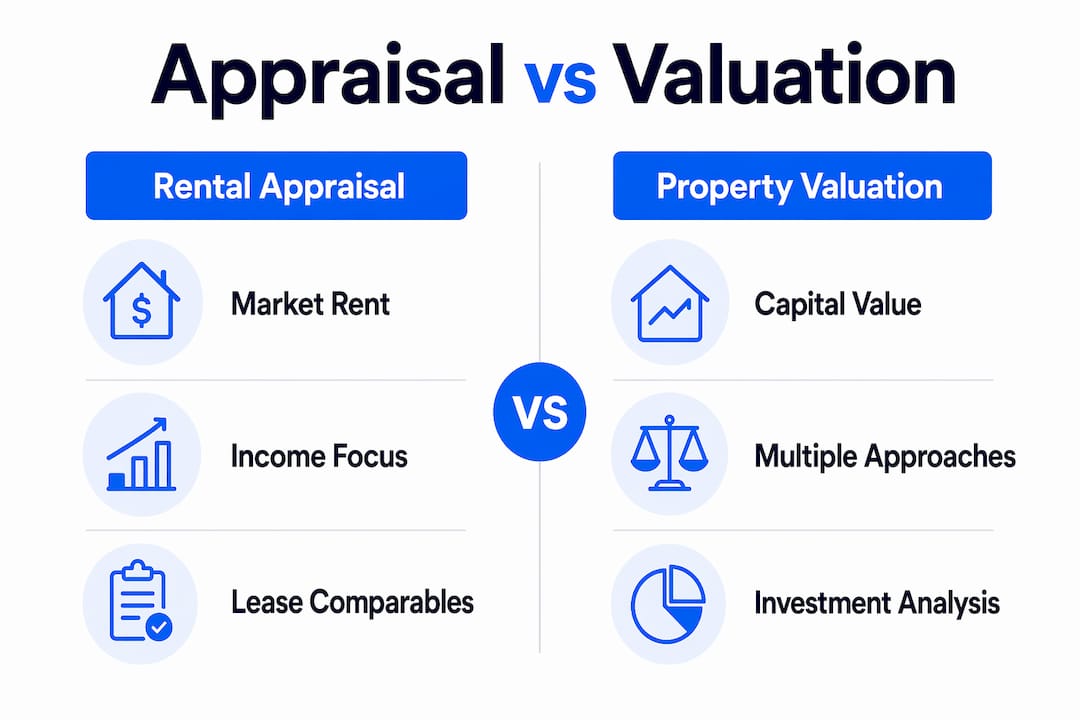
Rental appraisal and property valuation are related but distinct. A rental appraisal answers one question: what rent can this property achieve? A full property valuation answers a broader question: what is this property worth?
Property valuers use three standard approaches to determine value: the Income Approach, the Sales Comparison Approach, and the Cost Approach. For investment properties, the Income Approach is the most relevant. It converts net operating income into a value estimate using a capitalisation rate. Rental appraisal feeds directly into this calculation because the income figure starts with market rent.
| Concept | Rental appraisal | Full property valuation |
|---|---|---|
| Primary question | What rent can this property achieve? | What is this property worth? |
| Output | Market rent estimate (weekly or monthly) | Capital value in dollars |
| Methods used | Rental comparables, lease adjustments | Income, sales comparison, cost approaches |
| Used by | Lenders, investors, property managers | Lenders, buyers, sellers, courts |
| Frequency | At loan application or lease renewal | At purchase, refinance, or dispute |
Rental appraisal is a component of full valuation, not a substitute for it. An investor who only has a rental appraisal knows the income potential but not the capital value. An investor who only has a sales valuation knows what the property is worth today but not whether the rent stacks up. You need both to make a fully informed investment decision.
The income approach relies on more than headline rents. Net operating income and capitalisation frameworks convert rental income into a value estimate that accounts for vacancy, expenses, and market yield expectations. This is why a rental appraisal that overstates achievable rent does not just affect cash flow projections. It distorts the entire valuation.
What practical strategies help investors get better rental appraisals?
Getting the best possible rental appraisal outcome is not about gaming the system. It is about presenting accurate, well-organised evidence so the appraiser can make a well-supported estimate.
- Gather comparable rental data yourself. Find three to five recently closed leases for similar properties within one to two kilometres. Focus on properties with similar bedrooms, bathrooms, size, and condition. Present this to your broker before the appraisal is ordered.
- Understand how appraisers adjust. Appraisers do not just find a comparable and call it done. They adjust for differences in size, condition, and amenities. A property with a garage, air conditioning, or a renovated kitchen will receive upward adjustments relative to a comparable without those features.
- Time the appraisal with market conditions. Rental markets move seasonally. An appraisal ordered in a low-demand period may reflect softer rents. Where possible, align the appraisal with periods of stronger rental activity.
- Keep lease terms current. If your property is already tenanted, make sure the lease reflects market rent. A below-market lease can drag down the appraised rent figure, particularly if the lender uses the lower of lease rent or appraised rent.
- Treat short-term rentals differently. Short-term rental appraisals require stabilised income assumptions and normalised expense categories. Seasonality and variable occupancy make STR income harder to appraise than long-term rental income. Lenders apply more conservative assumptions to STR properties.
Tracking rental yield across your portfolio gives you a baseline to compare against appraisal estimates. If your appraised rent is consistently below your actual achieved rent, that is worth investigating before your next refinance or acquisition.
Understanding the difference between rental yield and capital growth also matters here. A strong rental appraisal supports yield-focused strategies, while capital growth relies more on the sales comparison approach in a full valuation.
Wealthstacker helps investors stay ahead of appraisal cycles
Rental appraisals only tell you what a property is worth at a single point in time. Markets move, rents shift, and your portfolio’s income assumptions can drift out of alignment without you noticing.
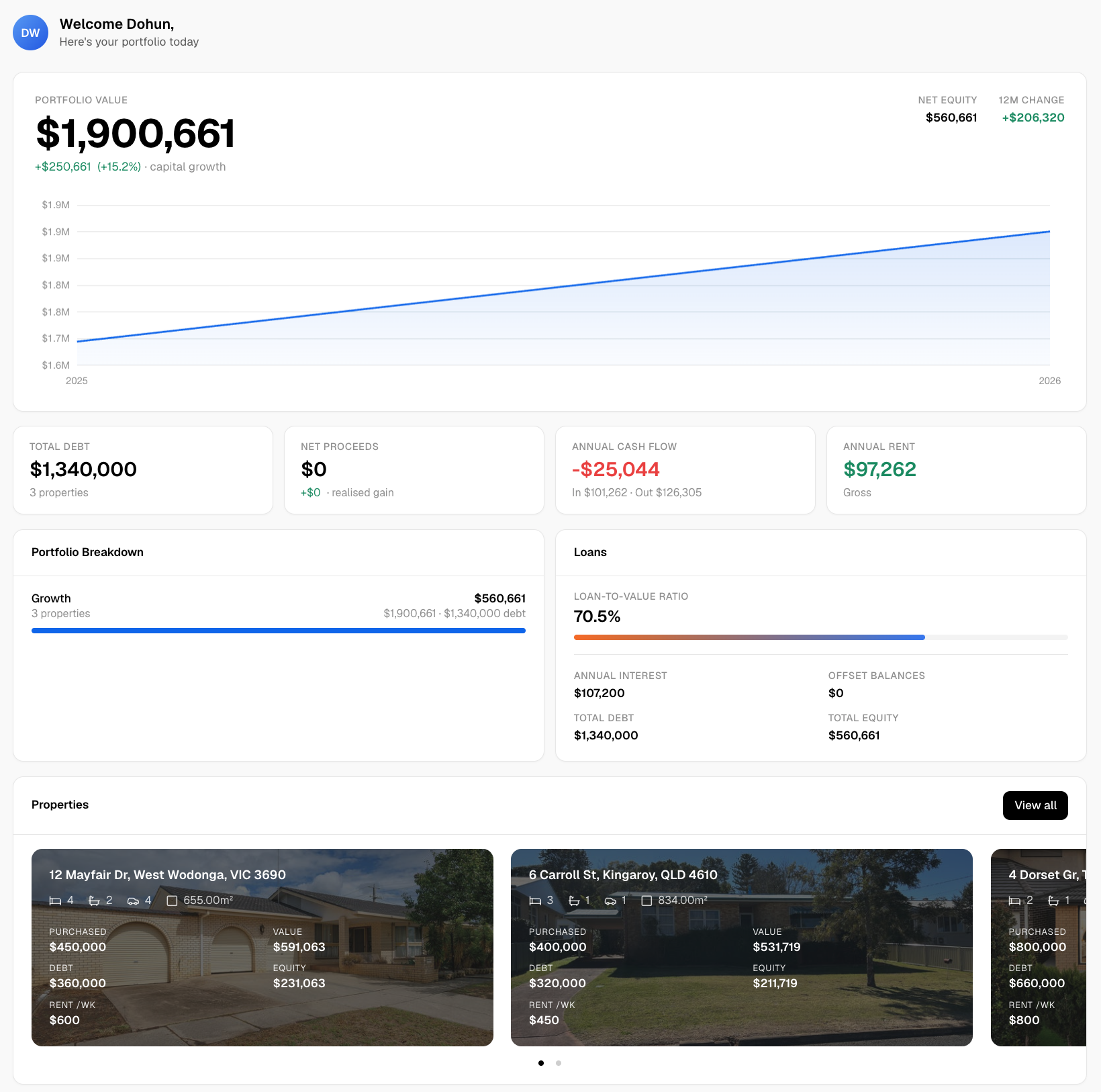
Wealthstacker gives investors automated quarterly valuations at no cost, so your property data stays current between formal appraisal cycles. The platform’s AI tools model both rentvesting and direct ownership strategies, letting you test income assumptions against real market conditions before you apply for finance. For investors who want to align their portfolio performance with appraisal-grade data, Wealthstacker provides the tracking and modelling tools to do exactly that. Visit Wealthstacker to see how your current portfolio stacks up.
Key takeaways
A rental appraisal is a professional market rent estimate that directly determines loan eligibility, income modelling accuracy, and investment strategy for property investors.
| Point | Details |
|---|---|
| Rental appraisal definition | A professional estimate of achievable market rent, documented using forms like Form 1007 or Form 1025. |
| Impact on DSCR loans | Lenders use the lower of lease rent or appraised rent, making the appraisal figure decisive for loan approval. |
| Differs from full valuation | Rental appraisal estimates income potential; full valuation converts that income into a capital value. |
| Prepare rental comp packages | Providing comparable closed leases before appraisal reduces the risk of a low rent estimate on vacant properties. |
| Short-term rentals need special treatment | STR appraisals require stabilised income assumptions due to seasonality and variable occupancy. |
FAQ
What is a rental appraisal in simple terms?
A rental appraisal is a professional opinion of the market rent a property can achieve, based on comparable closed leases in the same area. It is used by investors and lenders to assess income potential and financing eligibility.
How does rental appraisal affect a DSCR loan?
In a DSCR loan, the lender uses the lower of the actual lease rent or the appraiser’s market rent estimate to calculate the debt service coverage ratio. A low appraisal rent reduces the income figure used for qualification and can result in a smaller loan or outright rejection.
Is a rental appraisal the same as a property valuation?
No. A rental appraisal estimates achievable market rent, while a full property valuation determines capital value using the income, sales comparison, and cost approaches. Rental appraisal is one input into a full valuation, not a replacement for it.
What forms do appraisers use for rental appraisals?
Appraisers use Form 1007 for single-family rental properties and Form 1025 for two to four unit properties. Lenders rely on these forms to document the market rent estimate used in loan underwriting.
Can I influence the outcome of a rental appraisal?
You can improve the quality of the evidence an appraiser works with by preparing a rental comp package of recently closed leases for comparable properties. Appraisers base estimates on closed leases, not asking rents, so presenting strong comparable data supports a more accurate and favourable outcome.