
What does portfolio net worth mean for investors?
Portfolio net worth is defined as the market value of your investment holdings minus any debts directly tied to those investments. This is the standard industry term for what many investors call “investable net worth,” and it represents the portion of your wealth that actively works to generate returns. Unlike your total net worth, it deliberately excludes lifestyle assets such as your primary home, car, and personal belongings. Understanding this distinction is the foundation of smarter financial planning, and it is exactly what this article unpacks.
What does portfolio net worth mean, exactly?
Portfolio net worth is a narrower, portfolio-only version of the classic net worth balance sheet idea. Where total net worth counts everything you own and subtracts everything you owe, portfolio net worth zooms in on your investable assets only.
The formal definition works like this: take the current market value of all your investment holdings, then subtract any liabilities attached to those investments. Those liabilities include margin loans, investment property loans, and any portfolio-backed borrowing. What remains is your true investable wealth.

This matters because a large total net worth figure can be misleading. An Australian investor with $1.2 million in home equity and $80,000 in shares has a strong net worth on paper. However, their portfolio net worth is just $80,000, assuming no investment debt. That is the figure that tells them how much wealth they can actually deploy.
How to calculate portfolio net worth accurately
The calculation follows a clear two-step process. First, determine your portfolio value. Then subtract your portfolio-related debts.
Portfolio value is calculated by multiplying the quantity of each asset you hold by its current market price, then summing the results across all holdings. The formula looks like this:
Portfolio Value = Sum of (Quantity × Current Market Price) for each asset
From there, the portfolio net worth formula is:
Portfolio Net Worth = Portfolio Value minus Portfolio-Related Debts
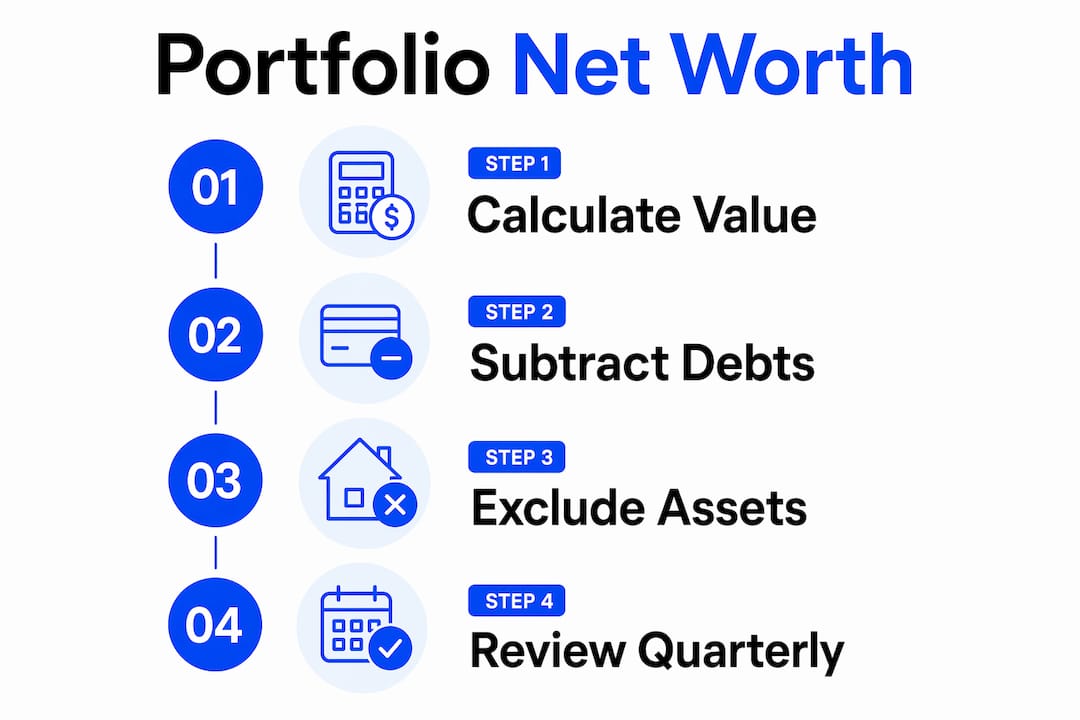
Here is a practical example. Say you hold $150,000 in Australian shares, $300,000 in an investment property, and $50,000 in managed funds. Your portfolio value is $500,000. If you have a $200,000 investment loan on the property, your portfolio net worth is $300,000.
Follow these steps to calculate yours accurately:
- List every investment asset you hold, including shares, ETFs, managed funds, investment properties, and bonds.
- Apply the current market price to each holding, not the price you paid. Using current market values rather than acquisition costs is the only way to get an accurate snapshot.
- Total those values to arrive at your portfolio value.
- List all debts directly tied to your investments, such as margin loans or investment property mortgages.
- Subtract total investment debts from portfolio value to get portfolio net worth.
Exclude your primary residence, personal vehicle, superannuation (if not yet accessible), and any personal belongings. The investable net worth formula is: Total Net Worth minus (Home Equity + Vehicles + Personal Items) = Investable Net Worth.
Pro Tip: Review your portfolio net worth quarterly using current market prices, not your last brokerage statement. Markets move fast, and a figure that is three months old can significantly distort your planning.
Net worth vs portfolio value vs portfolio net worth
These three terms are frequently used interchangeably, but they measure very different things. The table below clarifies each one.
| Term | What It Includes | Debts Subtracted? | Best Used For |
|---|---|---|---|
| Total Net Worth | All assets: home, car, investments, super, cash | All liabilities | Overall financial health snapshot |
| Portfolio Value | Investment holdings only at market price | No | Measuring gross investment performance |
| Portfolio Net Worth | Investment holdings only at market price | Investment debts only | Assessing investable wealth and capacity |
NerdWallet and Experian both define total net worth as total assets minus total liabilities. That broad definition is useful for a general financial health check, but it tells you very little about how much wealth you can actually put to work.
Portfolio value, by contrast, is a gross figure. It shows what your investments are worth at a point in time without accounting for any debt attached to them. A portfolio value of $600,000 sounds strong until you learn it carries $400,000 in margin loans.
Portfolio net worth sits between these two concepts. It strips out lifestyle assets to focus on investable wealth and then subtracts the debts tied to those assets. The result is the most honest measure of your capacity to generate investment returns and manage financial risk.
Why portfolio net worth matters for financial planning
Portfolio net worth is the figure that separates wealth you can use from wealth that is simply sitting in your home or driveway. Financial planners use it to assess real financial capacity, not just a headline number.
Here is why it deserves a central place in your planning:
- Retirement readiness. Portfolio net worth is crucial for understanding how much of your wealth can be mobilised in retirement. Home equity does not pay your bills unless you sell or borrow against it.
- Liquidity assessment. A single net worth figure can mislead about your actual cash flow capacity. Portfolio net worth separates what is liquid or near-liquid from what is locked away in lifestyle assets.
- Risk management. Including leverage in your calculation changes the risk narrative entirely. A highly leveraged portfolio may show a strong gross value but a fragile net position.
- Goal setting. Knowing your investable wealth helps you set realistic targets for income generation, property acquisition, and wealth accumulation over time.
- Borrowing power. Lenders and financial advisers assess your investable position when evaluating capacity for further investment. Portfolio net worth is a direct input into that conversation.
Portfolio net worth also fluctuates with market conditions. A sharp drop in share prices or property values reduces your portfolio net worth even if you have made no changes to your holdings. This is why tracking trends over time matters far more than reacting to a single day’s figure.
Pro Tip: Never confuse a high portfolio value with strong financial health. Always check what debts sit behind that number. A leveraged portfolio can look impressive and still leave you financially exposed if markets turn.
How to track your portfolio net worth over time
Consistent tracking turns portfolio net worth from a one-off calculation into a genuine planning tool. The goal is to build a clear picture of how your investable wealth grows, shrinks, or shifts across different market conditions.
Follow this tracking routine to stay on top of your position:
- Set a regular review date. Quarterly reviews work well for most investors. Monthly tracking suits those with active portfolios or significant leverage.
- Date-stamp every valuation. Always record the date alongside your figures. This lets you compare like with like and spot genuine trends rather than noise.
- Use current market prices. Never rely on purchase prices or outdated statements. Consistent use of current market values is what makes your figures comparable over time.
- Account for all investment debts. Update your margin loan balances, investment property mortgages, and any other portfolio-related borrowings at each review.
- Separate your portfolio net worth from your total net worth. Track both, but keep them in separate columns so you always know which figure you are looking at.
For Australian investors, tools like Wealthstacker make this process significantly more straightforward. Wealthstacker provides automated quarterly property valuations, real-time portfolio tracking, and integrated modelling for both rentvesting and direct ownership strategies. Rather than manually pulling figures from multiple sources, you get a consolidated view of your investable position in one place.
Private investments, such as unlisted property syndicates or startup equity, require a different approach. Valuation of private assets is often estimated from recent funding rounds or exit potentials rather than live market prices. Flag these separately in your tracking and update them whenever new information becomes available.
For a deeper look at how Australian investors approach this calculation, the net worth calculation guide from AlphaIQ covers the nuances well. If you want to go further and put your portfolio net worth to work, the personal wealth optimisation guide outlines five practical steps for maximising your asset base.
Key takeaways
Portfolio net worth is the most honest measure of your investable wealth, and tracking it consistently is what separates reactive investors from deliberate ones.
| Point | Details |
|---|---|
| Core definition | Portfolio net worth equals investment portfolio value minus investment-related debts only. |
| Exclude lifestyle assets | Remove your home, car, and personal items to isolate truly investable wealth. |
| Net worth vs portfolio net worth | Total net worth includes everything; portfolio net worth focuses on wealth that generates returns. |
| Leverage changes the picture | Margin loans and investment mortgages must be subtracted to reveal your real investable position. |
| Track trends, not snapshots | Quarterly date-stamped reviews using current market prices reveal meaningful financial progress. |
Why most investors are looking at the wrong number
Most investors I speak with know their total net worth. Very few know their portfolio net worth. That gap is where a lot of poor financial decisions live.
The problem is that a strong total net worth figure feels reassuring. You see $900,000 and assume you are in a solid position. But if $750,000 of that is tied up in your family home and a car, your investable wealth is just $150,000. That is the number that determines what you can actually do next: whether you can buy another investment property, whether you can weather a market downturn without selling, whether you are genuinely on track for retirement.
I have seen investors delay building a real portfolio for years because they felt wealthy on paper. They were not wrong about their net worth. They were wrong about what that number meant for their capacity to invest.
The other mistake I see regularly is ignoring leverage. An investor with $500,000 in property and a $400,000 mortgage has a portfolio net worth of $100,000, not $500,000. That distinction matters enormously when markets fall or interest rates rise. Knowing your real position before conditions change is what keeps you in control.
For Australian investors specifically, the mix of property, superannuation, and shares makes this calculation more complex than it looks. Getting it right is not about being conservative. It is about being accurate.
— Dohun
Track your portfolio net worth with Wealthstacker
Understanding your portfolio net worth is one thing. Tracking it accurately over time is where the real planning advantage comes from.
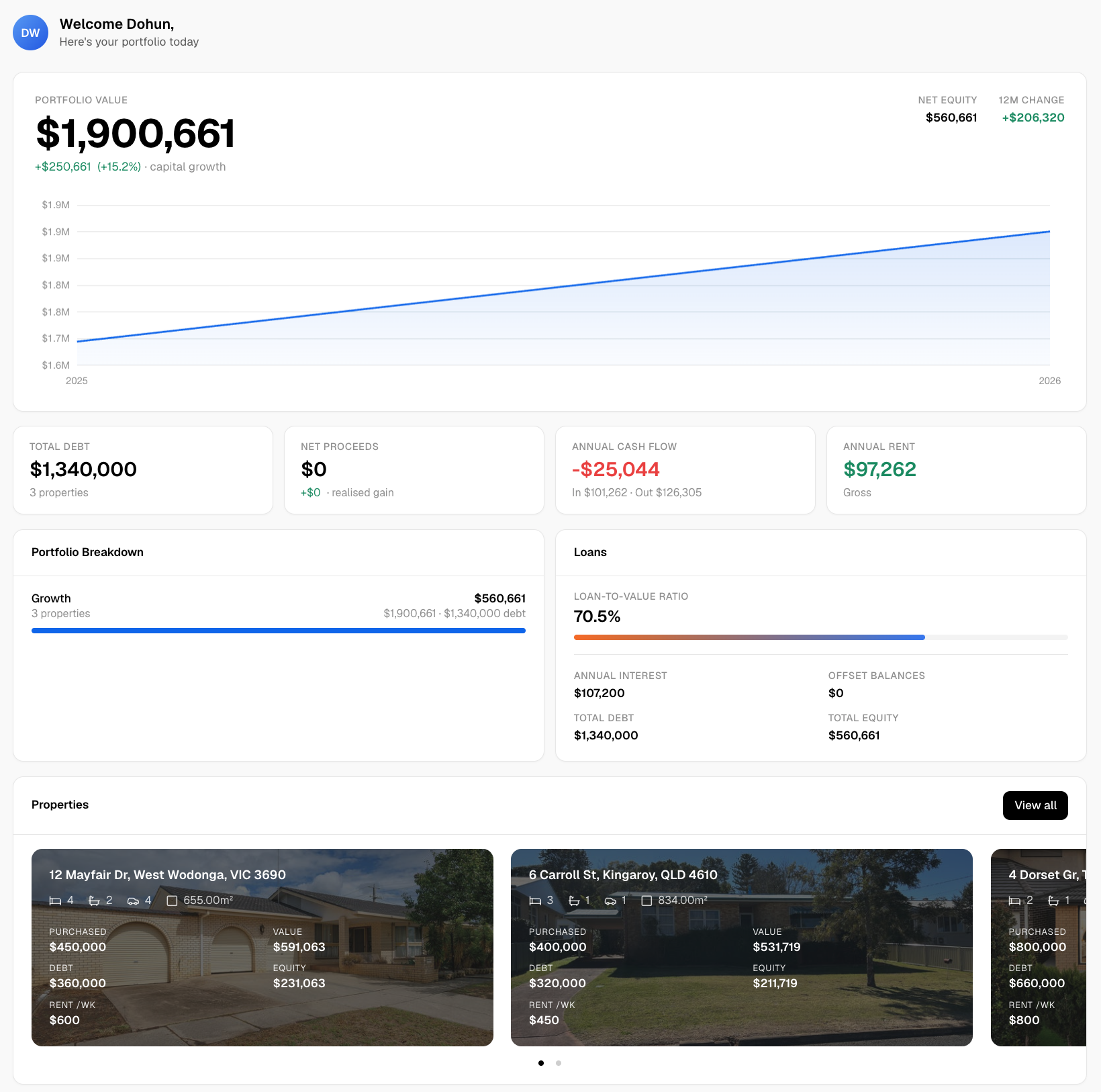
Wealthstacker is built specifically for Australian investors who want a clear, consolidated view of their investable wealth. The platform provides automated quarterly property valuations, real-time portfolio tracking across multiple asset classes, and personalised modelling for rentvesting and direct ownership strategies. You can assess your borrowing power, model future wealth scenarios, and monitor how your portfolio net worth changes as markets move. If you are serious about building wealth with clarity, start tracking with Wealthstacker today.
FAQ
What is the portfolio net worth definition in simple terms?
Portfolio net worth is the current market value of your investment holdings minus any debts tied to those investments. It excludes lifestyle assets like your home and car, focusing only on wealth that can generate returns.
How is portfolio net worth different from total net worth?
Total net worth includes all assets and all liabilities, including your home, vehicle, and personal belongings. Portfolio net worth is a narrower figure that covers only your investable assets minus investment-related debts.
What assets are excluded when calculating portfolio net worth?
Your primary residence, personal vehicle, household contents, and any non-investment personal property are excluded. The goal is to isolate investable assets that can generate income or capital growth.
How often should i recalculate my portfolio net worth?
Quarterly reviews are the standard recommendation for most investors. Each review should use current market prices and date-stamped figures to ensure meaningful comparisons over time.
Does leverage affect portfolio net worth?
Yes. Margin loans, investment property mortgages, and portfolio-backed borrowing all reduce your portfolio net worth. Including investment debt in the calculation is what separates a realistic figure from an inflated one.