
What does portfolio diversification mean in property?
TL;DR:
- Diversification in property investing involves spreading capital across different types and locations to reduce risk. It helps investors stay resilient during market fluctuations and downturns by combining sectors, regions, risk levels, and ownership structures. Proper planning and use of indirect investment vehicles enhance long-term wealth stability and portfolio growth.
Portfolio diversification in property is defined as a risk management strategy that spreads capital across different property types, locations, and investment approaches to reduce the negative impact of any single asset’s underperformance. The industry term for this practice is real estate portfolio diversification, and it sits at the core of every disciplined long-term investment plan. Understanding what portfolio diversification means in property is not just academic. It directly shapes how resilient your wealth is when markets shift, interest rates rise, or a single tenant vacates. This article explains the main dimensions of diversification, why it matters in the Australian context, and how to put it into practice.
What does portfolio diversification mean in property investing?
Portfolio diversification in real estate is a risk management strategy that spreads capital across different property types, locations, and strategies to reduce the damage any single asset can cause. The goal is not to maximise short-term gains. The goal is to smooth volatility across long-term market cycles.

The key mechanism is correlation risk. Two assets are correlated when they move in the same direction under the same market conditions. Ten residential properties in one suburb are highly correlated. When that suburb softens, every asset in your portfolio softens with it. Mixing uncorrelated asset types such as commercial space and residential rentals reduces this effect because they respond differently to economic pressure.
Diversification does not eliminate risk or guarantee profit. What it does is give you flexibility to stay invested through downturns without being forced to sell at the wrong time. That flexibility is the real value.
What are the main dimensions of property portfolio diversification?
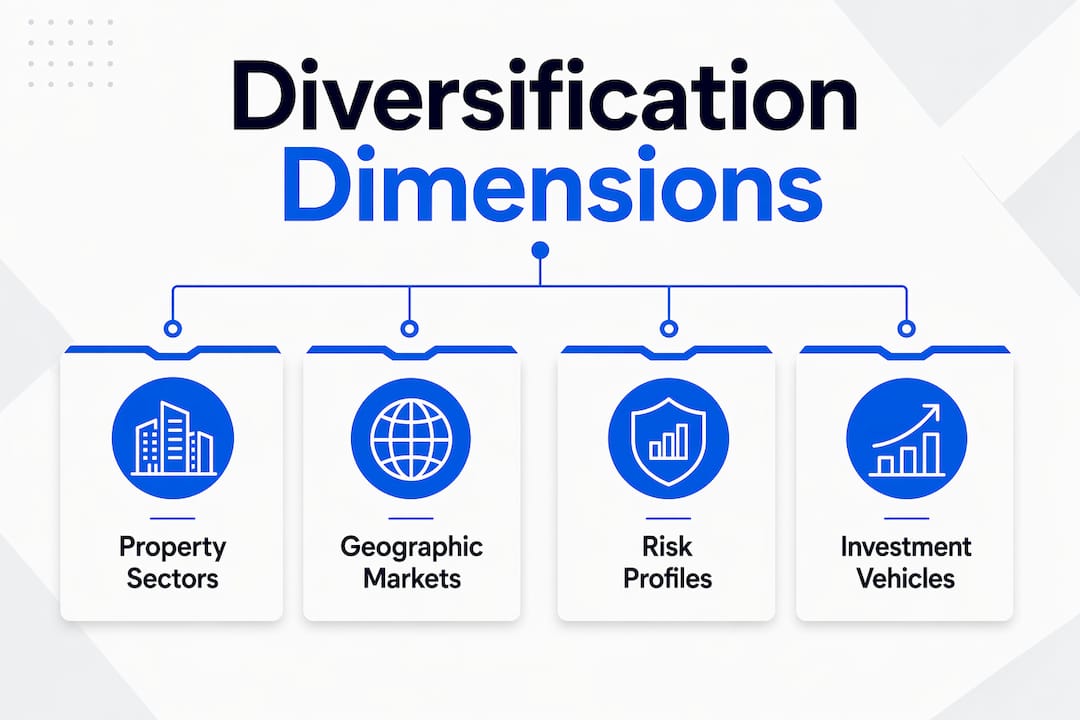
Effective diversification targets four dimensions: property sectors, geographic markets, risk profiles, and investment vehicles. Ignoring any one of these dimensions leaves a gap in your protection.
Sector diversification
Property sectors include residential, commercial, industrial, and retail. Each sector responds differently to economic cycles. Residential demand tends to hold during recessions because people always need housing. Industrial and logistics properties benefit from e-commerce growth. Retail can suffer during consumer downturns. Mixing sectors means one segment’s weakness rarely drags the whole portfolio.
Geographic diversification
Owning properties across different cities or regions reduces your exposure to localised downturns. A mining town in Western Australia and an inner-city apartment in Melbourne do not move in tandem. Geographic spread also protects against localised regulatory changes, such as state-level land tax increases or rental reform legislation.
Risk profile diversification
Not every property should carry the same risk. Stabilised income properties, such as long-leased commercial buildings, provide predictable cash flow. Value-add opportunities, such as older residential properties requiring renovation, offer capital growth potential but carry higher execution risk. Mixing stabilised income with value-add developments protects capital during downturns while preserving upside.
Investment vehicle diversification
Direct ownership is not the only path. Real Estate Investment Trusts (REITs), property syndicates, and managed funds each offer exposure to sectors and geographies that direct ownership cannot easily reach. These vehicles are covered in detail later.
| Dimension | What it means | Example |
|---|---|---|
| Sector | Property type spread | Residential + industrial |
| Geography | Location spread | Sydney + regional Queensland |
| Risk profile | Income stability vs. growth | Leased office + renovation project |
| Investment vehicle | Ownership structure | Direct ownership + REIT |
Why does diversification matter in Australian property investing?
Concentration risk is the single biggest threat to a property investor’s long-term wealth. An investor who owns four apartments in the same inner-city suburb is not diversified. They are making one concentrated bet on one micro-market. When that market corrects, every asset corrects simultaneously.
Australian property markets are not uniform. Sydney and Melbourne have historically driven national headlines, but regional markets in Queensland, South Australia, and Western Australia have outperformed capital cities during specific cycles. Urban versus regional diversification is a genuine strategy, not just a fallback for investors who cannot afford capital city prices.
Diversification is a long-term strategy that does not eliminate risk but provides the flexibility to stay invested through market cycles. When one segment softens, diversified holdings can hold steady or appreciate, maintaining overall portfolio health. That is the practical benefit: you are never fully exposed to one outcome.
The benefits of diversifying your property portfolio include:
- Reduced volatility across economic cycles
- Protection against localised market downturns
- Multiple income streams from different tenant profiles
- Flexibility to hold through downturns without forced sales
- Exposure to growth in different regions and sectors simultaneously
Pro Tip: Many investors believe owning numerous properties equals diversification. It does not. True diversification depends on asset correlation, not volume. A smaller number of assets spread across sectors and cities represents genuine diversification far better than ten properties in one postcode.
How can investors practically diversify their property portfolios?
Practical diversification requires a plan, not just opportunistic buying. The most common mistake investors make is acquiring properties reactively, based on what is available or affordable at the time, rather than what fills a genuine gap in their portfolio.
Phase your capital deployment
Phased capital deployment reduces timing risk and prevents overexposure during market peaks. Seasoned investors stagger acquisitions deliberately, spreading purchases across different market conditions rather than deploying all capital at once. This approach means you are never fully committed at the top of a cycle.
Select uncorrelated property types
When evaluating a new acquisition, ask how it relates to what you already own. If your portfolio is entirely residential, a commercial or industrial property adds genuine diversification. If all your properties are in one state, a purchase in a different region reduces geographic concentration. A structured allocation framework evaluates each acquisition against portfolio gaps in geography, asset class, and risk profile.
Diversify your tenant profile
A portfolio where every property relies on the same type of tenant carries hidden concentration risk. Mixing long-term commercial leases with residential tenancies and short-term accommodation spreads income risk. If one tenant sector faces pressure, such as retail during a downturn, other income streams continue.
Balance income and growth
Short-term income properties fund holding costs and reduce cash flow pressure. Long-term appreciation properties build wealth over time. A portfolio weighted entirely toward growth assets can create cash flow stress during periods of low rental demand. A portfolio weighted entirely toward income assets may underperform on capital growth. The balance depends on your financial position and investment horizon.
Pro Tip: Transitioning from ad-hoc buying to a planned allocation approach is the single most important shift disciplined investors make. Review your portfolio against your target allocation at least annually, and treat each new acquisition as a deliberate portfolio decision, not just an opportunity.
Check your property investment plan before committing to any new acquisition to confirm it fills a genuine gap.
What role do investment vehicles play in diversification?
Direct property ownership is the most familiar approach for Australian investors, but it is not the only one. Indirect ownership through syndications and funds offers diversification benefits that direct ownership cannot easily replicate, particularly for investors with limited capital or limited time to manage assets.
REITs (Real Estate Investment Trusts) are listed on the Australian Securities Exchange and provide exposure to commercial, industrial, and retail property at a fraction of the cost of direct ownership. They are liquid, which direct property is not. Property syndicates pool capital from multiple investors to acquire larger assets, such as commercial buildings or industrial estates, that individual investors could not access alone. Managed property funds offer professional management and geographic spread across multiple assets.
These vehicles complement direct holdings rather than replace them. An investor who owns two residential properties directly and holds a diversified REIT gains sector and geographic exposure without the operational complexity of managing additional properties.
| Vehicle | Liquidity | Sector access | Management burden | Minimum entry |
|---|---|---|---|---|
| Direct ownership | Low | Residential focus | High | High |
| REIT | High | Commercial, industrial, retail | None | Low |
| Property syndicate | Low to medium | Commercial, industrial | Low | Medium |
| Managed fund | Medium | Broad | None | Low to medium |
Understanding different investment strategies across these vehicles helps you build a portfolio that is genuinely diversified rather than just larger.
Key takeaways
Real estate portfolio diversification is the most reliable way to reduce concentration risk and maintain financial stability across long-term property market cycles.
| Point | Details |
|---|---|
| Diversification defined | Spreading capital across property types, locations, and strategies to reduce single-asset risk. |
| Four dimensions matter | Sector, geography, risk profile, and investment vehicle all require deliberate attention. |
| Volume is not diversification | Ten properties in one suburb carry more risk than four properties spread across sectors and cities. |
| Phase your acquisitions | Staggered capital deployment reduces timing risk and prevents overexposure at market peaks. |
| Indirect vehicles add reach | REITs and syndicates expand sector and geographic exposure beyond what direct ownership allows. |
Wealthstacker helps you manage property diversification
Building a diversified property portfolio requires more than good intentions. It requires up-to-date data on each asset’s performance and a clear picture of how your portfolio is positioned across sectors and locations.
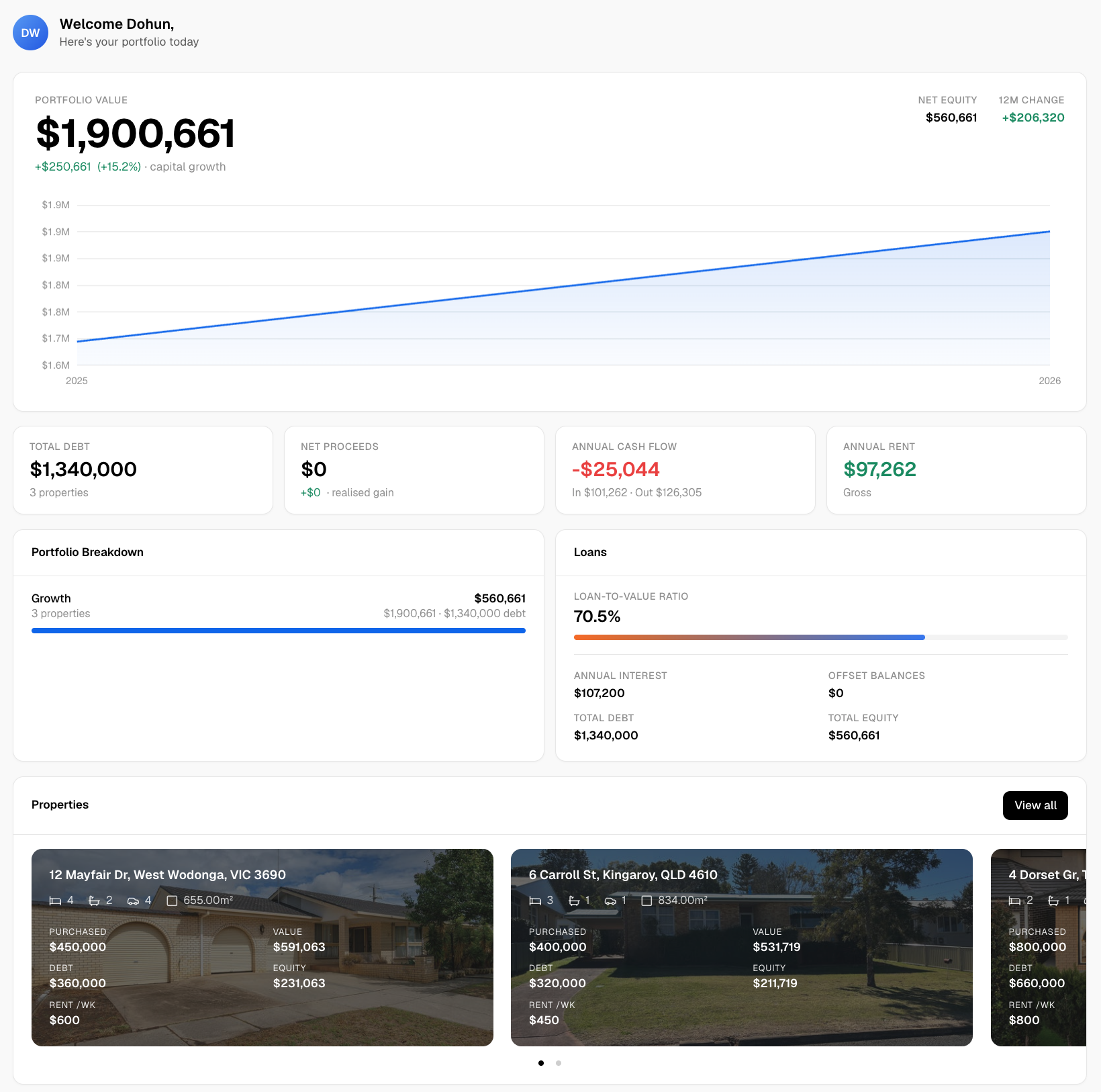
Wealthstacker is a property investment toolkit that provides automated quarterly valuations at no cost, so you always know where each asset stands. Its AI-driven modelling covers both direct ownership and rentvesting strategies, letting you assess your net worth in real time across multiple property types. Whether you are reviewing your current allocation or planning your next acquisition, Wealthstacker’s portfolio tracking tools give you the data to make decisions with confidence. Use the platform to map your existing holdings against the four diversification dimensions and identify where your portfolio has genuine gaps.
FAQ
What does portfolio diversification mean in property?
Portfolio diversification in property means spreading your real estate investments across different property types, locations, and strategies to reduce the risk that any single asset’s poor performance damages your overall wealth.
Does owning many properties mean I am diversified?
Not necessarily. Owning many properties in one location is a concentrated bet, not true diversification. Genuine diversification depends on how your assets relate to each other across sectors, geographies, and risk profiles.
How do I start diversifying my property portfolio?
Start by auditing your existing holdings against the four dimensions: sector, geography, risk profile, and investment vehicle. Use a structured allocation framework to identify gaps and phase new acquisitions to fill them deliberately.
Can indirect vehicles like REITs replace direct property ownership?
REITs and syndicates complement direct ownership rather than replace it. They add liquidity, sector access, and geographic spread at lower entry costs, but they do not provide the same level of control or leverage as direct property investment.
Does diversification guarantee profits?
Diversification does not guarantee profits and does not eliminate risk. It reduces concentration risk and smooths volatility across market cycles, giving you the flexibility to stay invested through downturns without being forced to sell.