
On-demand property valuations explained for investors
An on-demand property valuation is an automated market value estimate for a residential property, generated instantly from sales data and property attributes, with scheduled updates (typically quarterly) so you can track equity without commissioning a formal valuation every time. For Australian investors, first-home buyers and rentvestors, this means you can monitor your loan-to-value ratio (LVR), test refinance timing, and compare rent-versus-buy scenarios at no cost, using tools like Wealthstacker.
Three quick pointers before diving deeper:
- On-demand estimates are produced by Automated Valuation Models (AVMs), not licensed valuers. They are screening tools, not lending documents.
- Lenders, including those operating under APRA’s prudential framework, order their own valuations for loan security decisions. Your on-demand figure does not bind them.
- Quarterly automated updates keep your portfolio picture current between formal reports, which is where most of the day-to-day investor value sits.
Key takeaways
On-demand property valuations give Australian investors a quarterly, automated view of equity and LVR that is accurate enough for portfolio monitoring and refinance screening, but always requires a formal valuation before any lending decision.
| Point | Details |
|---|---|
| What on-demand valuations are | Automated AVM estimates with quarterly updates, used for equity monitoring and refinance screening. |
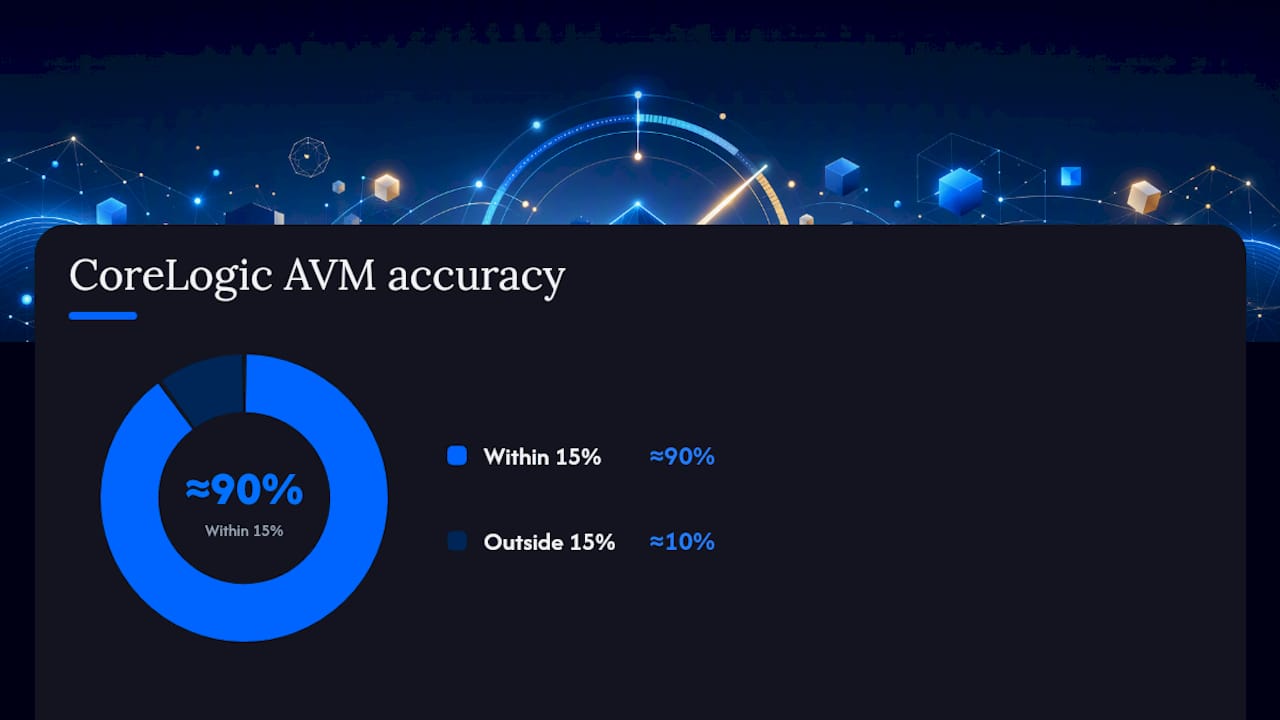
| Accuracy benchmark | Approximately 90% of CoreLogic AVM estimates fall within 15% of actual sale prices — useful for screening, not lending. |
| Bank valuations override yours | Lenders order their own valuation; your on-demand estimate does not set your LVR for loan purposes. |
| When to order a formal valuation | At offer, auction, large cash-out refinance, or when the AVM’s FSD is high or the property is unusual. |
| Wealthstacker | Delivers free automated quarterly valuations, portfolio dashboards, and scenario modelling for Australian investors and rentvestors. |
Table of Contents
- How on-demand valuations are produced
- Why Australian investors and rentvestors use on-demand valuations
- How on-demand estimates differ from bank valuations and agent appraisals
- When on-demand estimates are less reliable
- How equity, LVR and borrowing power connect
- How to use Wealthstacker’s on-demand valuations
- Wealthstacker gives you the numbers before you need them
- Sources
How on-demand valuations are produced
AVMs pull together a wide range of data inputs to generate each estimate. The core inputs include:
- Recent comparable sales and active listings in the same suburb or postcode
- Property attributes: bedrooms, bathrooms, land size, building area, age, and property type
- Rental listings and vacancy rates (relevant for yield-based calculations)
- ABS demographic data, infrastructure pipeline announcements, and days-on-market trends
From those inputs, three recognised valuation methods are applied depending on the property type. All three are standard practice in Australia:
- Comparable sales (comparative method): The most common approach for houses and units. The AVM identifies recent sales of similar properties nearby and adjusts for differences in size, condition, and features.
- Income capitalisation: Used for investment properties. The model estimates market rent, applies a capitalisation rate derived from comparable yields, and works backwards to a capital value.
- Cost approach: Applied to specialist or new-build properties where comparable sales are sparse. It estimates the land value plus the depreciated replacement cost of the improvements.
Each estimate also carries a Forecast Standard Deviation (FSD), a statistical confidence measure that tells you how tight or wide the probable value range is. A low FSD on a well-traded suburban house means the estimate is reliable. A high FSD on a rural acreage property signals you should treat the number with more caution. Enterprise AVMs used by Australia’s major banks include calibrated confidence levels for every valuation, and continuous recalibration keeps hit rates accurate as market conditions shift.
One practical caveat: public sales data in Australia can lag by several weeks after settlement, so an AVM generated today may not yet reflect the most recent comparable sales in a fast-moving market.
Why Australian investors and rentvestors use on-demand valuations
The practical benefits map directly to the decisions investors face most often:
- Live portfolio tracking: See how a suburb price movement affects your total equity across multiple properties without waiting for an annual review.
- Refinance timing: When your estimated LVR drops below 80%, you may be able to refinance without Lenders Mortgage Insurance (LMI). An on-demand estimate flags that window early.
- Purchase screening: Test whether a vendor’s asking price is defensible against recent comparable sales before committing to due diligence costs.
- Suburb signals: Track vacancy rates, days on market, and rental listing volumes alongside your valuation to spot softening or strengthening demand.
For rentvestors specifically, on-demand valuations are particularly useful. Monitoring equity growth across properties in different locations lets you identify when refinancing one asset could fund a deposit on the next, without paying for a professional valuation at every checkpoint. AI models can push automated comparable-sale alerts and update portfolio values within days rather than months, which keeps your net-worth picture current as interest rates or vacancy rates shift.
Pro Tip: Before contacting a broker about refinancing, run a quick checklist: check your current on-demand estimate and FSD, confirm your outstanding loan balance, calculate your estimated LVR, and note any recent renovations that the AVM may not have captured. That 10-minute exercise tells you whether a formal valuation is worth ordering.
How on-demand estimates differ from bank valuations and agent appraisals
Three different figures often circulate for the same property, and they serve different purposes:
- Automated on-demand estimate (AVM): Generated from data, updated quarterly, no physical inspection. Best for portfolio monitoring and screening. Can carry optimistic bias in rising markets if comparable sales data lags.
- Agent price opinion (appraisal): Provided by a selling agent, often with an incentive to pitch a higher figure to win the listing. Useful for gauging vendor expectations, not for financial planning.
- Formal bank or certified valuer report: Ordered by the lender or commissioned independently. Includes a physical inspection, is legally defensible, and is the figure that determines your loan terms.
Lenders conduct their own valuation for loan security and automated estimates may not reflect recent property condition changes. That distinction matters most when you are refinancing or purchasing, because the lender’s figure, not your on-demand estimate, sets your LVR and determines whether LMI applies.
Worked LVR example:
Suppose your on-demand estimate shows $850,000 and your loan balance is $620,000.
If the numbers still work at the lower figure, you are in a strong position.*
When on-demand estimates are less reliable
AVMs perform well on standard suburban properties with plenty of recent comparable sales. Accuracy degrades in predictable situations:
- Unique or architecturally significant properties with few true comparables
- Properties with unreported renovations or extensions (the AVM cannot see what council records do not show)
- Large rural or semi-rural land parcels where income and cost approaches diverge significantly
- New builds where settlement data has not yet entered the public record
- Thinly traded suburbs with fewer than a handful of sales per quarter
CoreLogic’s AVM results show a high proportion of automated estimates fall within 15% of actual sale prices, which is a useful screening benchmark.
Clear triggers for ordering a formal valuation:
- You are making or accepting a conditional or unconditional offer
- You are bidding at auction
- You want to access significant equity through a cash-out refinance
- The property has unusual features or the AVM FSD is high
- The lender requires it (which they almost always will for new lending)
On-demand estimates are guides, not guarantees. They are best used to identify when a formal valuation is worth ordering, not to replace one. An on-demand estimate cannot substitute for a lender’s valuation when applying for or refinancing a loan.
How equity, LVR and borrowing power connect
Here is a compact worked example using round numbers:
- Current loan balance: $560,000
- On-demand estimated value: $800,000
- Estimated equity: $240,000
- Estimated LVR: 70%
That is right on the LMI threshold.
Now apply the bank’s more conservative valuation of $760,000. The practical next steps after seeing a new on-demand value:
- Calculate your LVR at both the on-demand figure and a 5–10% discount
- Check whether the gap between your estimate and an 80% LVR threshold is large enough to absorb a conservative bank valuation
- If yes, contact a broker for a pre-assessment before ordering a formal valuation
- If no, consider waiting for further equity growth or paying down the loan before refinancing
How to use Wealthstacker’s on-demand valuations
Wealthstacker delivers automated quarterly property valuations at no cost, integrated directly into a portfolio dashboard alongside borrowing power estimates, suburb alerts, and 15-year scenario modelling. The platform’s AI tools for property valuation combine comparable sales data, rental yield signals, and demographic inputs to keep your portfolio picture current between formal reviews.
Key features relevant to on-demand valuations:
- Automated quarterly valuation updates across all tracked properties
- Portfolio dashboard showing equity, LVR, and net worth impact of market moves
- Suburb alerts for vacancy rate shifts, days-on-market changes, and comparable sales
- Borrowing power estimates that update as valuations change
- Rent-vs-buy and rentvesting scenario modelling over a 15-year horizon
Step-by-step actions when a valuation changes:
- Check the confidence score (FSD). A low FSD on a well-traded property means the estimate is reliable enough to act on. A high FSD signals you need more data before making a financial decision.
- Run a refinance simulation. Use Wealthstacker’s scenario modelling to see how the new value affects your LVR, monthly repayments, and borrowing capacity.
- Set a suburb alert. If the value has moved because of broader suburb trends, flag the area for ongoing monitoring so you catch the next movement early.
- Decide whether to escalate. If the simulation shows a refinancing opportunity and the FSD is low, contact a broker for a pre-assessment. If the property is unusual or the FSD is high, order a formal valuation before proceeding.
- Update your rent-vs-buy model. If you are a rentvestor, plug the new equity figure into Wealthstacker’s scenario planner to see how it affects your path to the next purchase.
Track your portfolio performance metrics alongside each valuation update to keep LVR, yield, and cash flow in view at the same time.
Wealthstacker gives you the numbers before you need them
Free automated quarterly valuations, a live portfolio dashboard, and 15-year scenario modelling in one place: that is what Wealthstacker puts in front of Australian investors who want to act on equity moves without paying for a formal valuation every quarter.
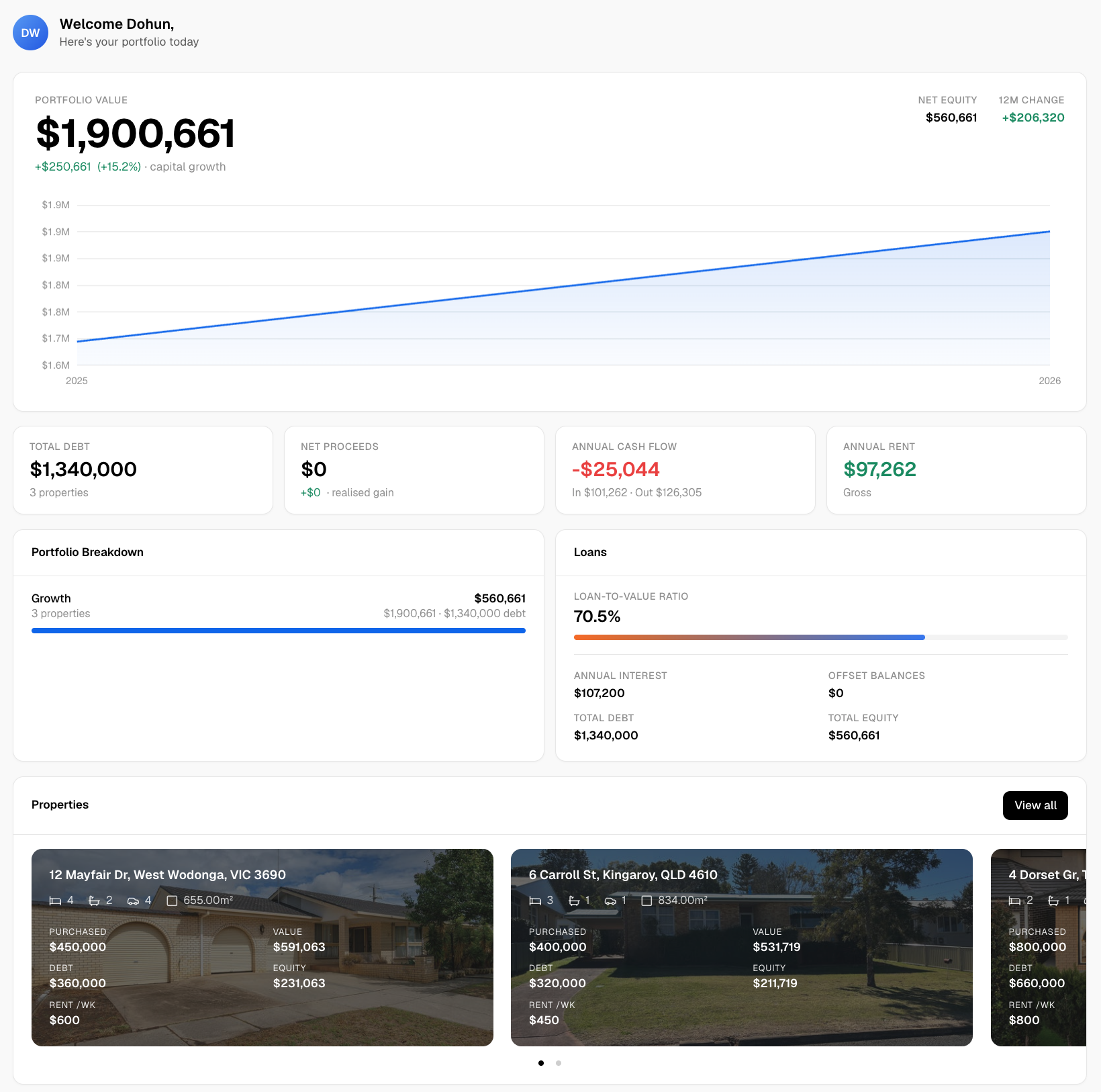
The platform tracks your equity and LVR across every property you hold, models refinancing outcomes before you call a broker, and sends suburb alerts when vacancy rates or comparable sales shift. For rentvestors juggling properties in multiple locations, that visibility is the difference between reacting to a market move and planning for it.
- Monitor equity and LVR across your portfolio, updated quarterly at no cost
- Model refinance outcomes and borrowing power before speaking to a lender
- Get suburb alerts on vacancy rates, days on market, and comparable sales
Start with Wealthstacker’s free toolkit and see your portfolio’s current equity position today.
Sources
- How property value is calculated | Aussie
- Property insights | CommBank
- Automated Valuation Model (AVM) | Hometrack Australia
This article is general information, not a substitute for advice from a qualified financial advisor. Consult a qualified financial professional about your own circumstances before acting on anything here.