
What does net worth tracking mean for your finances?
TL;DR:
- Net worth tracking involves regularly updating your total assets and liabilities to monitor financial health over time. It reveals trends that help you make deliberate financial decisions, beyond what a single snapshot can show.
Net worth tracking is defined as the regular practice of recalculating your total assets minus your total liabilities to monitor your financial position over time. Where a single net worth calculation gives you a snapshot, tracking turns it into a trend you can act on. Tools like spreadsheets, the Australian government’s Moneysmart calculators, and platforms like Wealthstacker and NerdWallet all support this practice. A monthly or quarterly update schedule is enough to reveal whether your wealth is growing, stalling, or shrinking. That visibility is what separates people who manage their finances deliberately from those who simply hope things are going well.
What does net worth tracking mean for your financial health?
Net worth tracking means converting a one-off calculation into a living record of your financial position. Net worth measures “what you own minus what you owe,” which makes it a more complete financial health score than income or savings figures alone. Your salary tells you what comes in. Your net worth tells you whether any of it is actually sticking.
The standard formula is straightforward: add up all your assets, add up all your liabilities, then subtract the second number from the first. A positive result means your assets outweigh your debts. A negative result, which is common for younger Australians carrying student loans or a large mortgage, simply means your liabilities currently exceed what you own. Tracking the number over time shows whether that gap is closing.
Financial experts treat net worth as a more reliable indicator of overall financial progress than a paycheck or credit score. A high income with unchecked debt growth produces a flat or falling net worth. A modest income with disciplined saving and investing produces a rising one. The trend line is the point.

What should you include when calculating net worth?
Accuracy in net worth tracking starts with knowing what to count. Assets fall into several clear categories: cash and savings accounts, investment and brokerage accounts, superannuation and retirement funds, home equity, and vehicles. Including assets like home equity requires a simple calculation: a home worth $200,000 with a $150,000 mortgage contributes $50,000 equity to your net worth, not the full property value.
Liabilities are equally straightforward to list:
- Mortgage balances
- Personal loans and car loans
- Student or HECS-HELP debts
- Credit card balances
- Buy-now-pay-later balances
Personal possessions like furniture, clothing, and jewellery are optional. Including them adds complexity without much financial signal. Focusing on major financial accounts and debts reflects meaningful movement better than cataloguing every minor asset you own. The goal is clarity, not completeness for its own sake.
Pro Tip: Value your home using a single consistent source, such as a recent appraisal or a property data service, rather than switching between estimates each time you update. Switching sources introduces noise that looks like a change in wealth when it is really just a change in methodology.
One important clarification: net worth can be negative, and that is not a crisis. It is a starting point. What matters is the direction of travel over successive updates.
How often should you track your net worth?
Monthly updates give you the best visibility into trends without becoming obsessive. Quarterly updates are also acceptable and suit people with less complex finances or fewer investment accounts to refresh. Updating on a consistent schedule is more important than the exact frequency you choose.
A practical update process follows these steps:
- Refresh cash and debt balances. Log into your bank accounts and credit cards and record current balances.
- Update investment and superannuation values. Pull current figures from your brokerage or super fund portal.
- Refresh real estate and vehicle values. Use the same valuation source you used last time.
- Record totals. Sum your assets, sum your liabilities, calculate net worth, and log the date.
- Note any significant changes. A large shift worth investigating, such as a market drop or a debt payoff, deserves a brief note so future-you understands the context.
The method you use matters less than whether it encourages you to keep updating. The table below compares the three most common approaches.
| Method | Best for | Key advantage | Main limitation |
|---|---|---|---|
| Manual spreadsheet | Detail-oriented trackers | Full control over categories | Requires manual data entry each update |
| Moneysmart calculator | Beginners wanting a quick check | Free, government-backed, simple | No ongoing trend history |
| Wealthstacker | Property investors and rentvesting | Automated quarterly valuations, AI modelling | Focused on property-heavy portfolios |
Consistent valuation methods are the single biggest factor in producing useful trend data. Switching between Zillow-style estimates, agent appraisals, and council valuations at different points makes your property value appear to jump around. That noise obscures real changes in your financial position.
Why does net worth tracking matter beyond income and expenses?
A budget tells you where your money goes each month. Net worth tracking tells you whether those habits are actually building wealth. Net worth reveals wealth-building outcomes even when monthly income and spending appear stable. A month where you stay on budget but your investment portfolio drops significantly will show up as a net worth decline, even though your cash flow looked fine.
The benefits of tracking net worth consistently include:
- Early warning signals. A flat or falling net worth despite a stable income flags a problem worth investigating, such as rising debt or underperforming investments.
- Goal progress visibility. Tracking your portfolio net worth over time shows whether you are on track to reach a specific financial target, like a deposit for an investment property.
- Motivation through momentum. Watching your net worth rise, even slowly, reinforces the financial behaviours driving that growth.
- Debt payoff clarity. Seeing your liabilities shrink in real numbers is more motivating than an abstract repayment schedule.
“The value of net worth tracking largely lies in consistency, focusing on trends with realistic values rather than precision.” — MyFSB Online
This point about consistency over precision is worth sitting with. You do not need a perfectly accurate valuation of every asset. You need a repeatable process that reflects real changes over time. A slightly imprecise number tracked consistently is far more useful than a perfectly precise number calculated once and forgotten.
What tools and tips help you track net worth effectively?
The right tool is the one you will actually use every update cycle. Spreadsheets built in Microsoft Excel or Google Sheets give you complete control and cost nothing. Moneysmart, run by the Australian Securities and Investments Commission (ASIC), offers a free net worth calculator suited to beginners. Wealthstacker goes further for property investors, providing automated quarterly valuations and AI-assisted modelling for both rentvesting and direct ownership strategies.
Practical tips for building a tracking habit that lasts:
- Start with your five biggest accounts. Prioritising major accounts and debts that materially affect your net worth reduces effort and increases the chance you keep updating long-term.
- Pick one valuation source per asset class. Using the same valuation method each time is the key to seeing genuine trends rather than accounting noise.
- Sync your update with a regular date. The first Sunday of each month, or the last day of each quarter, works well. Attaching the task to a fixed date removes the decision of when to do it.
- Avoid daily checking. Daily fluctuations in investment values create anxiety without producing useful information. Monthly or quarterly snapshots are enough.
- Connect net worth tracking to a specific goal. Tracking feels purposeful when it is tied to something concrete, like building a deposit or reaching a target superannuation balance.
Pro Tip: If you own investment property, use a platform like Wealthstacker that automates property valuations. Manual property estimates are the most common source of valuation inconsistency in personal net worth tracking.
For those building a property investment portfolio, integrating net worth tracking with investment reporting gives you a single, consistent view of how each asset contributes to your overall financial position. That integration removes the guesswork from decisions like whether to hold, sell, or refinance.
Key takeaways
Net worth tracking is the most complete measure of financial health available because it captures both what you own and what you owe in a single, updatable number.
| Point | Details |
|---|---|
| Core definition | Net worth tracking means regularly recalculating total assets minus total liabilities to monitor financial position over time. |
| What to include | Count major accounts and debts; skip minor personal possessions to keep updates manageable and meaningful. |
| Update frequency | Monthly updates give the best trend visibility; quarterly is acceptable for simpler financial situations. |
| Consistency over precision | Using the same valuation method each time produces more useful trends than switching sources for a more accurate number. |
| Right tool matters | Choose a method you will sustain, whether that is a spreadsheet, Moneysmart, or a platform like Wealthstacker for property-heavy portfolios. |
Wealthstacker makes net worth tracking clearer for property investors
Property is the largest asset most Australians hold, and it is also the hardest to value consistently. Wealthstacker addresses this directly by providing automated quarterly property valuations at no cost, so your net worth figures stay current without manual research.
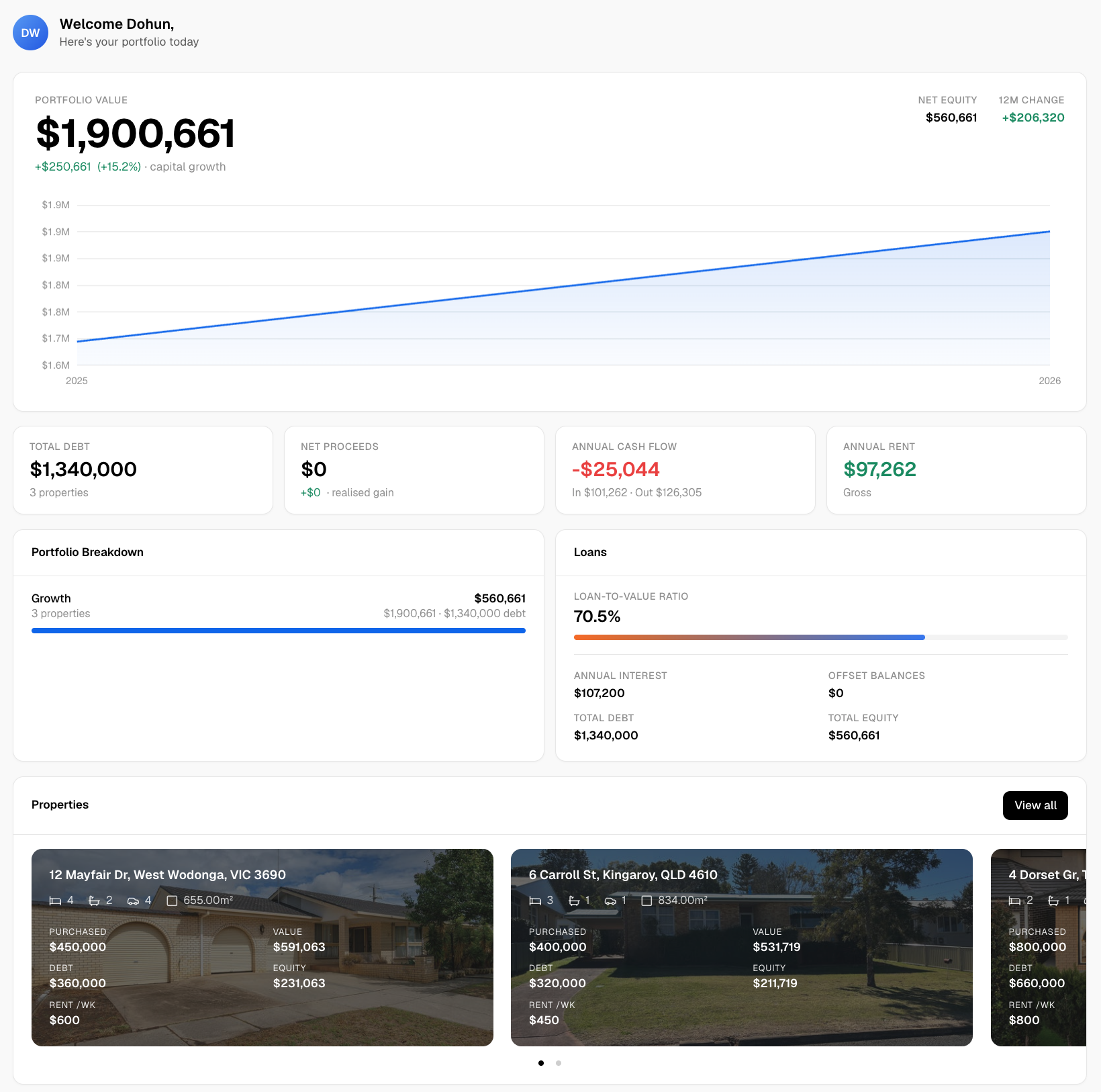
The platform combines AI-assisted modelling with personalised forecasts for both rentvesting and direct ownership strategies. That means you can see your projected net worth trajectory, not just your current position. For investors comparing strategies or assessing borrowing power, that forward-looking view changes the quality of every financial decision. Visit Wealthstacker to see how the platform tracks your property portfolio and net worth in one place.
FAQ
What is the basic formula for net worth?
Net worth equals total assets minus total liabilities. Assets include cash, investments, superannuation, and property equity; liabilities include mortgages, loans, and credit card balances.
How often should I update my net worth?
Monthly updates are recommended for the best trend visibility, though quarterly updates work well for people with simpler financial situations. Consistency matters more than frequency.
Can net worth be negative?
Yes, a negative net worth simply means your liabilities currently exceed your assets. This is common for younger Australians with large mortgages or student debts, and it improves as debts are repaid and assets grow.
What is the biggest mistake in net worth tracking?
Using inconsistent valuation sources for property or investments is the most common error. Switching between different estimates makes your net worth appear to fluctuate when the real change is just in the methodology.
Do I need to include every asset I own?
No. Focusing on major financial accounts and debts produces more useful data than cataloguing every minor possession. Include assets that materially affect your financial position and skip the rest.