
Seven types of property ownership structures explained
Most Australian property buyers only ever meet one ownership structure: they sign as a sole owner or as joint tenants with a partner, and nobody explains that six other options exist. The main structures are sole ownership, joint tenancy, tenancy in common, ownership through a company, ownership through a discretionary or unit trust, and ownership inside a self-managed super fund (SMSF). Layered over all of them are title systems, Torrens, strata, and fee simple versus leasehold, that determine how your interest gets registered and protected.
Here’s the quick version before you dig into the detail:
- Sole ownership — simplest option, appropriate for single buyers with no need to split income or protect assets from creditors.
- Joint tenancy — best for couples who want the property to pass automatically to the survivor, no will required.
- Tenancy in common — the right call when contributions are unequal or you want your share to go to someone other than your co-owner.
- Company ownership — suits investors chasing the flat corporate tax rate on rental income they plan to retain rather than distribute.
- Discretionary or unit trust — useful for income splitting across family members and for asset protection, at the cost of setup complexity.
- SMSF ownership — a retirement-focused vehicle with strict borrowing limits and a sole-purpose test that leaves little room for error.
- Title variations (Torrens, strata, leasehold) — these don’t replace the ownership types above, but they change what your ownership actually entitles you to.
Each of these carries different consequences for tax, estate planning, borrowing power, and day-to-day management. The sections below walk through each one, plus how to change structures once you’ve committed to something and later realise it doesn’t fit.
Key takeaways
The ownership structure recorded on your title, not any private agreement between owners, is what determines your tax split, your borrowing terms, and who inherits the property.
| Point | Details |
|---|---|
| Legal title controls tax | The ATO divides rental income and losses based on registered ownership interest, not side agreements. |
| Joint tenancy skips the will | Right of survivorship passes the property to the surviving owner automatically, overriding what a will says. |
| Trusts and companies cost more to run | Both need formal deeds or constitutions and ongoing compliance that sole ownership never requires. |
| SMSF property has narrow rules | The sole-purpose test and LRBA holding trust requirements leave little margin for error. |
| Structure changes are rarely free | Severing a joint tenancy or moving property into a trust typically triggers stamp duty, CGT, or both. |
Whatever you decide, check the exact wording on your Certificate of Title and document any ownership decision formally with your conveyancer, don’t rely on a verbal understanding with a co-owner to hold up against a will, a lender, or the ATO.
If you’re modelling how different ownership structures might affect your long-term position, whether that’s comparing rentvesting scenarios or working out borrowing capacity under joint names versus a trust, WealthStacker’s property investment toolkit runs free quarterly valuations and 15-year modelling so you can see how each option plays out before you sign anything.
Table of Contents
- What are the main land title systems in Australia?
- What is sole ownership and when does it make sense?
- Joint tenancy or tenancy in common: which one fits?
- How does owning property through a company work?
- Trust ownership: discretionary trusts and unit trusts
- Can you own property inside a self-managed super fund?
- How ownership structure changes your tax bill and estate outcome
- How do you choose the right ownership structure?
- What are the practical steps to change or set up ownership?
- Where to check the official rules
- Frequently asked questions
- Sources
What are the main land title systems in Australia?
Before comparing ownership types, it helps to understand what you’re actually registering that ownership against. Australia runs primarily on the Torrens title system, a state-guaranteed register where the government, not a paper trail of historical deeds, confirms who owns what. Under Torrens, your Certificate of Title lists the registered proprietor, the estate type, and any encumbrances like mortgages or easements, and that register entry is the authoritative record in most states, with digital registers now providing this in some jurisdictions.
A small number of properties still sit under General Law title (sometimes called “Old System” title), where ownership is proven through a historical chain of deeds rather than a single guaranteed certificate. Remnants of this older system persist in pockets of the country, though Torrens dominates nationally.
Strata title applies to units, townhouses, and apartments. You own your individual lot outright, and you share ownership of common property (foyers, lifts, gardens) with every other lot owner in the scheme. This matters for ownership structure decisions because a strata lot behaves differently under trust or SMSF ownership than a standalone house does, particularly around who manages the owners’ corporation obligations.
Then there’s the freehold versus leasehold distinction. Fee simple (freehold) gives you the closest thing to full ownership Australian law allows: indefinite tenure, subject to government powers like compulsory acquisition. Leasehold means you hold the right to occupy for a fixed term, common on some rural Crown land and in the ACT, where most residential land is technically leased from the territory for 99 years rather than owned outright.
Why does any of this matter for the ownership types discussed below? Because severance, registration, and even whether you can put a property into an SMSF or trust all hinge on how the title is held and what register entry your ownership structure needs to produce.
- Torrens title: state-guaranteed, single Certificate of Title, the default system across most of Australia.
- Strata title: individual lot ownership plus shared common property, standard for units and apartments.
- Fee simple: the strongest form of private tenure, essentially indefinite.
- Leasehold: fixed-term right to occupy, notably the standard structure for residential land in the ACT.
What is sole ownership and when does it make sense?
Sole ownership means one person’s name appears on the title as the sole registered proprietor. There’s no co-owner to negotiate with, no shared decision-making on renovations or sale timing, and the Certificate of Title records a single owner with no tenancy notation required.
The appeal is obvious: total control. You decide when to sell, whether to renovate, and how to use the property, with nobody else’s signature needed on the transfer document. For a single first-home buyer or an investor who wants a clean, uncomplicated portfolio, that simplicity is genuinely valuable.
The downside is equally direct. Sole ownership offers no asset protection. If you’re sued, run a business that goes under, or face a relationship breakdown where the property was never formally shared, the entire asset sits exposed. On death, the property doesn’t pass automatically to anyone; it becomes part of your estate and is distributed according to your will or, if you die without one, the intestacy rules of your state.
Capital gains tax works straightforwardly for sole owners: any gain on sale is assessed entirely against you, at your marginal tax rate (with a 50% CGT discount typically available if you’ve held the property over 12 months). If the property is your main residence, the main residence exemption generally applies in full, since there’s no co-owner to split the exemption with.
- Sole ownership pros: full control, straightforward record-keeping, no co-owner disputes.
- Sole ownership cons: zero asset protection, no automatic succession, all tax liability sits with one person.
- Best fit: owner-occupiers buying alone, or investors deliberately keeping structures simple for a single-property portfolio.
Pro Tip: If you’re an investor rather than an owner-occupier, weigh sole ownership against a discretionary trust early. Once you’ve bought and settled as a sole owner, switching to a trust later usually triggers stamp duty and a CGT event, which can wipe out the appeal of the trust structure entirely.
Joint tenancy or tenancy in common: which one fits?
These two are the co-ownership options, and they behave completely differently at the two moments that matter most: when one owner dies, and when someone wants out.
Joint tenancy gives every owner an identical, undivided interest in the whole property. Under the traditional “four unities” (possession, interest, title, and time), all owners hold the same rights at once. The defining feature is the right of survivorship: when one joint tenant dies, their interest passes automatically to the surviving joint tenant, regardless of what their will says. This is why most couples default to joint tenancy on the family home.
Tenancy in common works differently. Each owner holds a separate, quantifiable share, which can be equal (50/50) or unequal (70/30, say, reflecting different deposit contributions). There’s no survivorship. When a tenant in common dies, their share becomes part of their estate and passes according to their will or intestacy rules, not automatically to the other owner. Some registries will even issue separate certificates of title for each share under tenancy in common.
| Dimension | Joint tenancy | Tenancy in common |
|---|---|---|
| Best use-case | Couples wanting automatic succession | Unequal contributions, blended families, investment partners |
| Estate effect | Right of survivorship overrides the will | Share passes via will or intestacy |
| Asset protection | Limited; interest is undivided | Share can be structured or protected individually |
| Borrowing consequences | Lenders treat both owners as jointly liable | Lenders may assess shares separately, though most require joint liability anyway |
| Administrative complexity | Lower; one certificate, simpler dealings | Higher; shares tracked separately, more complex on sale or death |
If you want to convert a joint tenancy into a tenancy in common, a process called severance, it takes formal action, not a change of heart. Here’s what’s actually involved:
- Agree on the new share split with your co-owner, or act unilaterally if you’re severing your own interest.
- Prepare a transfer or severance instrument in the form your state’s land registry requires.
- Lodge the document with the relevant land titles office (procedures and fees vary by state).
- Wait for the register to be updated, at which point the Certificate of Title reflects tenants in common.
- Update your will immediately, because severance changes what happens to your share on death.
Severing a joint tenancy requires formal registration or a transfer instrument lodged with the land registry; simply changing your will does nothing while the joint tenancy remains on title. Depending on your state, severance or any transfer between co-owners can also trigger stamp duty and CGT considerations, so it’s worth checking with a conveyancer before lodging anything.
If a conveyancing document doesn’t state which tenancy applies, some state Acts default to joint tenancy. That single missing word on a transfer form can determine who inherits a property decades later.
How does owning property through a company work?
A company can hold real property in its own name, meaning the title shows the company as registered proprietor, not you personally. You own shares in the company, and the company owns the asset. That separation is the entire point.

The main attraction is limited liability. If something goes wrong, a tenant injury claim, a business dispute, a lawsuit against you personally, the company’s assets are generally shielded from your personal creditors and vice versa. Companies also pay a flat corporate tax rate on rental income, which can be attractive if you’re a high-income earner and plan to retain profits inside the company rather than distribute them as dividends.
The trade-offs are significant enough that most everyday property investors skip this structure. Companies don’t get access to the 50% CGT discount that individuals and trusts enjoy on assets held over 12 months, which means a capital gain on sale can be taxed more heavily than it would under personal ownership. Extracting profits as dividends triggers a second layer of tax at the shareholder level (offset partially by franking credits), and companies carry ongoing compliance costs, annual returns, financial statements, and often higher accounting fees than a simple personal holding.
Lenders also tend to be more cautious with company borrowers, frequently requiring personal guarantees from directors before approving finance, which somewhat defeats the liability-shielding purpose for smaller investors.
- Pros: limited liability, flat corporate tax rate on retained income, clean separation from personal assets.
- Cons: no CGT discount, dividend tax on distributions, higher compliance costs, lenders often demand personal guarantees anyway.
- Typical user: investors building a portfolio for long-term retained income rather than short-term capital growth and resale.
Company ownership rarely suits a first property. It tends to appear later in an investor’s journey, once the tax maths on retained rental income starts to outweigh the loss of the CGT discount and the extra administrative load.
Trust ownership: discretionary trusts and unit trusts
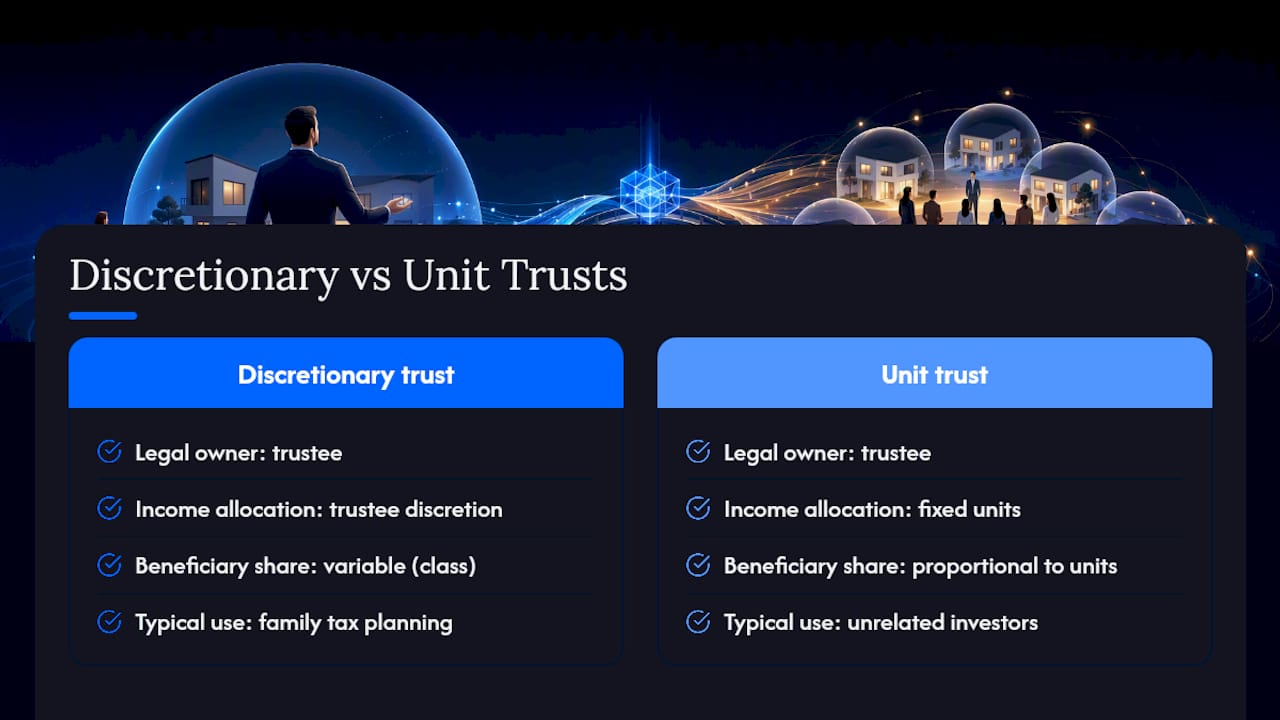
A trust holds property on behalf of beneficiaries, with a trustee (an individual or a company) as the legal owner recorded on title. The trustee controls the asset; the beneficiaries receive the economic benefit. That split between legal control and beneficial entitlement is what makes trusts flexible, and occasionally complicated.
A discretionary trust (often called a family trust) lets the trustee decide each year who among a class of beneficiaries receives income or capital, and how much. This flexibility is the main draw: it lets a family direct rental income to whichever member is on the lowest marginal tax rate that year. A unit trust works more like a company with shares, beneficiaries hold fixed “units” representing a set proportion of income and capital, which suits arrangements where contributions are unequal and fixed rather than discretionary, such as unrelated investors going in together.
Trusts offer genuine asset protection, since beneficiaries generally don’t have an enforceable personal claim on trust assets that creditors can seize, and they retain access to the 50% CGT discount that companies miss out on. But they come with real costs: setting up a trust deed properly, ongoing accounting and compliance, and land tax surcharges that apply to discretionary trusts in some states unless the deed specifically excludes foreign beneficiaries.
There’s also a tax trap worth knowing about. Distributions must actually be paid or made presently entitled to beneficiaries by 30 June each year, and if a trust makes a capital gain but the CGT discount component isn’t distributed correctly, beneficiaries can end up taxed on income they never received in cash.
Trust deeds and company constitutions determine control and beneficiary rights, and those documents shape tax outcomes and lending arrangements for the life of the structure, not just at setup.
Setting up trust ownership properly is not a do-it-yourself job. Get a solicitor to draft or review the trust deed and a tax adviser to confirm the distribution strategy before you lodge anything with a land registry; a defective deed can undo the asset protection benefit the whole structure was built for. For a deeper look at how these vehicles work specifically for property investors, see our full explainer on property investment trusts.
Can you own property inside a self-managed super fund?
Yes, but the rules are stricter than any other ownership structure covered here, and the consequences of getting it wrong include serious ATO penalties.
Every asset an SMSF holds must satisfy the sole-purpose test: the fund exists to provide retirement benefits to members, full stop. That means an SMSF generally cannot buy a holiday house for members to use, or a residential property for a member’s relative to live in. The title itself has to reflect this. Property must be held in the name of the trustees “as trustee for” the fund, or clearly evidenced through a holding trust or caveat, so the asset is unmistakably separated from members’ personal property.
SMSFs generally can’t borrow money, with one major exception: the Limited Recourse Borrowing Arrangement (LRBA). Under an LRBA, the fund borrows to buy a single acquirable asset, and that asset sits in a separate holding trust until the loan is repaid. If the loan defaults, the lender’s recourse is limited to that one asset, it can’t chase the fund’s other investments, which is the entire point of the “limited recourse” structure.
A handful of practical limits shape what an SMSF can actually buy:
- Related-party transactions are heavily restricted; you generally can’t buy a residential property from a fund member or their relative.
- In-house asset rules cap how much of a fund’s value can be tied up in related-party assets, typically 5%.
- Business real property is a notable exception. If a property is used wholly and exclusively for business purposes, the in-house asset cap doesn’t apply, and a residential component may even be acceptable if it’s 2 hectares or less and the business use remains dominant.
Pro Tip: Trustees are personally responsible for maintaining a written investment strategy and reviewing it regularly, an SMSF isn’t a set-and-forget structure. Treat the annual strategy review as seriously as your tax return.
Breaching the sole-purpose test or mishandling an LRBA holding trust can attract significant compliance penalties from the regulator, and in serious cases the fund can lose its complying status entirely.
Given the complexity, most people considering an SMSF for property benefit from a dedicated deep dive before committing. Our guide on the role of superannuation in property investment covers the compliance essentials in more depth.
How ownership structure changes your tax bill and estate outcome
The structure you choose doesn’t just sit in the background; it actively decides who pays tax on rental income, who inherits the asset, and how much a lender will hand you.
On tax, the ATO’s default position is that legal ownership interest determines how net income or losses are divided, regardless of any private side agreement between co-owners. If you and your partner are registered as joint tenants but privately agree that one of you should claim 100% of a negative gearing loss, the ATO will generally disregard that agreement and split the loss according to the legal ownership shown on title. This single rule catches out more property investors than almost any other, because it makes side arrangements essentially worthless for tax purposes.
Borrowing power also shifts with structure. Lenders assess sole owners and joint tenants relatively simply, using combined personal income and existing debt. Company and trust borrowers face more scrutiny: banks typically want personal guarantees from directors or trustees, and trust lending often requires the trust deed to explicitly authorise borrowing before an application even gets assessed. SMSF lending through an LRBA is the most restrictive of all, with a narrower pool of lenders and stricter loan-to-value ratios than standard investment lending.
Consider two scenarios side by side. Couple A buy as joint tenants: if one dies, the survivor automatically owns the whole property, no probate delay on that asset, no will dispute possible over that share. Same property type, same purchase price, radically different outcomes on death, purely because of how the title was worded at settlement.
Before you assume your structure does what you think it does, run through this quick check:
- Pull your Certificate of Title and confirm exactly how the tenancy is recorded.
- If you’re using a trust or company, read the deed or constitution to check borrowing authority and distribution rules.
- Call your lender and ask directly how your ownership structure affects your borrowing capacity and any guarantee requirements.
- Confirm with a tax adviser how income and capital gains will actually be split under your current registration.
How do you choose the right ownership structure?
Work through these questions in order, and the appropriate structure usually becomes obvious fairly quickly.
- Are you buying to live in it, or to invest? Owner-occupiers rarely need anything beyond sole ownership or joint tenancy; the CGT main residence exemption and simplicity outweigh most other considerations.
- Are you buying with someone else, and do you want automatic survivorship? If yes, lean joint tenancy. If contributions are unequal or you want your share to go to your own beneficiaries, choose tenancy in common.
- Do you need asset protection from business or professional liability risk? This points towards a discretionary trust or company, not personal ownership.
- Is this purchase specifically for retirement savings, and are you comfortable with strict compliance obligations? Only then does an SMSF enter the conversation.
- What’s your marginal tax rate, and do you want flexibility to split income across family members? High income plus family income splitting needs generally favours a discretionary trust over a company.
- How much administrative complexity and ongoing cost are you willing to carry? Sole ownership and joint tenancy cost almost nothing to maintain; trusts, companies, and SMSFs all carry real annual compliance costs.
Some common scenarios map fairly cleanly:
- First home buyer, single: sole ownership.
- Couple buying their first home together: joint tenancy.
- Two friends investing together with different deposit amounts: tenancy in common.
- High-income professional building a retained-income property portfolio: company or discretionary trust, compared carefully with an adviser.
- Retirement-focused buyer with substantial existing super and a clear investment purpose: SMSF, with specialist advice before signing anything.
Get the right professionals involved at the right time: a conveyancer or the state land titles office to confirm how any registration actually reads, a tax adviser before you commit to a trust, company, or SMSF structure, and a lender or mortgage broker early, since borrowing capacity can rule out an otherwise appealing structure before you get too attached to it. A property investment checklist can help keep track of which steps you’ve covered before settlement.
What are the practical steps to change or set up ownership?
Whether you’re setting up a new purchase or restructuring an existing one, the mechanics follow a fairly consistent pattern across states, even though exact forms and fees differ.
- Decide on the tenancy or structure before contract exchange wherever possible, changing it after settlement is always more expensive.
- If registering as joint tenants or tenants in common, ensure the conveyancing documents state the tenancy explicitly; don’t leave it to default.
- For company or trust purchases, have the entity’s constitution or deed finalised and provide it to your conveyancer before contracts are signed.
- For SMSF purchases involving an LRBA, set up the separate holding trust before the purchase contract is signed, not after.
- Lodge the transfer or registration documents with the relevant state land titles office and pay any applicable registration fee.
- If severing an existing joint tenancy, lodge the formal severance instrument and update your will immediately afterwards.
Budget realistically for the costs involved. Stamp duty applies to most transfers between parties (including, in many states, transfers into a trust or company, even where no money changes hands), conveyancer or solicitor fees typically run into four figures, and land registry fees vary by state and transaction type. Restructuring an existing sole ownership into a trust after purchase is one of the costliest moves you can make, since it usually triggers both stamp duty and a CGT event on what is, legally, a change of ownership.
Keep these documents on hand at every stage: the Certificate of Title, the trust deed or company constitution if applicable, any LRBA holding trust documents, and records of every transfer or severance instrument lodged. Any transfer between related parties, any severance, and any change of trustee can each independently trigger CGT or stamp duty, so treat every structural change as a tax event until an adviser confirms otherwise.
Where to check the official rules
- ATO: Co-ownership and right of survivorship — confirms how joint tenancy and tenancy in common are treated for CGT and inherited assets.
- ATO: Ownership of SMSF investments — sets out how SMSF property must be titled and how LRBAs work.
- SA Government: Property and land ownership types — plain-language state guidance on sole ownership, joint tenancy, and tenants in common.
- ICSM: Systems of ownership and registration — explains Torrens, General Law, and strata tenure systems in detail.
- Landgate WA: Types of title to land — practical detail on what a Certificate of Title actually records.
Frequently asked questions
What are the main types of property ownership structures in Australia? The core structures are sole ownership, joint tenancy, tenancy in common, company ownership, trust ownership (discretionary or unit trust), and SMSF ownership. Each carries different tax, estate, and asset protection outcomes, and the right choice depends on whether you’re buying to live in, invest, or fund retirement.
What’s the real difference between joint tenancy and tenancy in common? Joint tenants hold identical interests and the property passes automatically to the survivor on death. Tenants in common hold separate, often unequal shares that pass through the deceased’s will or intestacy rather than to the co-owner directly.
Can I change from joint tenancy to tenancy in common later? Yes, this is called severance, and it requires lodging a formal transfer or severance instrument with your state’s land titles office. Updating your will alone does nothing while the joint tenancy remains on the register.
Is a trust or a company better for owning an investment property? It depends on your goals.
Can my SMSF buy a residential property for me to live in? No. The sole-purpose test requires SMSF assets to serve members’ retirement benefits, which rules out buying a home for a member or their relative to live in, with the narrow exception of qualifying business real property.
Does the ownership structure I choose affect how much I can borrow? Yes. Lenders generally assess sole owners and joint tenants on combined income and debt, while company, trust, and SMSF borrowers face more scrutiny, often requiring personal guarantees or, for SMSFs, a Limited Recourse Borrowing Arrangement with a separate holding trust.
This article provides general information about property ownership structures and isn’t a substitute for personalised legal, tax, or financial advice. Confirm current rules for your specific situation with the ATO, your state’s land titles office, or a qualified professional before making any decision.
This article is general information, not a substitute for advice from a qualified financial advisor. Consult a qualified financial professional about your own circumstances before acting on anything here.
Sources
- Co-ownership and right of survivorship | Australian Taxation Office
- Ownership of SMSF investments | Australian Taxation Office
- Property and land ownership types | SA Government
- Systems of ownership and registration | ICSM