
Low-effort investment analysis platforms for Australian property investors
Wealthstacker is the single best low-effort platform for Australian property investors to trial first. It delivers automated quarterly valuations using CoreLogic-grade suburb data, runs side-by-side rentvesting versus buying scenarios with editable borrowing-power inputs, and produces useful outputs within days of signup on a free plan. The shift driving this recommendation is real: investment software analysts now judge platforms on their decision-making depth, not their bookkeeping features. Tools that can’t model future scenarios with editable assumptions are, in practice, just expensive spreadsheets.
Three key reasons Wealthstacker is recommended among low-effort investment analysis platforms:
- Suburb-level data quality. Automated quarterly valuations backed by primary Australian market feeds mean you’re not guessing at your property’s current worth.
- Rentvesting vs buy modelling. Built-in scenario templates let you compare strategies side by side, with borrowing-power estimates feeding directly into the model.
- Fast time-to-value. The free trial returns a property snapshot and a default rentvesting comparison within a few days of setup, no spreadsheet required.
Table of Contents
- What does ‘low-effort’ actually mean for a property analysis platform?
- What features should a low-effort investment analysis platform have?
- How do you pick the right low-effort platform quickly?
- What does a rentvesting vs buying scenario look like in practice?
- What data limitations should you check before trusting a platform’s outputs?
- What does a low-effort platform typically cost, and how fast do you get useful outputs?
- How do you validate a platform’s outputs during a trial?
- Key takeaways
- Wealthstacker fits the low-effort brief from day one
- Authoritative Australian sources worth checking
What does ‘low-effort’ actually mean for a property analysis platform?
A genuinely low-effort platform automates data collection, runs editable scenario templates, and produces clear decision outputs without you maintaining a single formula. That’s the whole definition. If you’re still exporting CSVs from your bank and pasting them into a model each month, the platform isn’t low-effort regardless of how slick the interface looks.
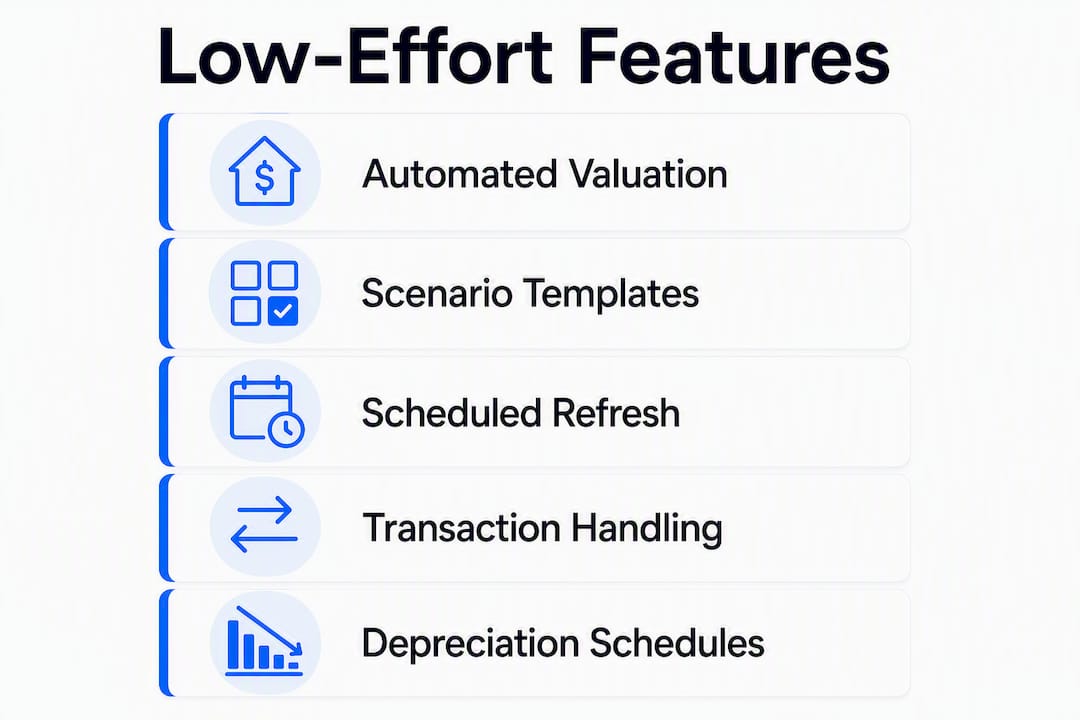
The capabilities that actually reduce ongoing effort are specific. Scheduled data refreshes mean suburb valuations update without you triggering them. Bank and lender feed integrations eliminate manual transaction entry. Prebuilt rentvesting templates mean you’re editing assumptions, not building logic from scratch. One-click export keeps your accountant happy at tax time without a three-hour reconciliation session.
Automated transaction handling, when correctly configured, makes monthly reporting usable and keeps accountant handover clean. That’s not a minor convenience. The hidden cost of spreadsheet sprawl is the time spent updating, reconciling, and fixing broken formulas — time that routinely exceeds the subscription cost of a purpose-built platform.
Pro Tip: On day one of any trial, add one property, connect a single loan, run the default rentvesting scenario, and note the time from signup to first insight. If it takes more than 30 minutes, the platform fails the low-effort test.
What features should a low-effort investment analysis platform have?
The non-negotiable checklist is short. Every platform you trial should have all five of these before you consider paying for it:
- Automated valuations updated at least quarterly from a primary Australian data feed (CoreLogic or equivalent). Amateur tools that rely on scraped or outdated estimates can mislead investors on suburb-level supply, demand, and vacancy.
- Rentvesting vs buy scenario templates with editable tax, interest-rate, and growth assumptions (over horizons of at least a decade). Advanced tools model 10–30 year horizons with changing rates and ATO tax impacts; anything less than a 10-year view limits your planning.
- Portfolio dashboard that consolidates rent, expenses, loans, and equity in one place, replacing scattered spreadsheets and email attachments.
- Borrowing-power estimates that feed directly into scenario models so your forecasts reflect what a lender will actually offer.
- Suburb market research tools with hazard and risk overlays, including insurance impact, vacancy rates, and property management cost assumptions.
The three features that return useful insights fastest during a trial are the automated valuation (day one), the rentvesting template (day two), and the borrowing-power estimate (day three). Run those three in sequence and you’ll know within 72 hours whether the platform earns a paid subscription.
Division 40 and 43 depreciation schedules are a useful bonus. Some platforms calculate depreciation on both diminishing-value and prime-cost methods, which reduces tax leakage for investors who’d otherwise miss deductible claims.

How do you pick the right low-effort platform quickly?
Prioritise platforms that prove automated, editable modelling within 48–72 hours of signup. That window is your filter. A free trial that returns a valuation and a default rentvesting comparison within that timeframe is strong evidence the platform meets low-effort criteria. If you’re still configuring data sources after a few days, move on.
Four questions to ask during any trial or demo:
- Data sources and refresh cadence. Where does the suburb data come from, and how often does it update? Quarterly is the minimum; monthly is better.
- Editable tax and interest assumptions. Can you change the marginal tax rate, stamp duty, and interest rate inputs without contacting support?
- Multi-property forecasting horizon. Does the model run to 15 years or beyond, and can it handle more than one property simultaneously?
- Export options. Can you download a PDF or CSV to share with a mortgage broker or accountant without a paid upgrade?
For a broader look at property investment decision shortcuts that apply across platforms, that guide covers the evaluation framework in more depth.
What does a rentvesting vs buying scenario look like in practice?
Rentvesting wins on the sample assumptions below, but only because the cash-flow surplus is actively deployed. Experts consistently warn that rentvestors underestimate the drag of paying rent plus an investment mortgage — the numbers only stack up when yield, growth, and surplus deployment are all modelled together.
Here’s how a low-effort platform produces the comparison in four steps:
- Enter the investment property price ($650,000), deposit (20%), loan rate (6.2%), expected annual growth (5%), and weekly rent received ($550).
- Enter the rent you’d pay to live where you want ($420/week) and your marginal tax rate (37%).
- Let the platform automate stamp duty, property management fees (8%), vacancy allowance (3%), and insurance estimates.
- Review the side-by-side net worth projection. The platform handles the year-by-year compounding.
| Year | Buy to live in (net worth) | Rentvest (net worth) | Rentvest advantage |
|---|---|---|---|
| 5 | — | — | +$16,000 |
| 10 | — | — | +$54,000 |
| 15 | — | — | +$104,000 |
Illustrative only. Assumes constant growth, rates, and rent. Not financial advice.
The single takeaway action: in your trial, change the vacancy rate from 3% to 6% and watch what happens to the rentvesting net worth at year 10. That sensitivity check tells you more about the model’s usefulness than any feature comparison. For more on building a portfolio while renting, that guide covers the long-term strategy behind these numbers.
What data limitations should you check before trusting a platform’s outputs?
Data integrity is the single biggest risk in low-effort modelling. Automated outputs are only as good as the feeds and assumptions behind them, and most platforms smooth over the details that matter most.
The assumptions worth inspecting in any model:
- Growth smoothing. Most models apply a flat annual growth rate. Real markets don’t work that way, and a 5% average can hide a 15% spike followed by three flat years.
- Rent growth and vacancy. Insurance premiums in high-risk areas have risen sharply since 2020 and can reduce net rental yield materially. Body corporate and management fees compound that drag. Check that these are editable inputs, not fixed defaults.
- CGT treatment. Does the model apply the 50% CGT discount after 12 months of ownership? If it doesn’t, long-term projections will understate after-tax returns.
Mitigation is straightforward: verify suburb comparables against at least one external source, check the feed refresh cadence before relying on a valuation, and confirm that lending assumptions are editable. Platforms that lock interest-rate inputs are particularly dangerous in a rate-sensitive environment.
Pro Tip: Run the same suburb through the platform’s valuation tool and a separate primary source. If the gap is more than 8–10%, dig into the platform’s data methodology before making any decisions based on its outputs.
What does a low-effort platform typically cost, and how fast do you get useful outputs?
Expect freemium to paid tiers. Free plans typically cover automated valuations and a single-property snapshot. Paid tiers unlock 15-year multi-property modelling, lender integrations, portfolio export, and advanced tax inputs. Monthly subscriptions are the most common structure; annual plans usually offer a discount.
Features that typically sit behind a paywall:
- 15-year net worth forecasting across multiple properties
- Lender and borrowing-power integrations
- Portfolio-level export (PDF/CSV for accountants)
- Hazard and risk overlays with insurance impact estimates
The typical timeline for useful outputs includes early automated valuation and initial rentvesting comparison within days, with advanced multi-property forecasting available subsequently.
That timeline assumes you engage with the platform actively in week one. Passive setup produces passive results.
How do you validate a platform’s outputs during a trial?
Three steps, in order. First, import one property with its purchase price, loan details, and current rent. Second, run the rentvesting vs buy template using the default assumptions, then edit the interest rate up by 1% and note the impact on year-10 net worth. Third, compare the platform’s automated valuation against recent comparable sales in the same suburb from a separate source.
What to upload on day one: property address, purchase price, loan balance, interest rate, current rent, and your marginal tax rate. That’s enough to generate a meaningful first output.
For the borrowing-power check, enter your gross income, existing debts, and deposit amount. The platform should return a borrowing estimate that you can then feed directly into the scenario model. If those two steps aren’t connected inside the platform, you’re doing integration work the tool should be doing for you.
Pro Tip: Ask the platform’s support team one specific question: “What is the data source for suburb valuations and when was it last updated?” The speed and specificity of the answer tells you as much about the platform’s data quality as the answer itself.
For a practical rentvesting strategy guide that covers the mechanics behind these trial steps, that resource goes deeper on cash-flow management and surplus deployment.
Key takeaways
Automation saves time, scenario modelling changes decisions, and data integrity determines whether you can trust either. The most effective approach to low-effort property analysis is a platform that connects primary Australian data feeds to editable scenario templates and delivers a usable rentvesting comparison within 72 hours of signup.
| Point | Details |
|---|---|
| Automation threshold | A platform is genuinely low-effort only when it eliminates manual CSV imports and formula maintenance entirely. |
| Scenario modelling depth | Editable tax, interest-rate, and growth inputs across a 15-year horizon separate decision tools from digital spreadsheets. |
| Data integrity check | Verify the suburb data source and refresh cadence before trusting any valuation or long-term projection. |
| Trial validation | Run a rentvesting vs buy comparison within 72 hours; if you can’t, the platform fails the low-effort test. |
| Wealthstacker | Wealthstacker offers free automated quarterly valuations, rentvesting vs buy modelling, and borrowing-power estimates on a free trial. |
Wealthstacker fits the low-effort brief from day one
Free automated quarterly valuations, no spreadsheet required. That’s the sharpest contrast Wealthstacker offers against manual analysis or generic calculators: you get CoreLogic-grade suburb data, a built-in rentvesting vs buy module, borrowing-power estimates, and a 15-year net worth forecast in a single platform, without paying a financial planner for the privilege.
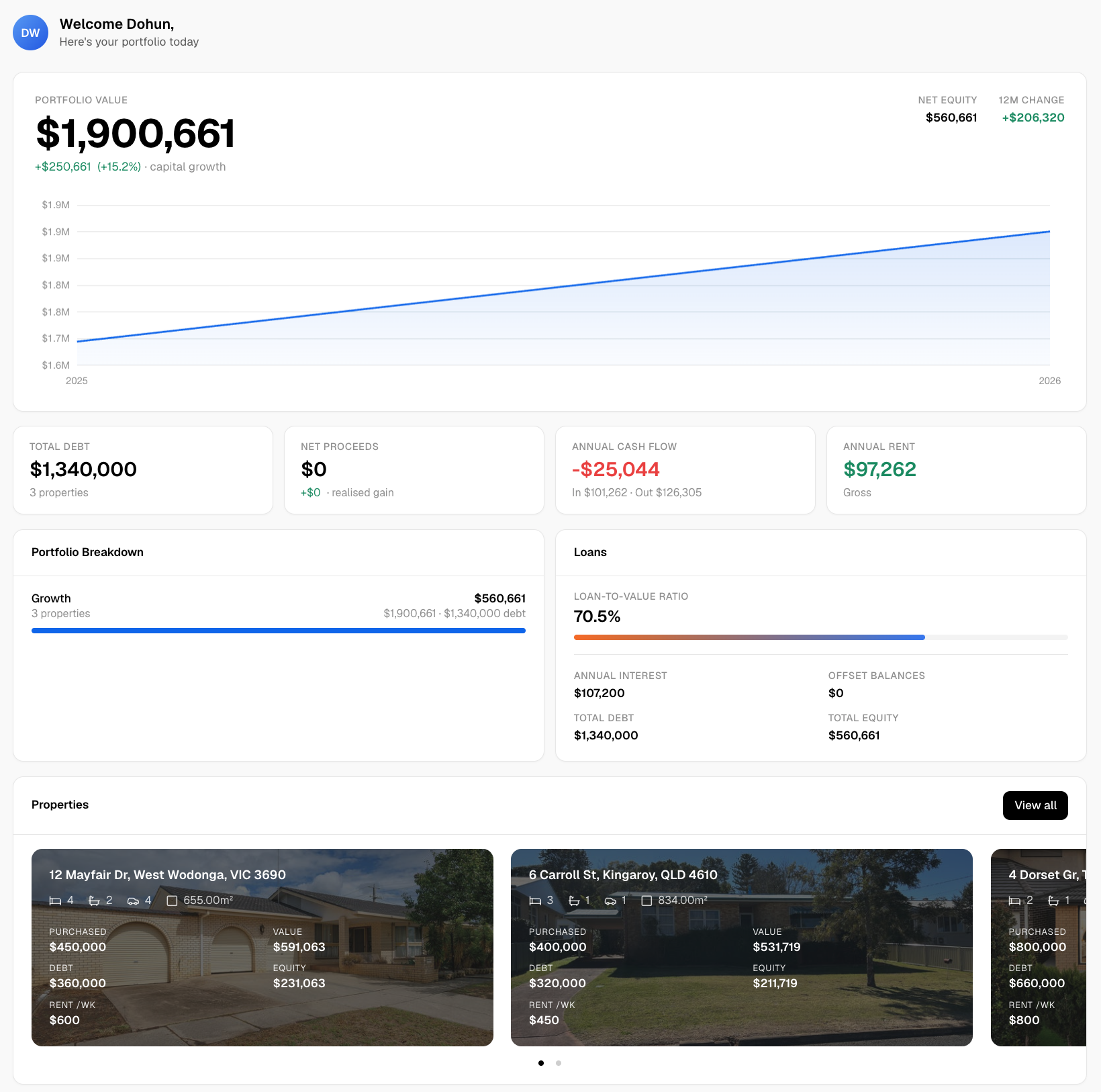
The feature set maps directly to the criteria this article covers: automated valuations on a quarterly schedule, editable scenario templates for rentvesting and buying, suburb-level market research with hazard overlays, portfolio tracking across multiple properties, and lender integration for borrowing-power estimates. The free plan delivers a property snapshot and a default rentvesting comparison within 48–72 hours of signup. Paid tiers unlock multi-property forecasting, full portfolio export, and advanced tax modelling.
Cancellation is straightforward, and your data exports with you. To run your first rentvesting scenario and see a borrowing-power estimate against a real Australian suburb, start your free trial at Wealthstacker and have a property address and loan details ready.
Authoritative Australian sources worth checking
Use these to sanity-check platform outputs against independent data before committing to a strategy.
| Source | What to verify |
|---|---|
| PropBoss Property Investment Software Guide | Decision-focused feature benchmarks; use to compare platform capabilities against industry standards. |
| PropertyTaxTools Rentvesting Calculator | ATO tax rate assumptions, stamp duty inputs, and multi-year modelling horizon; check against your platform’s outputs. |
| The Researcher: Best Property Investment Apps 2026 | Primary feed provenance, refresh cadence, and depreciation schedule coverage; use to verify data quality claims. |
When using these sources alongside a platform trial, focus on three comparisons: suburb comparable sales versus the platform’s automated valuation, rent yield assumptions versus local vacancy data, and the platform’s CGT treatment versus the ATO’s current 50% discount rules for assets held beyond 12 months. Any material gap between the platform’s output and these independent sources is worth raising with the platform’s support team before you rely on a long-term forecast.
This article is general information only and does not constitute financial, tax, or investment advice. Confirm current rules and assumptions with a qualified financial adviser or the ATO before making investment decisions.