
The role of leverage in building property wealth
TL;DR:
- Leverage in property investment allows controlling larger assets with borrowed money, amplifying wealth growth. Proper loan structuring, careful equity management, and maintaining cash reserves are essential to mitigate risks. Using Wealthstacker helps investors monitor their portfolio and make confident, informed decisions.
Leverage in property investment is defined as using borrowed money to control a larger asset than your own capital alone could buy. This financial mechanism sits at the heart of the role of leverage in building property wealth across Australia. Australian banks commonly lend up to 95% of a property’s value with lender’s mortgage insurance, meaning a $200,000 deposit can control a $1,000,000 asset. That 5x equity multiplier is the reason property has built more family wealth in this country than almost any other asset class. Used with discipline, borrowed capital turns modest savings into a portfolio that compounds over decades.
How does leverage work in Australian property investment?
Leverage works by letting you purchase a property worth far more than your deposit. Australian banks typically lend up to 80% LVR on residential property, and up to 95% with lender’s mortgage insurance. That structure creates a powerful multiplier effect on your initial capital.

The maths are straightforward. A $200,000 deposit on a $1,000,000 property means a 10% rise in property value delivers a $100,000 gain. That is a 50% return on your actual cash invested. Without leverage, the same $200,000 invested directly earns only a 10% return on the same price movement.
Once you own a property, you can access its growth through usable equity. Usable equity is calculated as 80% of the property’s current value minus your existing mortgage balance. Lenders typically release this equity through a separate loan account, which keeps your tax records clean and your rate options flexible. Understanding how equity works in property is the first step before drawing on it for a second purchase.
Loan structure matters as much as the deposit size. Investors choose between interest-only and principal-and-interest loans, fixed and variable rates, and stand-alone security versus cross-collateralisation. Each choice affects your cash flow, tax position, and ability to grow the portfolio.
- Interest-only loans reduce monthly repayments during the growth phase, freeing cash for maintenance and further deposits.
- Principal-and-interest loans build equity faster but require higher repayments.
- Fixed rates provide repayment certainty for budgeting.
- Variable rates allow offset accounts and extra repayments without penalty.
- Stand-alone security keeps each property’s loan separate, protecting portfolio flexibility.
Pro Tip: Avoid cross-collateralising your properties. When a lender holds multiple properties as security for one loan, selling or refinancing any single property requires their approval across the whole portfolio. Stand-alone loans give you far greater control.
What are the benefits and risks of using leverage to build property wealth?
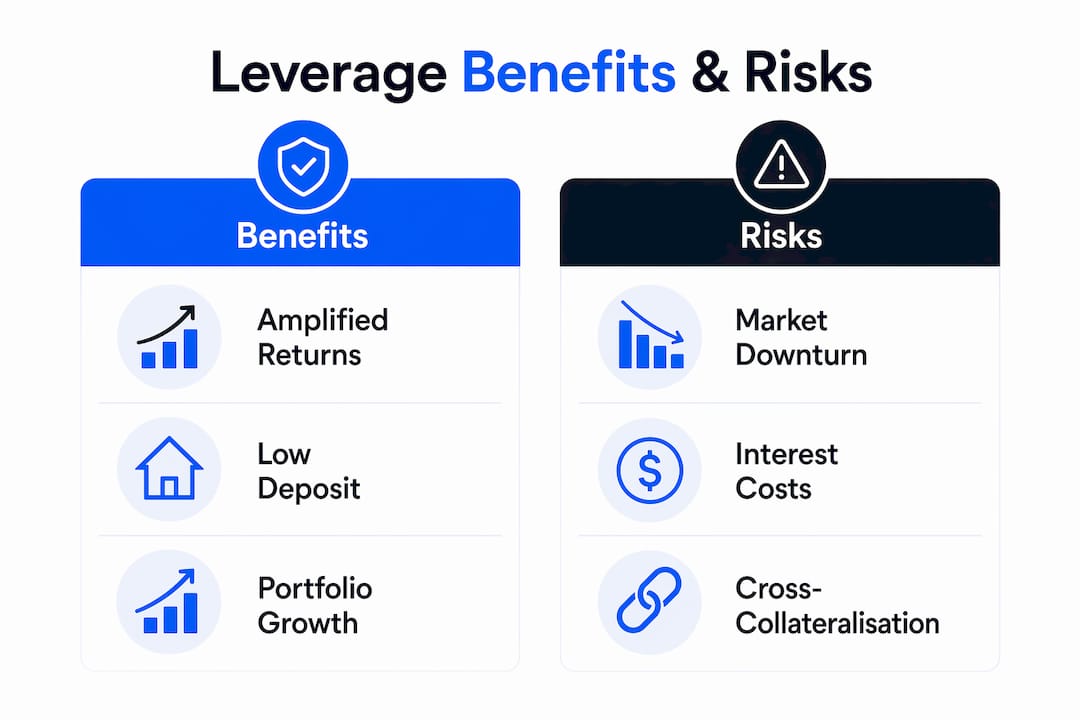
The primary benefit of using borrowed money in real estate is that your gains are calculated on the full property value, not just your deposit. A 7% annual growth rate on a $1,000,000 property generates $70,000 in wealth, even though you only contributed $200,000 of your own money. No other mainstream asset class in Australia offers this level of accessible, bank-funded amplification.
Property’s leverage advantage is not inherent to bricks and mortar. It comes from Australia’s banking system, which treats residential property as low-risk collateral and lends against it at high LVRs. Shares, by contrast, attract margin lending at much lower ratios and with far tighter margin call conditions. That structural difference is why property remains the preferred vehicle for building wealth through loans in Australian households.
The risks are equally real. Leverage magnifies losses just as effectively as it magnifies gains. A 10% fall in property value on a $1,000,000 asset wipes out 50% of a $200,000 deposit. About 20% of Australian investors carry high Debt-to-Income ratios, making them acutely sensitive to interest rate rises or sudden income loss. That figure from the Reserve Bank of Australia signals that over-leveraging is not a fringe problem.
Leverage does not create risk by itself. Over-leveraging, defined as borrowing beyond comfortable serviceability without an equity cushion or cash reserve, is what turns a growth tool into a financial liability.
Key risks to manage actively include:
- Vacancy periods that interrupt rental income and strain loan repayments.
- Interest rate rises that increase monthly costs without a corresponding income boost.
- Maintenance costs on older properties that erode cash flow unexpectedly.
- Market downturns that reduce property values and shrink usable equity.
Pro Tip: Maintain at least three months of loan repayments in a cash reserve or offset account. This buffer absorbs vacancy periods and rate rises without forcing a distressed sale.
Unlike shares, property demands active management throughout the investment cycle. Tenants, repairs, council rates, and insurance all require ongoing attention. Investors who treat property as a passive asset often find that poor management erodes the returns that leverage was meant to amplify.
How to structure property loans effectively for building wealth
Loan structure is where many investors leave money on the table. Poor loan structures and misunderstandings about interest deductibility increase the risk of leverage working against you rather than for you. Getting this right from the start protects both your tax position and your borrowing capacity for future purchases.
A structured approach to setting up investment loans follows a clear sequence:
- Separate your loans by property. Each investment property should carry its own stand-alone loan. This makes equity extraction, refinancing, and eventual sale far simpler.
- Use interest-only for investment properties. Interest-only repayments maximise tax deductibility on investment debt while keeping cash available for your owner-occupied mortgage, which carries no tax benefit.
- Split loans where appropriate. A split between fixed and variable portions gives you rate certainty on part of the debt while retaining offset account access on the variable portion.
- Attach offset accounts to variable loans. Every dollar sitting in an offset account reduces the interest charged daily, effectively earning a tax-free return equal to your loan rate.
- Review loan structures annually. Interest rates, property values, and your personal income all shift. A structure that worked two years ago may now limit your borrowing capacity or cost you unnecessary tax.
- Work with a mortgage broker. A broker who specialises in investment lending can align your loan structure with your long-term wealth plan, not just the next purchase.
Avoiding cross-collateralisation is the single most important structural decision for investors planning to hold more than one property. When properties are cross-secured, the lender controls your entire portfolio. Stand-alone security means each property stands on its own merits, and you retain the ability to sell, refinance, or draw equity independently.
Tax considerations have shifted in 2026. New residential builds retain full negative gearing following the 2026 Budget, while established properties face tighter treatment. This makes loan structuring on new builds particularly important, as the full interest cost remains deductible against rental income.
Pro Tip: Ask your accountant and broker to review your loan structure together at least once a year. Tax law changes and rate movements can make a previously sound structure inefficient within twelve months.
What practical strategies help families build lasting property wealth?
Building lasting wealth through property requires a plan that matches your borrowing to your income, your risk tolerance, and your long-term goals. Leverage accelerates the process, but only when applied with discipline. The families who build the strongest portfolios treat each purchase as part of a sequence, not a standalone decision.
Investors should deploy no more than 70% of usable equity at any one time. Keeping 30% in reserve protects against vacancy, unexpected repairs, and rate rises without forcing a sale. This rule prevents the most common mistake in real estate wealth accumulation: drawing every dollar of equity and leaving no buffer when conditions change.
Stress-testing your portfolio against a +2% to +3% interest rate rise is a non-negotiable step before any new purchase. Run the numbers on your current repayments at a higher rate and confirm you can still service all loans from income alone, without relying on rental income to fill the gap.
Practical strategies for families building a leveraged property portfolio:
- Start with one property and build equity before expanding. Rushing to a second purchase before the first has grown limits your options and stretches cash flow.
- Match each purchase to your income. Your salary and rental income together must comfortably cover all loan repayments at a stressed rate.
- Prioritise new residential builds in 2026. Full negative gearing on new builds makes the after-tax cost of borrowing lower than on established properties under current rules.
- Diversify across locations and property types. Concentrating in one suburb or one property type exposes the whole portfolio to a single market downturn. Portfolio diversification in property reduces this risk materially.
- Track equity and loan balances quarterly. Property values shift, and your usable equity position changes with them. Regular tracking tells you when you are ready to act and when to hold.
| Strategy | Why it matters |
|---|---|
| Deploy no more than 70% of usable equity | Preserves a cash buffer for vacancies and rate rises |
| Stress-test at +2% to +3% rate rise | Confirms loan serviceability under adverse conditions |
| Use stand-alone loan security | Keeps each property’s equity accessible independently |
| Prioritise new builds in 2026 | Full negative gearing reduces after-tax borrowing costs |
| Review loan structure annually | Adapts to rate changes, tax law, and portfolio growth |
Learning how to scale a rental portfolio step by step gives families a clear framework for moving from one property to many without overextending at any stage.
Key takeaways
Borrowing to invest in property builds wealth by amplifying returns on capital, but only when loan structure, equity management, and cash reserves are managed with discipline.
| Point | Details |
|---|---|
| Leverage multiplies returns | A $200,000 deposit controlling a $1,000,000 property turns a 10% gain into a 50% return on capital. |
| Usable equity funds growth | Calculate usable equity as 80% of property value minus the existing mortgage, then access it via a separate loan. |
| Stand-alone security protects flexibility | Avoid cross-collateralisation so each property can be sold or refinanced independently. |
| Deploy only 70% of usable equity | Keep a 30% buffer to cover vacancies, repairs, and interest rate rises without a forced sale. |
| Stress-test before every purchase | Model your repayments at +2% to +3% above current rates to confirm you can service all loans. |
Wealthstacker: your property leverage toolkit
Managing a leveraged property portfolio means tracking equity positions, loan balances, and cash flow across multiple properties at once. Wealthstacker brings all of that into one place, with automated quarterly valuations, AI-powered modelling, and real-time net worth forecasting built for Australian investors.
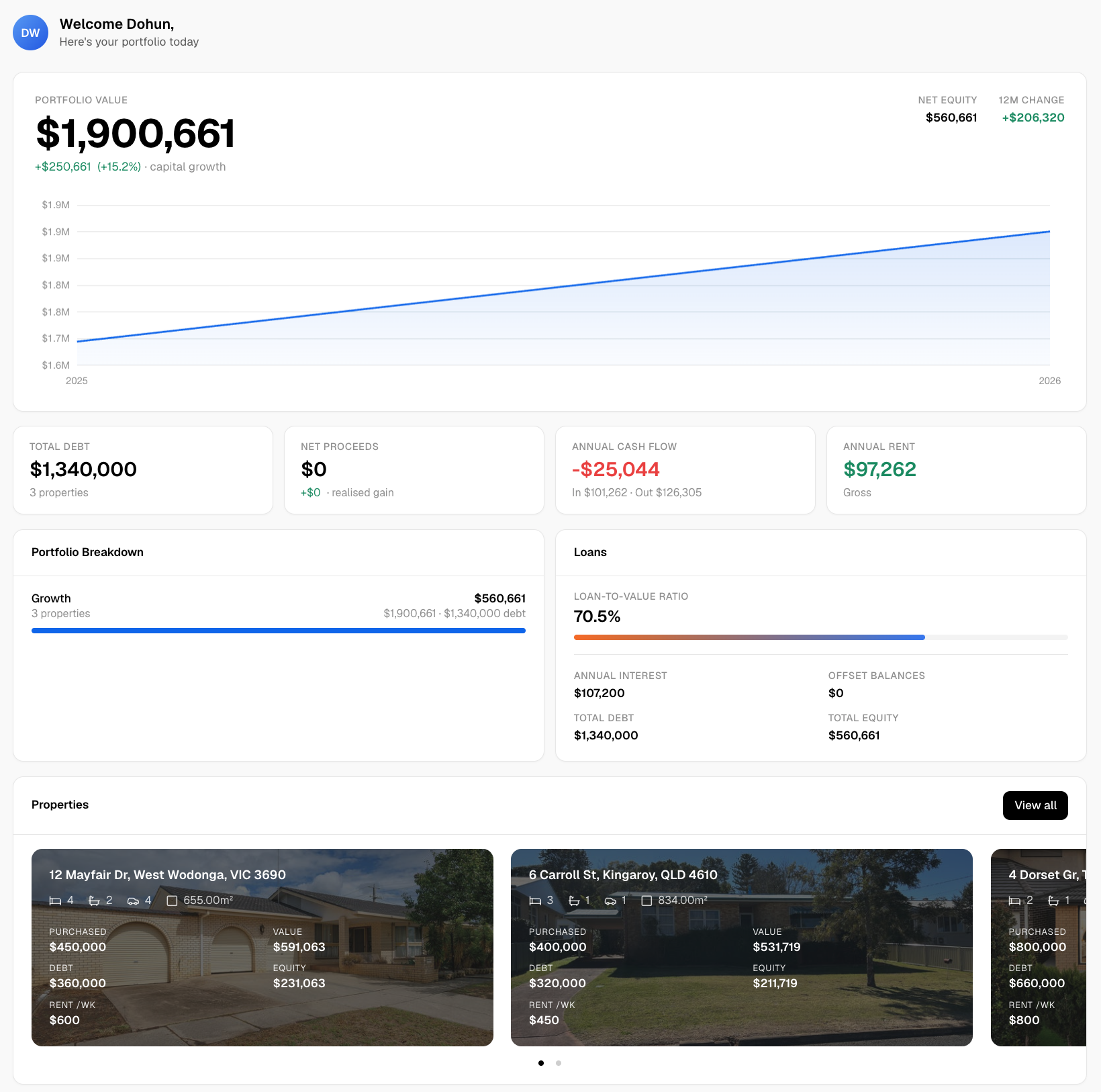
Whether you are assessing your borrowing power for a first investment or managing an existing portfolio, the Wealthstacker property investment app gives you the visibility to make confident decisions. The platform models both rentvesting and direct ownership strategies, so you can compare paths and choose the one that fits your income, equity, and long-term goals. Clear data leads to better borrowing decisions.
FAQ
What is the role of leverage in building property wealth?
Leverage lets investors control a property worth far more than their deposit, amplifying returns on capital. A 10% rise in a $1,000,000 property delivers a 50% return on a $200,000 deposit.
How much equity should I use when investing in property?
Deploy no more than 70% of your usable equity at any one time. Keeping a 30% reserve protects against vacancy periods and interest rate rises without forcing a sale.
What is usable equity and how is it calculated?
Usable equity is 80% of your property’s current value minus your existing mortgage balance. Lenders typically release this amount through a separate loan account to fund a new purchase.
Why should I avoid cross-collateralisation?
Cross-collateralisation ties multiple properties to one loan, giving the lender control over your whole portfolio. Stand-alone security keeps each property independent, making refinancing and selling far simpler.
How do I stress-test my property portfolio?
Model your loan repayments at 2% to 3% above your current interest rate and confirm you can service all loans from income alone. This exercise reveals whether your portfolio can survive an adverse rate environment.