
Stocks vs Property: Which Suits an Australian Investor?
Neither wins outright. Over very long periods, Australian shares and residential property have delivered similar total returns, so the better choice for you depends on your deposit, your time horizon, how much hassle you will tolerate and how you feel when your balance drops. Shares are cheaper to start, easier to sell and simpler to diversify. Property lets you borrow more, brings rent and a tangible asset, but costs more to buy and sell and ties up a lot of money in one place.
This guide compares the two on the things that decide real outcomes: returns, costs, tax, leverage, liquidity, effort and fit. It finishes with a practical way to work out your own mix.
WealthstackerModel Your Property Investment OptionsWealthStacker helps you compare buying and rentvesting strategies with personalized modeling and forecasts for your potential net worth.Explore WealthStackerTL;DR
- Long-run data since 1926 shows shares and property returning roughly the same, about 11% a year with income reinvested. Any single year or decade can favour either.
- Shares win on low entry cost, liquidity and diversification. Property wins on easy access to large-scale borrowing and, if it is your home, on tax.
- Gearing magnifies gains and losses in both. Higher returns on paper always come with higher risk.
- Most Australians do not have to pick one. A mix, sized to your goals and horizon, is common.
- Model your own numbers before committing: the same asset can look great or poor depending on your deposit, income and costs.
Table of Contents
- What the long-term numbers say
- How shares and property work as investments
- Costs: where the two differ most
- Tax: what the ATO says
- Leverage: the biggest swing factor
- Liquidity, diversification and effort
- Which one fits you?
- Test your own numbers
- Track what you own
- FAQ
- Sources
What the long-term numbers say
The headline comparison favours neither side. Data going back to 1926 suggests Australian shares returned 11.2% a year and residential property 10.9%, assuming dividends and rent, after costs, were reinvested. That is a gap you would never notice in a single decade of real life.
Shorter windows tell different stories, which is why articles on this topic often disagree. In 2025, national median home values rose 8.6%, for a total return of 12.4% including rent, while ASX 200 shares rose 6.8% for a total return of 10.32%. Pick a different year, such as one with a sharp share-market fall or a rate-hike cycle that cooled housing, and the order flips.
Two cautions when you read any comparison:
- Check what is being measured. Capital growth alone ignores rent and dividends. Total return includes them. Property figures also vary depending on whether holding costs such as rates, insurance, maintenance and agent fees are deducted.
- Check whose money it is. A headline property return is usually on the whole asset value, while your real return depends on how much of your own money went in and what the loan cost you.
The practical lesson: do not choose on a chart. Choose on how each asset behaves for your finances.
How shares and property work as investments
Both are growth investments. As Moneysmart explains, shares are parts of companies, while property may provide rent and can rise or fall in value. It also notes that both generally suit goals at least five years away, that shares can fall quickly, and that selling property can take time and be expensive.
Shares
You own a slice of a business and earn through share price growth and dividends. You can buy in small parcels, spread across many companies through diversified funds, and sell on any business day. Dividends from Australian companies often come with franking credits, which can matter at tax time, so check your own situation with a registered tax agent.
Property
You own a single, physical asset. Returns come from rent and from price growth in that particular suburb and property type. You can add value through renovation or by choosing the location well, but you can also be exposed to vacancies, repairs and local oversupply. Our guide to gross rental yield shows how to read the income side before you buy.
Costs: where the two differ most
The return on a chart is before the friction of getting in and out. This is where shares and property are furthest apart.
| Factor | Shares | Investment property |
|---|---|---|
| Minimum to start | A small parcel, often a few hundred dollars | A deposit plus costs, typically tens of thousands |
| Buying costs | Brokerage or fund fees | Stamp duty (varies by state), legal and inspection costs, loan fees |
| Ongoing costs | Fund management fees if you hold funds | Council rates, insurance, maintenance, agent fees, land tax in most states |
| Selling costs | Brokerage | Agent commission, marketing, legal costs |
| Sale timing | Next business day or so | Often months from listing to settlement |
Stamp duty alone can run into five figures on a typical investment purchase, and rates differ by state and territory, so use your state revenue office calculator for an exact figure. Those costs mean a property must grow before you are even level. Shares have a lower hurdle, but frequent trading and high-fee products can erode returns too.
Tax: what the ATO says
The tax treatment is more similar than most people expect, with one big exception.
- Capital gains tax applies to both. According to the Australian Taxation Office, shares and investment property are both subject to CGT when you dispose of them, and you may be eligible for a 50% discount if you held the asset for at least 12 months.
- Your own home is different. The ATO notes that a main residence is generally exempt from CGT, an advantage no standard investment asset has. This is why many Australians put the first dollars into a home they live in, and why some renters weigh up buying against investing elsewhere.
- Negative gearing. When rent does not cover costs and interest on an investment property, the loss can generally be offset against other income, subject to the rules. Our explainer on negative gearing rules and cash flow models walks through the primary law and what it means for cash flow. Remember that a deduction reduces tax, it does not turn a loss into a gain.
Tax settings change, and every investor’s position is different. Before you buy or sell, check the current ATO guidance or speak to a registered tax agent. It is also worth remembering that tax regimes differ sharply between countries: if you ever consider overseas property, capital gains tax on overseas property follows another country’s rules entirely and is not the same as Australian CGT.
Leverage: the biggest swing factor
Most of the story of property wealth in Australia is the story of borrowing. A mortgage lets you control an asset worth many times your deposit, which magnifies growth. It also magnifies losses.
Moneysmart is clear that borrowing to invest can amplify returns but significantly increases risk. It lists larger losses, interest rate risk if repayments rise, and investment income risk if rent or dividends fall.
The two types of borrowing behave differently:
- Property loans are secured against the property and typically have no daily revaluation trigger. If prices dip, you still make repayments, but you are not forced to sell the next morning.
- Margin loans for shares usually require you to keep the loan-to-value ratio below an agreed level, typically 70%. If the ratio is breached, a margin call can force you to add cash or sell at a bad moment.
That difference is a real reason many Australians find property leverage more practical. It is not a reason to borrow more than you can service when rates rise or a tenant leaves. If you are considering using equity from one property to buy another, read about APRA buffers and ATO tax risk when borrowing against equity and the pitfalls of cross-collateralised loans.
Liquidity, diversification and effort
Liquidity. Shares can be sold on any business day. Property typically takes months of preparation, marketing, contracts and settlement, and you cannot sell a bathroom or a bedroom to cover a short-term need. If you might need the money within five years, Moneysmart suggests growth assets may not be the right home for it in the first place.
Diversification. One share fund can hold hundreds or thousands of companies across industries and countries. One property is one building in one suburb. You can diversify property by buying several, but that takes a lot more capital and borrowing capacity.
Effort. Shares can be close to hands-off if you use diversified funds and regular contributions. Property involves tenants, managers, repairs, insurance renewals and compliance. Some investors enjoy the control. Others prefer to outsource it, which costs money. For ways to keep it low effort, see our piece on passive property strategies for busy professionals.
Behaviour. Shares show a price every second, which makes panic selling easy. Property is valued rarely, which can feel calmer but may simply hide the volatility. A strategy you can hold through a downturn beats a theoretically better one you abandon.

Which one fits you?
Use your situation rather than a slogan.
You are starting with a small amount
Shares or diversified funds let you begin now and add regularly. Property usually needs a deposit, costs and borrowing capacity first. If you are saving for a deposit, you may still invest part of your savings in the meantime, provided the timeframe is long enough to ride out falls.
You are a renter weighing up buying
Buying a home to live in gets the main-residence CGT exemption, but ties your cash to one suburb. Some renters choose to live where they want and invest elsewhere, an approach known as rentvesting. The trade-offs are real, and our guide to rentvesting risks in Australia lists what to check before you commit.
You have strong income and borrowing capacity
Property leverage and negative gearing may be worth modelling, with a buffer for higher rates and vacancies. Test the plan against slower growth, not just the optimistic case.
You want flexibility
Shares give you access to your money and the ability to adjust as life changes. Property commits you for years.
You want both
Many investors hold a home, a share portfolio and possibly an investment property over time. The question becomes how much to put in each and in what order. A useful way to decide is to write down your timeframe, how much you could lose without changing your life, and what you can afford to pay each month if interest rates rise.
Test your own numbers
General comparisons average out the details that matter to you: your deposit, your suburb, your rate, your tax bracket. We built WealthStacker to bring those into one place. It gives you free automated quarterly property valuations, a dashboard that tracks property, shares and crypto together, and a 15-year modelling tool that compares rentvesting and buying scenarios. It also offers goal and net worth planners and a borrowing power estimate, so you can see how different choices might shape your net worth over time. The forecasts are modelled estimates, not guarantees.
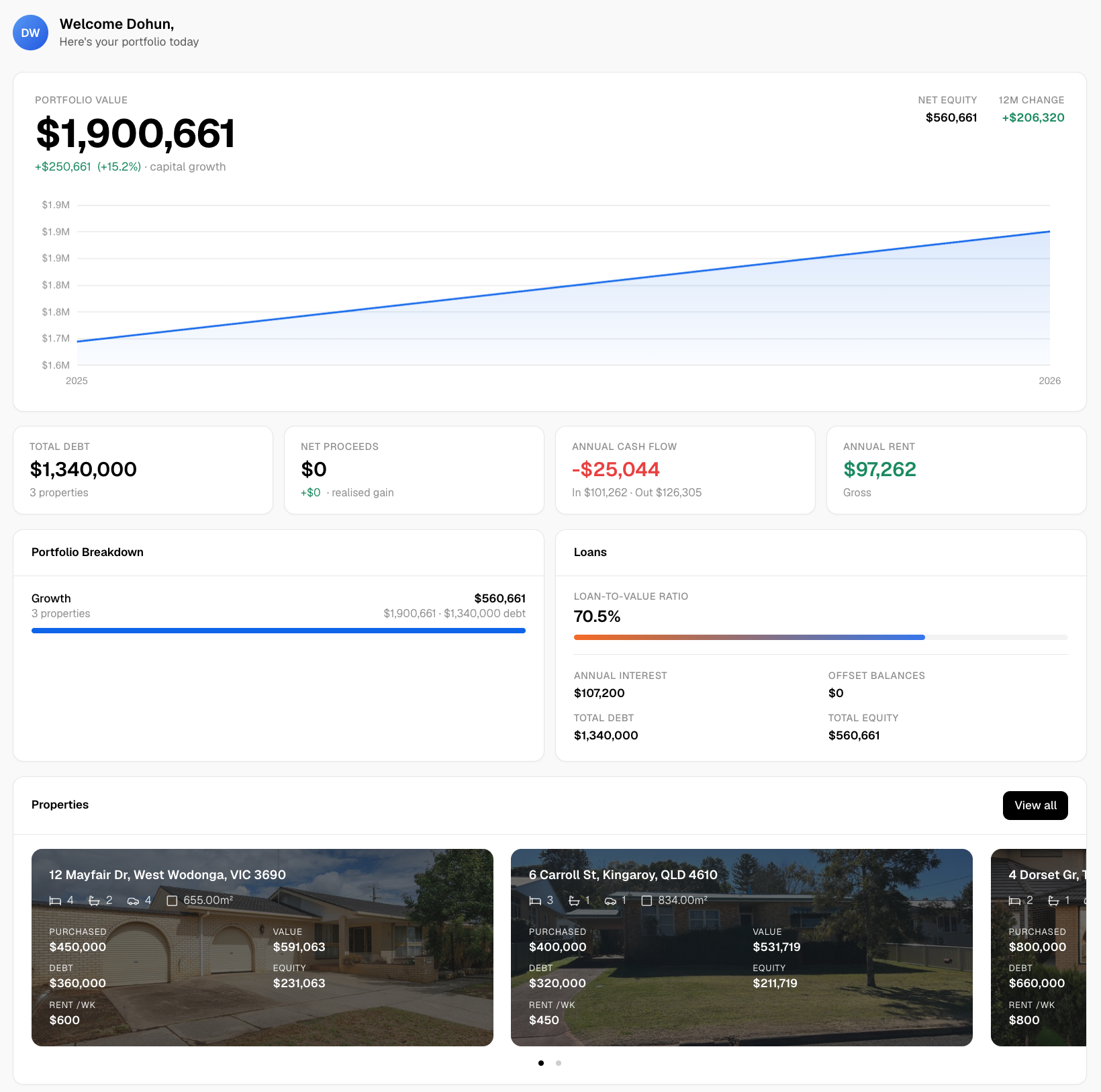
You can explore WealthStacker to see how your own mix of property and shares might develop. For the long view on property assumptions, our 15-year property forecast sets out three scenarios, and our ABS-based long-term projections explain the data behind them.
Track what you own
Once you hold both, measuring them on the same basis matters. Compare total return, not just price growth, and include costs and borrowing. Our portfolio performance metrics checklist shows which numbers to look at and how often.
FAQ
Is it better to invest in shares or property?
There is no universal answer. Long-run Australian data shows similar returns, so the choice rests on your capital, borrowing capacity, time horizon and temperament. Shares suit smaller, flexible, low-effort investing. Property suits those who want to use a mortgage and can hold for the long term.
Do shares or property have lower costs?
Shares generally cost much less to buy and sell. Property involves stamp duty, legal fees, agent commissions and ongoing holding costs, which vary by state and property. These are part of why property usually needs time to grow before you break even.
Is capital gains tax the same for shares and property?
Broadly, yes for investments. The ATO applies CGT to both and may allow a 50% discount if you held the asset for at least 12 months. Your main home is generally exempt. Confirm your own position with the ATO or a registered tax agent.
Can I invest in both shares and property?
Yes, and many Australians do over time, for instance by buying a home, building a share portfolio and later adding an investment property. Decide the proportion based on your goals, how long you can invest and how much risk you can handle.
Sources
- Choose your investments, Moneysmart
- Borrowing to invest, Moneysmart
- Capital gains tax, Australian Taxation Office
- Rental properties guide 2026, Australian Taxation Office
- Shares vs. property: What $100 invested in 1926 is worth now
- Shares vs. property: Which delivered the best capital growth in 2025