
Stocks vs Property Returns in Australia: What the Data Shows
Over the very long run, Australian shares and Australian residential property have delivered similar total returns. Which one comes out ahead depends on the period you pick, whether you borrow, and how much tax and cost you absorb along the way. Research by AMP’s Shane Oliver, reported in The New Daily, put property at about 11% a year since 1926, almost level with the sharemarket’s 11.3%, with much less volatility. Shorter, more recent windows tell a different story, and that gap is where most arguments start.
WealthstackerCompare Your Property Investment PathWealthstacker helps you assess property strategies with AI tools, personalized modeling and automated quarterly valuations.Explore WealthstackerTL;DR
- Long-run total returns for Australian shares and housing are close: about 11% a year each since 1926, on the figures AMP’s chief economist cited.
- Recent comparisons depend on the window and on costs. A 10-year Betashares model had equities ahead of a Sydney investment property once interest and costs were counted.
- Property is usually bought with a loan, which magnifies gains and losses. Shares can be bought outright in small amounts.
- Tax differs: dividends carry franking credits, rent is taxed as income, and both can attract the 50% CGT discount after 12 months. A proposed change from July 2027 is worth watching.
- The better choice is often a mix, set by your cash flow, time horizon and appetite for volatility.
Table of Contents
- What the long-run numbers say
- A recent 10-year comparison, with costs included
- Volatility: how bumpy each ride is
- Leverage: the biggest difference in practice
- Income, costs and what you actually keep
- Tax: dividends, rent and capital gains
- How to choose between shares and property
- Compare both paths with your own numbers
- FAQ
- Sources
What the long-run numbers say
The headline figure most Australians hear is that shares and property “both return around 8 to 10%”. That is an average across thousands of different assets, and it hides how different the two paths feel.
The AMP research cited above splits the return into two parts. The sharemarket’s average dividend yield is 4.5%, close to 6% once franking credits are included. Capital city houses and units yield 3.2% gross, or 2 to 3% after tax and costs. So shares lean on income, and property leans on capital growth, which is why the totals can land in the same place while the journeys look nothing alike.
Studies that start at different dates or measure different things reach different answers. A 20-year view from the mid-2000s tends to flatter property, because Australian housing went through a long boom. A comparison that starts in the 1970s and adjusts for inflation can favour shares. Treat any single percentage as a snapshot of one window, not a forecast.

A recent 10-year comparison, with costs included
Betashares published a hypothetical 10-year model covering 30 September 2015 to 30 September 2025. In it, an Australian equities strategy finished about $74,000 ahead of a Sydney investment property strategy ($854,388 against $780,056). An international equities strategy widened the gap to roughly $310,000 ($1,090,070).

The model’s property side carried around $410,000 in interest and about $125,000 in associated costs over the decade. That is the useful lesson: a leveraged property can show strong price growth and still trail on net wealth once holding costs are counted. It is a model with stated assumptions, not a promise, and a different city, purchase price or loan would change the result.
The same source notes that Sydney house rental yields now sit around 3%, down from close to 5% in the early 2000s. Median prices have risen to roughly $1.75 million as of February 2026, which is about 13 to 14 times Australian median household income. When yield falls and prices rise, more of your return has to come from growth. For the mechanics, see our guides to rental yield vs capital growth and gross rental yield.
Volatility: how bumpy each ride is
The ATO’s Tax, Super + You datasheet shows one-year returns on $100,000. Property returned $6,700 in 2014, a loss of $7,400 in 2019 and a gain of $16,800 in 2021. Shares returned $5,310 in 2014, $23,020 in 2019 and a loss of $16,500 in 2022.
Two things stand out. First, both asset classes lose money in some years. Second, the years do not line up: 2019 was weak for property and strong for shares, and 2022 hurt shares while property was not the problem. That mismatch is the case for holding both.
A caution on how property volatility looks. Home values are estimated, not priced every second, so property seems calmer than it is. You feel it only when you sell, refinance or face a rate rise. Shares show a new price daily, which makes the swings visible and the temptation to react stronger.
Leverage: the biggest difference in practice
Most investors buy property with a loan and buy shares with savings. Borrowing amplifies outcomes in both directions.
Moneysmart describes borrowing to invest as a medium to long term strategy, at least five to ten years. Its listed risks include bigger losses, capital risk, investment income risk and interest rate risk. If you borrow through a margin loan, lenders require the loan-to-value ratio to stay below an agreed level, usually 70%. If it rises above that, you get a margin call, generally with 24 hours to bring it back.
A mortgage on a property behaves differently from a margin loan. There is no daily margin call, which is a real comfort in a falling market. But you are tied to repayments whatever happens to rents and rates, and you cannot sell a bedroom to raise cash. If you plan to gear, model the repayments at a higher rate than today’s, and check your borrowing power before you decide how much risk you can carry.
Income, costs and what you actually keep
| Factor | Australian shares | Residential property |
|---|---|---|
| Income | Dividends, often franked | Rent, less vacancy and expenses |
| Entry size | Small amounts possible | Deposit plus stamp duty and fees |
| Ongoing costs | Fund fees or brokerage | Rates, insurance, maintenance, management, interest |
| Liquidity | Sell in days | Selling takes weeks to months |
| Diversification | Hundreds of companies in one fund | One asset, one suburb |
| Leverage | Optional | Usual |
The row that surprises people is diversification. One investment property is a single bet on one street, one tenant and one local market. A broad share fund spreads across many businesses and sectors. Property investors can diversify across suburbs and cities over time, and our piece on portfolio diversification in property explains how.
Hazard exposure is another cost people overlook. Flood, bushfire and cyclone risk can affect insurance premiums and resale value in particular suburbs, which is why we include hazard and risk overlays in our market research tools.
Tax: dividends, rent and capital gains
Tax can move the outcome by as much as asset choice does, so compare after-tax numbers.
- Capital gains: an Australian resident individual who holds an asset for at least 12 months can generally reduce the gain by 50%, as the ATO explains. That applies to both shares and investment property.
- Rental income: it is taxable, and a rental is negatively geared when deductible expenses exceed the income it earns, and positively geared when they do not. Our guide to negative gearing rules walks through the cash flow.
- Dividends: franking credits attach to many Australian company dividends, which is why the AMP figure for the sharemarket’s yield rises to close to 6% with them.
- Your tax rate: a deduction is worth more at a higher marginal rate. See tax strategies for high-income earners.
A proposed change to watch
Labor has proposed replacing the 50% CGT discount from July 2027 with an inflation-linked discount and a 30% minimum tax, as ABC News explained. Gains made on existing investments before the start date would keep the old discount, and investors in new-build homes could choose it. It is a proposal, so check the ATO and Treasury for the current law before you act, and speak to a registered tax agent about your own position.
How to choose between shares and property
There is no universal winner. These questions usually decide it.
- How long can you hold? Moneysmart’s five to ten year minimum for borrowed investing is a sensible floor for either asset when geared.
- Do you need income now or growth later? Shares lean toward income, property toward growth, on the yields above.
- How would a 20% fall feel? If you would sell in a panic, a smaller, less leveraged position suits you better.
- Do you already own a home? Your own home is already a large property exposure, so adding shares may balance your wealth.
- Are you renting by choice? Renters can invest in shares while they rent, or buy an investment property in a cheaper market. Our guide to rentvesting risks covers what to check first.
- What can you afford if rates rise? Stress-test the loan, not just the current repayment.
Many Australians end up with both: a home or investment property for leveraged growth, plus shares or ETFs and super for liquid, diversified exposure. Over decades, consistent contributions usually matter more than choosing the perfect asset. Our long-term property projections show how growth assumptions compound over time.
Compare both paths with your own numbers
Averages are useful, but your outcome depends on your income, deposit, rent and the suburb. WealthStacker is built to help you test that. It offers free automated quarterly property valuations, a 15-year modelling tool that compares rentvesting and buying scenarios, a net worth and goal planner, and market research for Australian suburbs.
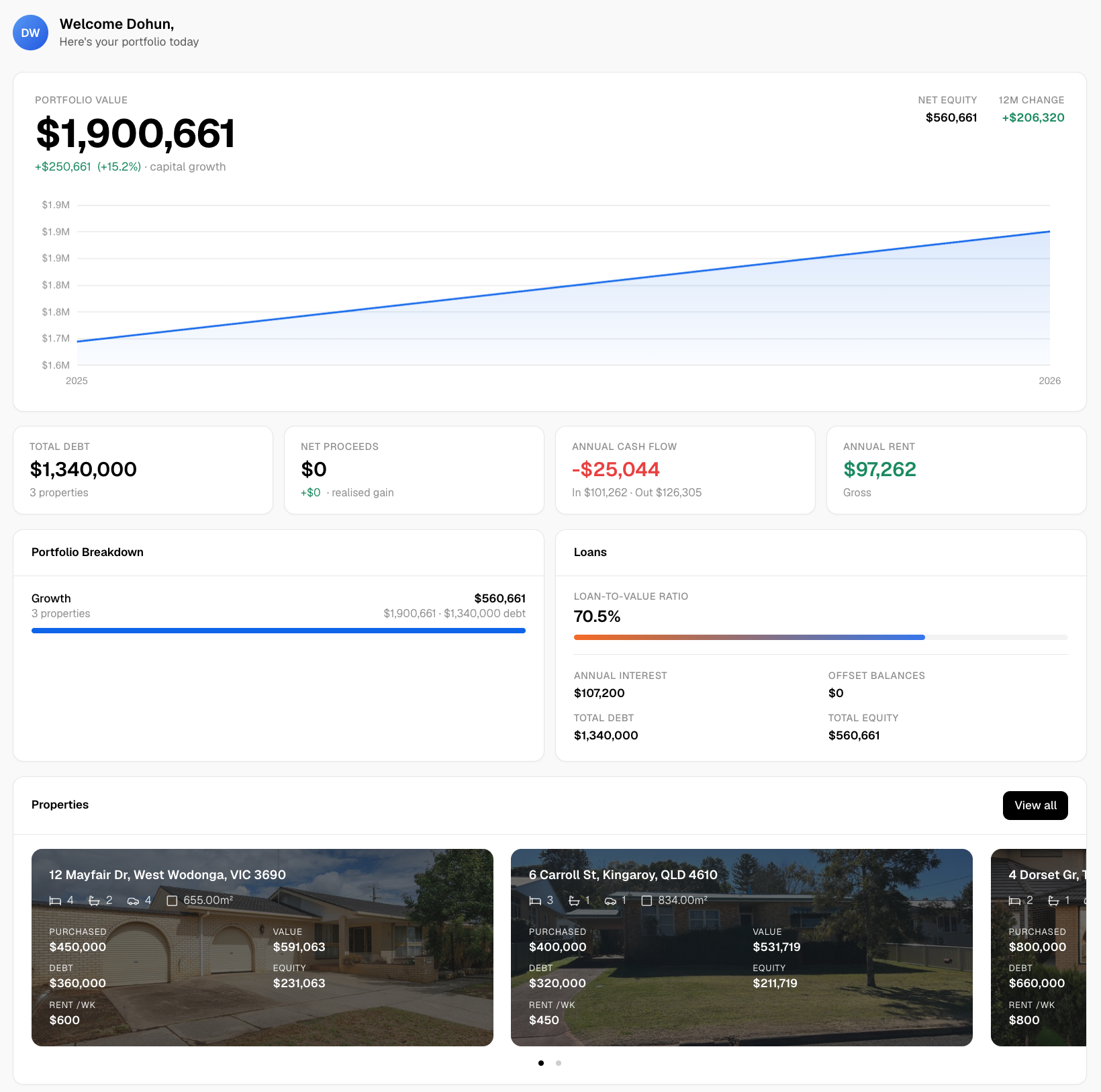
You can join WealthStacker to model your own scenario instead of relying on a headline percentage. Our modelling is a planning aid, not a prediction or financial advice.
FAQ
Which is better in Australia, shares or property?
Neither wins in every period. Long-run total returns are close, about 11% a year each since 1926 on AMP’s figures, while some 10-year models favour shares after interest and costs. The right mix depends on your time horizon, borrowing and risk tolerance.
Do shares or property have lower risk?
Both lose value in some years, and the ATO datasheet shows they often do so in different years. Property is usually bought with a loan, so a downturn can hurt more, and one property is a single concentrated bet. A diversified share fund spreads risk across many companies.
Is property or shares better tax-wise in Australia?
Both can receive the 50% CGT discount after 12 months. Property adds negative gearing deductions when expenses exceed rent, and shares add franking credits on many dividends. A tax agent can model your own rate, and the proposed July 2027 CGT change is worth monitoring.
Can I invest in both?
Yes, and many investors do. A common pattern is a property for leveraged growth and a share or ETF portfolio for liquidity and diversification. Modelling both side by side shows what your combined net worth could look like over time.
Sources
- Evan Thornley’s plan to get super funds into housing, The New Daily
- Revisiting the age-old debate: Shares vs property, Betashares
- Investment returns, Tax, Super + You
- Borrowing to invest, Moneysmart
- How to calculate your CGT, Australian Taxation Office
- How to claim rental expenses, Australian Taxation Office
- Labor’s capital gains tax changes explained, ABC News