
Role of superannuation property investment explained
TL;DR:
- Superannuation property investment uses Australian super funds, especially SMSFs, to acquire real estate for retirement wealth. Proper compliance with regulations ensures tax advantages and avoids penalties that can reach 45% of fund income.
Superannuation property investment is defined as the use of Australian superannuation funds, most commonly a Self-Managed Super Fund (SMSF), to acquire and hold real estate assets as part of a retirement savings strategy. The role of superannuation property investment is to give investors a tax-efficient, controlled vehicle for building wealth through property within the strict framework of Australian superannuation law. Under the Superannuation Industry (Supervision) Act 1993, commonly called the SIS Act, every investment decision inside a super fund must serve the sole purpose of providing retirement benefits. Getting this structure right delivers real advantages. Getting it wrong triggers penalties that can reach 45% of fund income.
How do SMSFs use superannuation funds to invest in property?
A Self-Managed Super Fund is a private superannuation trust that gives members direct control over their investment decisions, including the ability to hold real property. Unlike retail or industry super funds, an SMSF allows trustees to select specific assets, including commercial premises, residential property (subject to restrictions), and rural land. That control comes with full trustee responsibility for compliance.

Direct purchase vs borrowing
An SMSF can buy property outright if it holds sufficient cash. More commonly, funds use a Limited Recourse Borrowing Arrangement (LRBA) to borrow money for the purchase. Under an LRBA, the property is held in a bare trust until the loan is repaid, protecting other fund assets if the borrower defaults. The SMSF receives the beneficial interest in the property from day one, but legal title stays with the bare trustee until the debt is cleared.
From 10 august 2026, SMSF borrowing rules changed significantly. SMSFs can no longer use LRBAs to acquire residential property. Borrowing is now restricted to business real property used wholly and solely for business purposes. This change reshapes the leverage options available to most SMSF investors.
Lending conditions and fund size
SMSF lenders commonly require a deposit of 20–30% and charge interest rates 0.5–1.5% above standard loan rates. Lenders assess the SMSF’s income, not the personal income of its members. That distinction matters because a fund with low rental income or contributions may not satisfy serviceability requirements even if the members earn well personally.
The minimum effective fund balance for cost-effective SMSF property investment sits at around $250,000, with the ATO noting that funds below $200,000 may struggle to absorb compliance costs. A fund that is too small will spend a disproportionate share of its returns on accounting, auditing, and legal fees.
- The SMSF must have a documented investment strategy before acquiring property.
- The bare trust and corporate trustee must be established before contracts are signed.
- The property must be purchased at market value from an unrelated party (with limited exceptions for business real property).
- Rental income flows into the fund and is taxed at the concessional super rate of 15% during accumulation phase.
- An SMSF can lease commercial property to a related business at market rent, which is one of the most tax-effective structures available.
Pro Tip: Set up the bare trust and corporate trustee before you sign any purchase contract. Reversing the sequence can trigger double stamp duty and invalidate the LRBA structure entirely.
What are the key legal and compliance rules?
SMSF property investment sits inside one of the most regulated corners of Australian financial law. Trustees who treat compliance as an afterthought face consequences that are personal, financial, and permanent.
The sole purpose test
Section 62 of the SIS Act enforces the sole purpose test, which requires every SMSF investment to exist solely to provide retirement benefits to members. This means a trustee cannot live in, holiday in, or allow family members to use a residential property owned by the fund. The rule applies even if the trustee pays market rent. The ATO treats personal use of SMSF residential property as a clear breach.
Arm’s length and NALI rules
- Every SMSF property transaction must be conducted at market value, with independent valuations documented at the time of purchase and annually thereafter.
- Rent charged to any related party must reflect current market rates, supported by a formal lease agreement.
- Non-Arm’s-Length Income (NALI) penalties can reach 45% tax on income derived from non-arm’s-length transactions, making under-market rent arrangements extremely costly.
- In-house asset rules limit related party property acquisitions to 5% of the fund’s total assets.
- Non-compliant SMSFs risk tax penalties up to 45%, administrative fines, and trustee disqualification.
Trustees are personally liable for every compliance breach. That liability does not disappear if a trustee delegates decisions to an adviser. The ATO can disqualify trustees, freeze fund assets, and refer serious cases for prosecution.
Pro Tip: Commission an independent property valuation every year and keep the report on file. Auditors request this documentation routinely, and missing records are treated as a compliance failure.
A common misconception is that SMSF members can access fund-owned property before retirement. All SMSF investments must align with the retirement benefit purpose and the fund’s documented investment strategy. Early access is not a grey area. It is a breach.
What are the benefits and risks of property in super?
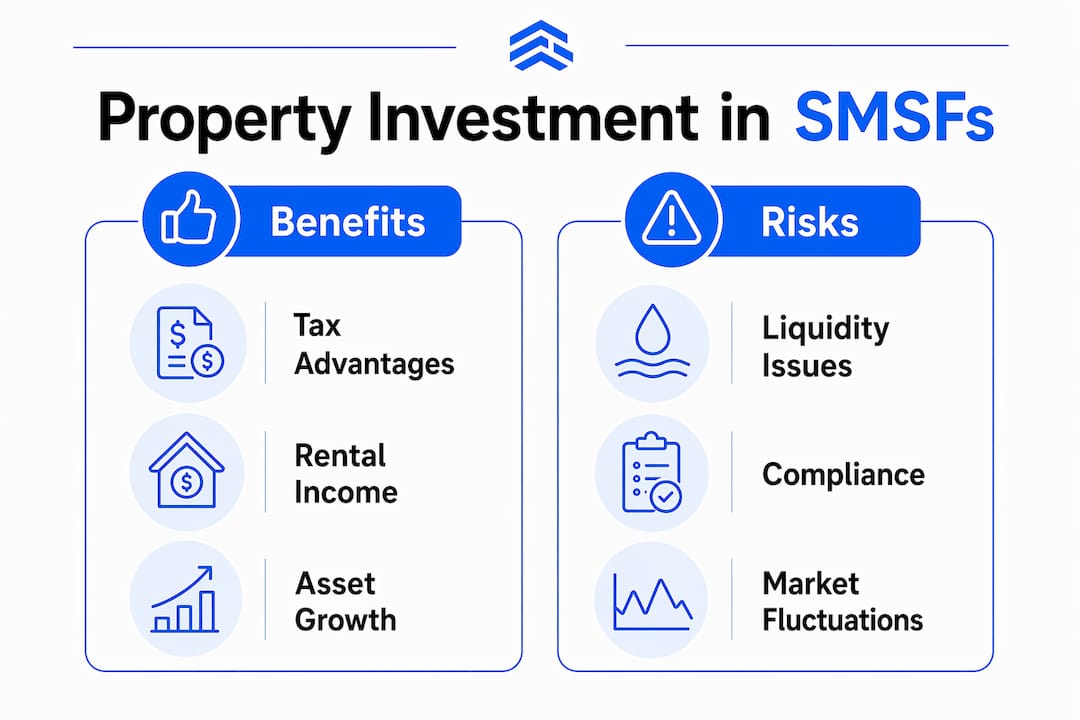
Property inside superannuation offers genuine tax advantages, but it also introduces risks that do not exist in personal property ownership. Understanding both sides is the foundation of a sound superannuation investment strategy.
Tax advantages
During the accumulation phase, rental income earned inside an SMSF is taxed at 15%, compared to the marginal tax rate that applies to personally held investment property. Capital gains on assets held longer than 12 months attract a one-third discount, reducing the effective rate to 10%. In the pension phase, both income and capital gains can be tax-free, subject to the transfer balance cap rules. These concessions make the super environment one of the most tax-efficient structures available for long-term property investment returns.
Negative gearing works differently inside super
Losses inside an SMSF can only offset income within the fund. They cannot be applied against a member’s personal income tax. This is a critical difference from personally held investment property, where negative gearing reduces taxable income directly. Investors who rely on negative gearing as a personal tax strategy will not replicate that benefit inside super.
Liquidity and concentration risk
Property’s illiquid nature creates real cash flow problems when a fund needs to make pension payments or cover unexpected expenses. Selling a property quickly to meet obligations is rarely practical. A fund with most of its assets in one property also carries high concentration risk. If the local market falls or the property sits vacant, the impact on the fund is severe.
| Benefit | Risk |
|---|---|
| Rental income taxed at 15% in accumulation phase | Losses cannot offset personal income tax |
| Capital gains taxed at 10% after 12 months | Property is illiquid; pension payments may be constrained |
| Tax-free income and gains in pension phase | High concentration risk if property dominates the fund |
| Commercial property can be leased to a related business | NALI penalties up to 45% for non-arm’s-length transactions |
| Long-term capital growth within a low-tax environment | Borrowing for residential property banned from august 2026 |
For a broader view of property investment strategies that work alongside super, the range of options extends well beyond direct SMSF ownership.
How should you plan your super property investment strategy?
A clear, written investment strategy is not optional. The SIS Act requires every SMSF to hold one, and it must specifically address property if the fund intends to acquire real estate. Vague strategies that list “property” without addressing risk, liquidity, and diversification will not satisfy an ATO audit.
- Assess fund size first. A fund below $200,000 will likely spend more on compliance than it earns from property. The effective minimum balance is around $250,000 before property becomes cost-effective.
- Sequence the entity setup correctly. The bare trust and corporate trustee must exist before any purchase contract is signed. This sequencing is not administrative detail. It is legally mandatory.
- Engage the right professionals. SMSF property investment is not a DIY project. You need a specialist SMSF accountant, a financial planner with SMSF experience, and a solicitor who understands bare trust structures.
- Review the investment strategy annually. Market conditions, rental yields, and fund member circumstances change. The strategy document must reflect current reality, not the conditions that existed when the fund was established.
- Plan for the pension phase transition. When members approach retirement, the fund’s liquidity needs change. A property-heavy fund may need to sell assets or restructure to meet pension payment obligations without breaching compliance rules.
For guidance on compliance reporting practices specific to SMSF property, structured documentation processes reduce audit risk substantially.
Pro Tip: Review your SMSF’s borrowing capacity before committing to a property purchase. Current lender criteria assess fund income, not member income, so a fund that looks strong on paper may not meet serviceability requirements.
Understanding your fund’s borrowing capacity before approaching lenders saves time and prevents costly contract complications.
Wealthstacker: tools for managing your property portfolio
Tracking a property investment inside superannuation requires more than a spreadsheet. Compliance deadlines, annual valuations, rental income records, and strategy reviews all need to stay current.

Wealthstacker gives SMSF trustees and property investors a purpose-built toolkit for monitoring real estate assets in real time. The platform delivers automated quarterly valuations at no cost, so your fund’s property values stay current without waiting for an annual review. AI-driven modelling lets you test different scenarios, including rental yield changes, market shifts, and pension phase transitions, before they affect your fund. Whether you are building wealth through an SMSF or comparing rentvesting against direct ownership, Wealthstacker’s property investment tracker gives you the data to make decisions with confidence.
Key takeaways
Superannuation property investment delivers its strongest results when tax advantages, compliance discipline, and a clear retirement strategy work together inside a well-funded SMSF.
| Point | Details |
|---|---|
| SMSF structure is essential | Only SMSFs allow direct property ownership within superannuation; retail funds do not. |
| Borrowing rules changed in 2026 | LRBAs for residential property are banned from august 2026; only business real property qualifies. |
| Compliance breaches are costly | Non-compliant funds face tax penalties up to 45% and trustees risk personal disqualification. |
| Tax advantages are real but conditional | Rental income is taxed at 15% and capital gains at 10%, but losses cannot offset personal income. |
| Fund size and sequencing matter | A minimum balance of around $250,000 and correct entity setup before contract signing are both required. |
FAQ
What is the role of superannuation property investment?
Superannuation property investment allows Australians to hold real estate assets inside a super fund, most commonly an SMSF, to build retirement wealth in a tax-efficient environment. The SIS Act governs all decisions, requiring every investment to serve the sole purpose of providing retirement benefits.
Can I live in a property owned by my SMSF?
No. The sole purpose test under Section 62 of the SIS Act prohibits any personal use of residential property held by an SMSF, including by the trustee or their family members. Breaching this rule triggers ATO penalties and potential trustee disqualification.
What deposit does an SMSF need to buy property?
Lenders typically require a 20–30% deposit for SMSF property loans and charge interest rates 0.5–1.5% above standard rates. Serviceability is assessed on the fund’s income, not the personal income of its members.
Can an SMSF buy property from a related party?
An SMSF can purchase business real property from a related party at market value, but it cannot buy residential property from a related party under any circumstances. All transactions must be conducted at arm’s length with documented independent valuations.
What happens to SMSF property when members retire?
When members enter the pension phase, the fund’s income and capital gains can become tax-free, subject to the transfer balance cap. However, illiquid property assets can complicate pension payment obligations, so funds need a clear liquidity plan well before the transition.