
Quarterly reports show your property’s investment health fast
Automated quarterly property reports are the earliest signal you’ll get that something in your portfolio has shifted. They track market value, rental income and cash flow on a rolling basis, catching changes long before your annual tax return or next loan review forces the issue.
That matters because small shifts in value ripple straight into your Loan-to-Value Ratio, your borrowing capacity, and what you owe come tax time. A property whose value has increased might have just freed up equity you didn’t know you had. One that’s dropped could be quietly pushing your LVR past the danger line.
Think of quarterly reports as an early-warning system, not a final verdict.
- They flag changes in market value and cash flow before they become problems
- They give you a paper trail of evidence for lending and tax purposes
- They tell you when it’s time to stop watching and start acting
Quick fact: Lenders generally want your LVR under 80% to avoid Lenders Mortgage Insurance, and a lagging valuation can hide a creeping LVR until refinancing time arrives. Then, it’s too late to fix cheaply.
Key Takeaways
Quarterly property reports work because they turn market value, rental income and cash flow into a trend line investors can act on before problems compound.
| Point | Details |
|---|---|
| Track LVR every quarter | Keep LVR under 80% to preserve refinancing options and avoid LMI. |
| Separate radar from evidence | Use AVMs to spot change, formal valuations to prove it for tax or lending. |
| Get ready for the CGT shift | Commission a valuation before 1 July 2027 to lock in contemporaneous evidence. |
| Keep a five-year evidence file | Retain rent rolls, comparables and receipts for SMSF and tax audits. |
| Automate the routine | Wealthstacker generates free quarterly valuations and exportable reports for brokers and advisers. |
Table of Contents
- What a quarterly property report contains
- Why quarterly updates change investment health decisions
- How to act on quarterly report signals
- AVMs versus formal independent valuations
- Build a reliable quarterly reporting routine
- Where WealthStacker fits into your quarterly reporting
- Sources
What a quarterly property report contains
A useful quarterly report isn’t just a single number. It’s a set of readings that, together, tell you whether a property is pulling its weight.
- Market value estimate. Most quarterly reports rely on an automated valuation model, which draws on recent sales, suburb trends and property attributes. It’s an estimate, not a certified figure, so treat the confidence range as part of the number.
- Rental income and vacancy. Actual rent received against market rent, plus any vacancy periods that dented the year’s cash flow.
- Net cash flow. Rental income minus mortgage repayments, rates, insurance, management fees and maintenance. This is the number that tells you if the property is feeding your budget or draining it.
- LVR and usable equity. Current loan balance against updated value, showing whether you’ve built equity you could put to work.
- Yield metrics. Gross and net yield, and sometimes a cap rate, so you can compare the property’s performance against the suburb or your other holdings.
- Supporting evidence. Comparable sales, rent roll extracts and receipts that back up the numbers if anyone ever asks how you got there.
Each of these feeds into decisions you’ll eventually have to make about refinancing, renovating or holding. Miss one metric and you’re flying partially blind.
Why quarterly updates change investment health decisions
An outdated valuation doesn’t just misinform you. It actively limits what you can do with the property. If your LVR looks worse than reality because you haven’t updated the value in 18 months, you might be knocking back refinancing options you’d actually qualify for.
Lenders generally set the usable equity threshold at 80% LVR before LMI kicks in. A quarterly update that shows your property has appreciated can reveal equity sitting there unused, equity you could tap for a renovation, a deposit on another property, or simply better loan terms.
There’s a bigger deadline looming too. Capital gains tax rules are shifting from 1 July 2027, and having a contemporaneous, well-documented valuation ahead of that transition can materially change your tax outcome. Waiting until the rules change to get evidence of what your property was worth beforehand is the expensive way to find out you needed it.
For self-managed super fund holdings, this gets sharper still. SMSF auditors expect market values at 30 June to be backed by objective evidence, not a guess pulled from memory.
- Updated valuations reveal usable equity for refinancing
- Contemporaneous records protect you against CGT recalculation
- SMSF compliance depends on defensible, dated evidence
Statistic to remember: a formal valuation typically costs around $500 and can be the difference between a defensible tax position and an expensive dispute.
How to act on quarterly report signals
Seeing a number move on a report is not the same as knowing what to do about it. Here’s the sequence worth following when a quarterly figure jumps or drops.
- Validate the signal. Check the rent roll against actual receipts, look at recent comparable sales in the suburb, and rule out one-off events like a tenant leaving mid-quarter.
- Quantify the impact. Work out what the change actually does to your LVR, your monthly cash flow and your net worth trajectory, not just the headline number.
- Prioritise your response. A rising LVR might call for a refinance enquiry. A falling yield might mean it’s time to review rent. A tired kitchen might be costing you tenants worth more than the renovation would cost.
- Decide if you need a formal valuation. If the decision involves a lender, the tax office or an SMSF audit, an automated estimate won’t cut it. That’s when you commission the real thing.
Pro Tip: Time your formal valuations around fixed dates, 30 June for SMSF and tax purposes, or just before a refinance application, rather than waiting for a “good moment” that never quite arrives.
Updated valuations should always inform your next move, whether that’s refinancing, renovating or holding, rather than sitting in an inbox unread.
AVMs versus formal independent valuations
Automated valuation models are excellent for what they’re built for: frequent, low-cost monitoring that catches trends between formal reviews. They’re your radar. They are not, however, a substitute for a registered valuer’s signature when the stakes are high.
- AVMs are fast, free and useful for spotting movement, but they carry a margin of error and no legal standing.
- Formal valuations are commissioned, documented and carry evidentiary weight that stands up to scrutiny from lenders, auditors and the tax office.
- The two aren’t competing tools. They’re sequential ones: the AVM tells you when something has changed, the formal valuation proves what it changed to.
RICS guidance is blunt about the distinction:
Independent professional valuations provide evidence suitable for taxation, lending and audit purposes in a way that online estimates and agent appraisals simply cannot match.
Use the AVM to decide when to look closer. Use the formal valuation to actually act, particularly around CGT dates, SMSF audits or a lender’s final say.
Build a reliable quarterly reporting routine
A reporting routine only works if it’s boring and repeatable. Grand plans that require an hour of admin every quarter tend to die by the second quarter. Keep it simple enough that you’ll actually do it.
- Export your AVM figure and note the confidence range.
- Pull the current rent roll and flag any arrears or vacancy.
- Save two or three comparable sales from the suburb that quarter.
- File receipts for any repairs, capex or renovations.
- Note anything unusual, a market event, a tenant change, a rezoning announcement nearby.
A minimal audit-ready file needs to be timestamped and stored somewhere retrievable, and kept for at least five years to satisfy tax and audit requirements.
| Field | What to record |
|---|---|
| Market value | AVM export with date and confidence range |
| Rental income | Rent roll extract and any arrears |
| Comparables | Two to three recent suburb sales |
| Expenses | Receipts for repairs, rates, capex |
| Formal valuation trigger | Note the date if converting to a commissioned valuation |
When a quarterly signal is big enough to change a lending or tax decision, that’s your cue to convert it into a formal, commissioned valuation rather than relying on the estimate alone.
Where WealthStacker fits into your quarterly reporting
Building that routine by hand every quarter is exactly the kind of task that gets skipped when life gets busy, which is the point at which most investors lose track of their own numbers.
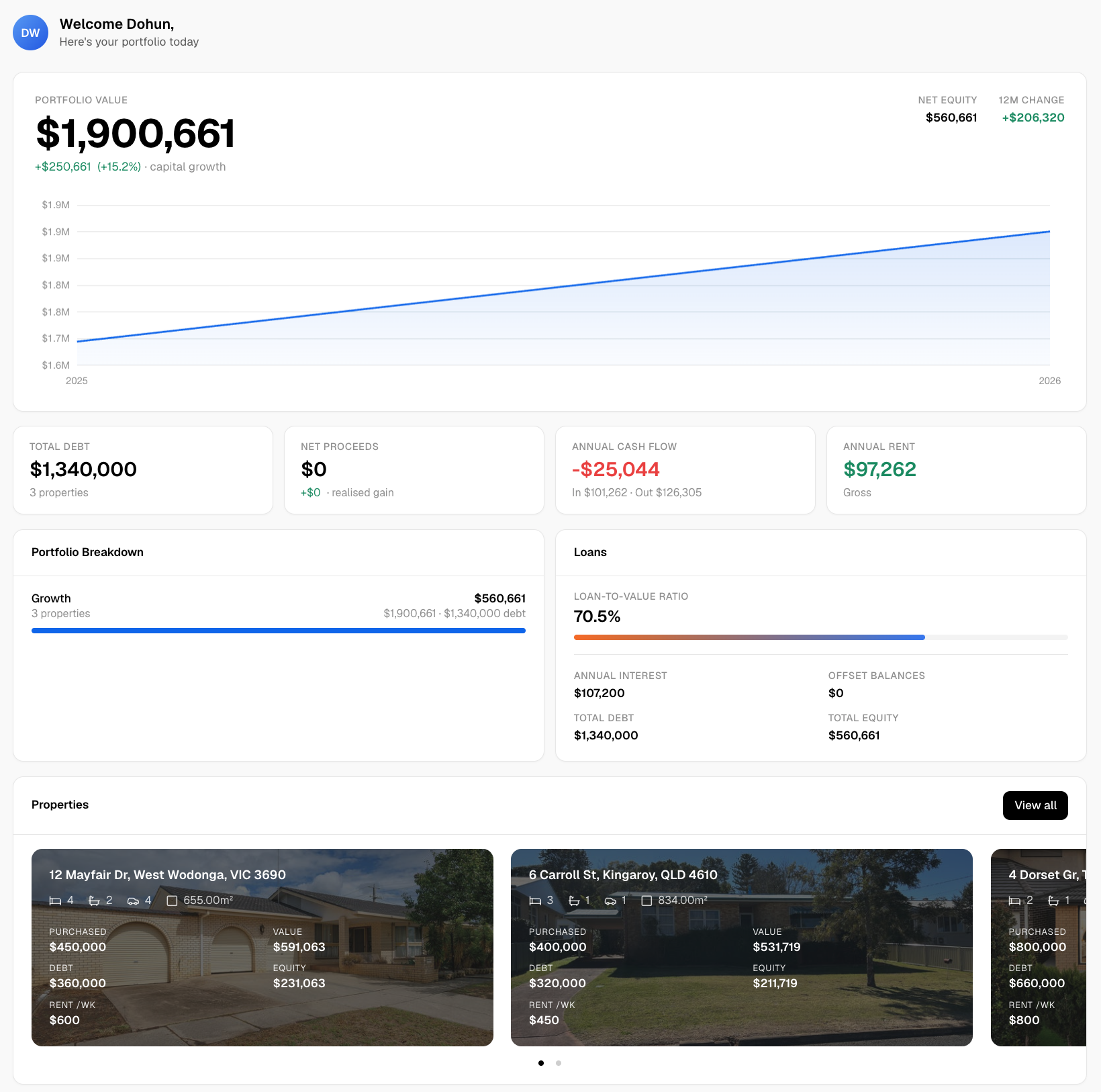
Wealthstacker automates the whole cycle at no cost: market value, rental income, cash flow and LVR, updated every quarter without you touching a spreadsheet. It’s built to match the reporting routine above field for field, so the export you download is already close to audit-ready. Beyond the numbers, Wealthstacker’s path planning models rentvesting against buying scenarios and forecasts your net worth over 15 years, so a quarterly change in value isn’t just a data point, it’s context for your next decision.
When a report signals it’s time to refinance or commission a formal valuation, you can hand your broker or valuer an exportable history rather than a guess. Sign up free at WealthStacker to start tracking your portfolio’s quarterly health, and if refinancing is on the table, mortgage broking support can help you act on what the numbers show.
Sources
- Loan to value ratio guide | Mozo
- Parliamentary briefing on CGT changes (summary) | Parliament of Australia
- Property investors encouraged to consider professional valuations ahead of capital gains tax changes | RICS
- How to value and increase the worth of your investment property | Aussie
Recommended
- Property investment reporting best practices: 2026 guide | WealthStacker
- Portfolio performance metrics checklist: Australian investor guide | WealthStacker
- Busy investor portfolio monitoring tips: 2026 guide | WealthStacker
- Property portfolio performance benchmarking guide for investors | WealthStacker