
Role of a financial planner in property advice
TL;DR:
- A licensed financial planner manages debt, tax, and portfolio balance, not property selection. They advise on structures, cashflow, and risk, recommending professionals like buyer’s agents for specific property decisions. Their role is crucial when property involves super, tax, or leverage, while property advisors focus on the where and what to buy.
A licensed financial planner’s job is to fit property into your whole financial picture, managing debt, tax, cashflow and superannuation rather than picking a specific house for you.
The short version:
- Financial planners advise on structures, cashflow and portfolio fit, not which suburb or street to buy in.
- Recommending a property purchase through an SMSF is financial product advice and requires an Australian Financial Services Licence (AFSL). Many property specialists do not hold one.
- Direct residential property is not a financial product under the Corporations Act, so a property advisor can operate without an AFSL — but that also means fewer consumer protections for you.
- A planner’s real value is in the middle game: stress-testing debt, sequencing equity releases and keeping your portfolio balanced across life stages.
- See a financial planner first when property decisions touch super, tax structures or significant leverage. Bring in a buyer’s agent or property advisor once the strategy is set.
The key distinction: A financial planner is your fiduciary for decisions that touch super, tax and portfolio allocation. A property advisor tells you what and where to buy. You often need both, but in the right order.
Table of Contents
- What a financial planner actually does for property investors
- How a financial planner differs from a property advisor or real estate agent
- How to prepare for your first meeting with a financial planner
- What to expect from advice: deliverables, timelines and fees
- Red flags to watch for when getting property-related financial advice
- When to bring in a mortgage broker, accountant, buyer’s agent or property manager
- How modelling tools support planner-led property decisions
- Key takeaways
- Wealthstacker: decision support for property investors
- Useful sources and further reading
What a financial planner actually does for property investors
The role of financial planner in property advice is less about finding deals and more about making sure a property decision doesn’t quietly wreck the rest of your financial plan. Here’s what that looks like in practice.
Whole-of-portfolio assessment. Before any purchase, a planner tests whether property fits your goals, liquidity needs and diversification. A client with 90% of their net worth in a single investment property and a variable-rate mortgage is exposed in ways a cashflow spreadsheet alone won’t reveal. Planners model that exposure against your super balance, income trajectory and risk tolerance. For context on portfolio diversification principles, the concentration risk from a single leveraged asset is often underestimated.
Debt and cashflow modelling. This is where planners earn their fee. They stress-test repayments under vacancy scenarios, interest-rate rises and income interruptions. A good planner will model what happens if rates climb 200 basis points and your tenant leaves simultaneously. Most investors have never run that scenario.
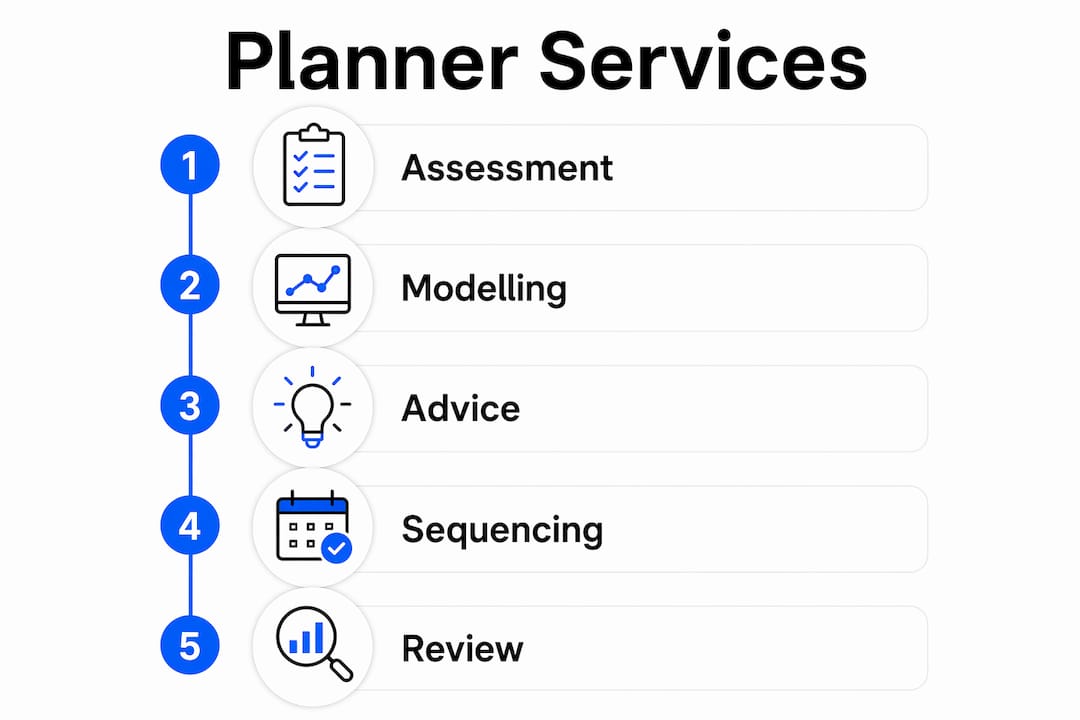
Tax and superannuation advice. Planners can advise on negative gearing, depreciation strategy and how property interacts with your marginal tax rate. When the conversation shifts to SMSF property investment, the regulatory stakes rise sharply. Recommending that an SMSF trustee purchase real property is financial product advice under ASIC guidance, because the SMSF itself is a regulated financial product. That advice requires an AFSL.

Financing and sequencing. Planners map out the order of purchases, equity releases and refinancing events. Getting the sequence wrong — drawing equity before fixing a rate, or buying a second property before the first is cash-flow positive — can compress your borrowing capacity at the worst moment.
| Service | What the planner delivers | When it matters most |
|---|---|---|
| Whole-of-portfolio review | Stress-tested asset allocation including property | Before a first or additional purchase |
| Debt and cashflow modelling | Repayment scenarios under rate rises and vacancy | At purchase and every 6–12 months |
| Tax and super integration | Gearing strategy, depreciation, SMSF structure advice | Annually and at major life events |
| Financing sequencing | Equity extraction order, refinancing timing | Before each new purchase |
| Ongoing monitoring | Rebalancing triggers, liquidity checks, documented review | Every 6–12 months |
Ongoing review. Practitioners recommend stress-testing your portfolio every 6–12 months, modelling rate rises of at least 25 basis points above current levels and checking liquidity at each review. That cadence is what separates a one-off transaction from a managed strategy.
How a financial planner differs from a property advisor or real estate agent
The regulatory boundary here is sharper than most investors realise, and the gap in consumer protection is significant.
The AFSL line. Direct property is not a financial product under the Corporations Act. A property investment advisor can tell you whether, what, where and how to invest in property without holding an AFSL. That’s a legitimate and useful service, but it sits outside the financial services licensing regime. The moment advice touches an SMSF structure, a Limited Recourse Borrowing Arrangement (LRBA) or any other regulated financial product, an AFSL is mandatory.
Scope comparison:
- Financial planner (AFSL-licensed): advises on structures, cashflow, tax, super, risk and portfolio fit; bound by best interests duty; must provide a Statement of Advice (SOA); listed on the Financial Adviser Register.
- Property investment advisor (unlicensed): advises on property selection, sourcing and strategy; covered by general consumer law, not financial services law; no SOA requirement; no best interests duty.
- Real estate agent: represents the vendor or buyer in a transaction; licensed under state/territory property law; no obligation to consider your financial position.
- Buyer’s agent: sources and negotiates property on your behalf; licensed under state/territory law; no financial planning remit.
Conflict of interest. The highest-risk scenario is an adviser who both recommends a property strategy and profits from the sale of the property. Experts consistently warn investors to prefer advisers who declare no vested interest in the property transaction. When the same person earns a commission whether or not the deal suits you, the advice is compromised by design.
Pro Tip: Before engaging any adviser, ask three direct questions: “Are you AFSL-licensed?” “Will you provide a written Statement of Advice?” “Do you or your firm receive any payment from the property developer or vendor?” If any answer is evasive, walk away.
How to prepare for your first meeting with a financial planner
A well-prepared first meeting cuts the discovery phase in half and gets you to modelled scenarios faster. Planners work from your complete financial picture, so gaps in your documents translate directly into gaps in the advice.
Documents to bring:
- Government-issued ID and tax file number confirmation.
- Last two years of personal tax returns.
- Current loan statements for all properties and your principal residence.
- Super fund statements showing current balance and investment options.
- A summary of your existing property portfolio: purchase prices, current estimated values, rental income, vacancy history and outstanding debt.
- Cashflow spreadsheet or bank statements covering the last three months.
- Any existing insurance policies (income protection, landlord insurance).
- Details of any trusts, company structures or SMSFs you are a member of.
Questions worth asking:
- What is your AFSL number and who is your licensee?
- Do you advise on SMSF property structures, and are you authorised to do so?
- What modelling will you run, and what scenarios will the stress tests cover?
- How does property interact with my retirement income projections?
- What does your fee structure look like for initial advice and ongoing reviews?
Presenting your goals clearly. Tell the planner whether you are targeting income (yield) or capital growth, your preferred timeline, the maximum leverage you are comfortable carrying, and whether you want property to fund retirement or be sold before it. A planner who understands your property investment plan can model scenarios that actually reflect your situation rather than generic benchmarks.
What to expect from advice: deliverables, timelines and fees
Common deliverables. The centrepiece of formal advice is the Statement of Advice (SOA). For property-in-SMSF recommendations, ASIC guidance via CPA Australia specifies that the SOA must explain the advantages and disadvantages of the strategy, including liquidity risk, costs such as stamp duty and loan fees, vacancy risk and diversification concerns. Beyond the SOA, expect:
- Cashflow modelling under multiple rate and vacancy scenarios.
- A written investment strategy aligned to your goals and risk profile.
- A documented monitoring plan with review triggers.
- A Record of Advice for any subsequent changes to the original recommendation.
Fee models. The industry has largely moved to fee-for-service since the Future of Financial Advice (FOFA) reforms banned conflicted remuneration on most investment products. Typical fee structures include fixed project fees for initial advice, hourly rates for scoped advice or reviews, and ongoing advisory fees for regular monitoring.
- Commissions can still appear in insurance products — ask your planner to disclose all remuneration sources in writing.
| Deliverable | Typical timing | What it covers |
|---|---|---|
| Statement of Advice (SOA) | 2–6 weeks from first meeting | Full strategy, modelling, risk disclosure |
| Cashflow stress test | Included in SOA or review | Rate rises, vacancy, income interruption |
| Record of Advice (ROA) | At each subsequent change | Updates to original strategy |
| Ongoing review meeting | Every 6–12 months | Rebalancing, refinancing triggers, life changes |
Realistic timelines vary. A straightforward strategy with no SMSF component might reach a written SOA in a few weeks. Complex SMSF or multi-property structures can take longer, particularly if legal or accounting input is needed.
Red flags to watch for when getting property-related financial advice
Warning: The most common source of poor property advice is an adviser who profits from the transaction they are recommending. Undisclosed commissions, referral fees from developers, and dual roles as both adviser and property seller are the three patterns that have caused the most investor harm in Australia.
Regulatory reviews have noted that direct property advice sits largely under general consumer law rather than financial services regulation, which means the protections are weaker unless your adviser holds an AFSL. That gap is where most problems occur.
Vetting checklist:
- Search the adviser’s name on the Financial Adviser Register at MoneySmart before the first meeting.
- Ask for a sample SOA from a previous (de-identified) engagement to assess quality and scope.
- Confirm in writing that the adviser or their firm receives no payment from the property developer, vendor or referral network.
- Check whether the AFSL covers SMSF advice if that is relevant to your situation.
- Ask whether the adviser is also a licensed real estate agent or buyer’s agent — dual roles are not automatically disqualifying, but the conflict must be disclosed and managed.
Specific warning signs:
- Pressure to act quickly on a “limited opportunity” before advice is documented.
- Reluctance to provide a written SOA or to disclose the AFSL number.
- Advice that focuses entirely on a specific property rather than your broader financial position.
- Fee structures that are contingent on you proceeding with a purchase.
When to bring in a mortgage broker, accountant, buyer’s agent or property manager
A financial planner is the coordinator, not the whole team. Think of the planner as the quarterback: they set the strategy and call the plays, but the execution requires specialists.
The specialist roles:
- Mortgage broker: structures your finance, compares lenders and negotiates terms. Bring them in once the planner has confirmed your borrowing capacity and preferred structure. For investment property finance, a broker who specialises in investor lending understands serviceability calculations and lender policy in ways a generalist does not.
- Tax accountant: handles depreciation schedules, land tax, CGT calculations and entity structuring. The planner sets the tax strategy; the accountant executes it and lodges the returns.
- Buyer’s agent: sources and negotiates the property once the planner has confirmed what type of asset fits the strategy. This is the role that actually picks the suburb and the street.
- Property manager: handles tenancy, maintenance and compliance once the property is purchased. Good landlord risk management starts here.
The planner-led sequence:
Strategy (planner) → Structure (planner + accountant) → Finance (mortgage broker) → Purchase (buyer’s agent + conveyancer) → Management (property manager) → Review (planner, every 6–12 months).
The planner’s ongoing role is to check that each specialist’s work still fits the original strategy, and to update the plan when life changes — income shifts, rate rises, new purchases or approaching retirement.
How modelling tools support planner-led property decisions
Practitioners note that high-quality planners focus on the middle game: managing debt impact, rebalancing and life-stage planning rather than front-end property picking. Modelling tools are what make that middle game visible.
What a good modelling tool provides:
- Automated quarterly valuations so the portfolio’s current value is always current, not six months stale.
- Cashflow projections under multiple scenarios (rate rises, vacancy, rent increases).
- Portfolio rebalancing scenarios showing the impact of selling, holding or adding an asset.
- Net worth tracking that integrates property equity, super and other assets in one view.
A practical example. A planner reviewing a two-property portfolio might use quarterly automated valuations alongside a stress test modelling a 150-basis-point rate rise and a 10-week vacancy on the lower-yielding property. If the modelled cashflow turns negative, the planner has documented grounds to recommend refinancing or selling before the investor is forced to act. Without that modelling, the decision is made on gut feel, usually too late.
AI-assisted valuation and tracking tools have made this kind of scenario analysis accessible outside enterprise software. The key is that the tool informs the decision; it does not replace the licensed advice.
| Tool capability | Planner use case | Investor benefit |
|---|---|---|
| Automated quarterly valuations | Current portfolio value for rebalancing decisions | No stale data in review meetings |
| Cashflow stress testing | Rate-rise and vacancy scenario modelling | Early warning before cashflow turns negative |
| Portfolio rebalancing scenarios | Hold vs sell analysis across multiple assets | Documented basis for major decisions |
| Net worth integration | Super + property + other assets in one view | Whole-of-portfolio visibility |
Disclosure: Modelling tools provide projections and scenario analysis. All personal financial advice must come from an AFSL-licensed financial planner who is authorised to advise on your specific situation.
Key takeaways
A financial planner’s core value for property investors is whole-of-portfolio coordination: integrating debt, tax, super and cashflow so that property decisions strengthen rather than destabilise your financial position.
| Point | Details |
|---|---|
| AFSL is the dividing line | Only AFSL-licensed planners can advise on SMSF property structures; property advisors operate under general consumer law. |
| Planners don’t pick properties | Their regulated role covers structures, cashflow, tax and portfolio fit, not specific addresses or suburbs. |
| Verify before you engage | Check the Financial Adviser Register, request a written SOA, and confirm no vested interest in the property sale. |
| Build the right team | Planner sets strategy; mortgage broker, accountant, buyer’s agent and property manager each handle their lane. |
| Wealthstacker supports the process | Use Wealthstacker’s automated valuations and scenario modelling to keep your portfolio data current between planner reviews. |
Wealthstacker: decision support for property investors
Most investors spend more time researching a kitchen renovation than modelling whether their property portfolio is actually on track. Wealthstacker closes that gap without requiring a finance degree.
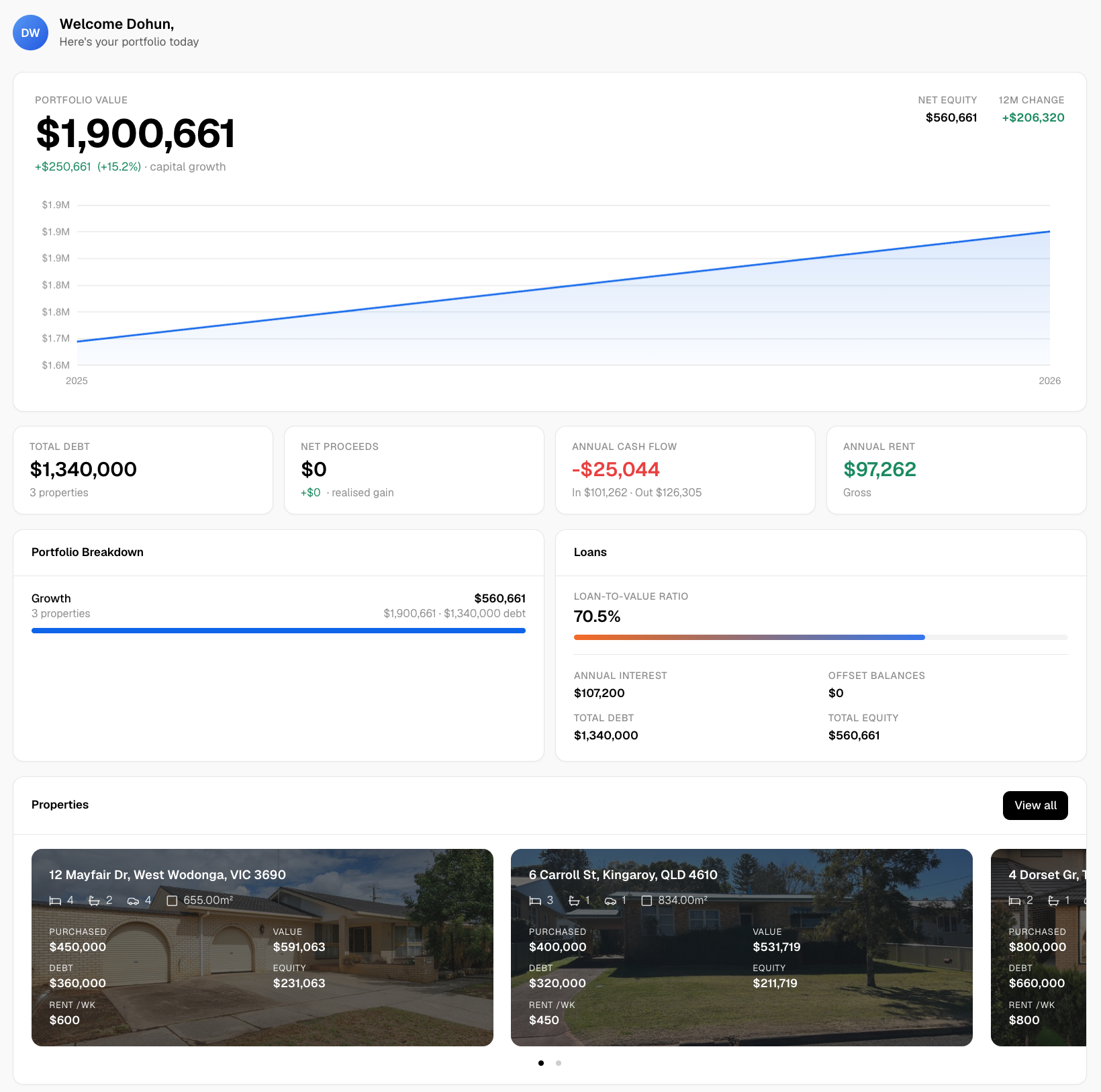
The platform delivers automated quarterly valuations at no cost, real-time net worth tracking across your full portfolio, and scenario modelling for both rentvesting and direct ownership strategies. Where a planner reviews your position every 6–12 months, Wealthstacker keeps the numbers current in between, so you walk into every review meeting with up-to-date data rather than estimates. It also models borrowing power and wealth accumulation forecasts, giving you a concrete basis for the conversations that matter most.
Wealthstacker complements licensed advice; it does not replace it. Personal financial advice for your specific situation must come from an AFSL-licensed planner. What the platform does is give you the modelling layer that makes those conversations sharper and faster.
Start tracking your property portfolio with Wealthstacker today.
Useful sources and further reading
These primary sources are worth bookmarking if you are doing your own due diligence on financial advice and property.
- ASIC — Giving financial product advice: The definitive regulatory guide to what requires an AFSL, including SMSF advice obligations and SOA requirements. Use this to verify whether an adviser’s scope matches their licence.
- MoneySmart — Working with a financial adviser: ASIC’s consumer-facing guide to adviser obligations, fee disclosure and what to expect from the advice process.
- MoneySmart — Financial Advisers Register: Search any adviser’s name to confirm their AFSL status, authorisations and any disciplinary history before you engage them.
- CPA Australia — Guidance note on SMSFs and property: Detailed guidance on when SMSF property advice triggers AFSL requirements, SOA expectations and the liquidity and cost risks that must be disclosed.
- SMSF Australia — Rules for financial planners giving SMSF advice: Practitioner-level explanation of the compliance gap between property specialists and AFSL-licensed planners in the SMSF context.
This article is general information only and does not constitute personal financial advice. Confirm current rules and how they apply to your situation with an AFSL-licensed financial planner or the relevant regulatory body.