
Role of AI tools in property valuation: 2026 guide
TL;DR:
- AI tools quickly estimate property values using sales data, trends, and property attributes, primarily for metropolitan areas. They require human review for complex or high-risk properties due to accuracy limitations and data gaps. Australian buyers trust AI valuations less, but lenders and investors widely use them for refinancing and portfolio management.
Automated Valuation Models, known as AVMs, define the core role of AI tools in property valuation: they process large volumes of sales data, suburb trends, and property attributes to produce fast, data-driven value estimates. These estimates support expert human analysis rather than replace it. Australian lenders, investors, and the Australian Property Institute now treat AI-assisted valuation as a standard part of the property finance workflow. Understanding how these tools work, where they fall short, and how to use them well gives you a real edge in property decision-making.
How do AI tools function within the property valuation process?
AVMs work by analysing comparable sales, property attributes, and local market trends simultaneously. A typical AVM ingests data points such as land size in square metres, number of bedrooms, suburb median price movements, and recent comparable sales within a defined radius. The model then weights these inputs using machine learning to produce a value estimate, often within seconds.

Digital valuation workflows have become dominant in residential mortgage processing, with physical inspections now reserved for complex or high-risk cases. The Australian Property Institute and Cotality both endorse hybrid digital workflows effective from 2025 onwards. That endorsement signals a structural shift, not a passing trend.
The hybrid model matters most in practice. An AVM generates the initial estimate, and a qualified valuer then reviews it against local knowledge, property condition, and any legal encumbrances the algorithm cannot see. This human-in-the-loop approach is what separates reliable valuations from risky ones.
Key inputs that AI valuation tools typically use include:
- Recent comparable sales within 500 metres to 2 kilometres
- Suburb-level price trend data over 12 and 24 month periods
- Property attributes: bedrooms, bathrooms, land size, building area
- Zoning classifications and planning overlays
- Days on market and vendor discount rates for the suburb
Pro Tip: Never treat an AVM estimate as final for a high-stakes decision. Use it as a starting point, then cross-reference with a registered valuer for any transaction above 80% loan-to-value ratio.
What are the accuracy levels and limitations of AI-based property valuations?
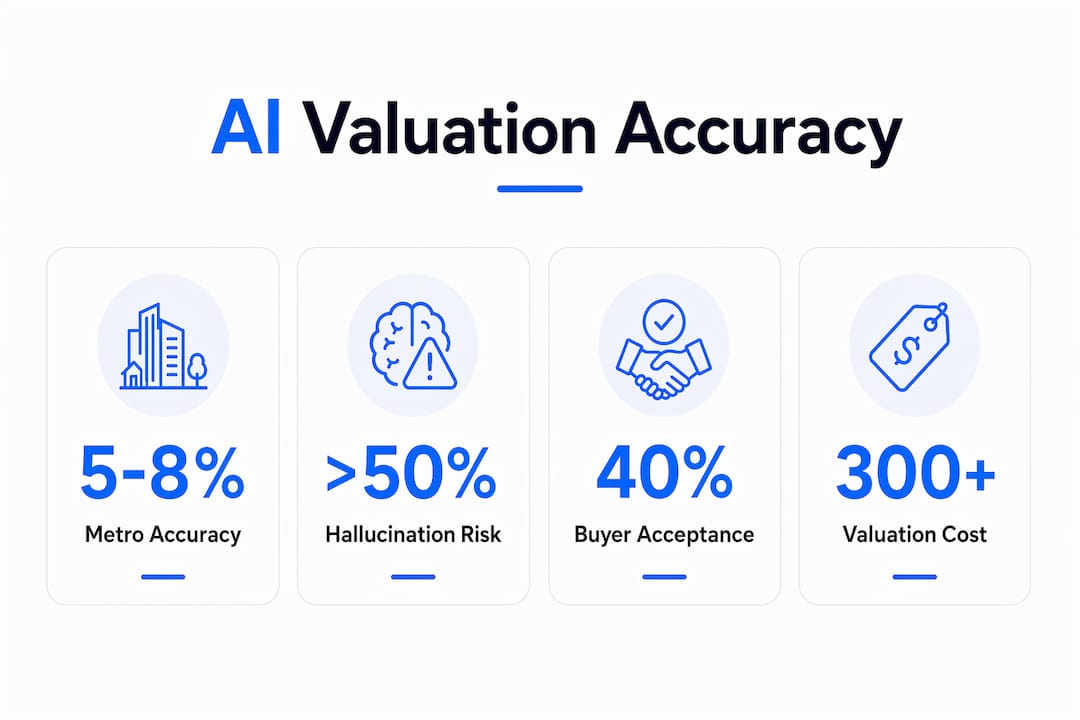
AVMs produce valuations within 5–8% of formal bank valuations for standard metropolitan properties. That level of accuracy is sufficient for most refinancing decisions and portfolio tracking purposes. The picture changes significantly outside metropolitan areas.
For non-standard scenarios, including unique homes, rural properties, and properties with legal complications, algorithmic valuations can vary from 10% to 50% from actual sale prices. That is not a minor rounding error. It represents a material risk for investors making decisions based on AI outputs alone.
The core problem is data blind spots. AI tools cannot assess property condition from a street address. They cannot account for an unregistered easement, a heritage overlay that limits development, or the fact that a property backs onto a busy road. These factors move prices in ways that no algorithm currently captures reliably.
| Property type | AVM accuracy range | Key limitation |
|---|---|---|
| Standard metro home | Within 5–8% of bank valuation | Minor data gaps on condition |
| Unique or prestige property | 10–30% variance possible | Insufficient comparable sales |
| Regional or rural property | Up to 50% variance | Thin sales data, local factors |
| Properties with legal issues | Unreliable | Cannot read title encumbrances |
Ethical governance in AI valuation is lagging behind adoption rates. RMIT University research identifies a clear need for human-in-the-loop frameworks to maintain accountability. Without those frameworks, overreliance on AI outputs creates real financial exposure for investors.
Pro Tip: For properties in regional areas or with unusual features, always commission a full formal valuation. The $300–$600 cost is minor compared to the risk of a 20% valuation error on a $700,000 asset.
Professional indemnity insurers now include hybrid and digital valuation workflows in their risk frameworks, effective from 2025. That inclusion legitimises AI-supported methods for standard properties while implicitly confirming that complex cases still require human expertise.
How does Australian market sentiment affect trust in AI valuations?
Australian buyers are the most sceptical of AI valuations among major English-speaking markets. Only 40% of Australian buyers accept AI-automated valuations, compared to 62% in Canada, 52% in the United States, and 46% in the United Kingdom. That gap reflects a cultural preference for expert human judgment in high-stakes financial decisions.
Low trust does not mean low adoption. Lenders use AVMs extensively on the back end of mortgage processing, even when buyers are unaware. The trust gap shows up most clearly when buyers are asked to rely on an AI estimate for a purchase decision without independent verification.
“Human judgment remains the premium in valuation, with many buyers willing to pay extra for expert verification of AI outputs. Transparency about how AI is used builds trust faster than any marketing claim.”
Agents and advisers who explain how AI tools work, and where they are used in the process, consistently report stronger client confidence. Transparency is the practical solution to the trust deficit. Hiding AI involvement or presenting AVM outputs as definitive valuations erodes credibility when clients later discover the methodology.
Factors that shape buyer acceptance of AI valuations in Australia include:
- Familiarity with the technology and its data sources
- Whether a human expert has reviewed and endorsed the output
- The property type: standard metro homes attract far more acceptance than unique or regional properties
- The stakes involved: buyers accept AI estimates for research but want human sign-off for contracts
You can track Australian buyer trust trends and how they compare to global benchmarks as the market continues to shift through 2026.
What practical impact do AI tools have on refinancing and investment decisions?
The most immediate financial benefit of AI in property valuation sits in the refinancing process. Australian lenders widely use AVMs for refinancing below 80% loan-to-value ratio. That practice saves borrowers $300–$600 per transaction by eliminating the need for a formal valuation, and it accelerates approvals by days. For investors managing multiple properties, those savings and time gains compound quickly.
For investors, the practical applications extend well beyond refinancing:
- Portfolio tracking. AI tools update estimated property values quarterly or more frequently, giving investors a current picture of equity across their portfolio without commissioning formal valuations each time.
- Market analysis. AI processes suburb-level price movements, rental yield trends, and days-on-market data faster than any manual research process. Investors use this to identify suburbs approaching a growth cycle before prices move.
- Scenario modelling. Platforms that integrate AI valuation data allow investors to model the impact of a purchase, sale, or refinance on their overall net worth in real time.
- Due diligence acceleration. AI tools surface comparable sales, zoning information, and flood or bushfire risk overlays in seconds. That speeds up the research phase of any acquisition.
- Rental pricing. AI-driven rental pricing tools are set to follow valuation automation in adoption over the next 12–18 months, giving investors another data layer for yield analysis.
AI adoption in valuation and refinancing is accelerating, with rental pricing AI and compliance tools next in line. Investors who build AI tools into their research process now will have a structural advantage as these capabilities mature.
The critical caveat is that AI-generated investment recommendations exhibit hallucination errors exceeding 50% when used without human oversight. Professionals treat AI as a research accelerator, not a decision-maker. The investor who uses AI to narrow a shortlist of suburbs and then applies their own judgment to the final decision gets the best of both approaches.
AI integration into agency systems, including CRM platforms, portal feeds, and trust accounting, delivers the greatest operational value. Standalone AI tools used in isolation produce far weaker results. That principle applies equally to individual investors: AI valuation tools work best when connected to a broader data and decision-making framework.
You can read more about how AI valuation and portfolio tracking work together in a practical investment context.
Key takeaways
AI tools in property valuation deliver reliable estimates for standard metropolitan properties but require human oversight for complex, regional, or high-stakes decisions.
| Point | Details |
|---|---|
| AVM accuracy for metro homes | AVMs come within 5–8% of formal bank valuations for standard metropolitan properties. |
| Regional property risk | Algorithmic valuations can vary up to 50% from actual sale prices for non-standard or rural properties. |
| Australian buyer trust gap | Only 40% of Australian buyers accept AI valuations, the lowest rate among major English-speaking markets. |
| Refinancing cost savings | Lenders using AVMs save borrowers $300–$600 per refinancing transaction below 80% LVR. |
| Human oversight is non-negotiable | AI investment recommendations have hallucination error rates above 50% without human verification. |
Wealthstacker: AI-powered tools for property investors
Wealthstacker brings together the benefits of AI in property assessments and portfolio management in one place. The platform delivers automated quarterly property valuations at no cost, so you always have a current picture of your portfolio’s value without commissioning formal reports.
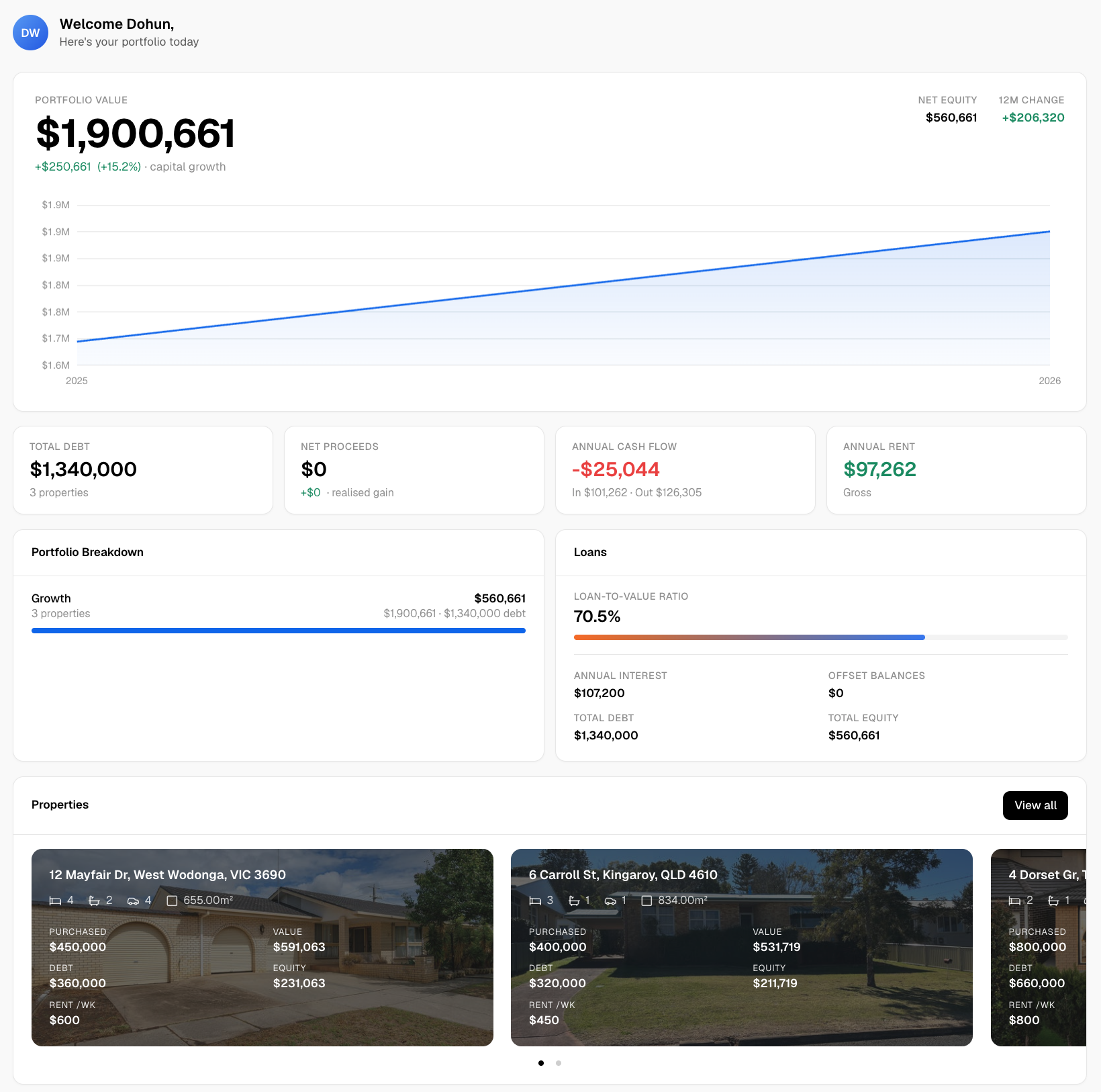
Wealthstacker integrates AI valuation data with personalised modelling for both rentvesting and direct buying strategies. You can assess your borrowing power, model your net worth in real time, and compare investment paths with forecasts built around your actual financial position. For investors who want AI-driven insights with human-grade rigour, Wealthstacker’s property investment app is the logical next step.
FAQ
What is an AVM in property valuation?
An Automated Valuation Model (AVM) is an AI-driven tool that estimates property value using comparable sales, suburb trends, and property attributes. Australian lenders use AVMs extensively for refinancing decisions below 80% loan-to-value ratio.
How accurate are AI property valuations in Australia?
AVMs are accurate to within 5–8% of formal bank valuations for standard metropolitan properties. Accuracy drops significantly for regional, rural, or unique properties, where variances of up to 50% are possible.
Why do Australian buyers trust AI valuations less than other countries?
Only 40% of Australian buyers accept AI-automated valuations, compared to 62% in Canada and 52% in the United States. Australian buyers show a strong cultural preference for expert human verification in high-value property decisions.
Can AI tools replace a formal property valuation?
AI tools do not replace formal valuations for complex properties, high LVR transactions, or legal disputes. They work best as a research accelerator and portfolio tracking tool, with a qualified valuer providing sign-off on significant decisions.
How do AI tools help property investors specifically?
AI tools give investors faster access to suburb price trends, comparable sales, rental yield data, and portfolio equity estimates. Platforms like Wealthstacker combine these AI valuation insights with personalised wealth modelling to support better investment decisions.