
Rentvesting vs buying your first property: 2026 guide
TL;DR:
- Rentvesting allows you to rent in your preferred area while investing in more affordable properties, but it forgoes government grants and offers tax deductions on investment expenses. Buying your first home provides government benefits, CGT exemption, and security of tenure but requires a larger upfront investment and limits mobility. The best strategy depends on your financial situation, target suburbs, and long-term plans, with rentvesting often needing seven or more years to outperform buying first.
Rentvesting is the strategy of renting where you want to live while buying an investment property in a more affordable area. It sits alongside traditional home ownership as one of the two main property investment options available to first-time buyers in Australia. The rentvesting vs buying first property debate comes down to three core trade-offs: upfront government benefits, ongoing tax treatment, and lifestyle flexibility. Neither strategy wins outright. The right choice depends on your income, your target suburb, and how long you plan to hold the asset.
What financial benefits and drawbacks separate rentvesting from buying first?
The biggest upfront cost difference is government assistance. First home owner grants range from $10,000 to $30,000 depending on your state, and stamp duty concessions add further savings. Buying an investment property first forfeits all of these permanently. That total loss sits between $20,000 and $60,000 before you have even settled on a property.
Rentvesting recovers ground through the tax system. Investors can claim deductions for mortgage interest, property management fees, council rates, and depreciation. Those deductions can reduce taxable income by $15,000 to $25,000 each year. Owner-occupiers receive none of these deductions because the Australian Taxation Office does not treat a principal place of residence as an income-producing asset.
Capital gains tax treatment is the third major financial difference. When you sell your owner-occupied home, the CGT main residence exemption applies and you pay zero tax on the gain. Sell an investment property held for more than 12 months and you receive a 50% CGT discount, but you still pay tax on the remaining gain at your marginal rate. Over a long hold period, that tax bill can be substantial.
Pro Tip: If the price gap between your lifestyle suburb and your target investment suburb exceeds $500,000, the capital growth upside of rentvesting often outweighs the lost government benefits. Run the numbers for your specific suburbs before deciding.
| Factor | Buying first home | Rentvesting |
|---|---|---|
| First home owner grant | Eligible ($10,000–$30,000) | Forfeited permanently |
| Stamp duty concession | Available in most states | Not available |
| Tax deductions | None | Interest, fees, depreciation |
| CGT on sale | Fully exempt | 50% discount, remainder taxable |
| Upfront cost saving | $20,000–$60,000 | Nil |
How does lifestyle flexibility affect the choice?
Rentvesting gives you the ability to live in suburbs that would be unaffordable to buy in. You can rent a two-bedroom apartment in an inner-city suburb and own a house in a regional growth corridor. That geographic separation is the core rentvesting advantage for buyers priced out of their preferred area.

Owning your own home delivers something rentvesting cannot: security of tenure. You can renovate, keep pets, and stay as long as you choose. Renters face lease renewals, rent increases, and the possibility of a landlord selling the property. Those risks are real and affect daily life in ways that financial models do not capture.
The lifestyle trade-offs for each strategy break down clearly:
- Rentvesting advantages: Live in your preferred suburb without buying there; relocate for work without selling; maintain lifestyle while building a property portfolio.
- Rentvesting challenges: Subject to landlord decisions; no ability to renovate your home; emotional disconnect from a property you do not live in.
- Buying first home advantages: Full control over your living space; emotional satisfaction of ownership; no risk of eviction or rent increases.
- Buying first home challenges: Locked into one location; lifestyle suburb may require a larger deposit and higher repayments; less flexibility to move for career opportunities.
Rentvesting requires a long-term horizon of 7 or more years to outperform the guaranteed upfront benefits of buying your first home. If you plan to stay in one city for the foreseeable future, buying first often makes more sense emotionally and financially.
What financial prerequisites do you need for each strategy?
Both strategies require a deposit, but the loan products differ. Owner-occupier loans typically carry lower interest rates than investor loans. The First Home Guarantee scheme allows eligible buyers to purchase with a 5% deposit and avoid lenders mortgage insurance, but it applies only to owner-occupiers buying a principal place of residence.
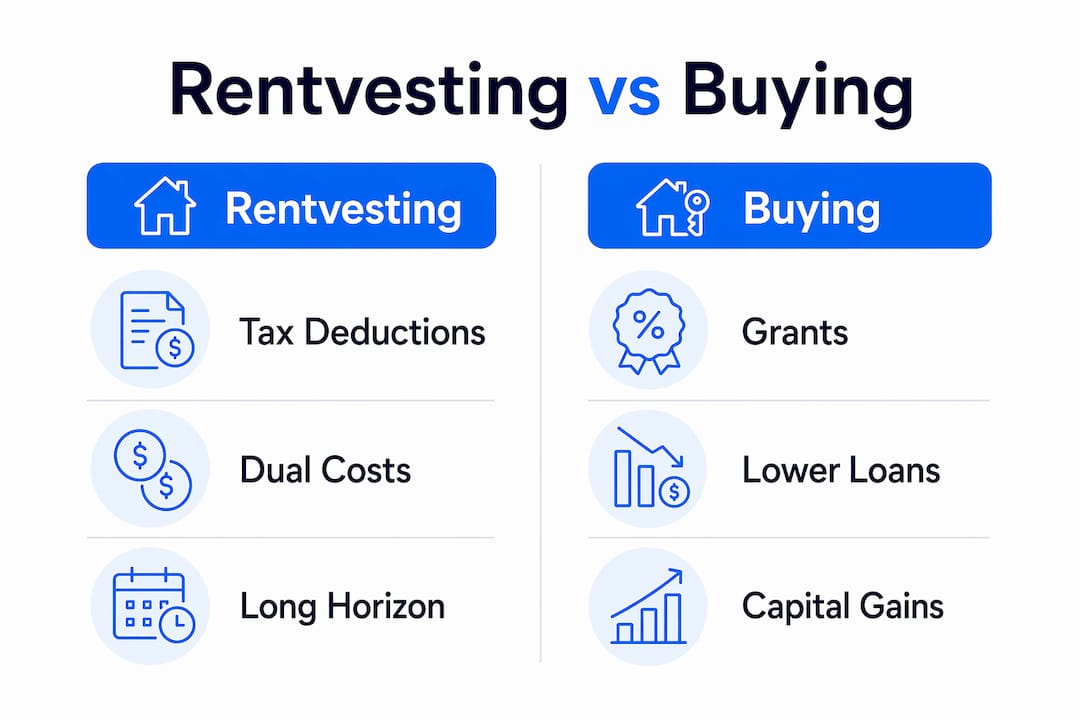
Rentvesting creates a dual cost structure. You pay rent on your home and a mortgage on your investment property at the same time. Westpac notes that rentvestors must maintain financial buffers for vacancies and unexpected repair costs because rental income is not guaranteed. A vacancy of even one month can create genuine cash flow pressure if your buffer is thin.
Loan structure matters more for rentvestors than for owner-occupiers. The Australian Taxation Office requires that interest expenses be correctly apportioned between private and investment use. Mixing the two in a single loan account can disqualify deductions and trigger penalties. An offset account attached to your investment loan, used only for investment purposes, is the standard approach.
Pro Tip: Before applying for any loan, use a financial modelling tool to stress-test your cash flow at a vacancy rate of four to six weeks per year. If the numbers still work, your buffer is adequate.
| Requirement | Buying first home | Rentvesting |
|---|---|---|
| Minimum deposit | 5% with First Home Guarantee | Typically 10–20% for investor loan |
| Loan type | Owner-occupier (lower rate) | Investor loan (higher rate) |
| Government scheme access | First Home Guarantee, FHOG | Not eligible |
| Dual cost exposure | No | Yes (rent plus mortgage) |
| Loan structure complexity | Low | High (apportionment required) |
What steps should you follow to evaluate and execute your strategy?
A clear process prevents costly mistakes. Work through these five steps before committing to either path.
-
Assess your savings, income, and borrowing capacity. Calculate your usable deposit after costs. Factor in stamp duty, legal fees, and a cash buffer. Your borrowing capacity sets the ceiling on what you can buy, regardless of strategy.
-
Calculate the price gap between your lifestyle suburb and affordable investment areas. If you want to live in a suburb where the median house price is $1.5 million but can buy in a growth corridor for $600,000, the $900,000 gap strongly favours rentvesting. A large price spread is the single strongest financial argument for choosing rentvesting over buying first.
-
Check your eligibility for government schemes. The First Home Owner Grant and First Home Guarantee are lost permanently if you buy an investment property first. Quantify that loss in dollar terms before deciding it is worth forfeiting. For many buyers, $30,000 to $60,000 in lost benefits is a decisive factor.
-
Model cash flow and long-term wealth scenarios. Build two projections: one where you buy your first home and benefit from CGT exemption on sale, and one where you rentvest and claim annual tax deductions. Use equity growth modelling to compare net worth outcomes at the 7-year and 15-year marks. The results often surprise first-time buyers.
-
Engage a mortgage broker, accountant, and property manager before you buy. A mortgage broker structures your loan correctly from day one. An accountant confirms your deduction strategy and CGT position. A property manager gives you a realistic rental yield and vacancy rate for your target investment suburb. Skipping any of these professionals is the most common and most expensive mistake first-time buyers make.
Pro Tip: Ask your accountant specifically about the six-year rule. If you ever live in the investment property before renting it out, you may access a partial CGT exemption. Buying an investment property you never live in forfeits that exemption entirely.
What common mistakes should you watch for with each strategy?
The most expensive mistake rentvestors make is misunderstanding grant eligibility. Choosing investment property first forfeits lifelong eligibility for first home buyer schemes. Many buyers discover this only after settlement, when it is too late to reverse the decision.
Underestimating ongoing costs is the second major trap. Investment properties require maintenance, insurance, property management fees, and council rates. These costs reduce your net rental yield and must be factored into your cash flow model before you buy.
Rentvestors who fail to budget for vacancy periods often find themselves covering the full mortgage from their salary for weeks at a time. Financial experts caution that rental income is not guaranteed, and a buffer of at least three months of mortgage repayments is the minimum prudent reserve for any investment property owner.
Using the wrong loan structure is a technical mistake with serious tax consequences. The ATO requires proper apportionment of interest between private and investment use. A loan that mixes both purposes can result in deductions being disallowed and penalties being applied. Always keep investment loan accounts separate from personal accounts.
Buyers who choose to purchase their first home outright sometimes underestimate the lifestyle cost of buying in an affordable but less desirable location. Commute times, access to amenities, and community fit all affect quality of life in ways that do not appear in a spreadsheet. Weigh these factors honestly before signing a contract.
Key takeaways
Rentvesting wins on tax efficiency and lifestyle flexibility, but buying your first home delivers government grants, CGT exemption, and security of tenure that rentvesting cannot replicate.
| Point | Details |
|---|---|
| Government benefits are permanent losses | Buying an investment property first forfeits $20,000–$60,000 in grants and concessions forever. |
| Tax deductions favour rentvestors | Annual deductions of $15,000–$25,000 can significantly offset the cost of holding an investment property. |
| CGT treatment differs sharply | Owner-occupied homes sell CGT-free; investment properties attract tax on half the gain at your marginal rate. |
| Dual costs require strong buffers | Rentvestors pay rent and a mortgage simultaneously and need reserves for vacancies and repairs. |
| A 7-year horizon is the minimum | Rentvesting typically needs seven or more years to outperform the upfront value of first home buyer concessions. |
Wealthstacker helps you model both strategies before you commit
Deciding between rentvesting and buying your first home is one of the most consequential financial choices you will make. Wealthstacker gives you the tools to run both scenarios with real numbers before you sign anything.
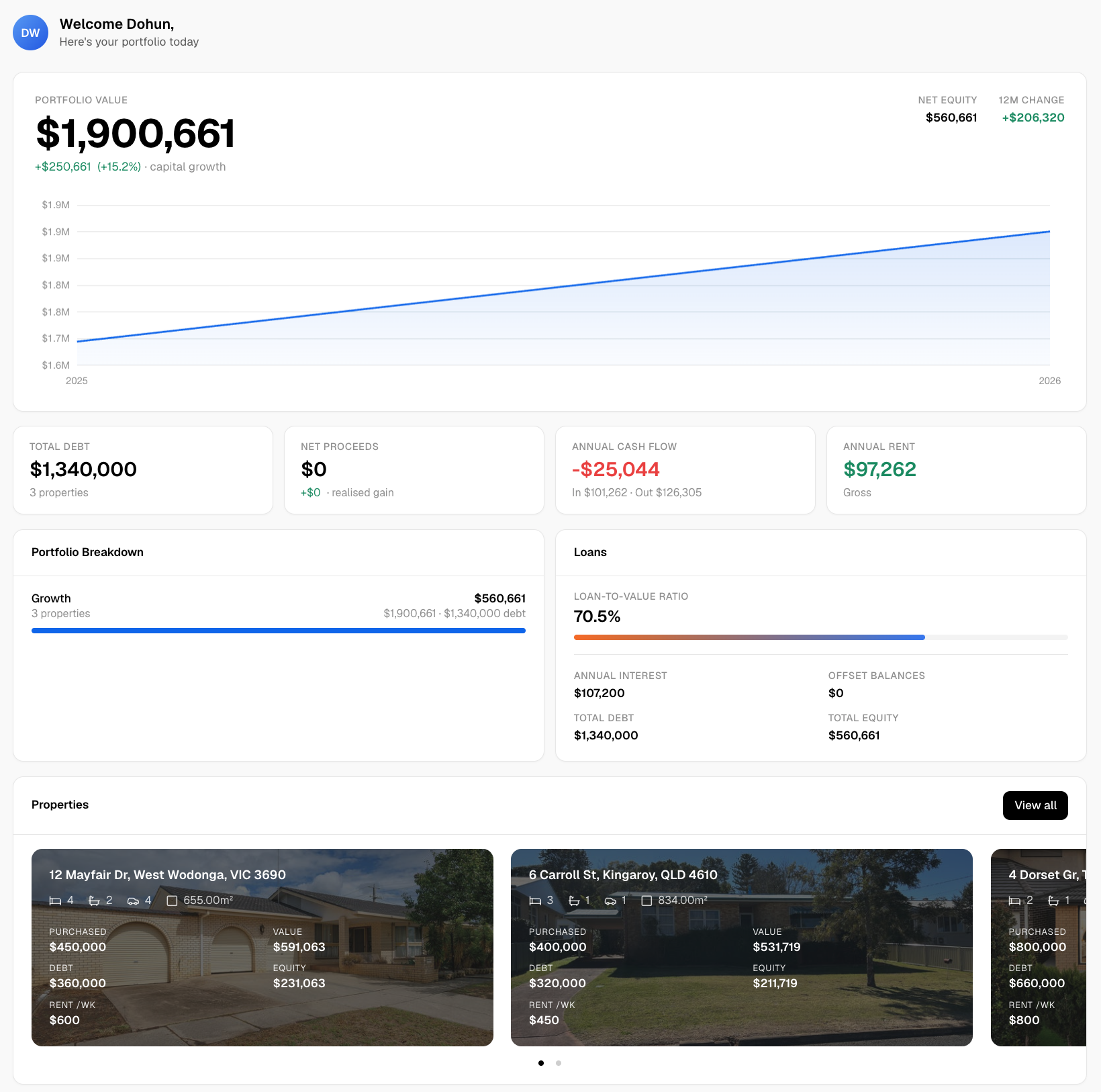
The Wealthstacker property investment app delivers automated quarterly valuations, AI-powered financial modelling, and personalised wealth projections for both rentvesting and owner-occupier strategies. You can compare your net worth trajectory across both paths in real time, assess your borrowing power, and stress-test your cash flow against vacancy periods and rate changes. For first-time buyers weighing up these options, that clarity is worth more than any single piece of advice. Visit Wealthstacker to build your property plan and see which strategy puts you ahead.
FAQ
What is rentvesting and how does it differ from buying your first home?
Rentvesting means renting where you want to live and buying an investment property in a more affordable area. Buying your first home means purchasing the property you live in, which qualifies you for government grants and CGT exemption on sale.
Do rentvestors lose access to first home owner grants?
Yes. Buying an investment property first permanently forfeits eligibility for first home owner grants ($10,000–$30,000) and stamp duty concessions, representing a total loss of $20,000–$60,000 or more depending on your state.
What tax deductions can a rentvestor claim?
Rentvestors can claim mortgage interest, property management fees, council rates, and depreciation as tax deductions, potentially reducing taxable income by $15,000–$25,000 per year. Owner-occupiers cannot claim any of these deductions.
How long does rentvesting need to work to be worthwhile?
Rentvesting typically requires a minimum horizon of seven years to outperform the upfront value of first home buyer concessions and CGT exemption. Shorter timeframes generally favour buying your first home outright.
What is the biggest financial risk of rentvesting?
The biggest risk is dual cost exposure: paying rent on your home and a mortgage on your investment property at the same time. Vacancy periods and unexpected repairs can create serious cash flow pressure without an adequate financial buffer in place.