
Rentvesting in Sydney: Run Cash Flow Models Before 12 May 2026
Rentvesting can still work in Sydney, but only if you run the numbers before you run the strategy. The test is simple: does a genuinely good investment property, bought with realistic assumptions, cash flow while you keep renting where you actually want to live? If the answer is yes with room to spare, rentvesting is worth pursuing. If you’re relying on optimistic rent forecasts and zero vacancy, it isn’t. The finance checklist and 2026 tax changes further down settle which camp you’re in.
TL;DR:
- Rentvesting is only financially viable if the investment property can reliably cash flow after realistic assumptions, including vacancy buffers and interest rate stress testing.
- Well-located properties in suburbs with low vacancy rates, strong yields, and infrastructure growth offer better chances of long-term capital and rental return, especially outside inner Sydney.
- Changes to 2026 tax law will reduce negative gearing benefits for properties bought after mid-2026, requiring revised cash-flow models and professional tax advice before purchase.
- Modeling both investment and owner-occupier loans simultaneously is essential, as investment loans can significantly impact future borrowing capacity and credit scores.
- Success depends on disciplined property selection, ongoing number re-evaluation, and maintaining adequate buffers to withstand vacancies, rate rises, or unexpected costs.
Wealthstackerwealthstacker.com.auModel Your Rentvesting StrategyCompare rentvesting and buying strategies with personalised modelling, real-time net worth estimates, and automated quarterly property valuations.Explore WealthStacker
Table of Contents
- What is rentvesting, and why are Sydneysiders doing it?
- Is rentvesting still worth it in Sydney right now?
- Can you afford to rentvest? The cash-flow checklist
- Choosing the right suburb for a rentvesting property
- The 2026 tax changes that reshape the rentvesting maths
- What can go wrong with rentvesting, and how to protect yourself
- Model the scenario before you commit to one
- How rentvesting changes your day-to-day life and long-term goals
- Rentvesting versus buying the home you live in
- Does rentvesting hurt your credit score or your next mortgage application?
- What successful rentvesting in Sydney actually looks like
- Sources
What is rentvesting, and why are Sydneysiders doing it?
Rentvesting means renting the home you live in while buying an investment property somewhere else, usually somewhere cheaper or with better rental yield. You get the lifestyle you want now and start building equity through someone else’s suburb instead of waiting to save a deposit for your own postcode.
In Sydney, the typical rentvester is a professional in their late twenties or thirties who wants to live near work, the harbour, or their social circle, but can’t stomach (or afford) a $1.5 million mortgage to do it. The motivations tend to cluster around three things:
- Living where the lifestyle is, without price locking them out entirely
- Getting a foothold in the property market sooner rather than later
- Starting a portfolio while renting, then adding to it as equity and income grow
Our rentvesting strategy guide breaks down the cash-flow mechanics in more depth if you want the full picture before deciding.
Is rentvesting still worth it in Sydney right now?
The maths has genuinely shifted. Higher interest rates mean investment loan repayments eat a bigger slice of rental income than they did a few years back, and analysis from the AFR makes the point plainly: the sums that used to work on autopilot now need careful recalculation, with asset quality mattering more than it used to.
That said, tenant demand hasn’t gone anywhere. Domain’s quarterly rent report showed Sydney house rents jumped significantly in a recent quarter, marking the largest quarterly increase since 2022, pushing median rents to record levels even as parts of the sale market cooled. That’s a signal that well-located rental stock is still in short supply, which matters if you’re the one collecting the rent cheque rather than paying it.
Here’s the decision rule worth applying to any property you’re seriously considering:
- Estimate the property’s likely capital growth over five to ten years, based on infrastructure spend, population growth and supply constraints in that specific suburb
- Add the net rental yield after costs, not the advertised gross figure
- Check whether that combined return covers your dual housing costs (rent plus investment loan) with a buffer left over for vacancy, rate rises or unexpected repairs
If the numbers only work when everything goes right, they don’t work. Structural undersupply in Sydney supports long-term demand, but that’s a tailwind, not a guarantee, and it won’t rescue a poorly chosen property.
Can you afford to rentvest? The cash-flow checklist
Lenders don’t take your rental income projections at face value. NAB’s guidance on rentvesting confirms that banks typically shade expected rental income, often by 20 to 25%, before factoring it into your borrowing power. That’s a meaningful haircut if you’ve been modelling on the advertised rent.
Run the numbers in this order:
- Work out your net monthly outflow: rent you pay, plus investment loan repayments, plus property costs (council rates, insurance, strata if applicable, maintenance), minus expected rental income after the lender’s shading.
- List every holding cost separately: property management fees (usually 5 to 8% of rent), landlord insurance, periodic repairs, and land tax if it applies.
- Build in a vacancy buffer of three to six months’ rent before you commit, so a bad tenant run doesn’t force a fire sale.
- Stress test the loan at a higher interest rate than today’s rate, not just the rate you’re being offered now.
- Check the number against your actual savings and income, not a best-case scenario.
Pro Tip: Model your investment loan and your future owner-occupier loan together, even if buying your own home is years away. Brokers routinely find that an investment loan quietly cuts tens of thousands off your future borrowing capacity, and that’s a nasty surprise to discover after you’ve already bought.
Choosing the right suburb for a rentvesting property
Picking a suburb is where most of the outcome gets decided, long before settlement. The property itself matters less than the fundamentals underneath it.
Look for these signals before you go anywhere near a contract:
- Vacancy rate under 2%, which points to genuine tenant competition rather than a glut of empty rentals
- Gross rental yield that’s competitive for the region, not just the headline Sydney average
- Days on market trending down, a sign buyers and renters are moving quickly
- Population and infrastructure growth, such as new rail lines, hospitals, or employment precincts nearby
- New-supply pipeline, because a wall of new apartments settling in eighteen months can flatten your rent growth overnight
Outer Sydney and nearby regional centres often beat the inner ring on yield simply because entry prices are lower relative to rent. Before committing, compare at least three candidate suburbs side by side on yield and vacancy, then call a local property manager and ask what tenant demand actually looks like on the ground. Agents’ listing spin and a property manager’s honest read are two very different things.
The 2026 tax changes that reshape the rentvesting maths
From the 2026 Federal Budget, negative gearing on established residential properties bought after 7:30pm on 12 May 2026 will be phased out from mid-2027 for those purchases, while new-build properties are treated differently under the updated policy. If your contract was signed before that cut-off, existing arrangements are broadly grandfathered. If it wasn’t, your deductible treatment of losses changes materially.
This isn’t a minor footnote. For anyone counting on negative gearing to offset a shortfall between rent and repayments, a purchase made after the threshold date needs a completely different cash-flow model, one that assumes less tax relief and a higher real cost of holding the asset.
Before signing anything, work through this:
- Confirm the exact contract date against the 7:30pm, 12 May 2026 cut-off
- Get advice from a tax professional on how the change applies to your specific purchase, established versus new build
- Re-run your affordability model with reduced deductible treatment, not the old assumptions
Wealthnest’s rundown of negative gearing myths is worth a read if you want the tax mechanics explained without the jargon.
What can go wrong with rentvesting, and how to protect yourself
The biggest risk is obvious once you say it out loud: you’re paying for two homes, yours and the tenant’s, and only one of them is generating income consistently. A vacancy, a big repair bill, or a rate rise can turn a manageable arrangement into a genuine squeeze fast.
NAB recommends holding a three to six month buffer specifically to absorb vacancy periods or unplanned costs without forcing a rushed sale. The second risk is quieter but just as damaging: an investment loan can shrink your future borrowing power for an owner-occupier purchase, so you need to model both loans as if you’re applying for them at the same time.
Practical mitigations:
- Keep a dedicated buffer account covering three to six months of investment property costs
- Model your investment and future home loan together before you buy, not after
- Use a property manager with a track record in that specific suburb, since active, responsive management measurably reduces vacancy and leasing turnaround in tight rental markets
Pro Tip: Ask any prospective property manager how many days their average listing sits vacant. If they can’t answer with a number, that’s your answer.
Model the scenario before you commit to one
Spreadsheets get messy fast once you’re juggling two loans, shading rental income, and a policy change that hits some contracts and not others. A real estate investment toolkit can handle that modelling directly: automated quarterly valuations, long-term projections comparing rentvesting against buying outright, suburb-level research, and borrowing-power estimates that account for lender shading.
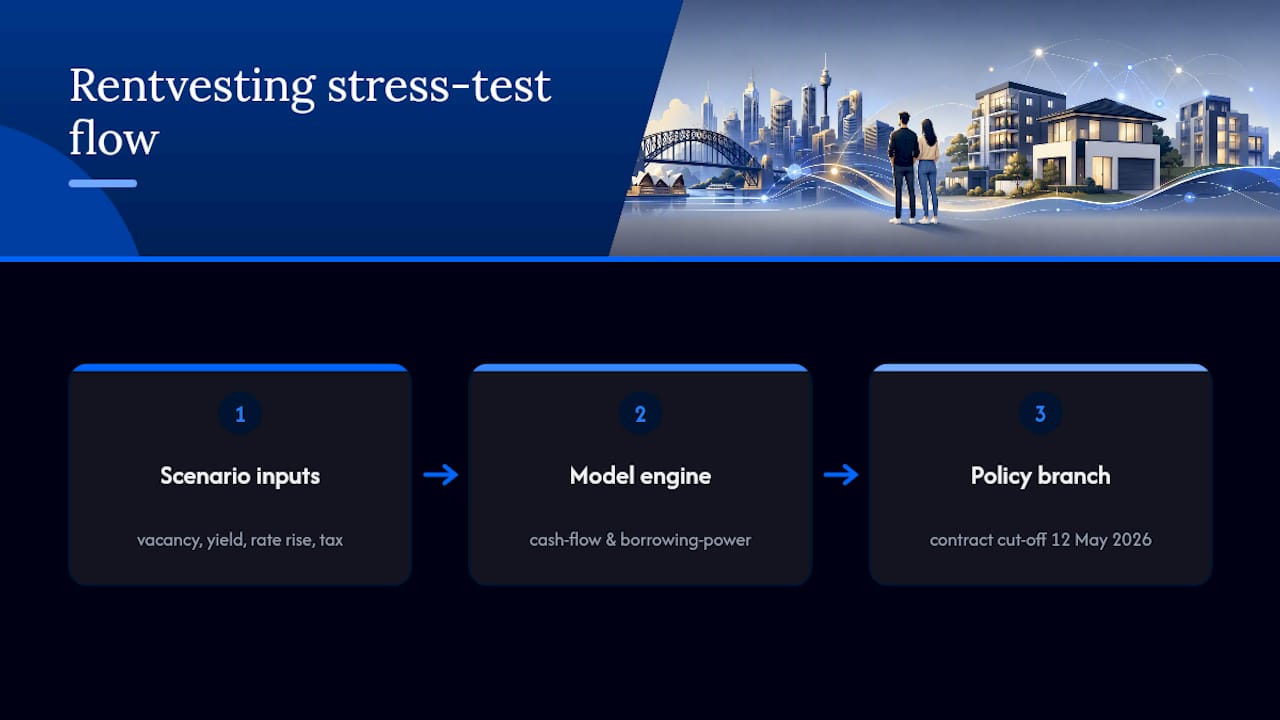
Run your vacancy assumption, rental yield, interest-rate rise, and post 2026 tax treatment as separate scenarios rather than one optimistic guess. Then take the output to a mortgage broker and a tax adviser, particularly if your contract date sits close to the 12 May 2026 cut-off, before you sign anything.
How rentvesting changes your day-to-day life and long-term goals
Rentvesting is as much a lifestyle decision as a financial one, and that trade-off deserves honesty upfront. You get to live in the suburb, the share house, or the apartment that actually suits your life right now, near work, near friends, near the coffee you like, without stretching into a mortgage that dictates where you’re allowed to want to live.
The trade-off is psychological as much as financial. You won’t have the “forever home” feeling that comes with owning where you sleep, and every rent increase or lease non-renewal is a reminder that your landlord, not you, controls that address. Some rentvesters find that unsettling. Others find it liberating, because their wealth-building happens in a suburb they’ve never had to compromise their weekend plans for.
Longer term, the strategy only pays off if you keep your eye on the actual goal: equity growth and rental income compounding over five to ten years, not the property becoming a home you’ll one day move into. Rentvesters who drift, buying an investment property then slowly talking themselves into moving in, often end up with an asset that was never optimised as either a home or a pure investment. Decide which one you’re building before you buy, and revisit that decision annually rather than by accident.
Rentvesting versus buying the home you live in
The comparison isn’t really rentvesting versus homeownership. It’s rentvesting now versus homeownership later, because most rentvesters intend to buy an owner-occupier property eventually, just after their investment has done some heavy lifting first.
Traditional homeownership in Sydney means saving a deposit for the suburb you want to live in, which at current prices can take years longer than saving a deposit for a cheaper investment-grade suburb elsewhere. The upside is certainty: no landlord, no lease renewal anxiety, and the security of a fixed housing cost once your mortgage rate settles. The downside is opportunity cost. Every extra year spent saving for an expensive owner-occupier purchase is a year your money wasn’t compounding in an investment property instead.
Rentvesting flips that order. You buy sooner, in a suburb chosen for yield and growth rather than lifestyle, and you keep renting where you actually want to be. The risk shifts from “can I ever afford to buy” to “can I service two housing costs at once”, which is precisely the calculation the finance checklist above is built to test. For a side-by-side worked comparison, our renting versus buying wealth comparison walks through the numbers over a longer horizon.
Neither path is universally better. A buyer with a stable job and a clear suburb preference might do better locking in an owner-occupier purchase now. A buyer who values flexibility and wants exposure to a stronger-yielding suburb sooner is usually better served by rentvesting first.
Does rentvesting hurt your credit score or your next mortgage application?
Rentvesting itself doesn’t damage your credit score. Making your repayments on time does the same thing it always does, whether the property is an investment or a home you live in. What changes is how the loan affects your borrowing power for the next application.
An investment loan sits on your credit file and shows up in every subsequent lending assessment. When you apply for an owner-occupier mortgage later, the lender adds your existing investment repayments to your liabilities, and factors in only a shaded portion of your rental income to offset them, typically that 20 to 25% discount NAB’s guidance describes. That combination can meaningfully shrink what you’re approved to borrow for your own home, even if the investment property is performing well on paper.
There’s a second, less obvious factor: multiple credit inquiries within a short window, applying for an investment loan, then an owner-occupier loan a year later, can nudge your credit score down temporarily, even though neither application was declined. Lenders read frequent inquiries as a signal of financial pressure, fairly or not.
The fix is the same one that comes up throughout this article: model both loans as if you’re applying for them simultaneously, well before you sign a contract on the investment property. If the combined servicing doesn’t stack up, it’s better to know that before settlement than after.
What successful rentvesting in Sydney actually looks like
The rentvesters who do well tend to share a pattern rather than a postcode. They buy an investment-grade property, not a bargain, in a suburb with genuine population growth and infrastructure spend, and they hold long enough for the market cycle to actually play out. A common approach is buying in a growth corridor on Sydney’s outer fringe or in a well-connected regional centre, where the entry price sits well below inner-Sydney levels but the yield and long-term capital growth are backed by real infrastructure, a new hospital, a rail extension, an employment precinct, rather than a marketing brochure.

What separates the ones who succeed from the ones who struggle usually comes down to discipline rather than luck. They kept a genuine vacancy buffer instead of assuming full occupancy every year. They chose a property manager who answered the phone and filled vacancies quickly rather than the cheapest quote. And they re-ran their numbers whenever rates moved or policy changed, instead of setting the loan and forgetting about it.
The pattern that tends to fail is the opposite: buying on emotion or fear of missing out, skipping the vacancy buffer, and discovering too late that the investment loan quietly capped what they could borrow for their own home. Rentvesting rewards the boring, careful version of the strategy far more reliably than the exciting one.
This article is general information, not a substitute for advice from a qualified financial advisor. Consult a qualified financial professional about your own circumstances before acting on anything here.
Sources
- What is rentvesting? — CommBank
- The maths justifying rentvesting has changed — AFR
- Rentvesting: pros and cons — NAB
- What is rentvesting and how does it work? — Mozo
- Domain quarterly rent report shows Sydney rent price drops and increases — ABC News