
Renter financial modelling for property investment: 2026 guide
TL;DR:
- Renter financial modelling compares the long-term financial outcomes of renting versus buying property. It accounts for cash flows, tax effects, depreciation, and opportunity costs over 15 to 20 years to determine the break-even point. Properly structured models emphasize investing the rent savings and tracking key variables to support sound wealth-building decisions.
Renter financial modelling for property investment is the method of quantifying and comparing the financial outcomes of renting versus buying property to guide long-term wealth-building decisions. The formal industry term for this process is investment property cash flow analysis, though most Australian renters encounter it as a rent vs buy comparison model. Done properly, it moves the decision from gut feel to numbers. This guide explains the key inputs, how to build a working model, the property investment strategies renters should consider, and the mistakes that quietly wreck otherwise solid projections.
What key financial components are included in renter financial modelling?
A reliable model starts with every dollar that leaves your pocket as a buyer and every dollar you could have invested instead as a renter. Miss one category and the comparison skews badly.
Initial outlays for buyers include:
- Deposit (typically 10%–20% of purchase price)
- Stamp duty (varies by state and property value)
- Legal and conveyancing fees
- Building and pest inspection costs
- Lenders mortgage insurance if the deposit is below 20%
Ongoing ownership expenses include loan interest, council rates, strata levies, landlord insurance, property management fees (if renting the property out), and maintenance. These costs are real cash out the door every month.
Rental income and vacancy assumptions sit on the other side of the ledger. A standard model assumes a vacancy rate of one to two weeks per year, though this varies by suburb and market cycle. Rental income analysis must also account for annual rent increases, which typically track CPI or local market conditions.

Tax effects are where most renters underestimate the model’s complexity. Negative gearing occurs when deductible rental property expenses exceed rental income, and the resulting loss offsets your taxable income at your marginal tax rate. That tax saving is real money, but it only exists because you are running a cash loss first.
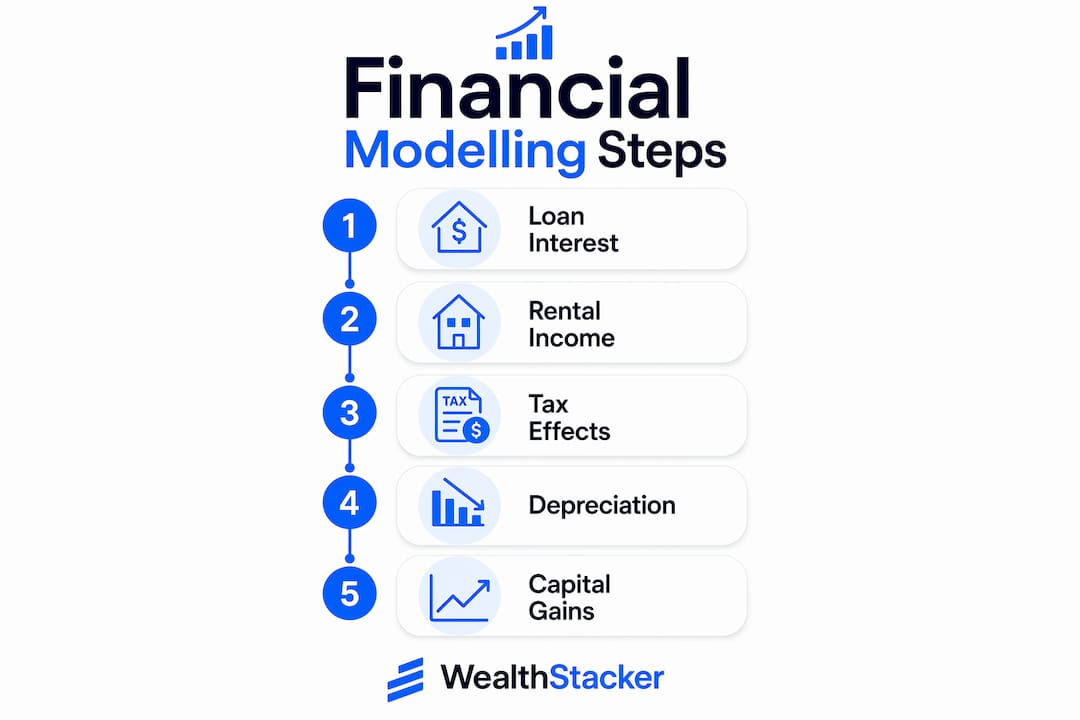
Depreciation adds another layer. Division 43 applies at 2.5% per year over 40 years on the building structure, while Division 40 covers plant and equipment at effective life rates. A quantity surveyor report substantiates both claims and typically costs $500–$770, which is itself tax deductible.
Capital gains tax (CGT) matters at the exit. Australia’s 50% CGT discount requires holding the property for over 12 months from contract date to qualify. Your model must track the holding period from day one, not from settlement.
Pro Tip: Model the opportunity cost of your deposit separately. A $120,000 deposit invested in a diversified portfolio from day one compounds significantly over 15 years. Ignoring this makes buying look far better than it actually is.
How do you build a renter financial model step by step?
A working model follows a clear sequence. Skipping steps produces numbers that look precise but mislead.
-
Set your modelling horizon. Choose 15–20 years as your base case. Shorter periods favour renting because property transaction costs have not had time to amortise. Longer periods favour buying in most Australian capital city markets.
-
Define your assumptions. Lock in annual capital growth rate, rental inflation rate, share market return assumption, and your personal income tax rate. Every output is only as reliable as these inputs, so document them clearly.
-
Build the buyer cash flow. Calculate monthly principal and interest repayments using your loan amount and interest rate. Add ongoing costs (rates, insurance, maintenance, management fees). Subtract rental income if the property is tenanted. Apply the negative gearing tax saving each year.
-
Build the renter investment path. Invest the full initial outlay (deposit plus purchase costs) into a diversified portfolio on day one. Each month, invest the difference between what the buyer pays in net costs and what you pay in rent. This is the opportunity cost method, and it is the only way to make the comparison fair.
-
Apply depreciation schedules. Track Division 43 and Division 40 deductions separately from cash operating costs. Depreciation reduces taxable income without touching your bank account, so it must sit in its own column.
-
Calculate the CGT outcome at exit. Apply the 50% discount if the holding period exceeds 12 months. Subtract the net CGT liability from the buyer’s final property value to get true after-tax wealth.
-
Summarise outputs in a table. A simple year-by-year table showing buyer net wealth versus renter net wealth makes the break-even year visible at a glance.
Here is a simplified example of how a summary table might look:
| Year | Buyer net wealth ($) | Renter net wealth ($) | Difference ($) |
|---|---|---|---|
| 5 | 180,000 | 210,000 | Renter +30,000 |
| 10 | 420,000 | 390,000 | Buyer +30,000 |
| 15 | 780,000 | 650,000 | Buyer +130,000 |
| 20 | 1,250,000 | 980,000 | Buyer +270,000 |
Note: Figures are illustrative only. Your model will produce different results based on your specific inputs.
The break-even year in Sydney with a 20% deposit often falls between year 7 and year 12 over a 15–20 year horizon, depending on assumptions. That range tells you the decision is genuinely close in many scenarios, which is exactly why modelling matters.
Pro Tip: Separate your spreadsheet into three tabs: Assumptions, Cash Flows, and Summary. Keeping inputs in one place means you can run sensitivity tests by changing one cell rather than hunting through formulas.
For a detailed walkthrough of investment property forecasting methods including deposit structures and projection factors, Wealthstacker’s 2026 guide covers the Australian context thoroughly.
What financial planning strategies should renters use with these models?
Modelling outputs are only useful if they connect to a real financial plan. The numbers tell you what is possible. Your behaviour determines what actually happens.
The most reliable renter wealth-building strategy is “rent and invest the difference.” Consistently investing 15%–20% of income into diversified assets creates a credible wealth trajectory that competes with property ownership over time. The discipline of treating that investment contribution as non-negotiable is what separates renters who build wealth from those who simply spend the difference.
“Renter wealth building relies heavily on opportunity cost and investment discipline. Consistently investing the money saved by renting is key to growing wealth before eventual property purchase or alternative investments.”
Rentvesting is a specific variation worth modelling separately. You rent where you want to live and buy an investment property in a more affordable market. This approach lets you access property investment strategies and negative gearing benefits without sacrificing your preferred lifestyle location. Your model needs a separate tab for this scenario because the cash flows look very different from a standard owner-occupier purchase.
Exit planning belongs in the model from the start. A comprehensive financial position review should include deposit size, borrowing power, purchase costs, and tax implications before committing to any property. Knowing your exit year in advance lets you time the CGT discount correctly and plan around life events like career changes or family needs.
Review and update your model at least once a year. Interest rates, rental yields, and personal income all shift. A model built in 2024 with assumptions that no longer hold will produce outputs that mislead rather than guide.
Key considerations for integrating modelling into your financial plan:
- Set a fixed monthly investment amount based on the model’s surplus calculation
- Review assumptions annually and adjust for actual market data
- Model at least three scenarios: base case, optimistic, and conservative
- Track actual results against model projections to spot assumption drift early
- Factor in life stage changes such as income growth, family costs, and retirement timing
What are common mistakes in renter financial modelling for property investment?
Most modelling errors are not calculation mistakes. They are structural choices that quietly distort the comparison.
Ignoring compounding opportunity cost is the most common error. Modelling the renter investment path by investing the initial outlay and monthly surplus from day one is the only way to account for compounding returns properly. Renters who skip this step make buying look far more attractive than the numbers justify.
Confusing cash flow losses with tax deductions in negative gearing creates a second major distortion. Negative gearing must be viewed as a combined cash flow and tax accounting model. The tax saving is real, but it only partially offsets the cash loss. Treating the full deduction as a cash benefit overstates the investment’s return.
Failing to model CGT holding period accurately costs renters real money at exit. Accurate CGT modelling requires tracking the holding period from contract date and apportioning periods rented versus owner-occupied to correctly apply the 50% discount. Getting this wrong by even one year changes the after-tax outcome materially.
Overlooking depreciation as a separate item distorts year-by-year cash flow projections. Depreciation does not affect cash flow but significantly impacts taxable income. Mixing it into operating cash flow produces misleading annual results.
Additional pitfalls to avoid:
- Using capital growth rates above long-run averages without justification
- Applying a single rental yield assumption across the entire holding period
- Forgetting to model rent increases on your own rental costs as a renter
- Not accounting for major capital expenditure events like roof replacement or kitchen renovation
Pro Tip: Run your model with a capital growth rate 1%–2% below your base case assumption. If the buyer still wins at year 15 under the conservative scenario, the decision is genuinely robust. If the renter wins under conservative assumptions, buying carries more risk than the headline numbers suggest.
For renters building a portfolio while renting, Wealthstacker’s 2026 guide covers the investment discipline and asset allocation decisions that sit alongside the property model.
Wealthstacker: property investment modelling built for renters
Renter financial modelling for property investment requires tracking dozens of variables across 15–20 year horizons. Doing that in a spreadsheet is possible, but it is slow and prone to formula errors.
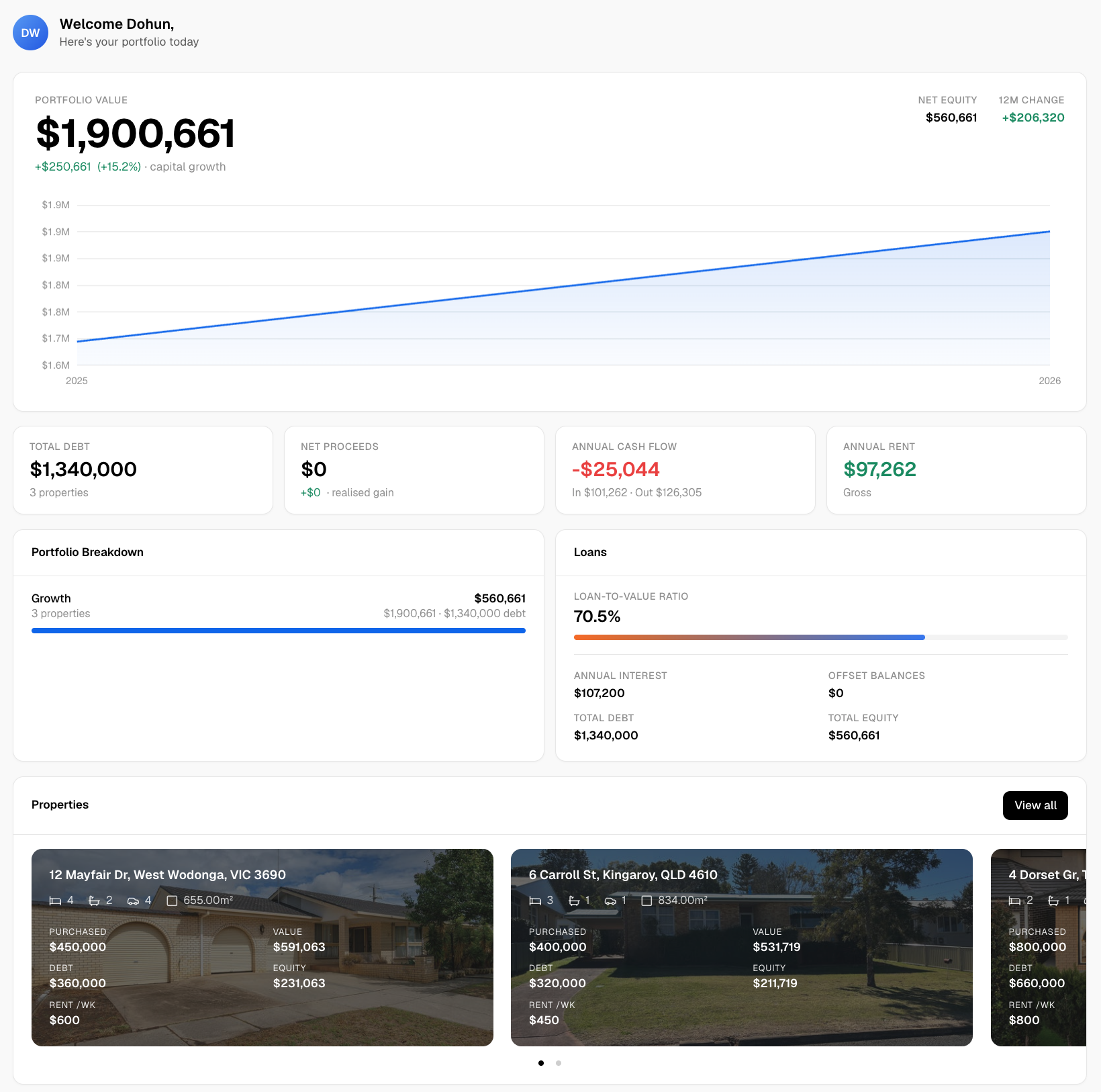
Wealthstacker is a property investment app and portfolio tracker built specifically for this kind of analysis. It provides automated quarterly property valuations at no cost, AI-driven modelling for both rentvesting and buying scenarios, and real-time net worth projections based on your actual financial position. You can model your investment path across multiple scenarios, compare renting versus buying outcomes, and track how your wealth is actually tracking against your projections. For renters who want data-driven clarity rather than guesswork, Wealthstacker puts the full picture in one place.
Key takeaways
Renter financial modelling for property investment works only when opportunity cost, tax effects, and depreciation are all modelled separately and consistently from year one.
| Point | Details |
|---|---|
| Model opportunity cost from day one | Invest the full deposit and monthly surplus in the renter path to capture compounding returns fairly. |
| Separate depreciation from cash flow | Track Division 43 and Division 40 deductions in their own column to avoid distorted annual results. |
| Track CGT holding period from contract date | The 50% CGT discount requires over 12 months from contract date, not settlement, to qualify. |
| Apply the rent and invest discipline | Consistently investing 15%–20% of income is the foundation of renter wealth building alongside any model. |
| Review assumptions annually | Interest rates, rental yields, and personal income shift; update your model every year to keep projections reliable. |
FAQ
What is renter financial modelling for property investment?
Renter financial modelling for property investment is the process of comparing the financial outcomes of renting versus buying by quantifying cash flows, tax effects, depreciation, and opportunity costs over a 15–20 year horizon. The goal is to identify the break-even year and the net wealth outcome under each path.
How does negative gearing affect a renter’s property investment model?
Negative gearing reduces taxable income when rental expenses exceed rental income, generating a tax saving at your marginal rate. The saving is real but only partially offsets the cash loss, so the model must track both items separately to avoid overstating the investment’s return.
What is the 50% CGT discount and when does it apply?
Australia’s 50% CGT discount applies when you hold a property for more than 12 months from the contract date. It halves the taxable portion of your capital gain, which materially improves after-tax wealth at exit and must be factored into any long-term property model.
What does “rent and invest the difference” mean in practice?
It means calculating the monthly cost difference between owning and renting, then investing that surplus into diversified assets every month without exception. Consistently directing 15%–20% of income into investments is the mechanism that makes the renter path competitive with property ownership over time.
How often should I update my property investment model?
Update your model at least once a year. Interest rates, rental yields, personal income, and market conditions all change, and a model built on outdated assumptions will produce projections that no longer reflect your actual financial position.