
Rental yield vs capital growth explained for investors
Rental yield is the annual rental income from a property expressed as a percentage of its purchase price, while capital growth is the increase in that property’s market value over time. These two metrics sit at the heart of every property investment decision, yet they pull in opposite directions. Understanding both is the difference between building a portfolio that works for your goals and one that quietly underperforms. This article breaks down the rental yield vs capital growth explained framework, with real calculations, Australian market context, and a clear strategy guide for 2026.
How to calculate rental yield and capital growth
Gross rental yield is calculated with a straightforward formula: (Annual Rent / Purchase Price) x 100. On a $500,000 property renting for $490 per week, that works out to roughly 5.1% gross. That number looks clean, but it does not reflect what you actually keep.
Net rental yield deducts your real costs: property management fees, maintenance, council rates, insurance, and vacancy periods. Expenses typically reduce yield by 1.5 to 2.5 percentage points, which means that 5.1% gross yield becomes closer to 3.0% to 3.6% net. Net yield is the figure that tells you whether a property is genuinely cash flow positive.

Capital growth is calculated as a percentage increase in market value over a set period. If a property bought for $500,000 is worth $620,000 five years later, the total growth is 24%, or roughly 4.4% per year compounded. That figure does not appear in your bank account until you sell or refinance, which is why it is often called “paper wealth” until it is realised.
Pro Tip: Always use net yield when assessing whether a property can service its own mortgage. Gross yield flatters the numbers and can lead you to underestimate holding costs by tens of thousands of dollars over a five-year period.
| Metric | Formula | Example | Result |
|---|---|---|---|
| Gross rental yield | (Annual rent / Purchase price) x 100 | $25,480 / $500,000 x 100 | 5.1% |
| Net rental yield | (Annual rent minus costs / Purchase price) x 100 | $18,000 / $500,000 x 100 | 3.6% |
| Capital growth (annual) | ((Current value / Purchase price)^(1/years) minus 1) x 100 | $620,000 / $500,000 over 5 years | 4.4% p.a. |
What are the key differences between rental yield and capital growth?
Rental yield reflects immediate income; capital growth reflects long-term wealth accumulation. One shows up in your bank account every month. The other shows up on your balance sheet years later. Both matter, but they serve different financial purposes at different stages of your investment life.
The most important structural difference is the inverse relationship between the two. Properties with high rental yields of 6% or more typically deliver capital growth below 3% per year. Conversely, high-growth properties returning 7% or more annually in capital appreciation usually yield below 4%. This is not a coincidence. It reflects how markets price properties: high-demand urban areas attract buyers who push prices up and compress yields, while regional or outer-suburban areas offer higher rent-to-price ratios but attract fewer buyers over time.
A practical example makes this concrete. A two-bedroom unit in a regional Queensland town might yield 7% gross but appreciate at 2% annually. A two-bedroom apartment in inner Melbourne might yield 3.2% gross but grow at 6% to 8% per year. Over a ten-year hold, the Melbourne property builds substantially more equity despite costing you money each month to hold.
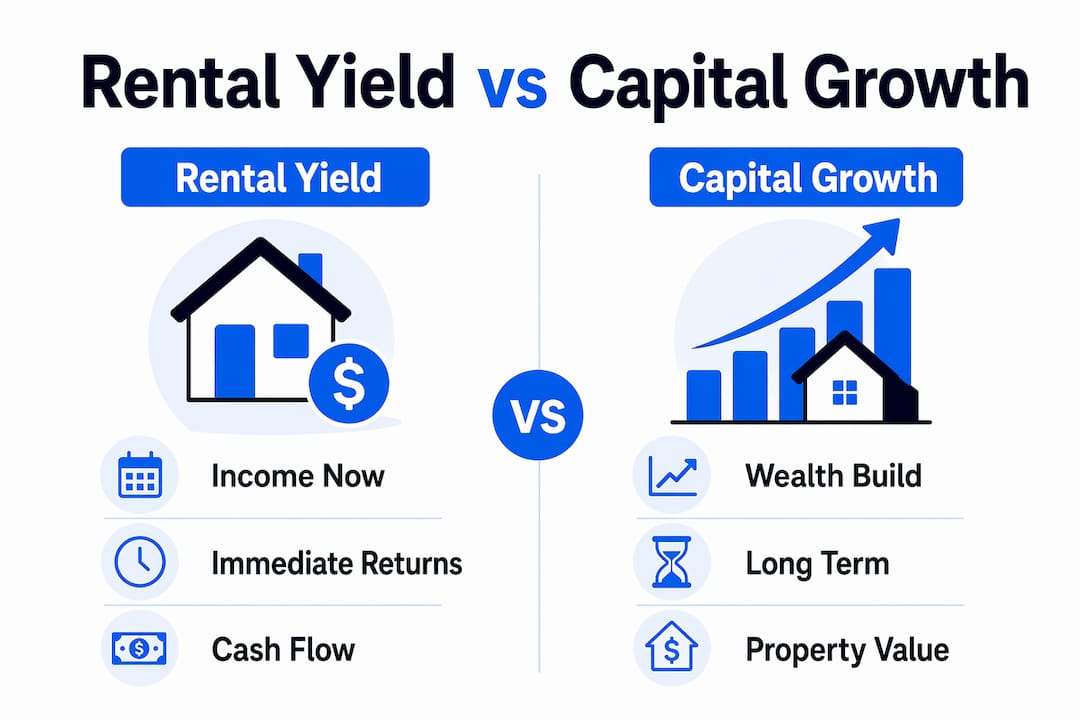
Rental income also tracks inflation because rents tend to rise with wages and living costs. This gives yield-focused investors a degree of income stability that pure growth investors do not have. Growth investors, by contrast, rely on compounding capital appreciation to build equity they can refinance and redeploy into further purchases.
Pros and cons at a glance:
-
Rental yield pros: Regular income, inflation-linked rent increases, easier to assess cash flow viability, useful near retirement
-
Rental yield cons: Often found in lower-growth markets, asset value may stagnate, high management demands
-
Capital growth pros: Builds equity for portfolio scaling, compounding effect over time, stronger long-term wealth creation
-
Capital growth cons: No immediate income benefit, requires financial buffer to cover holding costs, wealth is unrealised until sale or refinance
How to decide between rental yield or capital growth
Your choice between prioritising yield or growth depends on three factors: your current life stage, your cash flow position, and your investment timeline. There is no universal right answer, but there is a right answer for your situation.
Investors building wealth early in their careers benefit most from capital growth assets. The compounding effect over 15 to 20 years is difficult to replicate with yield alone. Investors approaching retirement, or those who need their portfolio to generate income now, are better served by properties with reliable yields above 4.5% net.
Rising mortgage rates between 3.5% and 4.2% have made this calculation more urgent in 2026. A net yield below your mortgage rate means you are paying to hold the property every month. That is a viable strategy if you have strong capital growth conviction and a financial buffer. It is a forced-sale risk if you do not.
A balanced portfolio approach that combines yield-generating and growth-oriented assets is the most sustainable strategy for most investors. One property funds the holding costs of another. Equity from growth assets provides the deposit for the next purchase.
Steps to evaluate your investment priorities:
-
Calculate your current monthly cash flow surplus after all living expenses and existing debt repayments.
-
Determine how many years you plan to hold before needing to access equity or income from the portfolio.
-
Assess your borrowing capacity and whether a negatively geared property is serviceable without stress.
-
Identify whether your primary goal is income now or wealth later, and weight your next purchase accordingly.
-
Review your portfolio annually using net yield and estimated capital growth to check whether your asset mix still matches your goals.
Pro Tip: Before committing to any investment property, model the cash flow at a mortgage rate 1.5 percentage points higher than today’s rate. If the numbers still work, you have a genuine buffer. If they do not, reconsider the purchase price or rental income assumptions.
Common pitfalls when comparing rental yield and capital growth
The most common mistake Australian property investors make is chasing yield without assessing growth potential. A yield above 7% almost always signals a market with weak demand fundamentals. The income looks attractive, but the asset value may barely move over a decade. You end up with a property that generates modest cash flow but builds no equity to fund your next purchase.
The opposite error is equally damaging. Buying purely for capital growth in a market where net yield sits at 2.5% means you are funding a significant monthly shortfall from your salary. Net yield below mortgage costs creates negative cash flow that requires a financial buffer or a very long hold period. Many investors who bought inner-city apartments in 2021 and 2022 found themselves in exactly this position when rates rose sharply.
Using gross yield instead of net yield is a third pitfall that distorts decision-making. A property advertised at 6% gross in a strata complex with high body corporate fees, regular maintenance levies, and a property manager taking 8% of rent will net closer to 3.8%. That changes the entire investment case.
Market fundamentals including population growth, infrastructure investment, and employment diversification are the most reliable indicators of whether a location can deliver both reasonable yield and growth. Surface-level comparisons of yield percentages across suburbs miss this entirely.
Common mistakes and how to correct them:
-
Mistake: Using gross yield to compare properties. Fix: Always calculate net yield including all recurring costs.
-
Mistake: Buying in high-yield markets without checking population trends. Fix: Research ABS population data and state government infrastructure pipelines before committing.
-
Mistake: Ignoring equity strategy. Fix: Plan how you will access capital growth through refinancing to fund future purchases rather than waiting to sell.
-
Mistake: Treating yield and growth as mutually exclusive. Fix: Build a portfolio that holds both asset types to balance income and appreciation.
Key takeaways
Rental yield and capital growth serve different financial purposes, and a portfolio that deliberately combines both outperforms one that optimises for either metric alone.
| Point | Details |
|---|---|
| Yield measures income now | Net rental yield of 4% to 6% is the target range for Australian investors seeking positive cash flow. |
| Growth builds long-term equity | Capital growth compounds over time and funds future purchases through refinancing, not just eventual sale. |
| Yield and growth trade off structurally | Properties yielding above 6% typically grow below 3% annually; high-growth assets usually yield below 4%. |
| Net yield is the only reliable figure | Gross yield overstates returns by 1.5 to 2.5 percentage points; always deduct real costs before comparing. |
| Strategy depends on life stage | Prioritise growth when building wealth; shift toward yield when approaching retirement or needing income. |
The yield-growth balance is not a formula, it is a judgement call
I have reviewed enough property portfolios to say with confidence that the investors who struggle most are those who picked a side and stuck to it rigidly. The yield-only investors often own a collection of regional properties that generate modest income but have not grown enough to refinance. The growth-only investors sometimes own one or two premium assets they cannot afford to hold through a rate cycle.
The investors who build genuine wealth treat yield and growth as complementary levers. They buy a growth asset first, let it appreciate, then use that equity to fund a yield asset that offsets holding costs. The yield asset does not need to be exciting. It just needs to pay for itself and free up cash flow for the next growth purchase.
What I find underappreciated in most discussions about capital growth vs rental yield is the role of life stage. A 32-year-old with stable income and a 20-year horizon should weight heavily toward growth, even if it means a monthly shortfall. A 55-year-old with a fixed income and a 10-year horizon should weight toward yield, even if it means slower equity accumulation. The maths of compounding favours growth early and income late. Most investors get this backwards because yield feels safer and more tangible.
In the current 2026 environment, with mortgage rates sitting between 3.5% and 4.2%, the margin between a viable and an unviable investment is thin. That makes market selection and net yield calculation more important than ever. Do not buy on gross yield headlines. Do not buy in a market just because it has grown recently. Buy where the fundamentals support both metrics over your specific hold period.
How Wealthstacker helps you balance yield and growth
Property investment decisions get complicated fast, especially when you are trying to compare net yields, model capital growth scenarios, and assess your borrowing capacity at the same time.

Wealthstacker is built for exactly this problem. The platform provides automated quarterly property valuations at no cost, so your portfolio data stays current without manual research. Its AI-powered modelling lets you run yield and growth scenarios side by side, compare rentvesting against buying strategies, and see how different asset mixes affect your projected net worth over time. Whether you are assessing your first investment property or rebalancing an existing portfolio, Wealthstacker’s investment toolkit gives you the numbers you need to make a deliberate, informed decision rather than an educated guess.
FAQ
What is the difference between rental yield and capital growth?
Rental yield is the annual rental income expressed as a percentage of the property’s purchase price, measuring immediate cash flow. Capital growth is the increase in the property’s market value over time, measuring long-term wealth accumulation.
How do you calculate net rental yield?
Subtract all annual property costs (management fees, maintenance, insurance, vacancy allowance) from annual rent, then divide by the purchase price and multiply by 100. Net yield is typically 1.5 to 2.5 percentage points lower than gross yield.
Can a property have both high rental yield and strong capital growth?
Rarely. Properties yielding above 6% typically grow below 3% annually, and high-growth properties usually yield below 4%. Locations with strong market fundamentals such as population growth and infrastructure investment offer the best chance of reasonable performance across both metrics.
What rental yield is considered good in Australia?
A gross yield of 4% to 6% is the benchmark range for Australian investment properties. Below 3.5% creates cash flow pressure, particularly when mortgage rates sit above 3.5%. Above 7% usually indicates a market with weaker capital growth prospects.
Should I prioritise yield or capital growth for my investment strategy?
Prioritise capital growth when you are in the wealth-building phase of your career and can service a monthly shortfall. Shift toward yield when you need reliable income or are approaching retirement. A balanced portfolio holding both asset types is the most resilient long-term approach.