
Rental Income Shading in Australia: How Lenders Count Your Rent
Rental income shading means a lender counts only a percentage of your rent when it tests whether you can afford a loan. If an investment property earns $31,200 a year, the lender might treat only $24,960 of it as income. The gap is deliberate, it varies by lender and property type, and it can change how much you are able to borrow. WealthStacker’s borrowing power estimations and 15-year modelling tools let you see that effect before you apply, rather than after a lender has run the numbers.
WealthstackerSee How Rent Affects Your Borrowing PowerWealthStacker’s borrowing power estimates and 15-year modelling help you explore how rental income could shape your property investment decisions.VisitTL;DR
- Shading (also called a haircut) is the lender discounting rent to allow for vacancies, repairs and costs. It is separate from how the ATO taxes your rent.
- APRA’s guidance says prudent lenders apply a minimum 20% haircut to expected rental income, and more where vacancy risk is higher. Many lenders sit at 80%, though published policies range from 95% to 50% depending on the lender and property.
- Short-term rentals, room rentals and some special-purpose properties are usually shaded harder than a standard residential lease.
- On $600 a week in rent, the difference between 80% and 95% shading is $4,680 a year of assessed income.
- Model your own scenario with the lender’s actual shading rate before you commit to a purchase.
Table of Contents
- What rental income shading actually means
- Why lenders shade rent: the APRA guidance
- Shading rates lenders publish
- A worked example
- How shading affects how much you can borrow
- What evidence lenders want for the rent
- Shading versus tax: two separate things
- Practical ways to improve how your rent is assessed
- Test your numbers with WealthStacker
- FAQ
- Sources
What rental income shading actually means
When you apply for a home or investment loan, the lender runs a serviceability test: can your income cover the repayments, living costs and other debts, even if interest rates rise? Rent from an investment property counts as income in that test, but not at face value.
The lender “shades” it. A tenant can leave, the property can sit empty between leases, and agents’ fees, strata levies and repairs eat into what actually reaches your account. So the lender counts a portion, commonly somewhere between 70% and 95% of gross (before-expenses) rent, and in some cases much less.

The key point for first-time buyers and rentvestors: shading is a lender’s internal risk setting, not a law and not a tax. Two lenders can look at the same lease and count different amounts.
Why lenders shade rent: the APRA guidance
Australia’s prudential regulator, APRA, sets the benchmark. Its practice guide APG 223 on residential mortgage lending (current version 19 June 2025) says prudent serviceability policies include a minimum haircut of 20 per cent on expected rental income, with larger haircuts for properties at higher risk of non-occupancy.
The same guide says lenders should place less reliance on third-party rent estimates than on actual rental receipts, and should account for property costs such as strata fees. It also says good practice is to place no reliance on future tax benefits from a loss-making rental. In other words, the lender is not counting on your negative gearing refund to make the loan work. For how that tax treatment works, see our guide to negative gearing rules and cash flow models.
That 20% is a floor for prudent practice rather than a fixed industry rate, which is why published lender policies differ.
Shading rates lenders publish
Lender credit policies are public in many cases, written for mortgage brokers. The examples below show how wide the range is. They are drawn from each lender’s own published documents, so they can be revised at any time.
| Lender policy (published) | Rental type | Share of gross rent counted |
|---|---|---|
| Macquarie broker guidelines | Residential rent | 95% |
| Same | Short-term stays, room rental, commercial | 80% |
| AAAFin income shading schedule (v2.3, February 2026) | Standard rental | 80% |
| Same | Holiday rental/Airbnb, averaged over the prior 12 months | 70% |
| Same | NRAS properties | 65% |
| Bank of Sydney lending guidelines (November 2025) | Metropolitan postcodes | At least a 20% discount |
| Same | Regional postcodes | At least a 30% discount |
| Same | National (standard) postcodes | At least a 50% discount |
Two things stand out. First, property type matters: a short-term rental is treated as less reliable than a 12-month lease. Second, location matters at some lenders: the Bank of Sydney policy also declines rent from high-density properties in national postcodes.
The NRAS (National Rental Affordability Scheme) and SDA (Specialist Disability Accommodation) categories apply to niche property types, and most investors will never meet them. If you plan to run a property as a holiday let, our comparison of Airbnb versus renting in Australia covers the income side.
A worked example
Say you buy an investment property rented at $600 a week. Gross rent is $600 × 52 = $31,200 a year.
| Shading rate | Rent counted for serviceability |
|---|---|
| 95% | $29,640 |
| 80% | $24,960 |
| 70% | $21,840 |
Between 95% and 80% there is a $4,680 gap in assessed income. That is rent you will really receive, but the lender ignores for the test.
Expenses then reduce it further. Macquarie’s published guidelines, for example, apply a separate floor of 15% of gross rental income for investment property expenses. On this property that is $4,680 as well. Lenders handle expenses in different ways, so the net figure depends on whose policy you land under.
For a first-time buyer or rentvestor, this is the practical lesson: the rent a property earns and the rent a lender credits can differ by thousands of dollars a year, and your borrowing capacity follows the lender’s figure.

How shading affects how much you can borrow
Shading is one of several settings in the serviceability test. Others work alongside it:
- Assessment rate. Lenders test repayments at a rate above the actual one. Macquarie’s guidelines, for instance, use a 3.00% buffer with an assessment rate floor of 5.30% and assess repayments as principal and interest for all loan types.
- Debt-to-income (DTI). The same guidelines cap DTI at 8 times income. Separately, from 1 February 2026 APRA’s DTI limits allow lenders to write up to 20% of new investment loans and up to 20% of new owner-occupied loans at a DTI of six times or more, with exemptions including newly built dwellings.
- Existing debts and living costs. These come off your income before rent is considered.
Lower shaded rent means a lower assessed income, and a lower income means a smaller loan under the same test. We explain the DTI side in our guide to the debt-to-income ratio in Australia, and the buffer in APRA’s 3% buffer and 6x DTI.
How to estimate the effect yourself
- Work out gross annual rent. Weekly rent × 52. For a property you do not own yet, use a realistic rent for the suburb.
- Apply the shading rate. Multiply by 0.95, 0.80 or 0.70, depending on the property type and lender policy.
- Deduct property costs the lender counts. This can include strata, rates and management fees, or a fixed percentage of rent.
- Add the result to your other assessable income. Then subtract existing debts and living costs.
- Run repayments at the assessment rate, not the advertised rate. Compare what is left with the new loan’s repayments.
- Repeat at a harsher shading rate. If the loan only works at 95%, it is fragile.
Doing this by hand across several properties and rates is slow. WealthStacker’s borrowing power estimations and 15-year investment modelling tools are built so that you can compare rentvesting and buying scenarios side by side without a spreadsheet. If you are weighing a rentvesting move, our checklist of rentvesting risks in Australia covers what else to check.
What evidence lenders want for the rent
Lenders do not take your word on rent. For a property you are buying, Macquarie’s guidelines (version 15.1) use the lesser of the rent on the lender-ordered valuation or a licensed agent’s estimate or tenancy management agreement no more than 60 days old, taking the lower figure if a range is given.
For an existing rental, accepted evidence includes a rental statement or executed tenancy agreement (no more than 60 days old, through an agent), your latest tax return, an annual rental income statement, or bank statements showing rental credits for at least three months. Other lenders list similar documents, such as a current lease or a valuer’s rental valuation.
If the property came to you through an estate, the same paperwork applies, and a guide on renting out an inherited property can help you think through setting it up as a rental. Getting a lease and agent statement in place early gives a lender something firm to count.
Shading versus tax: two separate things
This is the most common confusion. Shading is how a lender discounts rent to judge your repayment ability. Tax is what the ATO requires you to report.
For tax, the ATO says you declare the gross rent you earn, before it is reduced by property management fees and expenses paid on your behalf. You are not taxed on 80% of your rent, and a lender’s 80% does not reduce your tax bill.
On the deductions side, some lenders let you offset rental interest and expenses against rent in serviceability, including pooling across several properties in the same name. Macquarie notes that it relies on the customer’s representation of negative gearing eligibility and that customers should seek their own tax professional’s guidance. Take your tax questions to a registered tax agent or accountant, and your lending questions to a licensed broker or lender.
Practical ways to improve how your rent is assessed
- Show actual receipts. APRA’s guide favours actual rental receipts over third-party estimates, so a track record of agent statements and bank credits carries weight.
- Keep leases standard. A 12-month residential lease through an agent is generally treated more favourably than short-term or room-by-room income.
- Check the lender’s schedule early. Because shading and expense settings differ by lender and by postcode, ask your broker which lender’s policy suits your property before you sign a contract.
- Stress the shortfall. Model what happens if the property is vacant for eight weeks, or rates rise. Our interest rate stress testing checklist walks through eight checks.
- Mind your overall exposure. Several properties add up. See portfolio LVR explained for how lenders view the whole picture.
Financial planners advising clients can use the same logic: run each client scenario at the lender’s shading rate and at a harsher one, and keep the second figure in the file.
Test your numbers with WealthStacker
Shading is easy to understand and tedious to model across properties, rates and years. WealthStacker is an investment toolkit for Australian property: it provides free automated quarterly property valuations, borrowing power estimations, a portfolio dashboard and 15-year modelling for comparing rentvesting and buying strategies, plus an AI investment chat assistant for questions along the way.
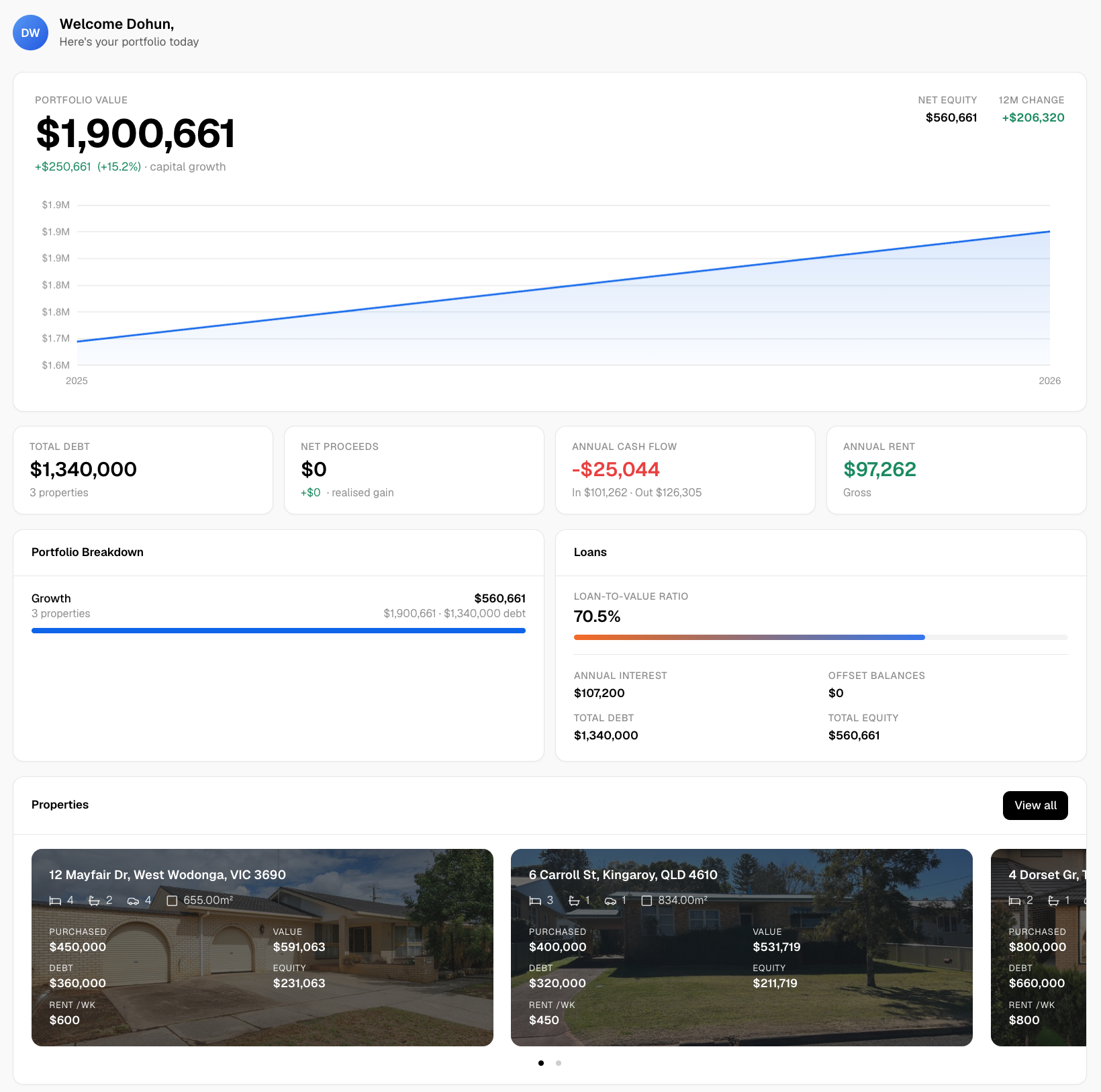
If you are deciding whether a property can carry its own weight, start at WealthStacker and test your purchase at different rent levels and interest rates.
FAQ
What is a typical rental income shading rate in Australia?
There is no single rate. APRA’s guidance points to a minimum 20% haircut for prudent lenders, and published lender policies range from counting 95% of rent through to heavier discounts of 50% in some postcode categories. Check the specific lender’s policy for your property type.
Does shading reduce the rent I actually receive or the tax I pay?
No. Shading only changes how much rent the lender counts when assessing your loan. You still receive the full rent, and the ATO requires you to declare the gross amount.
Why is Airbnb or short-term rent shaded more heavily?
Short-term income is less predictable than a 12-month lease, so lenders treat it as higher risk. Published examples include 80% at one lender and 70% averaged over 12 months at another, compared with 95% or 80% for a standard lease.
Can I use the rent from a property I haven’t bought yet?
Often yes, but lenders want independent evidence. One published policy uses the lower of the valuer’s rent figure and a licensed agent’s estimate no more than 60 days old. The result is then shaded like any other rent.
Sources
- APG 223 Residential Mortgage Lending, APRA
- Activation of debt-to-income limits, APRA
- Inputting income and liabilities into the Macquarie serviceability calculator
- Submitting rental income and tax deductions, Macquarie
- Macquarie broker credit guidelines, Residential Home Loans
- Income Shading, AAAFin
- Residential Lending, Bank of Sydney
- Rental income you must declare, ATO
- How to rent out an inherited property