
Real estate planning conversation starters: a meeting playbook
TL;DR:
- Structured property planning conversations using grouped prompts lead to clearer decisions and fewer costly mistakes.
- Prioritize aligning goals, finances, strategy, risk, and responsibilities in a single meeting supported by validated numbers and assigned owners.
Use a short, grouped set of conversation starters covering vision, money, strategy, risk, and responsibilities to leave a planning meeting with agreed goals, one modelling run, and two concrete next actions.
TL;DR: Run a session of suitable length using the prompts below. You will finish with a shared investment vision, validated numbers, and assigned owners for the follow-up steps.
The six prompt groups to copy into your agenda:
- Vision and goals — what life outcome does this investment serve?
- Household finances — income, debts, super balances, borrowing power
- Strategy choices — buy-to-live, buy-to-let, rentvest, hold period
- Risk and insurance — buffers, stress tests, vacancy and maintenance
- Decision rules and responsibilities — roles, dispute process, who signs off
- Next steps — modelling runs, adviser contacts, follow-up date
Table of Contents
- Why structured conversations change outcomes for Australian property investors
- What are the best conversation starters for property planning?
- Short scripts for opening topics and handling disagreement
- How to make the conversation concrete with numbers and modelling
- A meeting agenda and checklist you can copy into an invite
- What should you do immediately after the planning meeting?
- Key takeaways
- Wealthstacker turns your planning conversation into a live model
- Sources and further reading
Why structured conversations change outcomes for Australian property investors
Planned prompts move a property conversation from emotional to strategic. When partners or co-investors align on a shared vision, they stop negotiating as individuals and start operating as a team. The difference shows up in decisions: fewer impulsive purchases, clearer exit criteria, and less friction when the market moves.

Australian investors face specific structural pressures that make this alignment harder to reach without a framework. The Reserve Bank of Australia’s rate cycle has repeatedly caught investors off-guard, and the ATO’s rules on negative gearing and capital gains tax create outcomes that differ sharply depending on income, ownership structure, and hold period. A conversation that skips these specifics is not a planning conversation; it is just enthusiasm.
Pro Tip: The most common psychological trap for new investors and couples is anchoring on a specific property before agreeing on strategy. Run the prompts below before you open a listing portal.
Dual-income households that invest in property together tend to move faster, but speed without alignment creates expensive mistakes. The prompts in the next section are designed to surface disagreements early, when they are cheap to resolve.
What are the best conversation starters for property planning?
Allocate time before you start: 10 minutes on vision, 20 on finances, 25 on strategy and modelling, 10 on decisions and owners. One person facilitates; the other answers first, then you swap. Write answers on a shared doc or whiteboard as you go.
Group A: vision and goals
These prompts establish why you are investing, which determines every strategy choice that follows.
- What does financial freedom look like for us, and by when? Note the target income or net worth figure and the year.
- Are we investing to fund a specific life event — early retirement, education, a sea change? Record the event and the rough cost.
- How many properties do we realistically want to hold at peak, and what cashflow profile do we need? This is your financial freedom number — write it down.
- Does this investment serve our life plan or just our asset plan? A life-plan answer shapes hold period and risk tolerance.
Group B: household finances
Australian couples frequently underestimate how differing superannuation balances and short-term consumer debts change borrowing power and timelines. Surface these openly.
- What is each person’s current income, and how stable is it over the next three years?
- What debts do we carry — mortgage, car, HECS-HELP, BNPL, credit cards — and what are the monthly repayments?
- What are our respective super balances, and have we considered spouse contribution splitting?
- What is our combined borrowing power today, and what would it be if one income stopped?
Check your superannuation’s role in the ownership decision before the meeting, not during it.
Group C: strategy choices
- Are we buying to live in, buying to let, or rentvestingand why? Each path has a different tax and cashflow profile under Australian law.
- What is our target hold period, and what event would trigger an exit? Selling in under two years rarely recovers transaction costs.
- Do we want positive cashflow now or capital growth over time? Negative gearing suits high-income earners; it is a liability for lower-income investors.
- Does this property fit our long-term strategy, or are we reacting to market hype?
For a deeper look at passive approaches, the rentvesting strategies guide covers the trade-offs in detail.
Group D: risk and insurance
- What cash buffer do we hold, and how many months of repayments does it cover?
- Can we service the loan if rates rise by 2–3 percentage points?
- Have we priced landlord insurance, building insurance, and a maintenance reserve into the cashflow model?
- What happens if the property sits vacant for three months?
Stress-test every plan against interest-rate hikes and rental voids; treat contingency buffers as inevitable rather than optional.
Group E: decision rules and responsibilities
- Who runs the numbers and who reviews them before any offer?
- If we disagree on a purchase, what is our process — pause, get a third opinion, or defer to one person?
- What ownership structure suits us: joint tenancy or tenancy in common? The answer affects estate planning and tax. Discuss ownership structures before you sign anything.
- Who contacts the broker, tax agent, and conveyancer, and by when?
Short scripts for opening topics and handling disagreement
Starting a money conversation cleanly matters. These one-liners reduce defensiveness.
Vision opener: “Before we look at any properties, can we spend ten minutes on what we actually want our life to look like in ten years?”
Money opener: “I want to make sure we both understand our numbers before we talk strategy. Can we go through income, debts, and borrowing power first?”
Strategy opener: “Let’s agree on our approach before we fall in love with a suburb.”
When someone jumps to a specific property before goals are set, redirect with: “That sounds interesting. Can we park it and come back once we have agreed on our criteria? That way we can assess it properly.”
For disagreements, use a three-step pause: name the disagreement plainly, request the data that would resolve it, and set a specific time to re-run the model with updated inputs. Avoid resolving a financial disagreement in the same conversation where it surfaces — sleep on it, then revisit with numbers.
Roleplay tip: Run through the opener scripts with your partner or co-investor for ten minutes before the meeting. It sounds unnecessary until you realise how differently two people interpret the word “risk.”
How to make the conversation concrete with numbers and modelling
Bring three validated numbers to the meeting: your combined borrowing power, your current net monthly cashflow, and your target hold period. Everything else flows from those three.
Data to prepare before the meeting:
- Payslips or tax returns (last two years)
- Current loan statements and credit card limits
- Super balance statements for both partners
- Recent rental comparables for the target suburb
- A current property valuation or automated estimate
- Expected upfront costs: stamp duty, lender’s mortgage insurance (LMI), legal fees, building inspection
A solid property investment budget covers all of these line items and prevents the meeting from stalling on missing figures.
Core modelling runs to complete during the meeting:
| Model | What it answers | Key inputs |
|---|---|---|
| Cashflow projection | Will this property cost or earn money monthly? | Rent, loan repayments, rates, insurance, management fees |
| Break-even rent | What rent covers all costs? | Purchase price, loan rate, holding costs |
| Interest-rate stress test | Can we service the loan at +2–3%? | Current rate, loan balance, income |
| 15-year wealth path | Rentvest vs buy-to-let net worth comparison | Growth assumptions, rent savings, tax effect |
Wealthstacker’s quarterly automated valuations keep the “current property value” input accurate without manual research. The 15-year modelling tool runs the rentvest versus buy-to-let comparison with scenario toggles, and the net worth projector shows the cumulative wealth gap between strategies over time.
Example scenario: Inputs — $120,000 combined income, $80,000 deposit, $600,000 target property, 6.2% loan rate, 5% rental yield, 20-year hold. Expected output: monthly cashflow position, break-even rent, projected net worth at years 5, 10, and 15 under two strategies.
A meeting agenda and checklist you can copy into an invite
Timed agenda:
- 0–10 min — Vision and goals (Group A prompts)
- 10–30 min — Household finances (Group B prompts)
- 30–55 min — Strategy, modelling run, stress test (Groups C and D)
- 55–65 min — Decision rules, owners, next steps (Group E)
Documents to attach to the calendar invite:
- Combined borrowing power estimate
- Current loan and debt summary
- Super balance statements
- Suburb rental comparables
- Wealthstacker property valuation report
Owner-action table:
| Action | Owner | Deadline |
|---|---|---|
| Run 15-year model in Wealthstacker | Partner A | Before follow-up meeting |
| Contact mortgage broker for pre-approval | Partner B | Within one week |
| Book tax agent to discuss negative gearing | Partner A | Within two weeks |
| Update Wealthstacker model with broker figures | Partner B | Day before follow-up |
Use the property investment checklist to fill any gaps before the follow-up.
What should you do immediately after the planning meeting?
Three things matter in the 48 hours after the meeting: update the model with any figures that changed during the conversation, book the broker call, and set the follow-up meeting date before anyone leaves the room.
Immediate next steps:
- Update your Wealthstacker scenario with the agreed inputs
- Request a pre-approval from your mortgage broker
- Order a suburb or property report for the shortlisted area
- Book the follow-up meeting (two to three weeks out)
Questions to take to each adviser:
- Broker: “What is our maximum borrowing capacity, and how does it change if one income drops by 30%?”
- Tax agent: “What is the after-tax cashflow effect of negative gearing on our combined income, and does tenancy in common change that?”
- Conveyancer: “Which ownership structure suits our situation, and what are the stamp duty implications in our state?”
Before the follow-up, complete a property investment timeline review so trigger events and hold periods are locked in writing.
Key takeaways
Structured real estate planning conversations that use grouped prompts, validated numbers, and assigned owners consistently produce clearer decisions and fewer costly reversals than unstructured discussions.
| Point | Details |
|---|---|
| Use grouped prompts | Cover vision, finances, strategy, risk, and responsibilities in one 45–75 minute session. |
| Bring three numbers | Borrowing power, net monthly cashflow, and target hold period are the minimum inputs for any modelling run. |
| Agree decision rules | Set a dispute process and ownership structure before you make any offer. |
| Assign owners | Every action needs a named person and a deadline before the meeting ends. |
| Model with Wealthstacker | Use Wealthstacker’s 15-year modelling and quarterly valuations to turn conversation into a decision-ready scenario. |
Wealthstacker turns your planning conversation into a live model
Running a great planning conversation is step one. Wealthstacker is where the numbers go next.
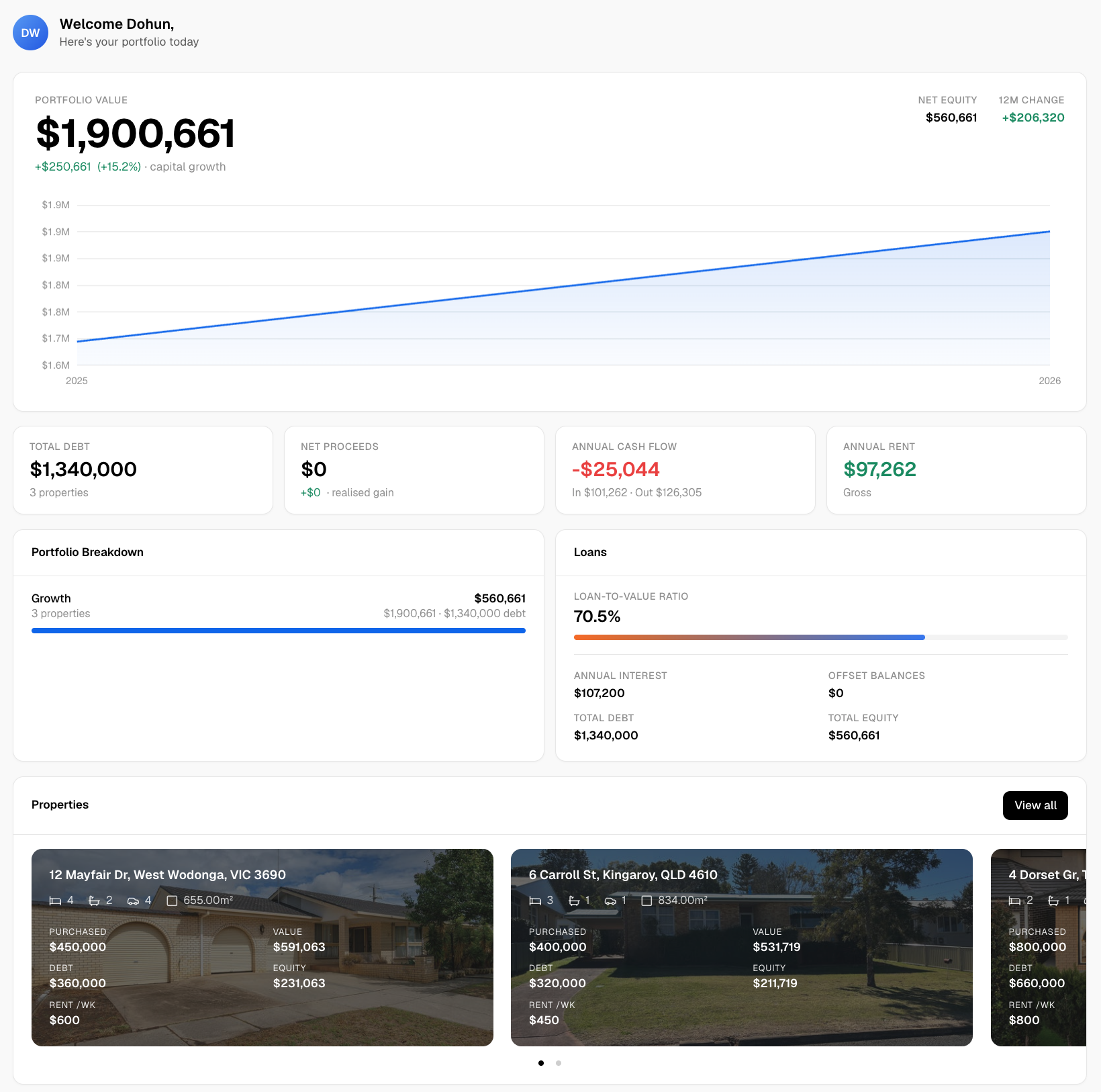
The platform gives you free automated quarterly property valuations so the “current value” input in your model is never stale. The 15-year scenario tool runs the rentvest versus buy-to-let comparison with adjustable rate and growth toggles, and the net worth projector shows the cumulative wealth gap between strategies at any point in the hold period. Before your follow-up meeting, attach a Wealthstacker valuation report to the calendar invite so both parties arrive with the same numbers.
Wealthstacker also covers borrowing power estimations and hazard overlays for suburb research, so the data you need for Groups B, C, and D is in one place rather than scattered across three browser tabs.
Start with a free valuation at wealthstacker.com.au and have a model ready before your next planning session.
Sources and further reading
The article draws on guidance from Atelier Wealth, The Property Couch, PropertyUpdate, Pearler, Lagos Financial, and CommBank’s investor step guide. For personalised figures on borrowing capacity, tax treatment, and ownership structures, consult a licensed mortgage broker, registered tax agent, and conveyancer for your specific situation. The ATO’s negative gearing guidance and the RBA’s current rate commentary are the primary sources for any tax or rate claims.
This article is general information only and does not constitute financial, tax, or legal advice. Confirm all figures and structures with a qualified professional before making investment decisions.
Start modelling: wealthstacker.com.au | Property investment plan guide | Investment reporting best practices