
Best propwealth.com.au alternatives for Australian investors
TL;DR:
- Wealthstacker is a powerful Australian property investment platform offering automated quarterly valuations and 15-year scenario modeling. It helps investors compare rentvesting versus buying and track multiple properties through comprehensive dashboards. Its real-time valuation updates and forecasting tools make it ideal for forward-looking investment planning without extra fees.
Wealthstacker is the strongest alternative to PropWealth for Australian property investors who need automated quarterly valuations, 15-year scenario modelling, and portfolio dashboards in one place. If you want a platform that handles rentvesting versus buying comparisons without manual spreadsheet work, that’s where to start. Here’s a quick shortlist of viable options:
- Wealthstacker — best for automated quarterly valuations, 15-year investment modelling, rentvesting vs buying scenarios, and AI-assisted research (recommended pick)
- PropertyData — best for suburb-level data research and market analytics
- Realestateinvestar — best for deal sourcing and property search filters
- CoreLogic / PropertyValue — best for authoritative valuation provenance and 98% Australian market coverage
- PropBoss — best for automated ledger reconciliation and ATO-aligned EOFY working papers
Each serves a different slice of the investor workflow. The gap PropWealth leaves most often is in forward-looking modelling: tools that show you where your net worth lands in 10 or 15 years under different borrowing and rentvesting assumptions. Wealthstacker is built specifically for that.
Table of Contents
- How do these propwealth.com.au alternatives compare?
- Profiles of each alternative: what they do and who they suit
- How do you choose the right platform for your needs?
- Switching platforms without losing data: a migration checklist
- Why Wealthstacker meets the core selection criteria
- What support and learning resources do these platforms offer?
- Key takeaways
- Wealthstacker: free valuations and modelling, ready when you are
How do these propwealth.com.au alternatives compare?
| Tool | Best for | Valuation frequency & source | Scenario modelling depth | Portfolio tracking | Suburb coverage | Pricing | Integrations |
|---|---|---|---|---|---|---|---|
| Wealthstacker | Rentvesting vs buying modelling, quarterly valuations, AI research | Quarterly, automated | long-term forecasts, custom variables, net worth planner | Multi-property dashboards | Australian suburbs and metros | Free tier + paid plans | Borrowing power, loan partners, export |
| PropertyData | Suburb research and market analytics | On-demand | Limited | Basic | Wide Australian coverage | Subscription | Data export |
| Realestateinvestar | Deal sourcing, property search | On-demand | Basic | Basic | National | Subscription, trial available | Search filters, alerts |
| CoreLogic / PropertyValue | Authoritative valuations, market data | Weekly to on-demand | Minimal | Minimal | 98% Australian coverage | Enterprise / API pricing | API, third-party integrations |
| PropBoss | Ledger reconciliation, tax workflow | Not primary focus | Minimal | Multi-property | National | Subscription | 120+ banks via CDR open banking, ATO-aligned EOFY |
Valuation frequency matters more than most investors realise. Platforms differ significantly by licensing and refresh cadence — CoreLogic-powered feeds update more frequently than vendor-modelled estimates. When you’re making a buy or hold decision, a valuation that’s six months stale can send you in the wrong direction.
Profiles of each alternative: what they do and who they suit

Wealthstacker
Wealthstacker is purpose-built for the individual Australian investor who wants to model decisions, not just track them. Free automated quarterly valuations sit at the core, with 15-year scenario modelling that lets you compare rentvesting against buying across different borrowing assumptions. The AI investment chat assistant handles research questions that would otherwise take hours to piece together from separate sources.
- Free automated quarterly property valuations
- long-term investment and net worth forecasting
- Rentvesting vs buying scenario comparisons
- Portfolio dashboards for multiple properties
- Hazard and risk overlays, borrowing power estimations
Best for: Investors who want forward-looking modelling and automated valuations without paying for a financial planner. Limitations: Newer platform; some advanced integrations are still expanding. Pricing: Free tier available; paid plans unlock advanced modelling and planning features.
PropertyData
PropertyData focuses on suburb-level analytics: vacancy rates, rental yields, days on market, and demographic overlays. It’s a research tool, not a portfolio manager. Useful for due diligence before acquisition, but it won’t model your 10-year wealth position or track your existing holdings.
- Suburb and postcode analytics
- Rental yield and vacancy data
- Market trend overlays
Best for: Data-first investors doing pre-purchase suburb research. Limitations: No portfolio tracking, no scenario modelling, no valuation automation. Pricing: Subscription-based; no publicly listed free tier.
Realestateinvestar
Realestateinvestar sits at the deal-sourcing end of the workflow. Its filters let you screen properties by yield, growth, and suburb metrics, which is genuinely useful when building a shortlist. Portfolio tracking exists but is basic, and the modelling tools don’t go deep on long-term wealth scenarios. For a deeper look at how it stacks up, the Realestateinvestar alternatives comparison covers the gaps in detail.
Best for: Investors actively searching for acquisition targets. Limitations: Modelling depth is limited; not built for ongoing portfolio management. Pricing: Subscription with trial available.
CoreLogic / PropertyValue
CoreLogic is the data backbone that many other platforms licence from. Going direct gives you the most authoritative Australian valuation data, with CoreLogic and PropTrack recognised as the leading sources for Australian-specific valuations. CoreLogic’s direct products cover 98% Australian market coverage and are priced for enterprise and professional users, not individual investors running a three-property portfolio.
Best for: Professionals and advisers who need raw, authoritative data. Limitations: Expensive for individual investors; minimal modelling or portfolio tools. Pricing: Enterprise and API pricing; not a consumer-grade free tier.
PropBoss
PropBoss is the strongest option if your primary pain point is bookkeeping and tax reconciliation. It reads rates notices, statements, and invoices automatically, coding entries to ATO rental categories and producing EOFY working papers aligned to the ATO’s rental schedule. The CDR open banking connections to 120+ banks and lenders reduce manual entry substantially. It’s not a modelling tool, though — if you want to forecast your net worth in 2036, look elsewhere.
Best for: Investors with complex ledger needs, multiple properties, or trust structures. Limitations: Minimal scenario modelling; valuation tracking is not the primary function. Pricing: Subscription; pricing transparency and trial availability are worth confirming directly.
How do you choose the right platform for your needs?
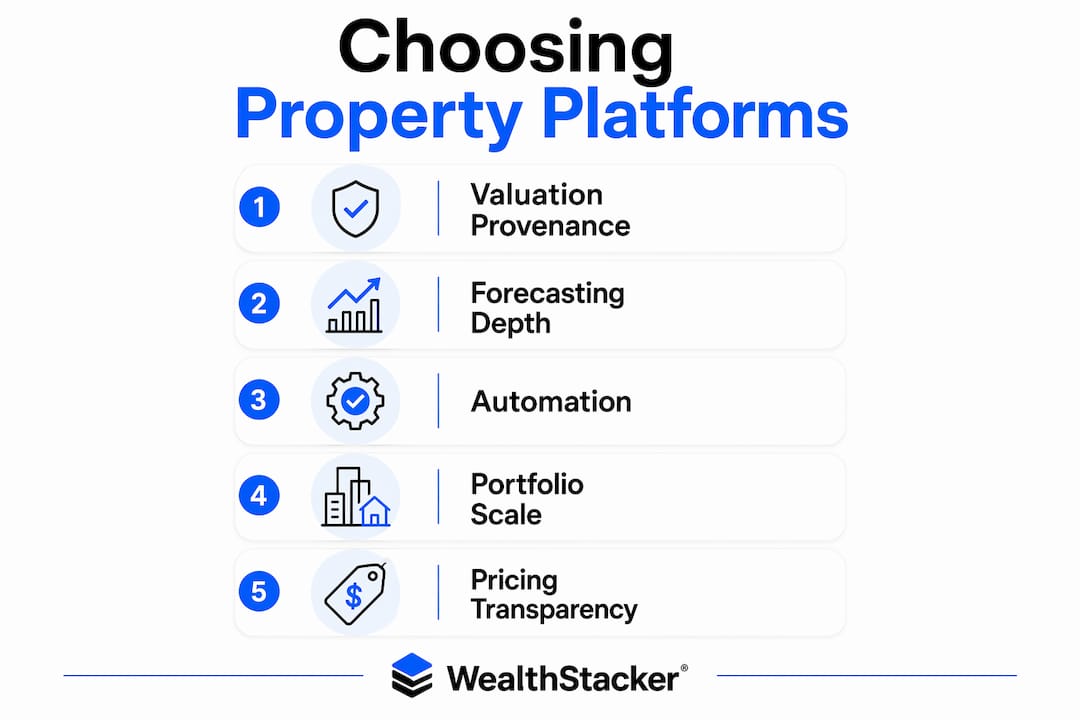
The single most important criterion is valuation provenance. A platform that can’t tell you where its valuations come from, or how often they refresh, is asking you to make six-figure decisions on unverified numbers. Start there.
From that foundation, work through these dimensions:
Forecasting depth: Does the tool model 10 or 15 years forward? Can you adjust variables like rental growth, interest rates, and capital growth assumptions? Fixed templates with no custom inputs are a red flag for serious investors. Understanding your property investment strategies before choosing a tool makes this evaluation much faster.
Automation: Manual data entry compounds errors over time. Platforms with automated PDF statement processing and bank integrations, like CDR-connected tools, reduce reconciliation time and human error considerably.
Portfolio scale: Some tools cap the number of properties on lower-tier plans. If you’re planning to grow beyond five properties, check the ceiling before you commit.
Pricing transparency: Transparent pricing and trial availability are baseline trust signals. Any platform that won’t show you a price page or offer a trial period deserves scepticism.
Questions worth asking during a trial: “How are valuations sourced and how often do they refresh?” “Can I export my full portfolio data as CSV or Excel?” “How does the tool handle trust or company ownership structures?”
Red flags: no data export option, unclear valuation methodology, no mobile access, and fixed scenario templates with no custom variables.
Pro Tip: Cross-check a sample property’s estimated value against a CoreLogic or RP Data report before trusting any platform’s valuations. A platform citing recognised data sources is far easier to verify, and a meaningful discrepancy on a single property tells you a lot about the model’s accuracy across your whole portfolio.
Switching platforms without losing data: a migration checklist
Timing matters. Avoid migrating mid-financial-year if you can — switching platforms in July, after EOFY reconciliation is complete, reduces the risk of broken workflows at tax time.
- Inventory your current data. List every property, loan, account, and trust structure held in your existing platform.
- Request exports in CSV and Excel formats. PDF statements are useful for records but harder to import; structured data files are what you need for a clean migration.
- Map your account and property structure. Note how ownership entities (individual, trust, company, SMSF) are labelled in your current tool and confirm the new platform handles them the same way. For SMSF-held properties, review the superannuation property investment considerations before migrating.
- Run a test import on one property. Before bulk importing, verify that balances, dates, and negative gearing adjustments carry across correctly.
- Reconcile opening balances. Compare the imported figures against your last bank statement and tax return line by line.
- Keep an archival backup. Before any bulk import, save a complete export of your old platform’s data to a secure location you control.
- Schedule the final cutover. Set a clean start date, ideally at the beginning of a new financial year or quarter, and stop entering data in the old system from that point.
Warning: Never delete your old platform account until at least one full financial year has passed and your accountant has signed off on the migrated records.
Why Wealthstacker meets the core selection criteria
Wealthstacker addresses the gaps that matter most to individual Australian investors: automated quarterly valuations at no cost, 15-year scenario modelling for rentvesting and buying comparisons, portfolio dashboards, and an AI assistant for market research. These aren’t bolt-on features — they’re the core of what the platform is built around.
On valuation provenance, Wealthstacker delivers automated quarterly updates, removing the need to manually request or pay for individual property reports. On modelling depth, the 15-year forecasting tools let you compare a rentvesting path against a direct purchase across different borrowing assumptions, with net worth projections updated in real time. That’s the kind of forward-looking analysis that static spreadsheets and tax-focused tools simply don’t offer.
The borrowing power estimator and loan partner integrations connect modelling to real financing decisions. Hazard and risk overlays add a layer of due diligence that most comparable tools don’t include at the free tier. For investors building a property investment budget or comparing strategies across multiple scenarios, that combination is hard to replicate elsewhere without paying for several separate subscriptions.
Recommended pick: Wealthstacker suits investors who want automated valuations, long-form scenario modelling, and portfolio tracking in one place, without needing a separate data subscription or a financial planner to run the numbers. Start with a free account and import a sample property to test the valuation and modelling outputs against your current data.
What support and learning resources do these platforms offer?
Support quality varies considerably across this shortlist, and it’s worth testing before you commit. Wealthstacker provides an AI investment chat assistant that handles research and modelling questions directly within the platform, which reduces the need to contact support for common analytical tasks. For platform-specific questions, direct support is available.
PropBoss and Realestateinvestar both publish help documentation and onboarding resources, though the depth of educational content differs. CoreLogic’s direct products are oriented toward professional users and typically come with account management rather than self-serve learning resources.
The broader gap across most platforms is investor education: tools that explain why a metric matters, not just what it shows. Wealthstacker’s built-in AI assistant partially fills that role by answering strategy questions alongside data queries.
Key takeaways
Wealthstacker is the recommended alternative to PropWealth for Australian investors who prioritise automated quarterly valuations, 15-year scenario modelling, and portfolio dashboards in a single free-to-start platform.
| Point | Details |
|---|---|
| Valuation provenance first | Always confirm how a platform sources valuations and how often they refresh before committing. |
| Modelling depth separates tools | Only a subset of platforms offer 15-year forecasting with custom variables for rentvesting vs buying comparisons. |
| Automate reconciliation | CDR-connected tools with PDF statement processing reduce manual entry errors across multi-property portfolios. |
| Migrate at financial year end | Switch platforms in July after EOFY reconciliation to avoid broken tax workflows and keep records clean. |
| Wealthstacker free tier | Wealthstacker offers free automated quarterly valuations and scenario modelling, covering the core investor workflow without an upfront subscription. |
Wealthstacker: free valuations and modelling, ready when you are
If you’ve been using PropWealth and want a platform that goes further on forward-looking analysis, Wealthstacker delivers free automated quarterly valuations alongside 15-year scenario modelling and portfolio dashboards — without requiring a paid subscription to access the core tools.
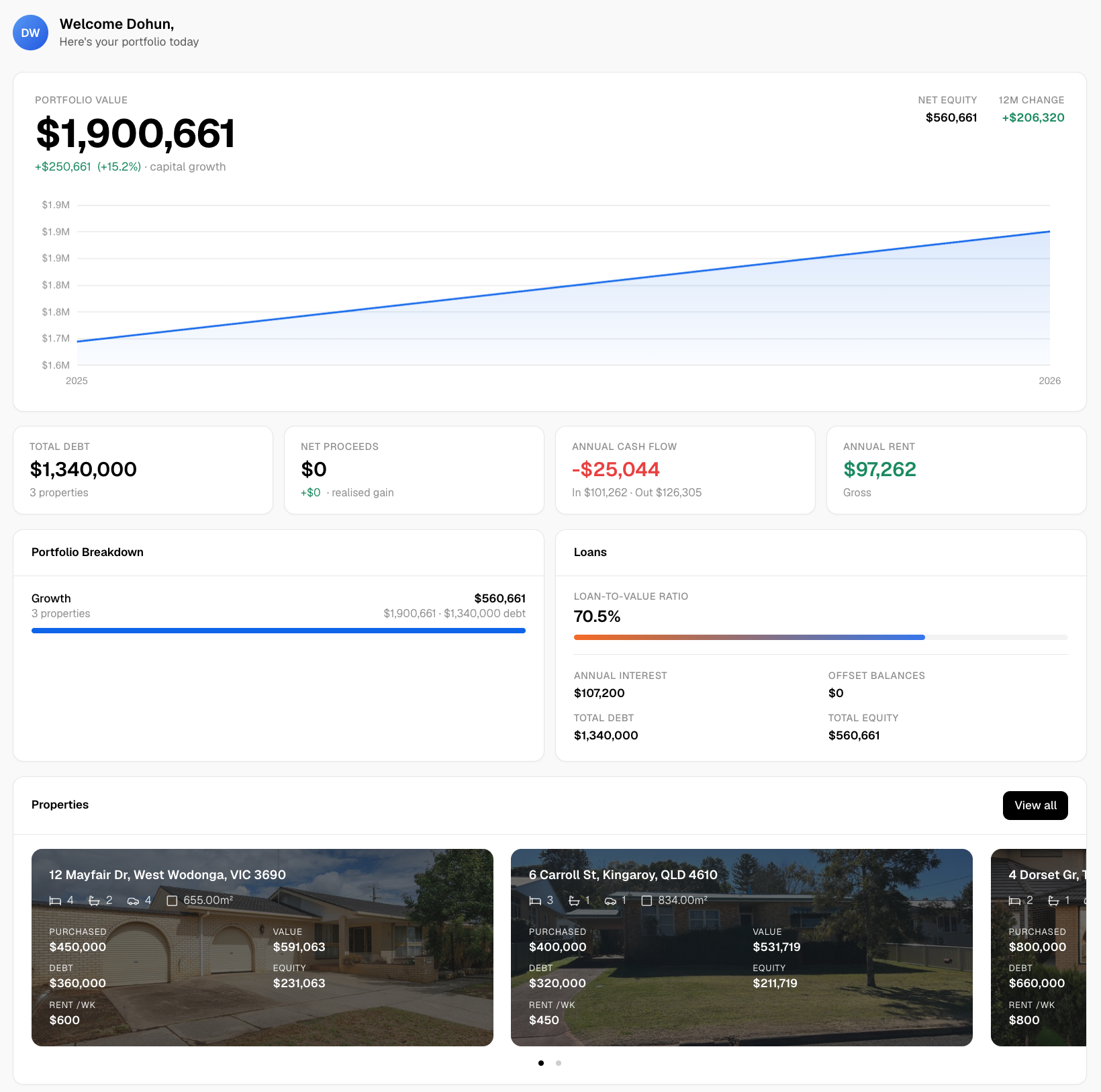
The free account covers the features most investors actually use day-to-day: quarterly valuations, rentvesting vs buying comparisons, borrowing power estimations, and suburb research via the AI assistant. Paid plans unlock deeper planning features when you’re ready to go further. To see how your current portfolio maps across, start your free account and import a sample property. The valuation and modelling outputs give you a direct read on whether the platform fits your workflow before you move anything across.
This article is general information only and does not constitute financial or investment advice. Confirm current platform features, pricing, and data sources directly with each provider, and consult a qualified financial adviser for decisions specific to your situation.