
Valuation Frequency: Avoid Needless Full Valuations in Australia
Valuations should match your purpose: lenders typically rely on an origination valuation and revalue only when specific triggers arise, active investors benefit from quarterly or six-monthly checks, and buyers or borrowers need a formal full-inspection valuation before purchase, refinance or regulated reporting. Automated tools such as WealthStacker offer free quarterly monitoring between those formal events. The sections below cover the exceptions and the details behind each schedule.
TL;DR:
- Lenders generally require an independent revaluation for refinancing, equity top ups, or covenant breaches; automated estimates usually cannot support a new loan decision.
- Buy and hold investors can schedule formal valuations every 6 to 24 months, with desktop or automated checks between reports.
- A full inspection suits purchases, SMSF reporting, and higher risk lending; PropertyPRO reports are limited to first mortgage lending and unrelated uses are not appropriate.
- Refinancing, renovations, sales, vacancy spikes, and reporting deadlines override routine schedules; market movement and scarce comparable sales can also make reports stale.
Wealthstackerwealthstacker.com.auTrack Property Values Between Formal ReportsWealthStacker provides automated quarterly property valuations to help you monitor market changes between formal valuation events.Visit WealthStacker
Table of Contents
- Typical valuation frequencies by use-case
- How lenders and prudential guidance treat valuation frequency and validity
- Valuation methods and how often each is appropriate
- Practical schedule: recommended valuation cadence and triggers
- Costs, report validity and how to tell when a valuation is stale
- How automated quarterly valuations fit into a monitoring schedule
- Get regular valuation updates without the paperwork
- FAQ
- Sources
Typical valuation frequencies by use-case
The right valuation cadence depends on what you’re actually trying to decide, not on a fixed calendar.
Lenders generally value a property once at origination and only commission another valuation when a defined event occurs, such as a refinance application, an equity top-up or a breach of a loan covenant. Outside those triggers, most lenders don’t revalue a security property as a matter of routine.
Buy-and-hold investors with moderate leverage tend to get a formal valuation every 6 to 24 months, depending on portfolio size and how geared they are, supplementing that with more frequent desktop or automated checks in between.
Active investors and portfolio managers who are weighing buy, sell or refinance decisions more regularly tend to check quarterly, reserving a formal valuation for the point just before a major transaction.
SMSF reporting, financial statements and tax events follow their own statutory timing rather than an investor’s preference, and the valuation must be fit for that specific regulated purpose.
Pre-purchase and refinance scenarios are the one case where a desktop estimate rarely cuts it: lenders and conveyancers expect a formal valuer inspection to support the transaction.
- Lenders: valuation at origination, then only on a defined trigger event.
- Buy-and-hold investors: formal valuation every 6 to 24 months, desktop or automated checks in between.
- Active investors: quarterly monitoring, formal valuation before major transactions.
- SMSF, tax and reporting: valuation timed to the statutory or regulatory requirement.
- Pre-purchase or refinance: formal valuer inspection, arranged specifically for the transaction.
How lenders and prudential guidance treat valuation frequency and validity
Authorised deposit-taking institutions don’t set valuation frequency arbitrarily. APRA’s prudential guidance on residential mortgage lending expects lenders to document their valuation policies and apply a hierarchy of acceptable methods, with risk-weighting generally based on the loan-to-value ratio struck at origination.
Reliance on an existing valuation for capital adequacy purposes typically requires an independent revaluation rather than an automated or indexed estimate.
That single point has practical weight for investors. A model-based or indexed valuation, however current it looks on a dashboard, is usually not something a lender will accept as the basis for a new loan decision or a formal capital calculation. Formal valuations in this world are event-driven, not calendar-driven: refinancing, a top-up request or a covenant trigger will prompt a fresh report, while nothing happens in between unless you ask for it.
The practical consequence is simple. If you’re relying on an old valuation report, or an automated estimate, to support a loan event, expect your lender to ask for an independent revaluation before proceeding.

Valuation methods and how often each is appropriate
Not every valuation method is built for the same job, and matching the method to the decision is most of the exercise.
There’s a rough hierarchy of rigour. A full inspection, where a qualified valuer physically assesses the property, sits at the top and is the standard for pre-purchase decisions, SMSF reporting and higher-risk lending. Below that sits the PropertyPRO pro-forma, a lender-focused template built specifically for first-mortgage purposes. Restricted or kerbside assessments trade some rigour for speed, desktop valuations go further again by skipping the site visit entirely, and automated valuation models (AVMs) sit at the monitoring end, useful for frequent, low-cost tracking rather than transaction certainty.
- Full inspection: pre-purchase, SMSF reporting, higher-risk lending decisions.
- PropertyPRO or desktop assessment: lender-focused checks where a full inspection isn’t required.
- Restricted or kerbside: a faster, cheaper middle ground when some verification is needed.
- AVM: regular portfolio monitoring and early-warning signals between formal valuations.
One detail worth flagging: the API’s Valuation Protocol for PropertyPRO reports is designed specifically for first-mortgage lending and explicitly shouldn’t be repurposed for SMSF reporting, marketing or other unrelated uses.
Pro Tip: Match the method to the decision, not the other way around: an AVM is fine for tracking equity, but a loan event needs an instruction specific to that purpose.
Practical schedule: recommended valuation cadence and triggers
A workable schedule combines a baseline cadence with a trigger list that overrides it when something material happens.
- Conservative: formal valuation every 12 to 24 months, automated checks quarterly in between.
- Balanced: formal valuation annually, desktop or automated check every six months.
- Active: formal valuation every 6 to 12 months, automated monitoring quarterly or more often around key decisions.
Regardless of which cadence you run, certain events should trigger a fresh look outside the schedule: refinancing, an equity top-up request, a sale, a major renovation, a sudden vacancy spike, a regulatory reporting deadline or a covenant breach notice from your lender.
The most cost-effective approach layers these together: run automated quarterly checks as your default, escalate to a desktop or kerbside review when a check flags something unusual, and reserve a full valuer inspection for the point just before a transaction or a loan event actually proceeds.

Costs, report validity and how to tell when a valuation is stale
Cost tracks rigour. A full inspection costs more than a desktop assessment, which in turn costs more than an AVM check, with property type, location and the depth of inspection all affecting the final fee.
Validity isn’t a fixed shelf life either. A report is purpose-limited from the outset: a PropertyPRO valuation is built for first-mortgage lending and shouldn’t be relied on for something else, while a tax or SMSF valuation needs its own specific instruction. Beyond the stated scope, a valuation’s practical reliability shortens faster when the market is moving quickly or when comparable sales are scarce.
ABS quarterly dwelling data puts the total value of residential dwellings at $12,688.9 billion in the June 2026 quarter, with the mean dwelling price slightly decreasing around that time. Movements of that size are a useful cue that an older valuation may no longer reflect current conditions.
- Keep a dated register of every valuation and its stated purpose.
- Run an automated check quarterly as a baseline.
- Schedule a formal valuation whenever a market indicator or loan trigger breaches your threshold.
How automated quarterly valuations fit into a monitoring schedule
Automated quarterly valuations work well as the monitoring layer between formal reports, and that’s the gap WealthStacker is built to fill: free quarterly valuations alongside scenario modelling for rentvesting and buying comparisons and borrowing-power estimates.
That kind of automated update is suited to tracking equity and spotting early warning signs, not to replacing a formal valuer where a transaction or a regulated report is involved. A sensible workflow runs quarterly automated checks as the default, moves to a desktop or kerbside review when something looks off, and brings in a full-inspection valuer once a transaction or loan event is actually on the table.
Get regular valuation updates without the paperwork
This service is designed to fill the gap between formal reports by offering free automated quarterly valuations, scenario modelling for rentvesting and buying decisions, and a single portfolio view that tracks property, shares and crypto together.
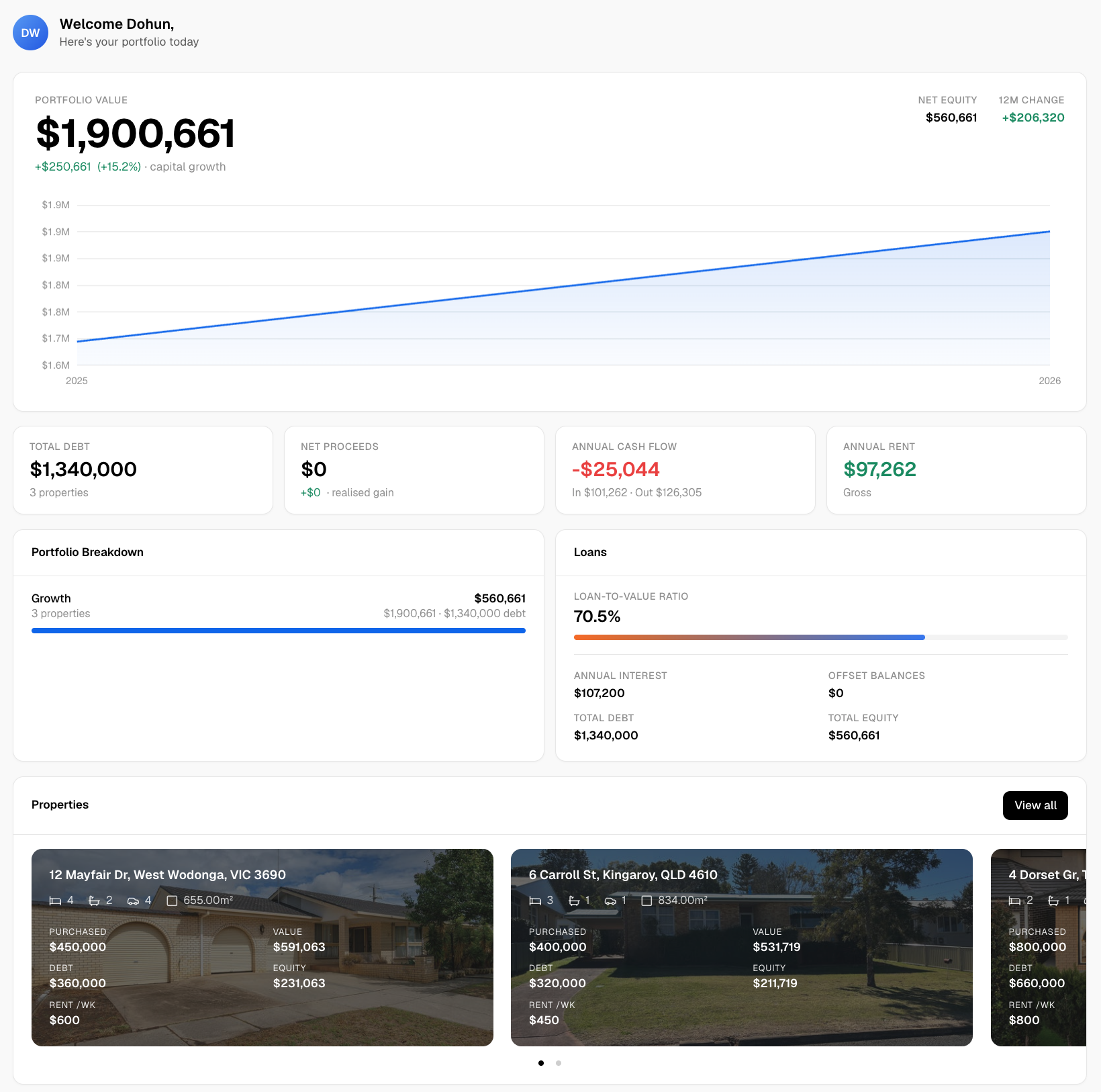
- Automated quarterly property valuations at no cost.
- Rentvesting and buying scenario comparisons alongside borrowing-power estimates.
- One dashboard for your whole portfolio instead of scattered spreadsheets.
This setup fits active investors and anyone who wants a regular, low-cost read on their property’s value between formal reports. Join the waitlist to get started.
FAQ
How often should you get a property valuation?
It depends on your purpose: lenders mainly need one at origination plus a revaluation on specific triggers, while active investors benefit from quarterly or six-monthly checks and buyers need a formal valuation before a transaction.
How often are property valuations done?
For lending, valuations are mostly event-driven rather than scheduled, tied to refinancing, top-ups or covenant triggers under APRA’s guidance. Investors monitoring their own portfolio often run automated or desktop checks quarterly, with a formal valuation annually or before a major decision.
How long is a property valuation valid?
There’s no fixed expiry date. Validity depends on the valuation’s stated purpose and how quickly the local market is moving, and a report written for one use, such as a first-mortgage PropertyPRO assessment, shouldn’t be relied on for an unrelated purpose like SMSF reporting.
What is the 18.6-year property cycle and how does it work?
The idea describes a long-running pattern of booms and corrections in land markets rather than a reliable timetable for when to revalue. It’s a market theory, not a valuation standard, so it shouldn’t replace the trigger-based schedule lenders and investors actually use.
Sources
- Prudential Practice Guide APG 223 Residential Mortgage Lending (marked up) | APRA
- Total value of dwellings, latest release | ABS