
Property investment reporting best practices: 2026 guide
TL;DR:
- Effective property investment reporting relies on accurate, timely disclosures and automated data integration. Using separate property-level ledgers improves report accuracy, audit readiness, and investor clarity. Clear communication of reporting changes enhances owner satisfaction and supports reliable, scalable analysis.
Property investment reporting best practices are defined by accurate, timely, and transparent financial disclosures that give investors and real estate professionals the information they need to make confident decisions. The industry standard in 2026 has shifted decisively toward automation, property-level accounting, and structured communication protocols. Platforms like Rioo and US Tech Automations have published detailed frameworks showing how top-performing portfolios close their books faster and keep owners better informed. Whether you manage two properties or twenty, the gap between ad hoc spreadsheets and a disciplined reporting system shows up directly in your audit readiness, investor satisfaction, and net worth trajectory.
1. What are the essential components of effective property investment reports?
Institutional investors expect consolidated portfolio-level financials, property-level profit and loss statements with variance commentary, and net operating income (NOI) summaries delivered within 10–15 business days of period close. That timeline is not a guideline. It is a non-negotiable condition for retaining institutional capital.
Every best-practice report contains these core elements:
- Property-level P&L with variance analysis. Each property needs its own income and expense statement. Variance commentary explains why actuals differ from budget, which is the first question any serious investor asks.
- Consolidated portfolio overview. A single-page summary of NOI across all assets lets investors assess total performance without digging through individual reports.
- Audit-ready distribution waterfall. Investor reporting must be fully auditable including line-item waterfall distributions that reference the operating agreement. This prevents incorrect investor tax statements and protects your fiduciary standing.
- Valuation records and approval workflows. Each asset should carry a current valuation with a documented approval trail. This is especially relevant for Australian self-managed superannuation fund (SMSF) portfolios where the ATO requires defensible valuations.
- Timing compliance. Reports delivered late signal operational weakness. Build your close calendar backward from the delivery deadline.
Pro Tip: Draft a one-page report template before you build your data system. The template forces you to identify every data point you need to collect, which prevents gaps at close time.
2. How does automation enhance property investment reporting efficiency and accuracy?

The foundational mistake in investor reporting is treating it as a presentation problem rather than a data problem. The best teams build systems where reports are generated programmatically from central, auditable data repositories. Formatting is the last step, not the first.
Property managers following a structured automation checklist deploy reporting systems 45% faster and achieve 30% higher owner satisfaction scores compared to manual methods. That gap is not about software quality. It is about whether the underlying data is clean and connected before automation begins.
A disciplined automation rollout follows this sequence:
- Audit your data sources. Identify every system that holds property data: your property management software, lease register, bank feeds, and general ledger.
- Eliminate manual exports. Any step that requires a human to copy data between systems is a failure point. Connect systems via API or direct integration.
- Build approval gates. Missing approval workflows cause 18% of reporting automation project failures. Skipping human review increases owner complaints fivefold.
- Standardise report templates. Lock in the format so that every owner receives a consistent document. Consistency builds trust faster than design quality.
- Test with one property first. Run a full reporting cycle on a single asset before rolling out across the portfolio.
- Schedule automated delivery. Set reports to deliver on a fixed date each period. Owners who receive reports on the same day every month stop asking where their reports are.
Property management reporting infrastructure is evolving to integrate operational data, lease accounting, and the general ledger in unified platforms, compressing the close process from days to hours. That compression is the real productivity gain.
Pro Tip: Never automate a broken process. If your manual reports contain errors, automation will produce those same errors faster and at greater scale. Fix the data first.
3. Why is separate property-level accounting critical in multi-asset portfolios?
Each investment property requires a dedicated ledger or sub-ledger to track NOI, cash-on-cash return, and tax basis independently. This is not a preference for tidy bookkeeping. It is the structural foundation that makes consolidated reporting accurate and audit-ready.
When properties share a single ledger, you lose the ability to isolate performance at the asset level. You cannot calculate a reliable cash-on-cash return for a specific property. You cannot demonstrate to the ATO that depreciation has been correctly allocated. You cannot tell an investor exactly what their share of distributions from one asset looks like.
The table below shows how proper and improper accounting structures compare across key reporting dimensions.
| Reporting dimension | Separate property ledgers | Pooled ledger |
|---|---|---|
| NOI accuracy | Exact per asset | Blended, unreliable |
| Tax basis tracking | Clear per property | Difficult to isolate |
| Audit readiness | High | Low |
| Investor distribution clarity | Line-item traceable | Estimated |
| Scalability to new assets | Add a new sub-ledger | Complexity compounds |
Property managers who apply written, standardised policies including capitalization thresholds consistently produce cleaner financial statements and reduce accounting debt over time. A capitalization policy defines the dollar threshold above which an expenditure is treated as a capital improvement rather than a repair. Without a consistent threshold across all properties, your financial statements become incomparable.
For Australian investors using trust structures or company titles, each legal entity typically requires its own set of books. This supports clear intercompany transaction allocations and simplifies the annual tax return process. Wealthstacker’s portfolio net worth tracking tools are built around this property-level structure, which makes consolidated views accurate rather than approximate.
4. What communication practices improve investor satisfaction during reporting transitions?
Reporting upgrades fail more often because of poor communication than because of technical problems. Owners who are not told in advance that their report format or delivery schedule is changing react negatively, regardless of whether the new system is better.
Owners not notified in advance of reporting changes provide 30% lower satisfaction scores. That drop is entirely avoidable. The fix is a simple communication plan that runs ahead of the transition.
Effective communication practices during a reporting transition include:
- Send a preview notice at least two weeks before the first new report. Explain what is changing, why it is changing, and what the owner will see differently.
- Provide a sample report. A one-page preview of the new format removes uncertainty and reduces inbound queries on delivery day.
- Create a named point of contact. Owners who know who to call with questions are less likely to escalate concerns.
- Acknowledge the transition in the first new report. A brief note at the top of the report confirming the format change signals professionalism and attention to detail.
- Collect feedback after the first cycle. A short two-question survey tells you whether the new format is working before problems compound.
Communication is not a soft skill in reporting management. It is a measurable driver of owner retention. Investors who feel informed are investors who stay.
5. How do top investment committees use sensitivity analyses and risk matrices?
Investment committees run their own sensitivity matrices if sponsors do not provide them. Effective reports proactively test the two highest-leverage variables simultaneously, rather than leaving that work to the reader.
Investment committees expect sensitivity analyses of key variables like exit cap rate and rent growth, showing multi-variable risk exposure in a single matrix. A dual-variable sensitivity matrix presents a grid where one axis shows a range of exit cap rates and the other shows a range of rent growth assumptions. Each cell in the grid shows the resulting internal rate of return (IRR) or equity multiple. This format makes risk visible at a glance.
The table below illustrates a simplified dual-variable sensitivity matrix for a hypothetical Australian residential investment property.
| Exit cap rate / Rent growth | 0% | 2% | 4% |
|---|---|---|---|
| 5.0% | 8.2% IRR | 9.7% IRR | 11.3% IRR |
| 5.5% | 7.1% IRR | 8.5% IRR | 10.0% IRR |
| 6.0% | 6.0% IRR | 7.4% IRR | 8.8% IRR |
Producing this analysis demonstrates fiduciary responsibility. It shows the investment committee that you have stress-tested the deal rather than presenting only the base case. For property investment analysis techniques that go beyond static snapshots, scenario modelling is the standard that separates institutional-grade reporting from amateur presentations.
Automated reporting systems can generate these matrices dynamically when the underlying model is connected to live data. That connection removes the risk of a sponsor presenting a sensitivity analysis built on stale assumptions.
6. How to build a consistent reporting calendar
A reporting calendar is the operational backbone of any disciplined reporting system. Without fixed dates, every period close becomes a negotiation between competing priorities.
Set your period close date first. This is the date after which no further transactions are posted to the current period. Work backward from your delivery deadline (10–15 business days post close) to establish the dates for data reconciliation, report generation, approval review, and distribution. Each step needs a named owner and a hard deadline.
For Australian investors managing properties across multiple states, time zone differences and state-specific compliance dates (such as land tax assessment periods) add complexity. Build those dates into the calendar at the start of the financial year, not reactively. Wealthstacker’s automated quarterly valuations align with this calendar-driven approach, giving investors a reliable data point at each reporting cycle without manual effort.
Pro Tip: Treat your reporting calendar as a client commitment, not an internal target. When owners know the exact delivery date, they stop sending reminder emails and you stop managing expectations reactively.
Key takeaways
Effective property investment reporting requires property-level ledgers, automated data integration, audit-ready distributions, and proactive owner communication to produce reliable, timely reports at scale.
| Point | Details |
|---|---|
| Deliver reports on time | Institutional standards require reports within 10–15 business days of period close. |
| Separate ledgers per property | Each asset needs its own sub-ledger to track NOI, tax basis, and distributions accurately. |
| Automate with clean data first | Fix data quality before automating; broken processes produce errors faster at scale. |
| Communicate changes in advance | Owners not notified of reporting changes score satisfaction 30% lower than informed owners. |
| Include sensitivity matrices | Dual-variable risk matrices demonstrate fiduciary responsibility and satisfy investment committee expectations. |
See how Wealthstacker supports your reporting
Wealthstacker is built for investors who want property-level clarity without the manual workload. The platform delivers automated quarterly valuations at no cost, giving you a reliable, up-to-date data point for every asset in your portfolio at each reporting cycle.
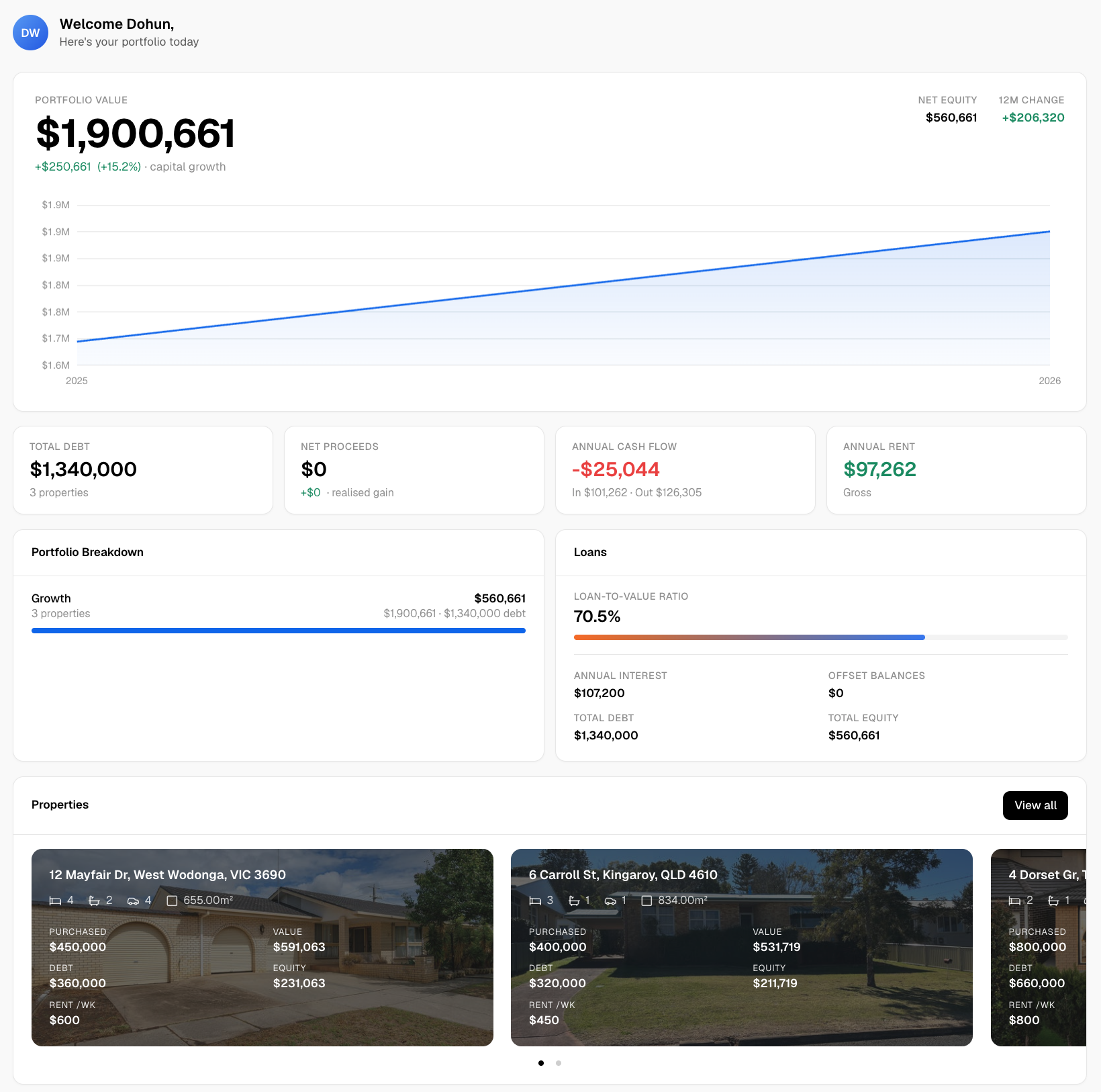
Wealthstacker integrates AI-driven modelling for both rentvesting and direct ownership strategies, so you can assess your net worth position in real time rather than waiting for your accountant’s annual summary. For investors building a portfolio while renting or managing multiple assets across different structures, the platform’s consolidated view keeps your reporting accurate and audit-ready. Explore the full property investment toolkit to see how automated reporting fits your portfolio.
FAQ
What is the standard delivery timeline for property investment reports?
Institutional investors expect reports within 10–15 business days of period close. This timeline applies to both property-level P&L statements and consolidated portfolio summaries.
Why does separate property-level accounting matter for Australian investors?
Each property needs its own ledger to track NOI, cash-on-cash return, and tax basis independently. Without this structure, consolidated reports become unreliable and ATO compliance becomes difficult to demonstrate.
How does automation improve reporting accuracy?
Automation removes manual data exports between systems, which eliminates transcription errors and consolidation mistakes. Connecting your property management software, lease register, and general ledger in one platform compresses the close process from days to hours.
What happens if owners are not notified of reporting changes?
Owners who receive no advance notice of reporting format or schedule changes give satisfaction scores that are 30% lower than owners who are informed ahead of time. A two-week advance notice with a sample report prevents most of that drop.
What is a dual-variable sensitivity matrix and why does it belong in investment reports?
A dual-variable sensitivity matrix tests two key assumptions simultaneously, such as exit cap rate and rent growth, to show a range of possible returns in a single grid. Investment committees expect this analysis; sponsors who omit it will find committees running their own versions independently.