
Build and automate property cash flow forecast for Australian investors
A property cash flow forecast shows your projected monthly and annual net cash position, before and after tax, so you can see whether an investment property will run positive or negative in your pocket. That single number drives buy, hold, refinance and sell decisions. The fastest way to get one is to build a simple 12-month model yourself or run the numbers through an automated tool such as WealthStacker.
TL;DR:
- A property cash flow forecast must accurately include rental income, vacancy rates, operating costs, debt service, and capital expenditure to be reliable.
- Stress testing scenarios with rate rises, vacancy, and repairs help determine whether the property can withstand economic shifts and maintain positive cash flow.
- Using tools like WealthStacker automates updates for market changes, providing ongoing, dynamic forecasts rather than static spreadsheets.
- Relying solely on rental yield without detailed cash flow analysis can mislead investors about a property’s profitability.
- Presenting clear, stress-tested figures helps inform timely buy, hold, refinance, or sale decisions based on comprehensive financial insights.
WealthstackerModel Your Property Investment PathWealthStacker combines automated valuations, AI tools and personalised modelling to compare rentvesting and buying strategies.Explore WealthStacker
Table of Contents
- What to include in every forecast: income, expenses, debt service and capex
- Step-by-step: build a working property cash flow forecast
- Assumptions, buffers and common forecasting mistakes to avoid
- Tax and depreciation: capital works and asset depreciation in after-tax forecasts
- Tools, templates and WealthStacker: what a good forecasting tool should do
- Stress testing: scenarios to run and how to read the results
- Turn forecast outputs into decisions: buy, hold, refinance or exit
- WealthStacker as your next step for forecasting cash flow
- Sources
- FAQ
What to include in every forecast: income, expenses, debt service and capex
A forecast is only as good as its inputs. Leave out one line item and the whole picture shifts from workable to misleading.
Start with projected rental income, but discount it for vacancy and the lag between tenancies rather than assuming the property is occupied every week of the year. Then layer in the costs that actually erode that income.
- Operating costs: agent management fees, insurance, council rates, strata or body corporate levies, and routine repairs.
- Loan repayments: model interest-only and principal and interest separately, since they produce very different monthly outflows on the same loan balance.
- Capital expenditure: schedule known events (a new hot water system, roof repairs) in the month they are likely to hit, not as a vague annual average.
- Tax adjustments: depreciation and capital works deductions change your after-tax cashflow even though they never move actual money.
Practical guidance on monthly ownership costs highlights agent fees and vacancy periods as the two items most often left out of a first-pass forecast, and they are usually the difference between a property that looks like it breaks even and one that quietly bleeds cash.
Step-by-step: build a working property cash flow forecast
Building a forecast is mechanical once you have the right inputs in front of you. Work through it in order rather than jumping straight to a net figure.
- Gather purchase price, loan amount, interest rate, expected rent and known expense estimates from the agent, lender and any existing lease.
- Pick a timeline: monthly detail for the first 12 months, rolled up into an annual total, with an optional 5 to 15 year view for longer-term planning.
- Project rent conservatively and apply a vacancy and leasing allowance rather than assuming full occupancy from day one.
- Enter every recurring operating expense and schedule any known capital expenditure in the month it is expected to occur.
- Add tax adjustments for depreciation and capital works, then calculate both a pre-tax and an after-tax net cashflow figure.
- Produce your outputs: monthly net cashflow, annual net cashflow, cumulative cashflow over the period, and simple ratios such as cash-on-cash return.
Once this is running in a spreadsheet or tool, you can flex any single assumption (a rate rise, a longer vacancy) and watch how it moves the annual number. That flexibility is the entire point of forecasting rather than relying on a single static estimate.
Assumptions, buffers and common forecasting mistakes to avoid
The most common forecasting mistake is building a model around full occupancy and no rent increases, then treating the output as a guarantee rather than a best case. Moneysmart’s guidance is direct on this point: never assume rental income will always cover your mortgage and holding costs, and stress-test the forecast before you rely on it.
A few habits keep a forecast honest.
- Build in a vacancy and advertising allowance rather than assuming the property leases the day the old tenant leaves.
- Model agent fees as a percentage of rent, and add letting or admin fees separately rather than folding them into a single “management” line.
- Apply a conservative rent growth rate and test what happens if repayments rise faster than rent does.
- Schedule maintenance and capital works by likely date, not as a flat annual estimate that hides the month a big bill actually lands.
Skipping any of these makes the forecast look better than the property will actually perform.
Tax and depreciation: capital works and asset depreciation in after-tax forecasts
Depreciation and capital works do not change the cash in your account, but they change what the ATO taxes, which is why every after-tax forecast needs them modelled separately from the pre-tax numbers.
- Capital works deductions: you can claim 4% per year for 25 years, or 2.5% per year for 40 years, depending on the construction date and type, for a property producing assessable rental income.
- Decline in value: depreciating assets such as appliances or carpet can be calculated using either the prime cost or diminishing value method, with different deduction curves over time.
- Immediate deductions: assets costing $300 or less can typically be written off immediately rather than depreciated over years.
- Professional estimates: a quantity surveyor’s depreciation schedule is the usual way to get accurate figures for a property’s capital works and asset base, and entering that schedule into a forecasting tool is worth doing properly rather than guessing.
The key distinction to hold onto: depreciation lowers taxable income, which lifts your after-tax cashflow, but it never appears as cash moving through your bank account.
Tools, templates and WealthStacker: what a good forecasting tool should do
A spreadsheet gives you full control over every assumption, but it needs manual updates every time a rate changes or a valuation moves. A web-based tool trades some of that flexibility for automation and live data, which matters most for investors juggling more than one property.
Whichever you choose, a forecasting tool should cover a fixed checklist.
- Monthly and annual outputs, not just a single yearly total.
- A toggle for pre-tax versus after-tax figures, including depreciation.
- Scenario toggles for rate changes, vacancy and rent growth.
- An exportable summary you can hand to a lender or accountant.
Some forecasting tools build this checklist into an automated toolkit with quarterly property valuations, scenario modelling for rentvesting versus buying, and long-term forecasts tied to goal and net worth planning, so the forecast stays current without re-entering figures every quarter.
Pro Tip: Save your forecast’s after-tax annual figure and cumulative 12-month cashflow before every lender conversation. Those two numbers are usually what a broker asks for first.
Stress testing: scenarios to run and how to read the results
A single forecast tells you what happens if everything goes to plan. Stress testing tells you what happens when it does not, and that is the number that actually matters for risk.
Run at least three scenarios: a baseline case using your current assumptions, a moderate stress case (say, a 1 to 2 percentage point rate rise and four weeks of vacancy), and a severe stress case (a larger rate rise stacked with an extended vacancy or an unplanned repair). ASIC’s Moneysmart guidance recommends exactly this kind of stress testing rather than relying on a single optimistic projection.

Watch three things across the scenarios: how quickly a contingency fund would be depleted, whether cumulative cashflow turns negative for an extended stretch, and whether the stressed repayment figure still meets serviceability. APRA’s guidance on serviceability buffers supports applying a buffer to repayments and a haircut to expected rental income when testing repayment capacity, which is a reasonable standard to borrow for your own modelling even outside a formal loan application.
Turn forecast outputs into decisions: buy, hold, refinance or exit
The numbers only earn their keep once you use them to make a call.
- Track monthly net cashflow, 12-month cumulative cashflow, cash-on-cash return and after-tax yield as your core decision metrics.
- Treat negative pre-tax cashflow as acceptable only when it is a deliberate tax strategy backed by capital growth expectations, not a surprise you discover after settlement.
- Prepare your forecast outputs as a clean summary for lenders, accountants or co-investors before you need them, rather than assembling figures under time pressure.
A 12-month net cash test is a practical way to turn these outputs into a straight sell-or-hold answer rather than an open-ended spreadsheet.
WealthStacker as your next step for forecasting cash flow
Building the forecast yourself teaches you what drives the number, but keeping it current every quarter is where most spreadsheets fall behind. Property values move, rents adjust and rates change, and a static model goes stale within a few months of building it.
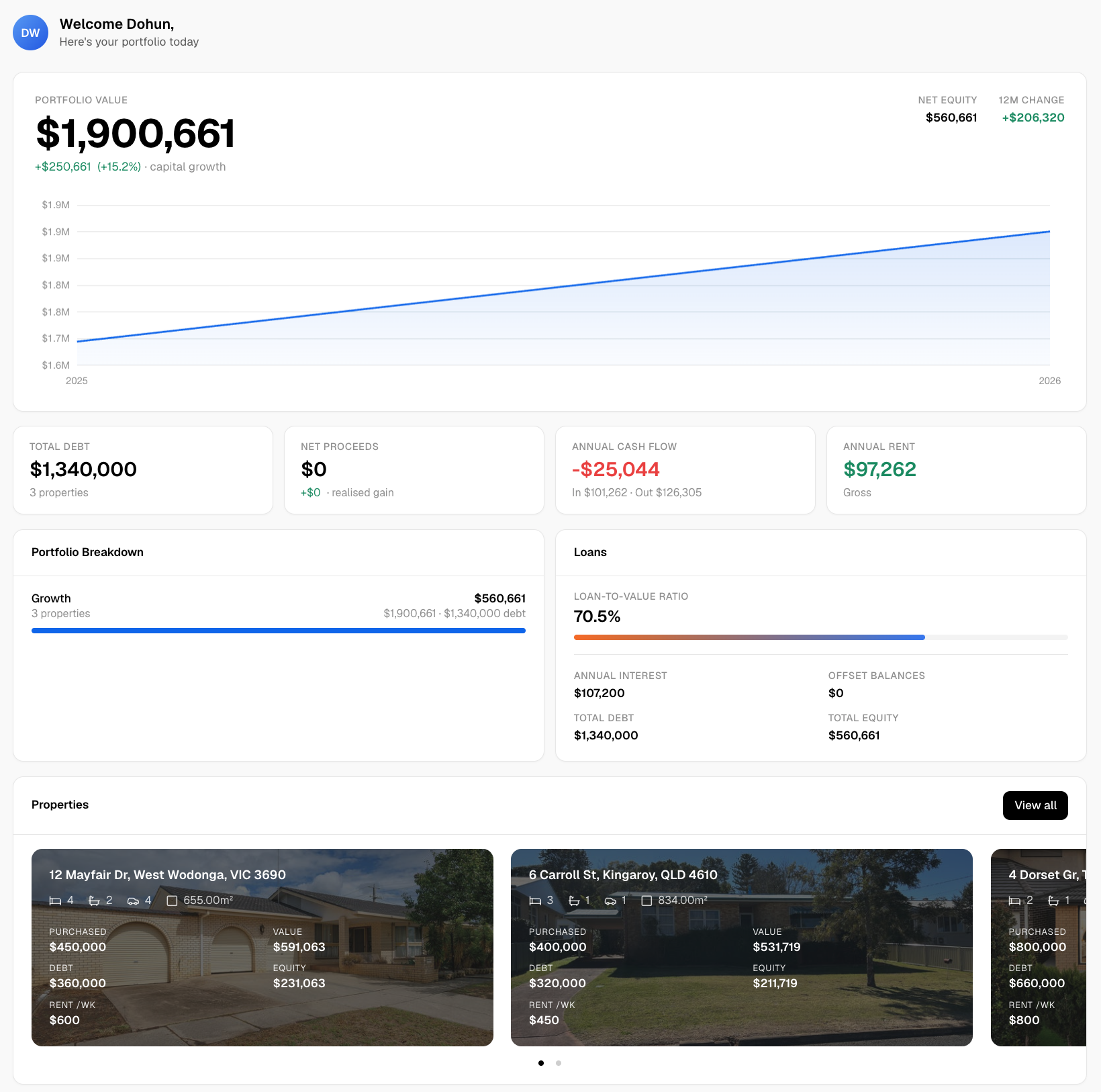
WealthStacker keeps the forecast live instead of frozen. It runs free automated quarterly valuations, models rentvesting against buying with AI-driven scenario planning, and projects your position out to 15 years alongside a broader net worth and goal plan, so you are not rebuilding a spreadsheet every time your circumstances shift. If you came here to work out whether a property will run cashflow-positive or negative and want that answer to update itself as the market moves, start with WealthStacker and run your own numbers through it.
Sources
- Capital works deductions (ATO)
- Realestate
- Buying an investment property (Moneysmart / ASIC)
- APRA announces update to macroprudential settings (APRA)
FAQ
How much should you cash flow on a rental property?
There is no fixed dollar target that applies to every property, since it depends on your loan terms, tax position and growth expectations for that asset. What matters more is knowing your monthly and annual net figure in advance and confirming it still holds up under a stress-tested scenario before you rely on it.
Is a 4% rental yield good?
Rental yield alone does not tell you whether a property is cashflow-positive, because it ignores your loan repayments, expenses and tax position. A full cash flow forecast that nets out those costs is a more reliable guide to whether a given yield actually works for your situation.
Can you provide a property value projection calculator?
WealthStacker offers automated quarterly property valuations along with AI-driven scenario modelling and 15-year forecasts as part of its toolkit, available at Wealthstacker. It is built specifically for comparing rentvesting and buying paths rather than producing a single static valuation.
What is cash flow on a property?
Cash flow on a property is the net amount of money left over each month or year after rental income covers loan repayments, operating expenses and any capital costs. A property is cashflow-positive when that figure is above zero and cashflow-negative when expenses and repayments exceed the rent collected.