
Save $900: Offset vs Redraw for Australians, ATO Tax Risks Explained
An offset account is a linked transaction account that reduces the daily interest calculation on your home loan while keeping your money accessible; a redraw facility lets you withdraw extra repayments you’ve already made against the loan. Both cut your interest bill by the same maths. Investors usually come out ahead with an offset because it protects tax deductibility and gives instant liquidity, while disciplined savers or cost-sensitive owner-occupiers often do fine with redraw. Plenty of loans let you use both.
TL;DR:
- Offset accounts offer instant, unrestricted access and protect tax deductibility for investment loans, but often come with ongoing fees that may outweigh savings for low balances.
- Redraw facilities are typically fee-free and allow extra repayments to reduce interest, but access can be delayed and may be limited by minimum withdrawal amounts.
- The interest savings from both features are mathematically the same, but offset accounts provide deposit protection and avoid creating a mixed-purpose loan, which affects tax.
- For investors, offset accounts are generally preferable to maintain deductible status and simplify rental income management, whereas owner-occupiers with stable balances may prefer redraw for lower costs.
- When choosing between the two, consider loan terms, fees, redraw processing times, and tax implications, and model scenarios to determine the best fit.
Table of Contents
- How does an offset account work?
- How does a redraw facility work?
- Offset vs redraw: what actually differs?
- What does the ATO say about redrawing from an investment loan?
- Offset or redraw: which suits owner-occupiers and which suits investors?
- How do you choose the right feature for your loan?
- Where to read more
- Sources
How does an offset account work?
An offset account sits alongside your home loan as its own transaction account, but the bank subtracts its balance from your loan principal before calculating daily interest. Keep $20,000 sitting there and the bank only charges interest as if your loan were $20,000 smaller, every single day.
Most offset accounts function like a normal transaction account. You get a debit card, direct debits, salary deposits, and bill payments, all while the balance keeps working against your loan. The catch is that not every offset is a full offset. Some lenders only offer a partial offset, where the linked account neutralises just a percentage of your loan interest rather than the full dollar amount, so a $20,000 balance sitting in a 40% partial offset only saves interest as if $8,000 were offset. Always check your loan contract or ask your lender directly.
Offset accounts often carry an ongoing package fee, which can genuinely outweigh the benefit if your average balance is low.
- 100% offset: the whole balance reduces your interest-bearing loan amount.
- Partial offset: only a set percentage of the balance counts.
- Package fees can erase savings on small balances, so run the numbers before signing up.
On a moderately sized loan at a typical interest rate, holding a balance in a full offset can save a few thousand dollars a year in interest before tax, purely from the reduced daily balance calculation.
How does a redraw facility work?
A redraw facility doesn’t need a separate account. It’s a feature built into the loan itself. Every time you pay more than your minimum repayment, that extra amount reduces your loan principal, and you can withdraw it later if you need it back.
Access isn’t always instant. Most banks set a minimum redraw amount (often $500 or so), process withdrawals within a business day or two rather than in real time, and some withhold your next scheduled repayment from the available redraw balance. That means the figure sitting in “available redraw” isn’t always the full amount you’ve paid ahead.
- Extra repayments reduce principal immediately, cutting the interest calculated on that lower balance.
- Redraw requests usually go through internet banking or an app, with processing times varying by lender.
- Lenders can restrict or suspend redraw during hardship arrangements or when you refinance to another bank.
- Some loans charge a small redraw fee per withdrawal; check the product disclosure statement.
Pro Tip: Before refinancing, withdraw any redraw balance you might need. Some lenders won’t transfer a redraw balance to the new loan, and you could lose access entirely.
The mechanics of interest calculation don’t care whether the money sits in a separate account or inside the loan.
Offset vs redraw: what actually differs?
If the interest savings are mathematically the same, the real decision comes down to access, cost, and tax exposure.
- Access and convenience: offset behaves like a everyday bank account with a card and instant transfers; redraw usually needs a request through the bank’s app or website, with a lag and a minimum withdrawal amount.
- Cost: offset accounts often carry a monthly or annual package fee (sometimes bundled with other loan features); redraw is typically fee-free but occasionally charges a small per-withdrawal fee, and some lenders cap how much you can redraw.
- Tax and legal effect: this is the one that trips up investors. Offset money sits outside the loan, so the loan’s original purpose stays intact. Redrawing funds from an investment loan and spending them privately can create a mixed-purpose loan, splitting the interest between deductible and non-deductible portions.
- Deposit protection: offset balances are deposit accounts covered by the Financial Claims Scheme up to $250,000 per account holder per bank. Redrawn funds are held inside the loan structure and aren’t protected the same way, because they’re not a deposit.
Independent comparisons from lenders like ANZ confirm the pre-tax savings are functionally the same across both features for equivalent balances. The decision, in practice, is rarely about interest maths. It’s about how you’ll use the money and what happens to your tax return if you get it wrong.
What does the ATO say about redrawing from an investment loan?
The Australian Taxation Office looks at what the redrawn money is actually used for, not what the loan was originally set up for. Pull cash out of an investment loan through redraw and spend it on a family holiday or a car, and the interest on that portion of the loan stops being tax-deductible. The loan becomes what accountants call a mixed-purpose or “contaminated” loan, and untangling deductible from non-deductible interest across multiple years gets messy fast.
Investors who treat redraw like an ATM on an investment property loan risk losing part of their interest deduction and creating a compliance headache that follows the loan for years. Offset accounts sidestep the problem entirely because the money never touches the loan structure.
This is why brokers and accountants so often steer property investors toward offset accounts over redraw on investment loans. The offset balance sits in a separate deposit account, protected up to $250,000 under the Financial Claims Scheme, and the loan purpose never changes no matter how much cash flows through it.
The practical fix is simple: funnel rental income into an offset attached to the investment loan, keep personal spending in a separate everyday account, and talk to an accountant before you redraw a single dollar from a loan tied to an income-producing property.
Offset or redraw: which suits owner-occupiers and which suits investors?
- Owner-occupiers with modest, stable balances often do fine with redraw. If you don’t need instant access to your extra repayments and your lender charges no ongoing offset fee, redraw can be the cheaper option outright.
- Owner-occupiers who like flexible cashflow (irregular income, frequent transfers between savings goals) usually prefer an offset, since it doubles as a transaction account without touching the loan structure.
- Property investors almost always lean toward offset. It protects interest deductibility on the investment loan and makes managing rental income far simpler.
- Anyone weighing the fee should apply a rough rule of thumb: if your average offset balance multiplied by the interest rate saves more than the annual package fee, the offset is worth it. A $15,000 average balance at 6% saves $900 a year, comfortably covering a $120 annual fee.
Plenty of borrowers run both: an offset for everyday spending and rental income, redraw as a longer-term forced savings buffer they’re less tempted to dip into.
Pro Tip: If you’re rentvesting or juggling one owner-occupier loan and one investment loan, keep them structured separately with their own offset accounts. Mixing cash flows between the two is exactly how accidental loan contamination happens.
How do you choose the right feature for your loan?
Start with your loan’s actual terms, not assumptions. Ask your lender or broker:
- Is the offset 100% or partial, and is that clearly stated in the loan contract?
- Is there an ongoing package fee, and does it apply whether or not you use the offset?
- What’s the minimum redraw amount, and how long does processing take?
- Does the loan withhold the next scheduled repayment from available redraw?
- What happens to redraw access if you refinance or hit financial hardship?
If you’re comparing an owner-occupier loan against an investment loan, the tax treatment differences alone can outweigh a small fee saving. Independent guides from partners like Buyers Agents Brisbane are worth a read for another angle on the fee and cashflow trade-offs before you lock anything in.
Once you know your numbers, model a couple of realistic scenarios. Wealthstacker’s property investment app lets you run offset versus redraw outcomes against your actual borrowing power and 15-year projections, so you can see the compounding effect before you commit to a loan structure rather than guessing after settlement.
Where to read more
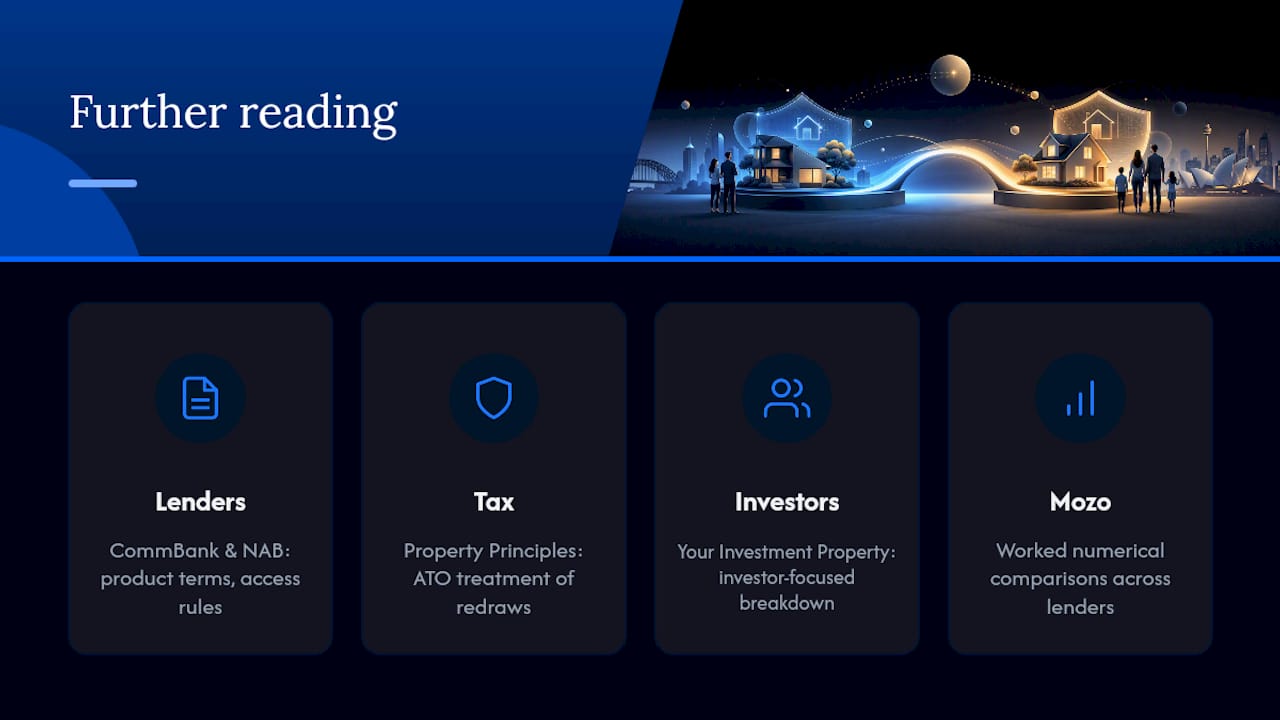
For the mechanics of offset versus redraw straight from a major lender, CommBank’s explainer and NAB’s comparison both walk through product terms and access rules. For the tax side, Property Principles covers ATO treatment of redrawn funds on investment loans in plain language, and Your Investment Property offers a deeper investor-focused breakdown. Mozo’s guide is useful for worked numerical comparisons across different lenders.
This article is general information, not a substitute for advice from a qualified financial advisor. Consult a qualified financial professional about your own circumstances before acting on anything here.
Sources
- Redraw vs offset explained
- Offset account for investment property in Australia: what most investors get wrong
- Offset vs redraw: which saves you more? | Mozo
- Differences between home loan redraw and an offset account
- Understanding offset accounts and redraw facilities for investment loans