
Offset vs Extra Repayments: Which Saves You More?
On a variable-rate loan, money in an offset account and extra repayments both cut the interest you pay by roughly the same amount. The real differences are access, fees, tax and what happens to your borrowing power later. If you might need the cash back, or you hold an investment loan, an offset is usually the more flexible tool. If you are disciplined, your loan has no offset, or the offset carries a high fee, extra repayments can be the cleaner choice.
WealthstackerModel Your Property Investment OptionsWealthStacker uses AI tools and personalized modeling to help you assess property strategies and understand their potential effect on your net worth.Explore WealthStackerTL;DR
- Both methods reduce the balance your interest is calculated on. An offset does it by netting a separate deposit account against the loan, and extra repayments do it by shrinking the loan itself.
- An offset keeps your money in an ordinary transaction account. Extra repayments sit in the loan, and getting them back depends on your lender’s redraw terms.
- Offset loans can carry higher rates or monthly fees, so the saving has to outweigh the cost. A small offset balance may not justify it.
- For investment loans, the tax treatment of an offset differs from redraw. Deposits and withdrawals in an offset do not change the character of the loan’s interest, but redrawn principal can.
- Check the numbers for your own loan, and speak to a tax professional or broker before restructuring investment debt.
Table of Contents
- How each one actually reduces your interest
- Access to your money
- What each costs you
- When extra repayments win
- When an offset wins
- Offset vs redraw: where the tax rules bite for investors
- Debt recycling: a related strategy
- How an offset affects your borrowing power
- Investors: offset, extra repayments and interest-only loans
- A simple way to decide
- Model it with your own numbers
- FAQ
- Sources
How each one actually reduces your interest
A home loan charges interest on the balance you owe, usually calculated daily. Anything that lowers that balance, or the portion of it that counts for interest, saves you money.
An offset account is a transaction account linked to your home loan, and its balance reduces the amount of the loan charged interest. Moneysmart’s example is a $750,000 loan with $50,000 in the offset: you pay interest on $700,000. The loan balance itself stays at $750,000. Your $50,000 is still yours, sitting in an account you can use.
Extra repayments work differently. They help pay off a loan faster and reduce the interest you pay, because the principal itself falls. The money has gone into the loan, and the loan balance is now lower.
Here is a simple illustration, using a made-up 6.00% rate to keep the arithmetic clean. Say you owe $500,000 and have $50,000 spare.
| Loan balance | Balance charged interest | Interest per year at 6.00% | |
|---|---|---|---|
| No action | $500,000 | $500,000 | $30,000 |
| $50,000 in offset | $500,000 | $450,000 | $27,000 |
| $50,000 extra repayment | $450,000 | $450,000 | $27,000 |
The interest saving is the same: $3,000 a year. That is why lenders and comparison sites keep saying the two are equivalent on interest. One bank describes it as a redraw facility reducing the loan balance, while with an offset, interest is charged on the difference between the loan and offset balances.
So if the interest saving is identical, the decision rests on everything else.
Access to your money
This is the biggest practical difference.
Offset funds are accessed like any deposit account. You can pay bills from it, use a card on it and transfer out, subject to the account’s own features. Your emergency buffer, your tax money and your next deposit can all live there while still cutting interest.
Extra repayments are different. Your money is now part of the loan. To get it back you generally use a redraw facility, and redraw funds must be transferred out rather than spent directly. Moneysmart warns that redraw access may be limited, delayed or subject to fees depending on your lender’s terms. Some loans have no redraw at all, in which case an extra repayment is effectively a one-way trip.

If you have ever wondered whether you can pay extra into a loan that has an offset, the answer depends on the lender’s product terms. Read the product disclosure or ask the lender before assuming either way.
A practical test: would you be stressed if that money were hard to reach for a week? If yes, it belongs in an offset, not in the loan.
What each costs you
Offset features are not free. Moneysmart says to check the interest rate, annual or package fees, any monthly offset account fees, and whether the savings you expect outweigh the costs. Offset loans can attract higher rates or fees than basic loans without the feature.
A quick way to test it:
- Take the average balance you will realistically keep in the offset.
- Multiply by your loan interest rate to get the yearly interest saving.
- Subtract the extra yearly cost of the offset loan compared with a basic loan (higher rate on the full balance, plus fees).
- If the result is positive and you will use the offset consistently, it is worth it.
Example: you keep $20,000 in the offset on a 6.00% loan, saving $1,200 a year. If the offset loan costs $395 a year in package fees and also carries a rate a little higher than the basic loan on a $500,000 balance, the rate difference alone can swallow the benefit. A 0.10% higher rate on $500,000 is $500 a year. That pushes the total cost above the $1,200 saving? No, $895 is still under $1,200, but the net gain is only about $305, and it vanishes if your balance dips. Those figures are invented to show the method. Use your own loan’s numbers.
Canstar’s guidance makes the same point: if your offset balance will not be significant, a basic loan may suit you better because offset loans can have higher rates and fees.
When extra repayments win
Extra repayments make sense when:
- Your loan has no offset, or the offset version costs more than it saves.
- You will not touch the money. If you would never withdraw it, redraw access is irrelevant.
- You lack the discipline to leave an offset alone. Cash in a transaction account is easy to spend. Money in the loan is harder to reach, which for some people is the point.
- You have a fixed-rate loan. Many fixed loans limit extra repayments or do not offer a full offset, so check the terms and any cap on additional payments before you commit.
They also build a structural cushion. A lower balance means lower required interest at any given rate, and many lenders let you keep paying the old, higher amount, which puts you ahead of schedule.
When an offset wins
An offset tends to be the better fit when:
- You hold savings you want to keep liquid: a buffer, a deposit for a second property, money set aside for tax.
- Your balance is large enough to justify any fee or rate premium.
- You are an investor or may become one, because the tax treatment of an offset can be easier to manage (see below).
- You expect to move, refinance or keep the loan flexible, and want your cash independent of the loan.
There is also a tax angle. Savings in an offset are not taxed, whereas interest on a standard savings account is taxable. The same dollar in the offset earns a saving of interest you no longer pay, rather than assessable income. Your tax situation will decide how much that matters.
If you have more in the offset than the loan balance, the loan does not close automatically on most products: you simply stop paying interest while the account stays linked. Check your lender’s terms on what happens to the balance.
Offset vs redraw: where the tax rules bite for investors
For your own home, the interest is not deductible, so the choice is purely about cash flow. For an investment property loan, tax enters the picture.
The ATO says interest deductibility depends on the purpose of the borrowing and how the borrowed funds are used. A loan used for both private and investment purposes is a mixed-purpose loan, and the interest has to be apportioned fairly between deductible and non-deductible amounts.
That is where offset and redraw part ways. In an ATO private ruling, depositing into or withdrawing from an acceptable offset account does not change the character of the interest on the associated loan. Depositing reduces interest without reducing principal, and withdrawing increases interest without creating a new borrowing.
Redraw is treated differently. The ATO has said an offset withdrawal is not a borrowing, so what you spend it on does not change the deductible portion of the investment loan’s interest. Redrawing principal you previously repaid is different, and the deductibility then depends on what you use the redrawn money for.
In plain terms: if you pay extra into an investment loan and later redraw it to buy a car or fund a holiday, part of that loan may now be private-purpose debt, and interest on it is not deductible. If the same money sits in an offset and you withdraw it for the same purchase, the investment loan’s interest stays fully tied to the investment.
Those are rulings on specific facts, not personal advice. Your accountant should confirm how they apply to you, especially if you plan to mix purposes.
Our offset vs redraw guide goes deeper on the dollar difference and the ATO risks.

Debt recycling: a related strategy
People searching for offset versus extra repayments often land on debt recycling. The idea is to direct spare cash at your non-deductible home loan, then redirect borrowing to invest, so that over time private debt shrinks and deductible debt grows.
The same tax principle applies: purpose decides deductibility. For interest to be deductible, the investment must produce, or be reasonably expected to produce, income such as dividends or rent. Lenders and advisers also point to separate loan splits for private and investment purposes as a way to avoid a mixed-purpose loan and keep records clear.
How it compares with an offset:
| Offset | Debt recycling | |
|---|---|---|
| Main aim | Cut interest while keeping cash accessible | Convert non-deductible debt into deductible debt |
| Creates new borrowing? | No | Yes, to invest |
| Investment risk | None from the offset itself | Yes, you hold the investment |
| Record-keeping | Light | Heavy: clear split of uses and funds |
| Tax advice needed | Sometimes | Yes |
Debt recycling adds market risk and compliance work. An offset adds neither. Many Australians use the offset first and consider recycling only once their buffer is solid and they have professional advice.
How an offset affects your borrowing power
A common worry: does a big offset balance hurt, or help, when you apply for another loan?
Lenders assess your ability to repay, not just your savings. APRA says banks look at income, existing expenses and debt commitments when assessing serviceability, and under APS 220 lenders must assess new borrowers’ ability to meet repayments at least 3.0 percentage points above the product rate.
What this means for offset versus extra repayments:
- Both reduce your debt over time, which helps serviceability in principle.
- An offset keeps the loan balance high on paper. The loan limit and the balance remain as they were, even though you pay less interest. A lender will usually see both the loan and the offset balance, but how it treats the cash varies by lender, so ask your broker.
- Extra repayments lower the balance and build equity. Usable equity is usually up to 80% of a home’s value, less the current loan, so a lower balance can unlock more to use for a deposit. Redrawing it is possible if your loan allows, and lenders may re-assess.
- Withdrawing from the offset raises interest again. If you plan a second purchase, your cash-flow calculations must include the higher exposed balance after you pull the deposit out.
The same bank notes that lenders assess both loans and living costs for a second property, and may count expected rent for an investment. Borrowing power depends on income, expenses, debts, rates and credit history. You can see how the 3% buffer and debt-to-income limits play out in our guide to testing Australian mortgage limits, and how to model APRA buffers and ATO risk before borrowing against home equity.
Investors: offset, extra repayments and interest-only loans
Many investors choose interest-only loans, because investors could claim higher tax deductions on an investment property. But during the interest-only period the principal does not reduce, and repayments rise when the period ends.
So what should you do with spare cash on an interest-only investment loan?
Use the offset. Funds in the offset reduce interest while the principal stays put, and they remain available if you need them for repairs or vacancy. The ATO’s treatment of offset deposits and withdrawals, covered above, is the main reason investors lean this way.
Be disciplined. ASIC notes the benefit only accrues while funds remain deposited. The Reserve Bank has observed that offset and redraw facilities can effectively amortise debt during an interest-only period, but borrowers need discipline to avoid higher interest costs and staying indebted for longer. ASIC also found that overconfidence can lead people to overestimate how many additional repayments they will actually make.
Stress-test the end of the period. Moneysmart advises borrowers to check they could afford higher principal and interest repayments when the interest-only term ends, allowing for possible rate rises. Our interest rate stress testing checklist walks through eight checks.
If you want to understand how principal repayments compare with interest-only structures in another market, this explainer on bullet versus amortising loans shows the logic of planning the exit before you borrow.
Do not lean on rent alone. Moneysmart cautions that rental income may not cover mortgage costs, especially during vacancies, and that rising rates can strain your disposable income. Keep a buffer for management fees, insurance, maintenance and vacancy. The bank mentioned earlier suggests putting savings in a 100% offset, or making extra repayments if the loan allows, as part of a plan for those costs.
One structural point: if you hold both a home loan and an investment loan, which one gets the spare cash matters, because home loan interest is not deductible and investment loan interest generally is. If you are comparing loan types, see owner-occupier vs investor loans. If your loans are tied together under one security, read about cross collateralisation risks before restructuring.
A simple way to decide
Work through these questions in order:
- Does your loan offer an offset, and what does it cost? If the premium outweighs the saving at your likely balance, lean towards extra repayments on a basic loan.
- Might you need the money within a year or two? If yes, use the offset or a redraw you know works.
- Is the debt private or investment? For private debt, speed matters most. For investment debt, keep tax purpose clean and prefer the offset for spare cash.
- Are you planning another purchase? Keep funds in the offset, then model what withdrawing them does to your repayments and borrowing power.
- Will you leave it alone? If not, put the money where it is harder to spend.
Many people combine both: a fixed monthly extra repayment for steady progress, plus an offset for the buffer and lump sums.
Model it with your own numbers
The arithmetic above is simple. The harder part is seeing how each choice compounds over years, alongside rent, rate changes and a second purchase. WealthStacker is built for that: free automated quarterly valuations, a 15-year modelling tool for comparing rentvesting and buying scenarios, borrowing power estimates and net worth planners, so you can test your own plan rather than rely on a rule of thumb.
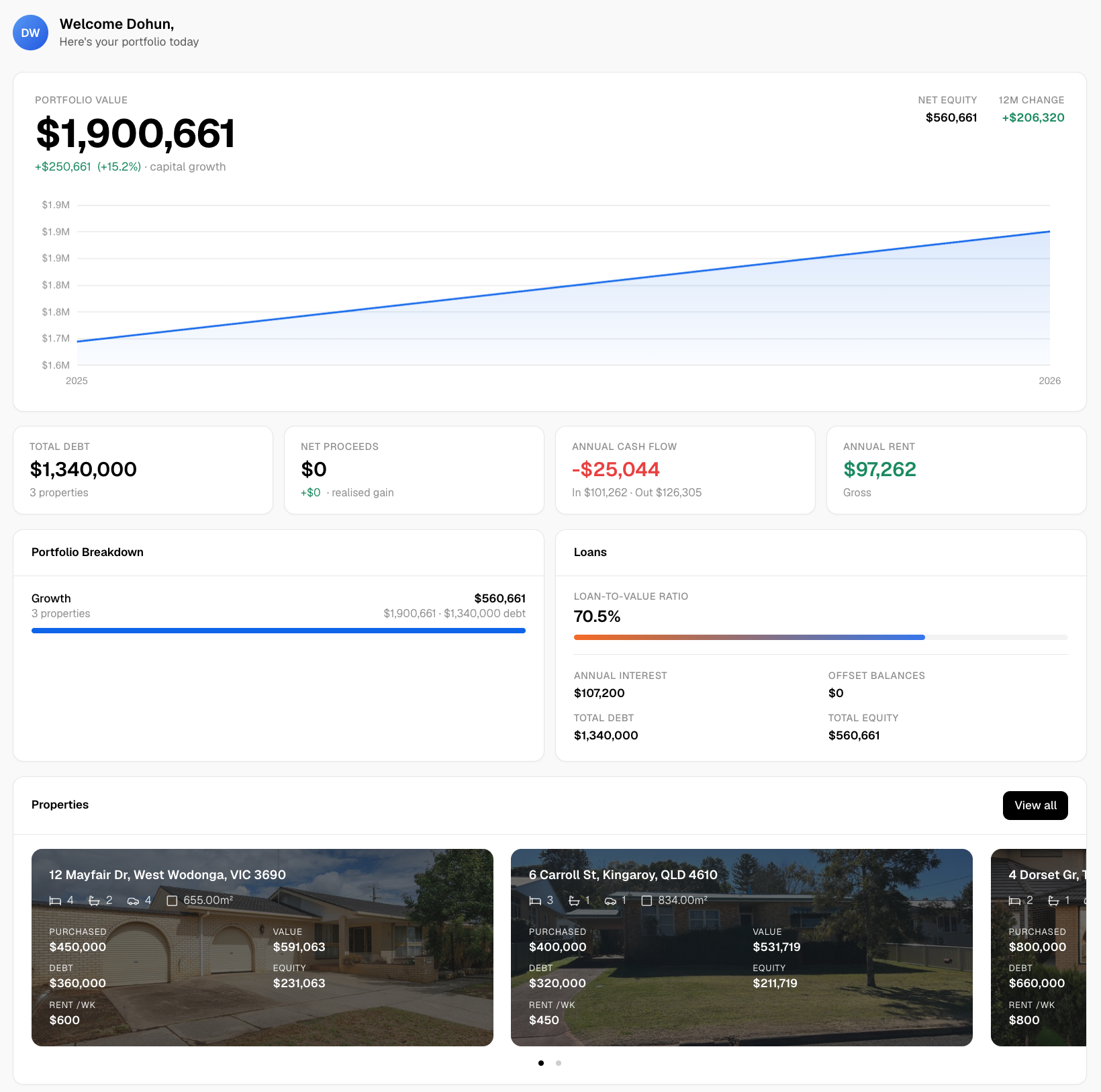
Try the WealthStacker toolkit to see how an offset, extra repayments or both would change your path. If you are weighing rentvesting, read what to check before you buy first.
FAQ
Is an offset account better than making extra repayments?
Not always. Both save the same interest on the same balance, so the better one is the one that fits your access needs and costs. An offset suits money you may need and investment loans. Extra repayments suit loans without an offset, or when offset fees outweigh the saving.
Can I withdraw extra repayments later?
Only if your loan has a redraw facility, and the terms vary. Moneysmart notes that redraw access may be limited, delayed or subject to fees, so check your lender’s conditions before paying in money you might need.
Does an offset account affect the tax on my investment loan?
An ATO private ruling says deposits into and withdrawals from an acceptable offset do not change the character of the interest on the linked loan. Redrawing principal can be treated differently, depending on what you use it for. Confirm your situation with a tax professional.
Does an offset account reduce how much I can borrow?
Lenders assess income, expenses and debts, and apply a buffer of at least 3.0 percentage points above the product rate. How they treat offset cash varies by lender, so ask a broker how your balance and limit will be counted before you apply.
Is debt recycling the same as using an offset?
No. An offset reduces interest without new borrowing. Debt recycling creates deductible investment debt by redirecting borrowing, which adds investment risk and record-keeping. Get tax advice before trying it.
Sources
- Mortgage offset accounts, Moneysmart
- Pay off your mortgage faster, Moneysmart
- Interest-only home loans, Moneysmart
- Buying an investment property, Moneysmart
- Differences between home loan redraw and an offset account, NAB
- Using equity to invest or buy another home, NAB
- 6 things you need to know about redraw and offset, Canstar
- ATO legal database: mixed-purpose loans
- ATO legal database: offset deposits and withdrawals
- ATO legal database: offset withdrawal versus redraw
- APRA submission on housing lending
- ASIC Report 445, Review of interest-only home loans
- RBA, Box B: Interest-only mortgage lending
- How to avoid a mixed purpose loan during debt recycling
- Tax implications of debt recycling for teachers on PAYG income
- Saving for your second deposit