
Best Interests Duty and Commissions: Mortgage Broker vs Bank in Australia
For most Australians with complex income, tight timelines, or a deposit under 20%, a mortgage broker will usually get you further than walking into a branch. For simple borrowers with a strong existing bank relationship and a big deposit, going direct can still work fine. Read on for the specifics before you commit either way.
TL;DR:
- Mortgage brokers typically access a panel of 20 to 30 lenders, increasing approval chances for complex or time-pressured borrowers.
- They are paid by the lender through upfront and trail commissions, incentivizing stability and actual loan retention.
- A broker’s value shines in complex cases such as self-employment or multiple properties, while straightforward applicants with a strong bank relationship may prefer direct contact.
- When evaluating options, ask brokers for lender panel details, commission breakdowns, and case examples, and compare bank rates beyond just the headline rate.
- For most borrowers, especially those with complex income or tight deadlines, using a broker generally yields better outcomes than going direct.
Table of Contents
- Mortgage broker vs bank: the quick comparison
- What does a mortgage broker actually do?
- How are mortgage brokers paid, and what protects you?
- Weighing up the pros and cons of using a broker
- Weighing up the pros and cons of going direct to a bank
- Who actually benefits from each option?
- How to choose a broker or vet a bank offer
- Decide now: a six-question checklist
- Model your loan outcomes before you commit
- Where to verify these details yourself
- Sources
Mortgage broker vs bank: the quick comparison
Before you spend hours on either path, run through the basics side by side.
- Access to lenders: A broker typically works from a panel of 20 to 30 or more lenders; a bank only shows you its own suite of products.
- Cost to you: Brokers are usually free to the borrower because the lender pays their commission; banks don’t charge you to apply, but you won’t see what you’re missing from other lenders.
- Regulatory protection: Brokers have carried a legal Best Interests Duty since 2021, meaning they’re required to put your interests first. Bank staff answer to their employer, not to you.
- Speed and approval odds: For straightforward applicants, either route is quick. For anything unusual, a broker who knows which lender’s credit policy fits your situation often gets a faster yes.
If your situation is simple and you already bank with an institution offering competitive rates, skip ahead to the direct-to-bank pros and cons. If not, the next few sections explain why brokers dominate the market the way they do.
What does a mortgage broker actually do?
A broker’s job starts well before any paperwork gets filed. They take your income details, deposit size, credit history, and goals, then work out which lenders on their panel are likely to approve you, at what rate, and with which conditions. That matching process is where most of the value sits, not in some mythical secret rate nobody else can get.
Brokers arrange around three in four new home loans written in Australia, according to industry data cited by Finder. That scale exists because most borrowers don’t have the patience or the credit knowledge to compare 20 lenders’ policies themselves.
Once you’ve picked a direction, the broker handles the heavy lifting: gathering payslips and statements, structuring the application to suit the lender’s specific criteria, and chasing the bank when things stall. Good brokers also flag problems before submission, things like a missed loan repayment three years ago that a straight bank application might not surface until it’s too late to fix.
Panel size matters, but it isn’t unlimited. Most panels run 20 to 30-plus lenders, covering the big four, regional banks, and second-tier lenders. What they often exclude are niche online-only lenders and some smaller non-bank operators who don’t pay broker commissions. If you’ve got your eye on a specific fintech lender’s low advertised rate, ask your broker directly whether that lender sits on their panel, because it might not.
Where brokers tend to add the most value is complexity: self-employed income, multiple properties, irregular pay, or a deadline that a bank’s standard processing queue can’t meet. Industry commentary from Canstar makes the same point: brokers aren’t producing a hidden lowest rate, they’re managing lender knowledge and paperwork so your application lands on the right desk the first time.

How are mortgage brokers paid, and what protects you?
Brokers are paid by the lender, not by you, through a two-part commission structure. Understanding the numbers helps you judge whether a recommendation is genuinely in your interest.
- Upfront commission: Typically 0.65% to 0.70% of the drawn loan amount, paid once the loan settles.
- Trail commission: Usually around 0.15% per annum of the outstanding loan balance, paid for as long as you keep the loan with that lender.
- Clawback: If you repay or refinance the loan within roughly 18 to 24 months of settlement, the lender can claw back some or all of the upfront commission from the broker.
On a $600,000 loan, the upfront commission is a small percentage paid by the lender, not deducted from your loan or added to your rate.
Clawback rules matter to you indirectly. They give a broker a commercial reason to recommend a loan you’ll actually keep for a few years, rather than churning you into a new product every six months for a fresh commission. It’s a built-in incentive toward stability, though it’s worth knowing it exists when a broker steers you firmly toward one lender.
The legal backstop here is the Best Interests Duty, introduced in 2021 under the National Consumer Credit Protection Act. It requires brokers to prioritise your interests over their own commission and to disclose how they’re paid. Moneysmart confirms you can ask any broker exactly which lenders they’re accredited with and request a written fee quote if they charge one directly.
Weighing up the pros and cons of using a broker
A broker earns their keep in most complex or time-pressured scenarios, but the arrangement isn’t flawless.
Pros:
- Access to a wider set of lenders than you’d realistically compare yourself.
- Application preparation and follow-up handled on your behalf.
- Usually free to you, since the lender covers the commission.
- Legal obligation to act in your best interests, not the lender’s.
Cons:
- Panels don’t include every lender, particularly some online-only options.
- Commission structures can still shape recommendations, even under Best Interests Duty.
- Quality varies enormously between brokers; some genuinely know their panel inside out, others barely scratch the surface.
Pro Tip: Ask any broker to show you at least three loan options they considered for your situation, not just the one they’re recommending. A broker following the MFAA’s Best Interests Duty guidance should be able to produce this without hesitation.
Weigh the cons against your own complexity.
Weighing up the pros and cons of going direct to a bank
Walking straight into your existing bank still makes sense for some borrowers, particularly those with a long, clean relationship and a straightforward application.
Pros:
- Deep familiarity with that bank’s own products, discounts, and internal approval quirks.
- Existing customers sometimes get loyalty pricing or fee waivers not always visible to brokers.
- Direct negotiation, no third party relaying messages back and forth.
Cons:
- You only ever see one lender’s offer, with no benchmark for comparison.
- You do the legwork yourself, gathering documents, chasing updates, resubmitting if something’s missing.
- Processing can be slower during busy periods, since you’re in the general queue rather than routed through an experienced broker who knows how to avoid common delays.
Direct banking suits a specific profile: strong, stable income, a healthy deposit, and no urgency. If your income is irregular or your deadline is tight, the single-lender limitation starts to bite hard.
Who actually benefits from each option?
Your income shape and timeline decide this more than anything else.
Self-employed borrowers with fluctuating income often struggle against a single bank’s rigid servicing calculators. A broker who knows which lenders take a more flexible view of business income, and how debt-to-income limits affect borrowing capacity, can be the difference between an approval and a knockback.
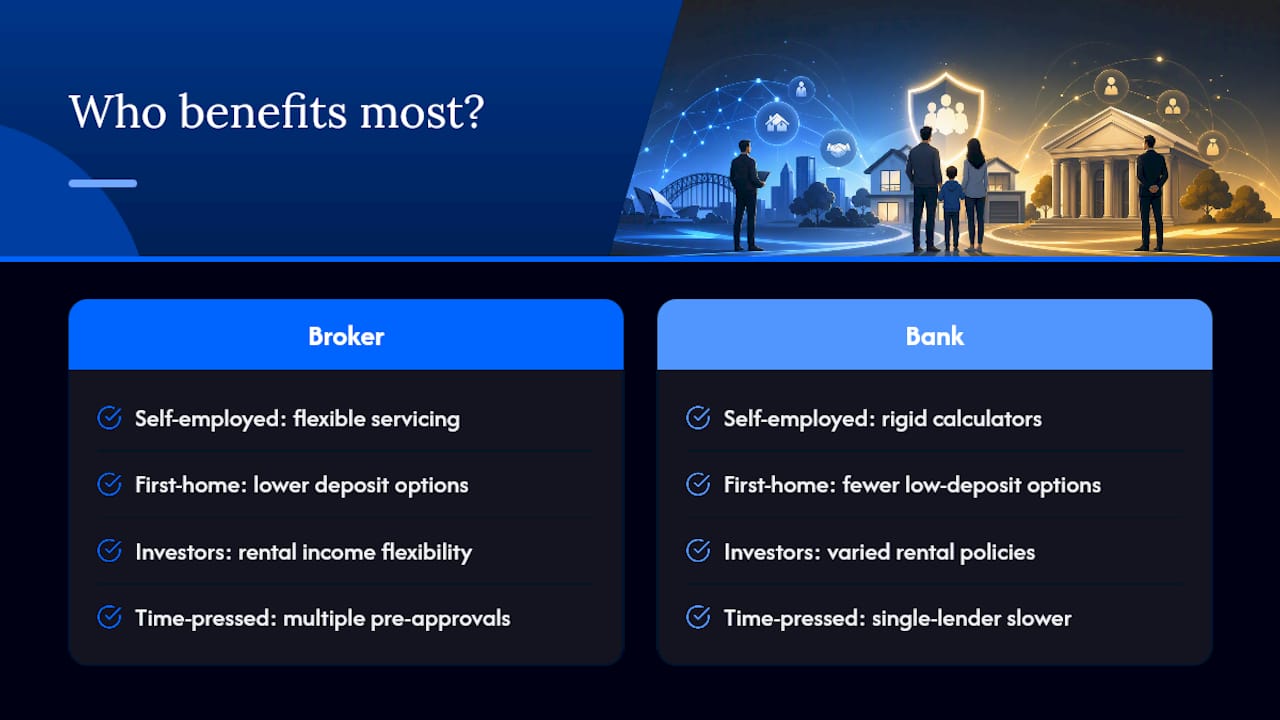
First-home buyers with a small deposit benefit from a broker’s knowledge of lenders offering lower deposit thresholds or lenders’ mortgage insurance waivers, something worth checking against buy versus rentvest scenarios before committing to either path.
Property investors juggling an owner-occupier loan against an investment loan often need a broker who understands how lenders treat rental income differently, since policies vary widely across the panel.
Time-pressured buyers in a competitive auction scenario benefit from a broker chasing pre-approval across several lenders simultaneously.
Contrast that with a straightforward PAYG borrower refinancing an existing loan with the same bank they’ve held for a decade. Here, direct negotiation with the existing lender, sometimes just a phone call requesting a rate match, can resolve things faster than starting a fresh broker relationship.
How to choose a broker or vet a bank offer
Whichever path you take, ask the right questions upfront rather than after you’ve signed anything.
- Ask the broker which lenders they’re accredited with. If they can’t answer clearly, that’s a warning sign, not a technicality.
- Ask exactly how they’re paid, including the upfront percentage and trail rate, and whether any lender pays them more than others.
- Request examples of similar cases they’ve handled, particularly if your situation is self-employed, investor-focused, or time-sensitive.
- If a broker charges a direct fee, get it in writing before proceeding.
- If going direct, compare the bank’s comparison rate, not just the headline rate, against at least one other lender so you have a benchmark.
- Check the bank’s current processing timelines, since these shift with seasonal demand.
Pro Tip: Treat any refusal to disclose commission details as a hard stop. Under the Best Interests Duty, a broker who can’t or won’t explain how they’re paid isn’t meeting their basic obligations.
Watch for pressure to sign quickly, vague answers about panel size, or an inability to show you a genuine comparison. Any of those should send you elsewhere.
Decide now: a six-question checklist
Answer these honestly before you pick a path.
- Is your income self-employed, irregular, or from multiple sources?
- Is your deposit under 20%?
- Do you have less than a few weeks before you need approval?
- Do you lack confidence comparing loan products yourself?
- Do you want someone chasing the bank on your behalf?
- Would you value an adviser reviewing your loan again in a year or two?
Three or more “yes” answers point toward a broker. Mostly “no” answers, especially if you’ve got a strong relationship with your current bank, suggest going direct could work fine. Either way, get your borrowing capacity and repayment numbers modelled properly before you approach anyone.
Model your loan outcomes before you commit
Whichever route you take, a broker’s shortlist or a bank’s pre-approval is only half the picture, you still need to know what that loan does to your finances over the next 10 to 15 years.
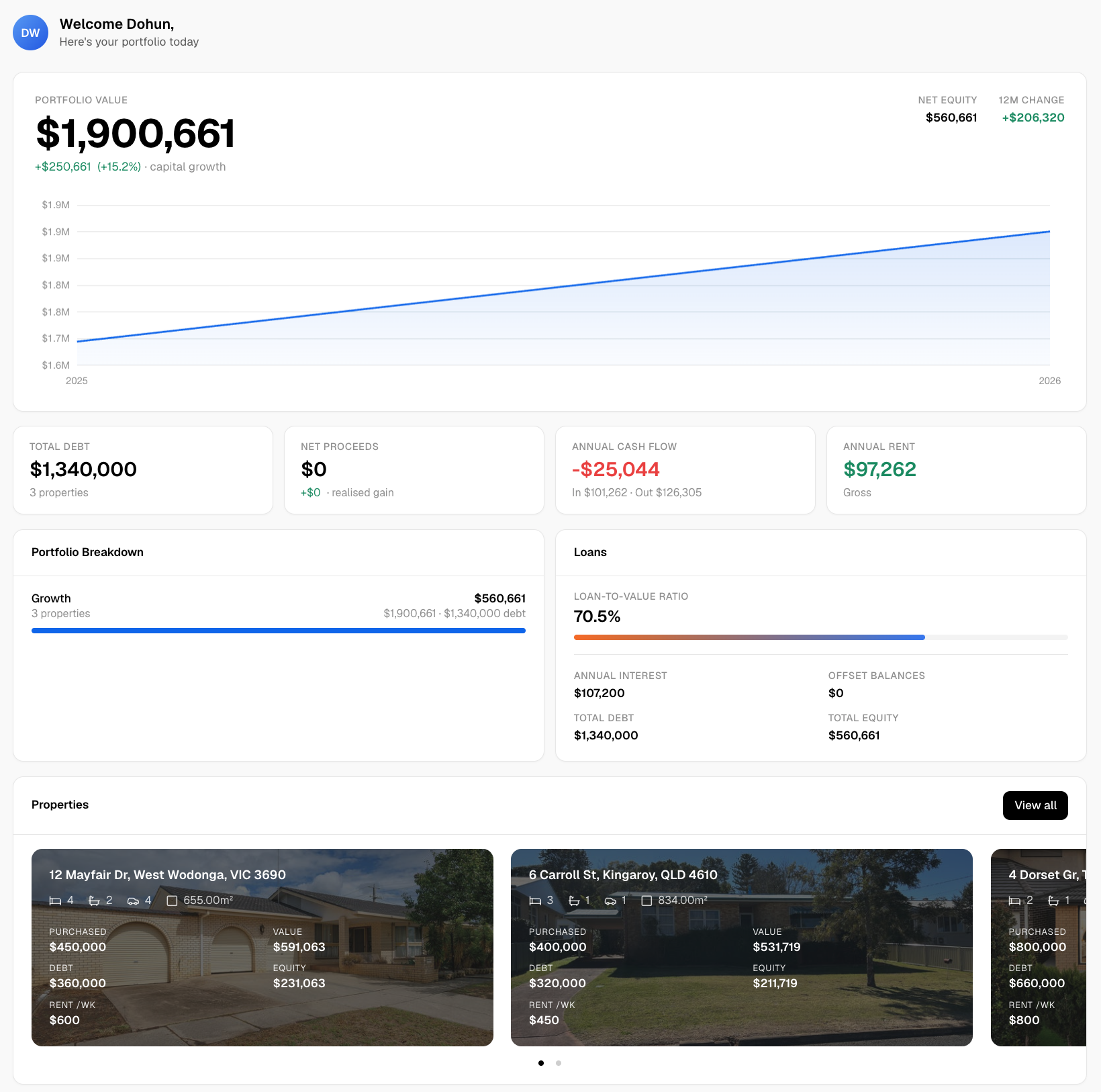
Wealthstacker gives you free automated quarterly property valuations and a borrowing power estimator you can run independently of any broker or bank recommendation, so you’re not relying purely on someone else’s numbers. Use it to model a rentvesting scenario against a straight purchase, stress-test a recommended loan against your long-term net worth goals, or simply sanity-check whether a broker’s suggested lender actually stacks up over 15 years compared to the alternative. If a bank or broker hands you a rate, run it through Wealthstacker’s modelling tools before you sign anything, and see where it puts your wealth position a decade from now.
Where to verify these details yourself
Check Moneysmart’s broker guidance, ASIC’s RG 273, and the MFAA’s remuneration factsheet directly. Always ask any broker or lender to confirm commission details and your complaint options in writing.