
10 best money blogs for beginners, FIRE and investing
The best money blogs right now are Strong Money Australia for financial independence, ItsMiMoney for jargon-free beginner budgeting, mates.finance for evidence-based investing primers, Talk Investing for adviser-backed podcast content, Get Rich Slowly for long-running habit-building advice, Money Crashers for broad personal finance and side hustles, Afford Anything for property and FIRE crossover thinking, Budgets Are Sexy for irreverent budgeting takes, The Barefoot Investor for simple structured money rules, and Monevator for low-cost index investing in depth.
Each earns its spot for a different reason. Strong Money Australia is where you go when you want to actually see the maths behind quitting work early. ItsMiMoney works if the word “superannuation” still makes your eyes glaze over. mates.finance is for readers who want their investing advice backed by data rather than vibes. Talk Investing suits people who trust a credentialed adviser more than an anonymous blogger. The rest round out the list for frugality, side income, and no-nonsense budgeting rules.
- Strong Money Australia — best for financial independence seekers; start with its foundational FIRE guides.
- ItsMiMoney — best for absolute beginners; start with its free budgeting programme.
- mates.finance — best for evidence-based investing; start with its ETF and index fund primer.
- Talk Investing — best for adviser-backed content; start with a recent podcast episode and its companion article.
- Get Rich Slowly — best for long-term habit builders; start with its archive on debt payoff.
- Money Crashers — best for broad money topics and side hustles; start with its budgeting basics hub.
- Afford Anything — best for property-curious FIRE readers; start with its rentvesting-style episodes.
- Budgets Are Sexy — best for readers who hate boring finance content; start with its net worth updates.
- The Barefoot Investor — best for simple, rules-based money management; start with its bucket system explainer.
- Monevator — best for low-cost index investing; start with its passive investing archive.
Table of Contents
- Best money blogs grouped by what you’re trying to achieve
- What to expect from each blog before you subscribe
- How to evaluate a money blog before you trust its advice
- How this shortlist was put together
- What to actually read first, and what compound interest does for you
- Which blog to start with, at a glance
- Frequently asked questions about money blogs
- Sources
Best money blogs grouped by what you’re trying to achieve
Reading ten blogs at once is a recipe for doing nothing. Pick the category that matches your actual goal this year, then follow one or two sources properly instead of skimming all of them.
If you’re starting from zero
ItsMiMoney and Get Rich Slowly are the two to bookmark. ItsMiMoney runs free, structured, jargon-free programmes on budgeting, mortgages, and investing, built so you can work through them in order rather than hunting for relevant posts. Get Rich Slowly has been publishing since the mid 2000s, and its longevity shows in how plainly it explains debt payoff and basic saving habits without assuming prior knowledge. Start with ItsMiMoney’s budgeting module, then move to Get Rich Slowly’s debt archive once the basics feel comfortable.
If financial independence is the goal
Strong Money Australia and Afford Anything cover FIRE from different angles. Strong Money Australia is squarely focused on the mindset and mechanics of reaching financial independence, with long-form guides that walk through savings rates and withdrawal strategy. Afford Anything leans harder into property as a FIRE lever, useful if you’re weighing rentvesting against traditional saving. Start with Strong Money Australia’s core FIRE guide before branching into Afford Anything’s property episodes.
If you want evidence-based investing guidance
mates.finance and Monevator are built for this. Mates.finance publishes guides on ETFs, index funds, superannuation, and market regimes that read more like a finance course than a blog. Monevator has spent over a decade making the case for low-cost index investing, with detailed breakdowns of fees and asset allocation. Start with mates.finance’s ETF primer, then read Monevator’s index fund archive for a UK-flavoured but broadly applicable second opinion.
If you want adviser-backed technical depth
Talk Investing stands apart because it’s produced by practising financial advisers who publish companion articles alongside their podcast to unpack the numbers in full. It doesn’t offer personalised advice, but the technical grounding is a level up from most blogger commentary. Start with a recent episode and read the matching article side by side.
If frugality and everyday budgeting are the priority
The Barefoot Investor and Budgets Are Sexy fit here, though they couldn’t be more different in tone. The Barefoot Investor’s bucket system is famous for a reason. It’s simple enough that you can set it up in a weekend. Budgets Are Sexy takes the opposite approach: casual, funny, and built around transparent net worth updates rather than rigid rules. Start with the Barefoot bucket explainer if you want structure, or Budgets Are Sexy’s net worth series if you want motivation through someone else’s numbers.
What to expect from each blog before you subscribe
Knowing a blog’s tone and format before you commit ten minutes to it saves a lot of wasted scrolling. Here’s what each one actually delivers.
Strong Money Australia writes long, methodical posts aimed at people serious about early retirement. The tone is calm and numbers-heavy rather than motivational, and it’s backed by a companion Strong Money podcast that goes deeper into listener questions. Updates are semi-regular rather than daily, which suits its long-form format.
ItsMiMoney runs as structured courses rather than a traditional post feed. Everything is free, and the explicit goal is financial literacy without jargon, which shows in how it breaks mortgages and budgeting into digestible steps. It’s aimed squarely at people who’ve never engaged with finance content before.
mates.finance reads like an academically grounded reference library. Its guides cover ETFs, superannuation, and macro market conditions with a data-driven approach rather than personal anecdotes. This makes it less entertaining than some blogs on this list, but more useful if you want to actually understand mechanisms.
Talk Investing operates as a podcast first, blog second, with articles that mirror episode content in written form. The authors are financial advisers, which shows in the caution around personalised recommendations and the depth of the technical explanations.
Get Rich Slowly, Money Crashers, Afford Anything, Budgets Are Sexy, The Barefoot Investor, and Monevator each bring a distinct voice: Get Rich Slowly is steady and habit-focused, Money Crashers is broad and practical across side hustles and budgeting tools, Afford Anything blends property strategy with FIRE thinking, Budgets Are Sexy is anecdotal and funny, The Barefoot Investor is rules-based and blunt, and Monevator is detail heavy on index fund mechanics and cost minimisation.
- Look for clear disclosure of any affiliate links or sponsored content before trusting a product recommendation.
- Check whether the author publishes under their real name with a stated background, rather than hiding behind a generic “team” byline.
- Favour blogs with a companion podcast or newsletter. It usually signals a bigger, more accountable operation than a one-off blog.
Pro Tip: Subscribe to one newsletter and one podcast, not five of each. A single well-read source beats a cluttered inbox of half-read digests.
How to evaluate a money blog before you trust its advice
Not every blog with a nice layout deserves your attention. Run through this checklist before you take financial cues from a stranger on the internet.
- Check the author’s background. Look for a named person with a stated history in finance, whether that’s a licensed adviser, an accountant, or simply someone who’s documented a long personal track record.
- Look for sourcing. Reliable blogs link to primary data, such as the ATO’s guidance on tax and super, rather than repeating unsourced claims from other blogs.
- Check update frequency. A blog that hasn’t posted in two years may still have useful archives, but treat any references to rates, thresholds, or products as outdated until verified elsewhere.
- Look for companion formats. A podcast, calculator, or structured course alongside the blog usually signals a more serious, longer-running operation.
- Read the disclosure page. Reputable sites state clearly when a link is an affiliate link or when content is sponsored.
Red flags are just as telling as good signs. Be wary of blogs pushing get-rich-quick claims, recommending specific products without disclosing a commercial relationship, or offering strong opinions with zero named author. If a site can’t tell you who’s behind the advice, don’t take the advice.
Pro Tip: Set up one RSS reader or newsletter folder and unsubscribe ruthlessly. If you haven’t opened an email from a blog in a month, it’s dead weight, not dedication.
How this shortlist was put together
The blogs on this list were assessed against a few consistent criteria rather than picked by traffic numbers or popularity alone.
- Educational quality first. Each blog needed to teach a concept, not just recommend a product.
- Evidence-based content. Preference went to sites that reference primary sources such as tax authorities, superannuation guidance, or established financial data rather than recycling secondhand claims.
- Author credibility. Sites run by named individuals with disclosed backgrounds, whether advisers, long-term FIRE practitioners, or finance writers, ranked ahead of anonymous content farms.
- Format variety. Blogs offering a newsletter, podcast, or calculator alongside written content scored higher for practical usefulness.
- Update patterns checked. Each site was reviewed for whether it’s still actively maintained or largely an archive.
Scope matters here too. This list deliberately excludes sites built primarily to sell a product or course, even when their content volume is high. It also isn’t a ranking by page views or social following. A blog with a smaller audience but tighter, better-sourced content beat a bigger site padded with SEO filler.
What to actually read first, and what compound interest does for you
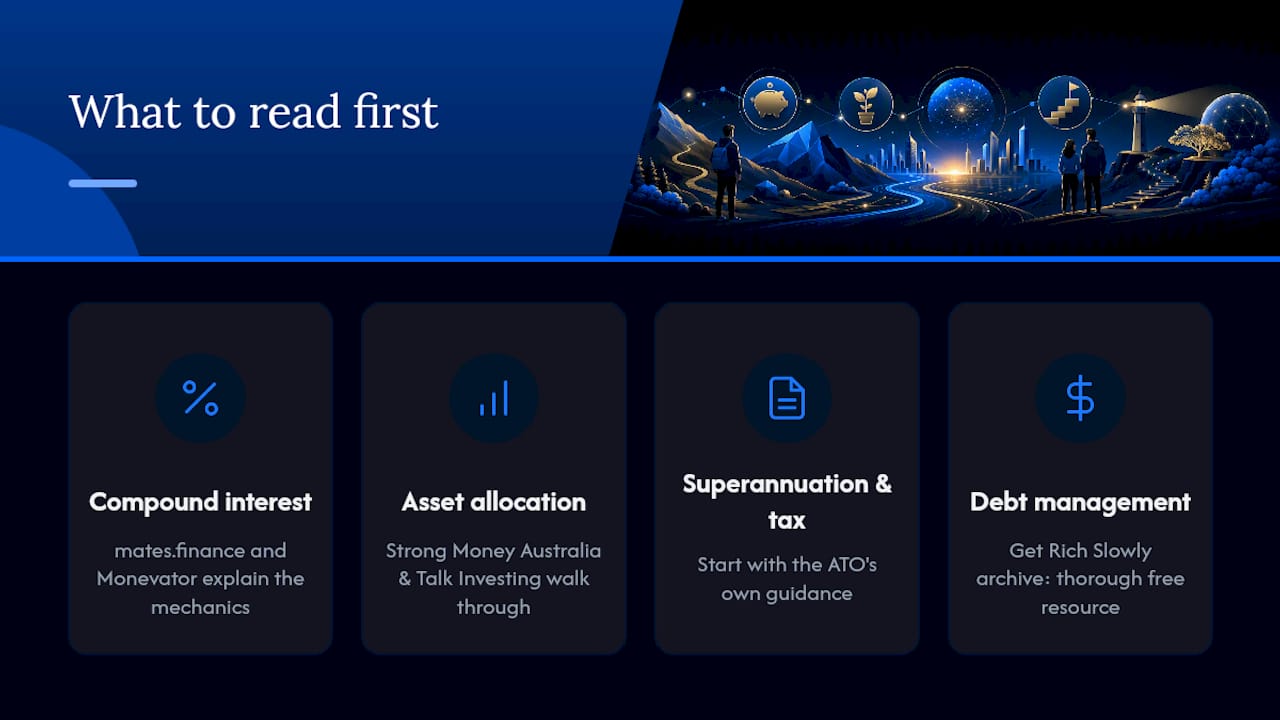
Before you dive into ten different blogs, get the fundamentals sorted. Four topics come up in almost every good personal-finance resource: compound interest, asset allocation, superannuation and tax basics, and debt management.
For compound interest, mates.finance and Monevator both explain the mechanics well. For superannuation and tax, start with the ATO’s own guidance before layering on blog commentary, since blogs occasionally lag behind rule changes. For debt management, Get Rich Slowly’s archive is one of the more thorough free resources going. For asset allocation, Strong Money Australia and Talk Investing both walk through the reasoning rather than just handing you a model portfolio.
The reason compound interest gets so much airtime isn’t hype. It’s maths. Investopedia’s worked example shows how a $5,000 starting balance with regular contributions and consistent growth can compound into a seven-figure outcome over several decades, and the AFR has reported similar expert commentary on turning small starting capital into six-figure sums through steady contributions and growth assets.
The pattern that matters here: in the early years, your own contributions do most of the work. Decades in, growth on growth takes over and starts doing the heavy lifting. That’s the entire argument for starting now rather than waiting for a “better” time.
Three moves to make this week: subscribe to one beginner resource (ItsMiMoney is the easiest entry point), automate a recurring transfer into savings or investments so the habit doesn’t rely on willpower, and pick one investing primer, such as mates.finance’s ETF guide, and actually finish reading it before opening a new tab.
Which blog to start with, at a glance
The single biggest driver of long-term wealth is consistent, automated saving paired with low-cost, evidence-based investing, not chasing high-return shortcuts.
| Point | Details |
|---|---|
| Beginners start here | ItsMiMoney’s free structured programme covers budgeting and mortgages without jargon. |
| FIRE followers start here | Strong Money Australia’s core guides explain savings rates and early retirement mechanics. |
| Investors start here | mates.finance’s ETF and index fund primer gives an evidence-based grounding. |
| Frugal readers start here | The Barefoot Investor’s bucket system offers a simple weekend setup. |
| Bookmark smart | Pick one newsletter and one podcast rather than subscribing to everything at once. |
Try one “start here” pick this week rather than bookmarking all ten and reading none of them.
Frequently asked questions about money blogs
What are the best money blogs for absolute beginners? ItsMiMoney and Get Rich Slowly are the strongest starting points. ItsMiMoney runs free structured programmes with no jargon, while Get Rich Slowly’s long archive covers debt and saving basics in plain language.
Which money blogs focus on financial independence and early retirement? Strong Money Australia is the clearest FIRE-focused resource on this list, with Afford Anything offering a property-heavy take on the same goal.
Are money blogs a reliable substitute for financial advice? No. Even the most credible personal-finance blogs, including adviser-run ones like Talk Investing, avoid giving personalised advice. Use blogs for education and frameworks, then confirm specific decisions against your own circumstances or a licensed adviser.
How often should I check money blogs for updates? Weekly is usually enough for most readers. A newsletter digest from one or two sources beats checking multiple sites daily, and it reduces the temptation to chase every new trend.
What’s the difference between a personal finance blogger and a financial adviser writing a blog? A personal finance blogger typically shares personal experience and general education, while an adviser-run blog, like Talk Investing, comes with professional accreditation and stricter disclosure standards, though neither replaces personalised advice.
This article provides general information about publicly available personal-finance blogs and is not financial advice. Confirm current tax, superannuation, and investment rules with the ATO or a licensed financial adviser before making decisions.

This article is general information, not a substitute for advice from a qualified financial advisor. Consult a qualified financial professional about your own circumstances before acting on anything here.
Sources
- Tax and super in Australia — what you need to know (ATO)
- Financial Independence Retire Early | Strong Money Australia
- ItsMiMoney — Financial Literacy, Jargon-Free
- Mates
Official resources matter as a check against blog content, not a replacement for it. Blogs are excellent for motivation, framing, and real-world examples. Government guidance and primary data are what you use to confirm the numbers actually still hold. If you’re ready to turn what you’ve read into an actual property or rentvesting decision, Wealthstacker’s free portfolio toolkit can model your next move using current market data rather than a blog post’s example figures.