
LMI Waiver Professions in Australia: Who Qualifies in 2026
Doctors, dentists and some other health professionals have the widest access to LMI waivers in Australia, with a few lenders going to 95% of the property’s value. Lawyers, accountants and finance professionals are usually capped at 90% and face an income floor. Each lender publishes its own list, so your job title, your registration or membership and the type of loan all decide whether the waiver applies to you.
This guide sets out which professions are commonly covered, where lenders disagree, what a waiver can save and why your living expenses still shape how much you can borrow.
WealthstackerModel Your Property Investment OptionsCompare rentvesting and buying strategies with personalised modelling, real-time net worth estimates and automated quarterly property valuations.VisitTL;DR
- Waivers centre on medicine, dentistry, allied health, law, accounting and finance. Nursing is covered by some lenders and excluded by others.
- Limits differ by lender. Top-tier medical roles can reach 95% LVR at some banks, while most other professions stop at 90%.
- Conditions matter as much as the job title: current registration or membership, an income floor, and the type of purchase.
- On a $650,000 purchase with a 10% deposit, a waiver to 90% LVR is worth roughly $10,500 to $18,700, according to Canstar.
- A waiver does not change serviceability. Lenders still test your income against the greater of your declared expenses or the HEM benchmark.
Table of Contents
- What an LMI waiver actually does
- Which professions can get LMI waived
- The conditions that decide eligibility
- How much a waiver can save you
- Why HEM still matters when LMI is waived
- Model it before you apply
- A practical checklist for your profession
- FAQ
- Sources
What an LMI waiver actually does
Lenders mortgage insurance (LMI) is a one-off premium that protects the lender if you borrow more than 80% of a property’s value and default. You pay it, but the lender is the one protected. If you want the mechanics and the timing question, our guide to LMI in Australia, pay now or wait covers it in detail.
An LMI waiver is a lender’s decision to skip that premium for borrowers in occupations it considers lower risk, typically because of stable, high incomes. It is a lender policy, not a government scheme, so it can be changed or withdrawn. Check the current terms before you sign anything.
A waiver also does not replace the lender’s own checks. APRA’s prudential guidance says LMI is not an alternative to the lender’s own assessment of whether you can repay the loan.
Which professions can get LMI waived
The pattern across lenders is consistent even where details differ.
Doctors, dentists and specialists
This is the strongest category. Bank of Melbourne’s broker flyer lists dentists, GPs, medical specialists and hospital-employed doctors (interns, residents, registrars and staff specialists) as eligible for a 95% LVR waiver with no minimum income requirement. The maximum loan is $5 million, with $7.5 million total lending with the waiver.
ANZ’s fact sheet places the medical practitioner, dental practitioner and specialist roles in its Group 1, which is the group with the most generous terms.
Other health professionals
A second tier of health roles usually gets a lower ceiling. Bank of Melbourne’s flyer puts audiologists, chiropractors, midwives, registered nurses, occupational therapists, osteopaths, physiotherapists, podiatrists, psychologists, radiographers, sonographers, speech pathologists, optometrists, pharmacists and veterinary practitioners at 90% LVR with a $90,000 minimum income.
The lists are not the same everywhere. ANZ’s fact sheet puts physiotherapists, chiropractors, optometrists and vets in Group 2, and lists nurses, midwives, pharmacists, psychologists, podiatrists, osteopaths and occupational therapists, among others, as not eligible. So a registered nurse may qualify at one lender and not at another. That is the single biggest reason to compare lenders rather than assume.

Lawyers, accountants and finance professionals
These professions are generally capped at 90% LVR and tied to an income floor and a recognised body. ANZ’s fact sheet says legal professionals must hold a current practising certificate with the relevant state body, and judges and magistrates must supply confirming documents such as a letter of appointment. For accountants, it names members of the Global Accounting Alliance, Chartered Accountants Australia and New Zealand, or the American Institute of Certified Public Accountants, with current membership or certification.
The income floor varies by lender. Published figures I have seen range from around $100,000 to $150,000 depending on the bank and the profession, so treat any single number as a guide and confirm it with the lender.
Professions that rarely appear
Teachers, engineers, IT workers and public servants are not on the standard lists at the major banks. Some smaller lenders and mutuals run essential-worker or broader programs, usually capped at 90% and with extra conditions. If your job is not on a major bank’s list, ask about those lenders and about programs that apply regardless of occupation.
The conditions that decide eligibility
Most people who miss out do so on conditions, not on job title. Check each of these:
- Registration or membership. It must be current, and it must be with a body the lender accepts. Associate or provisional membership often does not count.
- Income from the profession. Where an income floor applies, it generally has to come from your professional income, not rent or other sources.
- Employment status. Some programs want permanent employment and a completed probation period.
- Loan purpose. Some waivers cover owner-occupied purchases only. Land, construction and refinancing may be excluded. If you are buying house and land, ask whether a separate land and build contract is covered.
- Loan size and total debt. Caps apply per loan and per borrower across the lender’s group. ANZ’s fact sheet and Bank of Melbourne’s flyer both set maximums.
- Loan product. Some lenders require a specific package or principal and interest repayments.
Two more points catch people out. Joint applications are assessed under the lender’s rules for each applicant, so ask how a partner in a different profession is treated. And if you refinance later while still owing more than 80% of the property’s value, the new lender may charge LMI again, which can outweigh the rate saving.
How much a waiver can save you
The saving depends on your deposit, loan size and lender’s insurer. Canstar reports that on a $650,000 purchase, a waiver to 90% LVR is worth $10,500 to $18,700 to someone with a 10% deposit. With a 5% deposit it is worth nothing at a 90% cap, because the loan sits outside the waiver. At 95% LVR the premium would run $19,100 to $29,000.
Canstar also cites a calculator showing these savings at a 10% deposit:
| Property price | Loan (90% LVR) | LMI saving |
|---|---|---|
| $750,000 | $675,000 | $13,500 |
| $1,000,000 | $900,000 | $22,392 |
| $1,250,000 | $1,125,000 | $30,715 |
Those figures assume a 30-year term and a borrower who is not a first home buyer, according to Canstar. Your quote will differ.
The practical point: a waiver is worth the most when your deposit is near the lender’s maximum LVR. If you are a nurse at a lender capped at 90% and you only have 5% saved, the waiver does not help until you lift your deposit.

Why HEM still matters when LMI is waived
A waiver changes the premium. It does not change how much a bank thinks you can afford. That is where the Household Expenditure Measure (HEM) comes in.
HEM is a benchmark of household living costs built from ABS survey data. A PPE Sydney paper by Burstall describes it as grouping about 600 expenditure categories into absolute basics, discretionary basics and luxury, and adjusting by 13 income bands and by location. Australian banks introduced it in 2010.
The lender does not simply use HEM, though. APRA’s guidance expects lenders to use the greater of your declared living expenses or an appropriately scaled HEM or similar index. If you spend less than HEM on paper, the bank substitutes HEM. If your real spending is higher, the bank uses your higher number.
What that means for a professional with a high income:
- Your income may clear a waiver’s income floor comfortably, but your expenses can still shrink your borrowing power.
- Higher income bands carry a higher HEM figure, so the benchmark rises as you earn more.
- Dependants, location and spending history all move the number the lender uses.
The Reserve Bank has estimated that a little under 15% of home buyers borrow the maximum amount HEM allows, which shows how often the benchmark is the binding limit. For a closer look at how banks apply it, see our guide to HEM living expenses.
The 3% buffer on top
Lenders also test your repayments at a higher rate than the one you will pay. APRA’s guide sets a serviceability buffer of at least 3.0 per cent over the loan’s interest rate. Combined with HEM, that is why a 95% LVR waiver does not mean a 95% loan is approved. You can walk through the test in our guide to the APRA buffer and 6x debt-to-income limit, and run your own numbers with interest rate stress testing.
Model it before you apply
A waiver decision usually comes down to three numbers: the deposit you have, the price you can afford under the lender’s expense assumptions, and the premium you would otherwise pay. We built WealthStacker so you can see those together. You can test borrowing power, compare buying and rentvesting over a 15-year horizon and track your net worth path, with free automated quarterly property valuations to keep your starting point current.
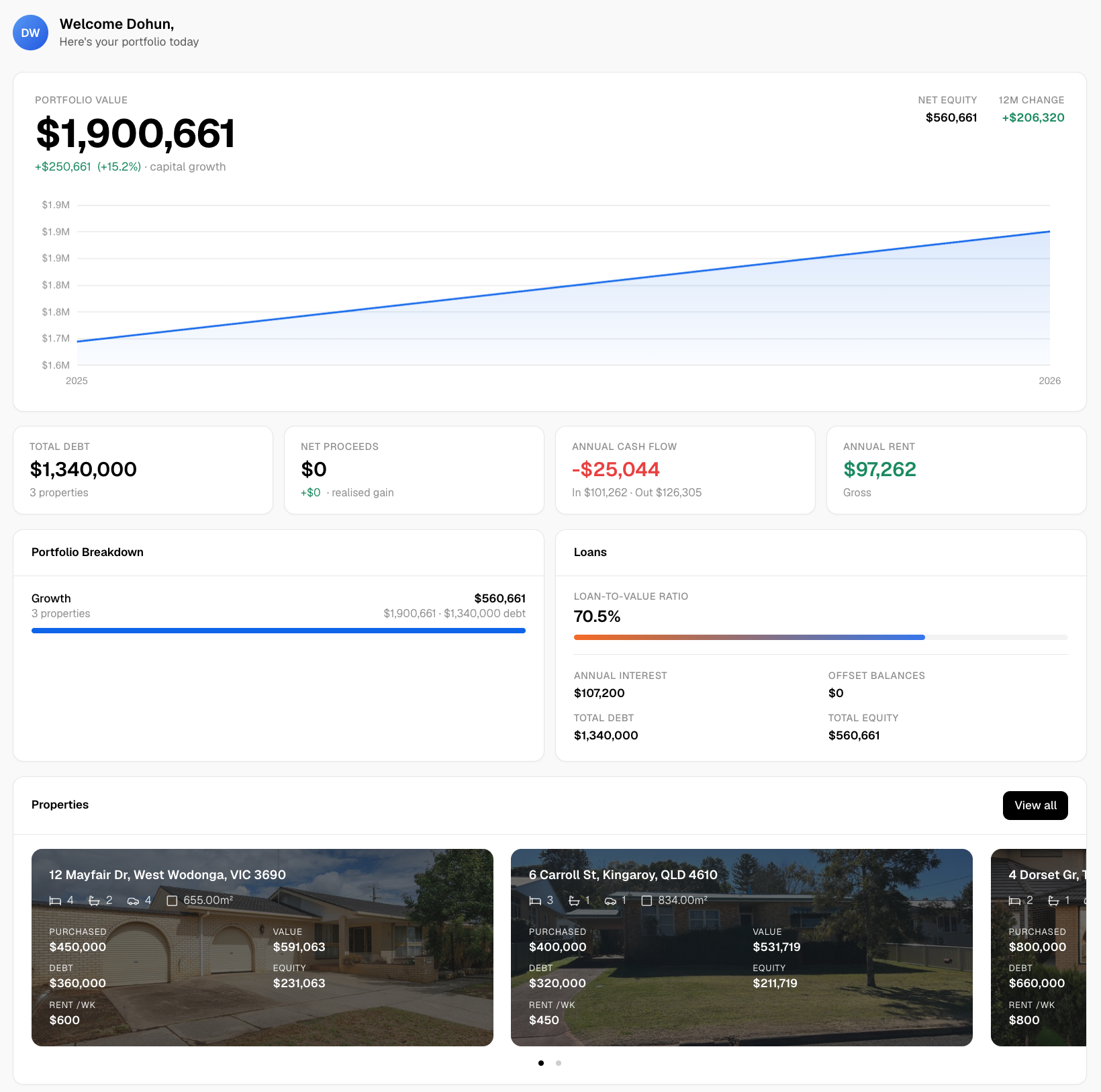
If you are weighing a purchase against renting and investing, try WealthStacker to see how a waiver, a different deposit or a different suburb changes your plan. If you are choosing between lender types, our comparison of a mortgage broker and a bank explains how each is paid and what duty they owe you.
A practical checklist for your profession
- Find your exact role on the lender’s list. “Health professional” is not enough. Lists name specific titles such as physiotherapist, optometrist or hospital-employed doctor.
- Match your registration or membership to the lender’s accepted bodies. Accountants in particular should confirm that their membership level counts.
- Confirm the income floor and how it is measured. Ask whether bonuses, overtime and rental income count.
- Check the loan type. Owner-occupier, investment, construction and refinance often have different rules. Our guide to owner-occupier and investor loans explains why lenders treat them differently.
- Get the policy in writing. Occupation lists are amended and programs are withdrawn, so confirm current terms with the lender or a broker at the time you apply.
- Model the whole cost. Compare the waiver with the rate, fees and package costs, since the lowest-premium option is not always the cheapest loan.
If you carry a HELP debt, it also reduces your borrowing power. See how the HELP repayment threshold affects borrowing.
FAQ
What professions can get LMI waived in Australia?
The most common are doctors, dentists and specialists, then other health professionals, lawyers, accountants and finance professionals. Some lenders also include registered nurses and midwives, but others exclude them. Each bank publishes its own list, so check the one you plan to use.
Do I need a minimum income to qualify?
Often, yes, but not always. Bank of Melbourne’s flyer sets no minimum income for its top medical group but asks for $90,000 a year for its second tier of health roles. Other lenders set higher floors for law and finance, so confirm the figure for your profession.
Can I get a waiver on an investment property?
Sometimes. Some lenders limit waivers to owner-occupied homes, while others extend them to investment loans, often at a lower LVR. Check the lender’s policy for your loan purpose before you rely on it.
Does a waiver mean I can borrow more?
No. It removes the insurance premium for a higher LVR, but the lender still assesses your income, your expenses and a buffered interest rate. Your borrowing power is set by that test, not by the waiver.
Is it worth waiting to save a 20% deposit instead?
It depends on how fast property prices rise against your savings, and on what the waiver saves you. Compare the premium you would avoid with the cost of waiting, and model both paths. Our LMI guide sets out the trade-off.
Sources
- ANZ LMI Waiver Fact Sheet for professionals
- Bank of Melbourne broker offer flyer: LMI waivers
- Canstar: LMI waiver for professionals
- APRA Prudential Practice Guide APG 223 Residential Mortgage Lending
- Burstall, Finance versus household needs: the Household Expenditure Measure (PPE Sydney)