
Interest Only vs Principal and Interest: Which Loan Suits You?
With an interest-only (IO) loan you pay only the interest for a set period, so the amount you owe stays the same. With a principal and interest (P&I) loan, every repayment pays the interest and also reduces the debt. IO gives lower repayments now. P&I builds equity through repayments and usually costs less over the life of the loan. Which one suits you depends on your cash flow, your goal for the property and how you would cope when repayments step up.
WealthstackerSee How Property Choices Shape WealthCompare property strategies with WealthStacker's AI tools and personalized modeling to assess potential net worth in real time.Explore WealthStackerTL;DR
- IO repayments cover interest only, so the balance doesn’t fall. P&I repayments cover interest plus part of the balance.
- IO usually costs more in total. In one major bank’s worked example, five years of IO added $33,854 in lifetime interest on a $500,000 loan.
- IO periods are limited. Lenders typically cap them at five years at a time, and repayments jump when the period ends.
- Investors often consider IO for cash flow and deductible interest. Owner-occupiers usually find P&I the safer default.
- Model both before you decide. Compare repayments, tax and the step-up on your own numbers, and speak to a licensed broker, accountant or financial adviser.
Table of Contents
- How the two repayment types work
- A worked example: what the difference looks like in dollars
- Why interest-only costs more over the life of the loan
- How long can an interest-only period last in Australia?
- What happens when the interest-only period ends
- Interest only for investors: cash flow and tax
- Interest only vs P&I for owner-occupiers
- Side-by-side comparison
- Can you make extra repayments on an interest-only loan?
- How to decide: a five-step check
- Model both loans on your own numbers
- FAQ
- Sources
How the two repayment types work
Every home loan repayment has two parts: interest, which is the cost of borrowing, and principal, which is the amount you borrowed. The repayment type decides whether you pay down the second part.
Principal and interest (P&I)
A P&I repayment covers the principal and the interest charged on it. Early in the loan, most of each repayment goes to interest. As you chip away at the balance, more of each repayment goes to principal. One major lender also notes that reducing the principal gradually reduces the interest charged, assuming the rate doesn’t change.
That’s why P&I feels slow at first and then speeds up. You make steady repayments and the balance falls a little faster each year.
Interest only (IO)
With IO, your repayments cover only the interest on the amount borrowed for a set period, for example five years. The principal doesn’t reduce during that time. When the period ends, repayments switch to P&I and they are higher, because you now repay the original balance as well as interest.
IO is a temporary phase, not a permanent loan type. Eventually the debt has to be repaid.
A worked example: what the difference looks like in dollars
The clearest numbers come from one major bank’s worked example of a $500,000, 30-year loan at 4.39%. The rate is illustrative, and today’s rates will differ, but the shape of the result holds.
| P&I from day one | 5 years IO, then P&I | |
|---|---|---|
| Monthly repayment, years 1 to 5 | $2,501 | $1,829 |
| Monthly repayment, years 6 to 30 | $2,501 | $2,748 |
| Total interest over 30 years | $400,307 | $434,161 |
Three things stand out:
- The saving is real but temporary. You pay $672 less a month for five years.
- The bill arrives later. From year six you pay $247 more a month than you would have on P&I from the start.
- The total cost is higher. The IO path costs $33,854 more in interest under those assumptions, because you owe the full $500,000 for longer.
The example also assumes the rate is the same for both loans. In practice, that often isn’t the case, as the next section shows.
Why interest-only costs more over the life of the loan
There are two reasons.
You owe more for longer. Interest is charged on the balance. If the balance doesn’t fall for five years, you pay interest on the full amount for those five years. The Reserve Bank of Australia notes that IO borrowers maintain higher debt for longer, so their interest costs are larger.
The rate may be higher. MoneySmart says IO may cost more over the life of the loan because its interest rate could be higher than a P&I rate. Comparison pages often put the premium at around 0.2% to 0.5%, but the gap varies by lender, loan and borrower, so check the rates on the products you are actually comparing.
The shorter repayment window also matters. A 30-year loan with five years of IO leaves 25 years to repay the unchanged balance, which generally produces higher repayments than the original P&I schedule.
How long can an interest-only period last in Australia?
Not indefinitely. The RBA says lenders typically limit the maximum IO period to five years. The detail differs by lender. Here is what two published policies say:
- One major lender states its maximum IO period at one time is five years, with a total permitted IO period of five years for owner-occupiers and 15 years for investors. IO isn’t available in the final five years of the loan term.
- Another lender’s guidance says IO terms are generally one to five years, subject to credit approval, and the loan must have at least 20 years remaining when the IO term ends.
The first lender also says you can switch between P&I and IO during the life of the loan, within its period rules. Because policies differ, the loan’s product disclosure and your lender or broker are the final word on your options.
Limits on how long IO can run are common in other lending markets too. A US overview of interest-only periods and lender restrictions shows how the same idea plays out under different rules.

What happens when the interest-only period ends
This is where most borrowers get caught out. The RBA explains that IO loans can carry more risk because repayments step up when the IO period ends and the principal must be repaid over a shorter remaining period. MoneySmart adds that the higher repayments may not be affordable.
In the worked example above the step-up is $919 a month, from $1,829 to $2,748. That’s before any change in the interest rate. If rates have risen by then, the jump is bigger.
Before you choose IO, work out three numbers:
- The P&I repayment you’ll face after the IO term, at today’s rate.
- The same repayment at a rate two or three points higher. Our guide to interest rate stress testing for Australian borrowers walks through the checks.
- Whether your income, or the rent on the property, could cover it comfortably.
Lenders do a version of this too. The RBA says prudent lenders assess an IO borrower’s ability to pay both interest and principal, not just the interest.
Interest only for investors: cash flow and tax
Investors are the group most likely to use IO, for a few reasons.
Cash flow
Lower repayments leave more money each month. One major bank says IO may suit short-term cash flow flexibility or funds for other priorities, and may free funds for renovations, repairs or maintenance on an owner-occupied or rental property.
Deductible interest
The Australian Taxation Office says interest on money borrowed to buy a rental property can be deductible when the property is rented or held to produce assessable income. Additional payments that reduce the loan principal aren’t deductible. The ATO also says deductions must be apportioned when only part of the borrowing relates to the rental, or the property earns rent for only part of the year.
The RBA notes investors may use IO to sustain higher debt, maximising potentially deductible interest expenses, and to free funds for other investments. One lender says IO may suit some investors because it can potentially maximise tax deductions, depending on circumstances.
A bigger deduction is not the same as a bigger profit. You still pay the interest, and you get back only a portion of it through your tax return, at your marginal rate. Ask a registered tax agent how this applies to you.
The equity trade-off
IO leans on the property rising in value. MoneySmart warns that if it doesn’t, you won’t build equity through repayments, and you may be exposed if the market falls or you need to sell. The RBA adds that a lender’s potential loss after default can also be larger than with P&I lending.
If you are weighing this up as a renter buying elsewhere, see our guide to rentvesting risks in Australia.
Interest only vs P&I for owner-occupiers
If you live in the home, P&I is usually the simpler choice. You build equity with every repayment, you aren’t relying on the market to do the work, and you don’t face a repayment jump. The 15-year IO allowance in the example above applies to investors, while the same lender gives owner-occupiers five years in total.
IO can still have a place for owner-occupiers in a short, defined situation: a renovation, a period of reduced income such as parental leave, or while you sell one property and buy another. In each case, have a plan for the date the IO period ends. Our article on owner-occupier vs investor loans explains how lenders treat each type.
Side-by-side comparison
| Factor | Principal and interest | Interest only |
|---|---|---|
| What each repayment covers | Interest and part of the balance | Interest only |
| Balance during the period | Falls | Stays the same |
| Repayment size | Higher at the start | Lower during the IO period, higher after |
| Total interest over the loan | Usually lower | Usually higher |
| Interest rate | Often lower | Often higher |
| Equity from repayments | Builds steadily | None during the IO period |
| Typical fit | Owner-occupiers, long-term holders | Investors focused on cash flow, short-term needs |
| Main risk | Tighter monthly cash flow | Repayment jump, no equity, more debt for longer |
Can you make extra repayments on an interest-only loan?
Often yes, but it depends on the product. For example, one digital lender’s target market document says extra principal repayments may be made during an interest-only period on its variable-rate home loan, subject to that product’s terms. Check your own loan contract or ask your lender or broker.
Two practical points:
- Extra repayments lower the balance, which lowers the interest charged. For an investment loan, the ATO says extra payments that reduce principal are not deductible, although the interest on what remains is.
- If you want flexibility without switching repayment type, compare how an offset account and a redraw facility work. Our guide to offset vs redraw covers the tax risks to watch for on investment loans.
How to decide: a five-step check
- Write down the goal. Is the property a home, or an investment you plan to hold for decades or sell within a few years?
- Get both quotes. Ask a broker or lender for the P&I and IO rate on the same loan, and compare the full-term cost, not just the first repayment.
- Calculate the step-up. Work out the repayment when IO ends, and again at a higher rate.
- Check the tax. Confirm with a tax professional how interest deductions apply to your situation.
- Plan the exit. Decide whether you will refinance, switch to P&I earlier, sell, or pay lump sums. If you are comparing brokers and banks for the quote, see our piece on broker vs bank.
Model both loans on your own numbers
Comparing repayment types by hand means juggling rates, terms and tax assumptions. WealthStacker is built to make that easier. It offers free automated quarterly property valuations, 15-year investment modelling that compares rentvesting and buying scenarios, borrowing power estimations and interactive net worth and goal planners, so you can see how a repayment choice might affect your position over time, without a spreadsheet.
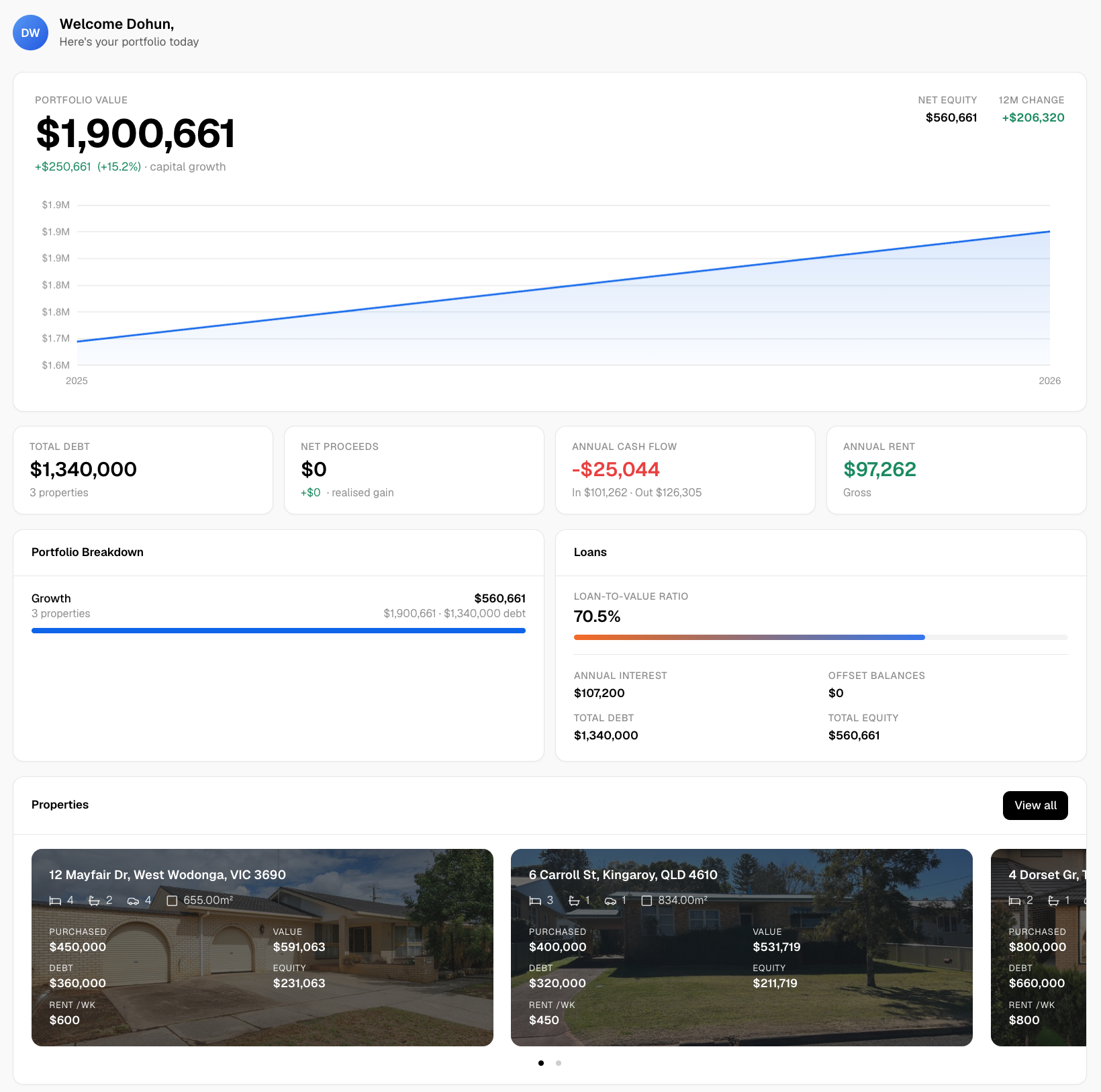
Try the WealthStacker toolkit or join the waitlist to start modelling your own loan scenarios.
FAQ
What is the difference between interest only and principal and interest?
On an interest-only loan your repayments cover just the interest for a set period, so the balance stays the same. On a principal and interest loan, each repayment covers interest and also reduces the balance. IO repayments are lower at first but rise when the period ends, and IO generally costs more in total.
Is interest only cheaper than principal and interest?
It’s cheaper month to month during the IO period, but usually dearer overall. In one major bank’s example, five years of IO on a $500,000 loan cost $33,854 more in interest across 30 years, and IO rates are often higher than P&I rates. The saving is a deferral, not a discount.
How long can I stay on interest only?
Lenders typically cap a single IO period at five years. Some lenders allow owner-occupiers five years in total and investors up to 15 years in total, and IO usually isn’t available in the last five years of the loan term. Check your lender’s current policy.
Do investors have to pay principal?
Eventually, yes. Investors may choose IO for a period, but the loan has to be repaid. The ATO says interest on a rental property loan can be deductible, but extra payments that reduce principal aren’t. A tax professional can tell you how that applies to your situation.
Can I switch from interest only to principal and interest?
Generally yes. One major lender says borrowers can switch between P&I and IO during the loan, within its period rules. Ask your lender about fees, rate changes and how the switch affects your repayments.
Sources
- Interest-only home loans, MoneySmart
- Principal and interest vs. interest only home loans, NAB
- Interest only repayments, ANZ
- The Limits of Interest-only Lending, Reserve Bank of Australia
- Interest Only home loans, CommBank
- Understanding interest only repayments and terms, Macquarie
- Interest expenses, Australian Taxation Office
- Target Market Determination, Neat Home Loan