
How to Improve Your Credit Score Before a Mortgage
You improve a credit score for a mortgage by getting your free credit report, correcting anything wrong on it, paying every bill on time, trimming debt and limiting new credit applications. Then you give those habits time to show up on your file. Your score is only one input, though. Lenders also test whether your income can carry the loan, so the strongest plan pairs a clean credit file with a clear view of your borrowing power. That is where we come in: WealthStacker’s free toolkit includes borrowing power estimates and 15-year scenario modelling, so you can see what your improved file is working towards.
WealthstackerSee What Your Borrowing Power SupportsWealthStacker combines borrowing power estimates with property scenario modelling to help you explore what your mortgage plan could support.VisitTL;DR
- Your score comes from your credit report: how much you have borrowed, how many credit applications you have made and whether you pay on time (Moneysmart).
- You can get a free copy of your report every 3 months, and errors can be fixed for free. Start there.
- Every application is noted on your file, so space them out and avoid unnecessary new credit in the months before you apply.
- Salary sacrifice does not touch your credit score. It can change how a lender counts your income, and policies differ between lenders.
- Once your file is in shape, test the loan itself: borrowing power, buffers and repayments decide how much you can actually borrow.
Table of Contents
- What lenders see when they check your credit
- Step 1: Get your free credit report and read it line by line
- Step 2: Fix errors and challenge wrong listings
- Step 3: Make every repayment on time
- Step 4: Reduce what you owe
- Step 5: Space out your credit applications
- How long does it take?
- Does salary sacrifice affect your borrowing capacity?
- A worked example: a twelve-month plan
- Where your credit score stops and your borrowing power starts
- Put the numbers behind your plan
- FAQ
- Sources
What lenders see when they check your credit
When you apply for a home loan, the lender checks your credit file through a credit reporting agency. The file holds your borrowing history, and the agency turns it into a score. Moneysmart explains that scores run from zero to either 1,000 or 1,200, depending on the agency, and that a higher score signals a lower risk to lenders. That can mean a better deal, while a lower score can limit your ability to get a loan at all (Moneysmart).
Three things drive the score, according to Moneysmart: how much you have borrowed, how many credit applications you have made and whether you pay on time. That short list is useful, because it tells you where your effort pays off. You cannot shortcut a score, but you can control all three of those inputs.
A score is not a pass mark. Lenders set their own policies, and a high score does not guarantee approval. A modest score does not always rule you out either. What a lender looks for is a pattern: reliable repayments, a manageable amount of debt, and no recent red flags such as defaults or a burst of applications.
Why mortgages get rejected on credit grounds
Moneysmart lists the common reasons a lender turns down an application on credit file grounds (Moneysmart, loan rejection):
- late or missed repayments
- unpaid debts
- many recent credit applications
- a default or a serious credit infringement
Each of these is something you can work on, which is the good news. The rest of this guide takes them in a sensible order.
Step 1: Get your free credit report and read it line by line
The first move costs nothing. Moneysmart says you have the right to a free copy of your credit report every 3 months, and recommends checking it at least once a year. The Privacy (Credit Reporting) Code 2025, in force from 25 March 2025, backs this up: access is free if you have not requested a report in the previous 3 months, and free at any time if you can show that a credit provider refused your application in the previous 90 days. Credit reporting bodies must respond to access requests within 10 working days (OAIC, Privacy (Credit Reporting) Code 2025).
There is more than one credit reporting agency in Australia, and each holds its own version of your file. Ask each of them for your report, then check:
- Personal details. Name, date of birth, current and past addresses and employers. A wrong address can cause mismatches.
- Accounts you recognise. Credit cards, personal loans, car finance, buy now pay later and phone or utility accounts that were reported.
- Accounts you do not recognise. These may point to an error, or to identity theft.
- Repayment history. Any late payments marked, and whether they are accurate.
- Defaults and enquiries. Whether each default belongs to you and whether the enquiries match applications you actually made.
Do this early. If you plan to buy in twelve months, you want time to fix problems, not a surprise during the application.
Step 2: Fix errors and challenge wrong listings
If something on the report is wrong, Moneysmart advises asking the credit reporter to correct it, and that this is free (Moneysmart). Gather any evidence you have, such as a payment record, a closing statement or a letter from the lender, and make the request in writing so you have a record.
Defaults deserve particular attention. Under the Privacy (Credit Reporting) Code 2025, a credit provider can only disclose default information to a credit reporting body at least 14 days after giving you the required notice and no later than 3 months after that date. The overdue amount must also have been overdue for at least 60 days (OAIC). If a default on your file does not meet those steps, you have grounds to dispute it.

If the default is genuine, it will not vanish on request. Moneysmart notes that default listings expire 5 years from when they go on your report. Paying off an old debt is still sensible, because it stops the problem growing and shows the lender you have dealt with it, but plan your purchase timeline around the facts on your file.
Step 3: Make every repayment on time
Payment history is one of the three inputs Moneysmart names, and it is the one you control every month. Small habits do the work:
- Set up automatic payments for at least the minimum on every card, loan and buy now pay later plan.
- Line up due dates with your pay cycle, so the money is there when the payment lands.
- Keep an eye on small bills. A forgotten phone or utility account that goes to collection can create a problem out of proportion to its size.
If you are struggling to keep up with a payment, contact the provider before the due date, not after. A missed repayment on your file is far harder to undo than a conversation about a payment arrangement.
Step 4: Reduce what you owe
How much you have borrowed is the second input. Moneysmart’s advice for people building a stronger application is to review and reduce debts, keep up repayments, make extra repayments where you can and set a budget (Moneysmart).
A practical order for most people:
- List every debt with its balance, interest rate and minimum repayment.
- Make the minimum on all of them, then direct any spare cash to the highest-interest debt first. That saves the most money while you work down the balances.
- Do not open a new account just to move debt around, unless the saving is clear. Each new application is recorded.
- Decide with your lender whether to keep or close cards you no longer use. Policies differ, so ask the lender you plan to apply with.
Lowering debt helps twice. It supports your credit file, and it lifts the amount you can borrow, because lenders assess your commitments when they test whether you can afford the loan. If you want to see how a lower balance changes that picture, our guide to debt-to-income ratio in Australia explains how lenders weigh your total debt against your income.
Step 5: Space out your credit applications
Moneysmart notes that every credit application is recorded on your report, and that too many in a short time can lower your score. That includes credit cards, personal loans, car finance and, increasingly, buy now pay later. If you are a few months from applying for a mortgage, this is the habit that matters most:
- Hold off on new cards, limit increases and finance on a car or furniture.
- Do your rate and loan comparison using tools that do not require a full application, and apply formally only when you are ready.
- If an application is refused, wait before trying another lender. Use the free report you are entitled to after a refusal to see what the lender saw.
A single enquiry from your home loan application is routine. The risk is a cluster of them.
How long does it take?
There is no standard timetable, and nobody can promise a score by a given date. Fixing a wrong listing can show up within weeks once the credit reporter processes your request. Building a track record of on-time payments takes months, and a genuine default stays on your file for 5 years. For most people the sensible approach is to start with the free report at least six to twelve months before you plan to apply, then re-check your report every 3 months to see your progress.
Does salary sacrifice affect your borrowing capacity?
Salary sacrifice is a common question for people preparing a mortgage, and it is worth separating from credit scores. It does not appear on your credit report, so it does not change your score. It can change how a lender calculates your income, which is a different test.
Here is the mechanism. When you sacrifice part of your salary, for example into super, your take-home pay falls. Lenders must assess and verify income and expenses when they work out whether you can afford a loan. APRA’s practice guide APG 223 sets that expectation for authorised deposit-taking institutions, and mentions verification through payslips, employer confirmation, tax assessments and bank statements (APRA, APG 223). Different lenders have different policies on whether they count salary you have voluntarily sacrificed. The lender will usually want the arrangement confirmed as voluntary.
Two practical points follow:
- Before you apply, ask the lender how it treats sacrificed salary, and have your payslips and employer confirmation ready.
- If you plan to use super towards a first home, the ATO says salary-sacrificed super contributions can be eligible concessional contributions for the First Home Super Saver scheme, with a limit of $15,000 per financial year and $50,000 overall (ATO). The ATO also states that these contributions count as reportable employer super contributions in your repayment income for study and training support loans such as HELP.
That last point links to another borrowing factor: study debt. If you have a HELP debt, see how the HELP threshold affects borrowing power.
For tax questions on your own situation, such as how much to sacrifice, speak to the ATO or a registered tax adviser.
A worked example: a twelve-month plan
The following is an illustration, not a real customer. Say you are renting, you want to buy in a year and you have two credit cards, a phone plan and a buy now pay later account.
| When | What you do | Why it matters |
|---|---|---|
| Month 1 | Request your free report from each credit reporting agency and read every line | Finds errors and unknown accounts early |
| Month 1 to 2 | Ask for corrections to anything wrong, in writing | Moneysmart says correction is free |
| Month 2 | Set automatic payments on every account | Protects your payment history |
| Months 2 to 9 | Pay the highest-interest card down, avoid new credit | Lowers what you owe and avoids new enquiries |
| Month 6 | Re-check your report (free every 3 months) | Confirms fixes and progress |
| Months 9 to 12 | Check borrowing power, decide on lenders, then apply | One planned application rather than several |
Notice that nothing here is clever. A good file is mostly boring consistency, applied for long enough to show up.
Where your credit score stops and your borrowing power starts
A clean credit file gets you through the door. How much you can borrow is a separate calculation based on your income, your debts and your living expenses, tested against a buffer above the actual rate. If you want to understand how that works, our explainer on the APRA 3% buffer and the 6× debt-to-income limit walks through the tests. Our guide to interest rate stress testing shows how to check your own repayments against higher rates, and how to avoid LMI covers deposit routes that reduce upfront costs.
Put the numbers behind your plan
Once your credit file is in good shape, the next question is what you can afford and what each path builds over time. WealthStacker is a free-to-start toolkit for exactly that: borrowing power estimates, free automated quarterly property valuations, and 15-year modelling that compares rentvesting with buying, with goal and net worth planners to show where each path leaves you. There is also an AI chat assistant and suburb research tools for Australian markets. If you are weighing up when to buy and how much to borrow, you can start with WealthStacker.
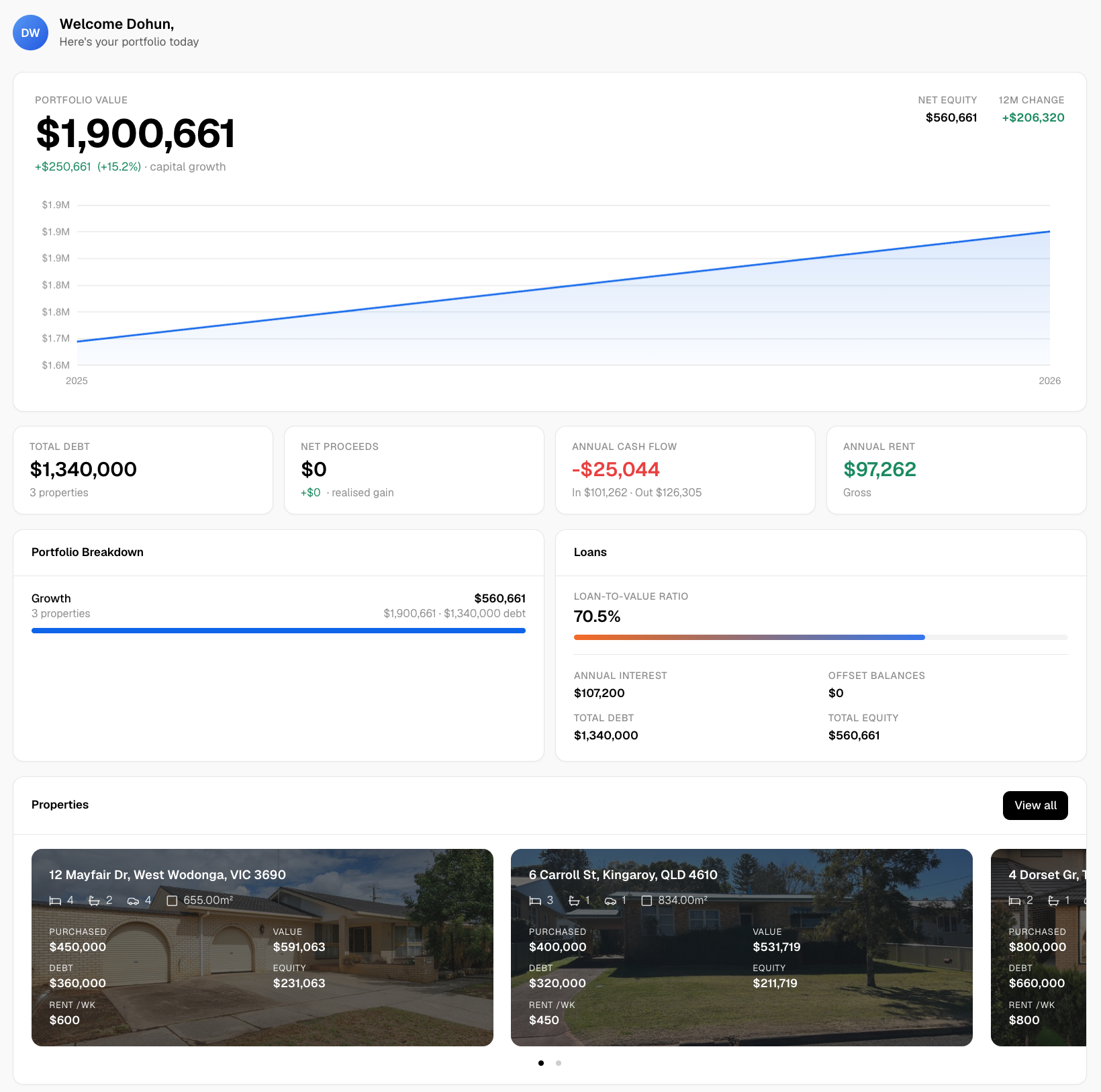
If you already own property, the same dashboard tracks your portfolio alongside shares and crypto, so your borrowing position is visible before you approach a lender.
FAQ
What credit score do I need for a home loan in Australia?
There is no single cut-off. Lenders set their own policies, and Moneysmart says a higher score means you look less risky, which can mean a better deal. Your score is one factor alongside income, debts, deposit and living expenses.
Can I get a mortgage with a bad credit score?
It can be harder. Moneysmart lists late payments, unpaid debts, many recent applications and defaults as reasons for rejection. Check your free report, correct any errors, and give your repayment record time to improve before you apply.
Does applying for a mortgage lower my credit score?
Every credit application is noted on your report, and Moneysmart says too many in a short time can lower your score. A single application for your home loan is a normal part of the process. The risk comes from several applications in quick succession.
Is a 900 credit score possible in Australia?
Yes, if your agency scores out of 1,200. Moneysmart says the range is zero to either 1,000 or 1,200, depending on the agency. Because each agency uses its own scale, compare your score only against that agency’s bands.
Does salary sacrifice affect borrowing capacity?
It does not affect your credit score, but it can affect how a lender counts your income. Policies differ, so ask your lender how it treats voluntarily sacrificed salary and have your payslips and employer confirmation ready.
Sources
- Credit scores and credit reports, Moneysmart
- Loan rejection, Moneysmart
- Privacy (Credit Reporting) Code 2025, OAIC
- APG 223 Residential Mortgage Lending, APRA
- About your contributions, First Home Super Saver scheme, ATO