
Grow wealth while renting property: your 2026 guide
What is rentvesting and why does it work?
Rentvesting is the strategy of renting where you want to live while buying an investment property somewhere you can actually afford. You stay in inner Melbourne or coastal Sydney, your tenant covers most of your mortgage in Logan or Geelong, and you build equity without sacrificing your lifestyle. According to Westpac research cited by Mozo, a significant share of first-home buyers are considering rentvesting, reflecting how much purchase prices have moved beyond reach in Australia’s major cities.
The core appeal is early market entry. Instead of saving for a decade to buy in your preferred suburb, you buy where the numbers work now, then let capital growth and rental income do the heavy lifting. A typical rentvestor profile in Australia sits in their late 20s to mid-30s, earns a professional income, and is priced out of inner-city owner-occupier purchases that often exceed $1.5 million.
Key advantages rentvesting offers:
- Early market entry without waiting years to save a deposit for your lifestyle suburb
- Lifestyle flexibility to rent near work, family, or amenities regardless of where you invest
- Tax deductions on mortgage interest, council rates, insurance, property management fees, and depreciation
- Rental income that offsets your mortgage costs and reduces out-of-pocket holding expenses
- Leveraged capital growth on an asset you control with a fraction of its full value as a deposit
Rentvesting is not a shortcut. It is a deliberate financial decision that rewards careful property selection and solid cash management. The sections below cover the financial mechanics, the real risks, and a step-by-step path to doing it well.
Financial benefits that help you grow wealth while renting property
The tax treatment of investment properties is where rentvesting genuinely separates itself from simply staying a renter. Every dollar of deductible expense, including mortgage interest, depreciation, repairs, and management fees, reduces your taxable income. For a rentvestor on a 37% marginal rate, a $12,000 annual rental shortfall translates to roughly $4,440 back at tax time, cutting the real weekly holding cost considerably.
Rental income itself is the other lever. A property yielding 5% gross on a $500,000 purchase generates $25,000 a year before expenses. That income services the bulk of the mortgage, which means your out-of-pocket contribution is far smaller than carrying a $500,000 loan on your own home with no offsetting rent.

Leverage is the mechanism that accelerates wealth building most aggressively. You control a full-value asset using a deposit, and every percentage point of capital growth applies to the whole property value, not just your equity. The role of leverage in property wealth is why property has historically outperformed cash savings for long-term wealth accumulation.
Portfolio diversification is also available to rentvestors in a way it is not to owner-occupiers. Once equity builds in the first investment property, you can refinance and use that equity as a deposit on a second, then a third. Scaling a rental property portfolio step by step is how many Australian investors move from one property to a genuinely diversified income-producing portfolio over a decade.
Key figure: A gross rental yield of 4.5–5.5% is workable across most metro and regional Australian markets. Below 4% gross typically means you are paying for capital growth at the expense of current cash flow.
What are the real risks of rentvesting?
Rentvesting carries genuine financial exposure that property podcasts tend to gloss over. Running two housing budgets simultaneously is the central pressure point. You pay rent you cannot lock in long-term, while covering any shortfall on a mortgage elsewhere, and if your investment sits vacant, you carry the full mortgage alone.
Investment loan rates are typically higher than owner-occupier rates, which narrows your margin from day one. Beyond the rate differential, rentvestors need a cash buffer of 3–6 months covering mortgage repayments and unexpected repairs to avoid financial distress when vacancies or maintenance costs hit. Property management fees typically run at 7–10% of rental income, and a major repair or extended vacancy can wipe out months of positive cash flow.
The tax picture is also less uniform than it appears. Financial analyst James Graham warns that negative gearing benefits are uneven across income brackets. At a median individual income of around $55,000, the tax bill is modest, which means the deductible losses from an investment property do not generate the substantial refunds that high earners receive. If you are not in the upper tax brackets, the numbers may not stack up the way the marketing suggests.
Capital gains tax is a cost that owner-occupiers never face on their primary residence. Investment properties sold by rentvestors do not qualify for the main residence CGT exemption, so the full taxable gain, less the 50% discount for assets held over 12 months, is added to your assessable income in the year of sale.
First home grants and stamp duty concessions are also forfeited when you buy an investment property first. Depending on your state and purchase price, that represents a $20,000–$60,000 upfront cost penalty compared with buying as an owner-occupier.
Key risks to plan for:
- Vacancy periods where you cover 100% of the mortgage without rental income
- Rising interest rates on investment loans widening your out-of-pocket gap
- CGT liability on sale with no main residence exemption available
- Forfeited first home buyer grants and stamp duty concessions worth $20,000–$60,000
- Negative gearing changes from 12 May 2026 limiting deductions on established properties
How to start rentvesting: a practical step-by-step guide
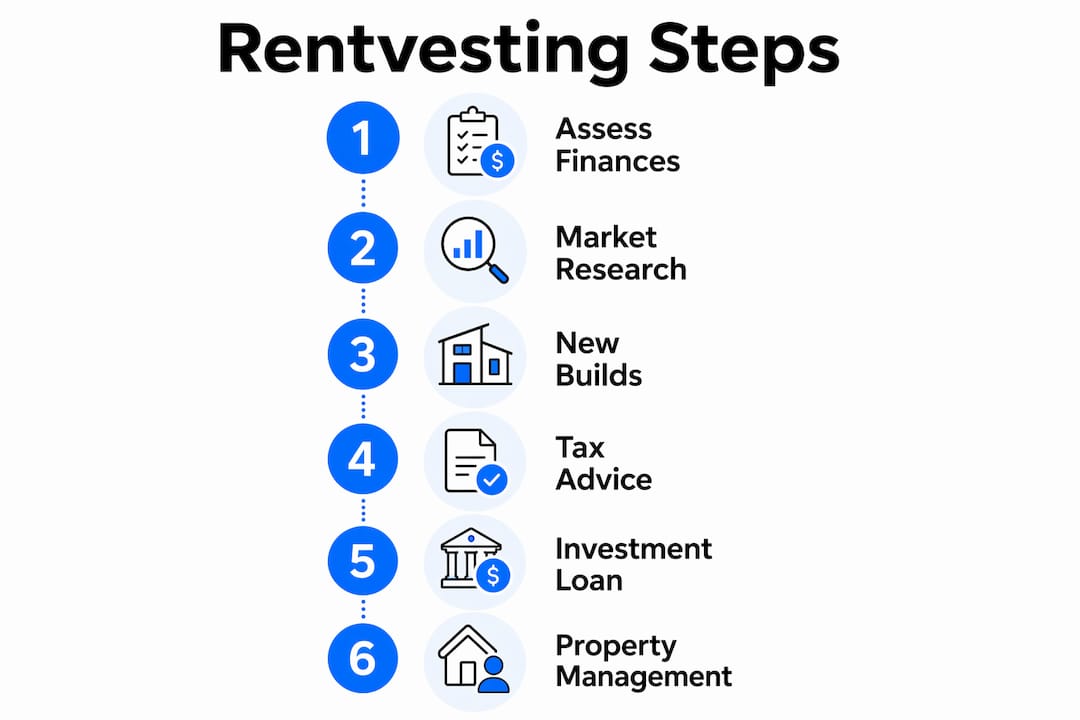
Step 1: Assess your finances honestly
Calculate your borrowing capacity for an investment loan, then model what that loan does to your future borrowing capacity for an owner-occupier purchase. Most lenders shade rental income at 75–80% for serviceability purposes, and your existing investment loan repayments reduce what you can borrow later. Renter financial modelling before you commit is not optional; it is the difference between a strategy that works and one that traps you.
Step 2: Research markets with genuine growth fundamentals
Treat the investment property as a financial asset, not a lifestyle choice. Successful rentvesting depends on selecting high-growth regions with strong rental yields, low vacancy rates, and a visible infrastructure pipeline. Target gross yields of 4.5% or above, vacancy rates under 2%, population growth in the local government area, and a diverse employer base. Single-industry towns carry concentration risk that can unwind years of equity growth quickly.
Step 3: Consider new builds for post-2026 tax treatment
From 12 May 2026, losses on established investment properties purchased after that date can no longer offset salary income under the new negative gearing rules. New residential builds are fully exempt from this change, preserving the full ability to offset losses against salary and retaining the 50% CGT discount. If you are entering the market after Budget night, a new build is the most tax-effective rentvesting path available.
Step 4: Get qualified tax and financial advice
The interaction between negative gearing, CGT, your marginal tax rate, and your state’s first home buyer eligibility is complex enough that a general guide cannot substitute for advice tailored to your income and goals. A good accountant and mortgage broker working together will model both the rentvesting path and the owner-occupier path side by side with your actual numbers.
Step 5: Apply for an investment loan with realistic cost estimates
Investment loans typically require a 20% deposit. Allow an additional 5–8% for stamp duty (no concession on investment purchases), conveyancing, building and pest inspections, and loan establishment fees. On a $500,000 purchase, plan for total upfront costs of around $125,000–$150,000, including deposit, stamp duty, transaction fees, and inspections.
Step 6: Manage the property to minimise vacancies
Vacancy is the single biggest cash flow risk. Price the property at or slightly below market rent to attract quality tenants quickly, use a licensed property manager, and build a maintenance reserve so repairs do not become emergencies. A well-maintained property in a tight rental market rarely sits vacant for long.

Pro Tip: Separate your lifestyle preferences from your investment criteria entirely. The suburb you want to live in and the suburb that will build your wealth fastest are almost never the same place. Treat them as two completely different decisions.
Australian data and expert insights on rentvesting in 2026
The 30% rule remains the standard affordability benchmark for Australian renters, with households spending more than 30% of gross income on rent considered to be in housing stress. In cities like Sydney, renters routinely spend 35–40% of income on rent, which is one reason rentvesting appeals: owning an investment property elsewhere builds equity while you absorb the cost of renting in a high-demand location.
The RBA’s 2026 housing investor data shows that around 70% of housing investors own just one investment property, and the highest income quintile accounts for nearly 40% of all housing investors in Australia. Higher income earners have benefited more from negative gearing and capital gains discounts, which is consistent with James Graham’s caution that the tax benefits are not evenly distributed.
The 2026 Budget changes are the most significant policy shift for rentvestors in years. Losses on established residential properties purchased after 12 May 2026 can only offset rental income or future capital gains, not salary. New builds remain fully exempt. This does not kill rentvesting, but it does change the calculus sharply for buyers targeting established properties after Budget night.
| Factor | What to target | Why it matters |
|---|---|---|
| Gross rental yield | 4.5–5.5% | Keeps cash shortfall manageable |
| Vacancy rate | Under 2% | Reduces income disruption risk |
| Population growth | 1.5%+ annually in the LGA | Supports long-term demand and capital growth |
| Property type | New build post-May 2026 | Preserves full negative gearing and 50% CGT discount |
| Cash buffer | 3–6 months of mortgage costs | Covers vacancies and unexpected repairs |
Key insight: Property experts stress that rentvesting success depends on selecting properties in high-growth areas and treating the investment like a financial asset, not a lifestyle home. Emotional attachment to a suburb is the most common reason rentvestors underperform.
For a broader view of how portfolio building while renting fits into a long-term wealth plan, the comparison between rentvesting and buying your first property is worth running with your actual numbers before committing either way. You can also explore rentvesting vs buying in detail to see which path suits your income, location, and timeline.
Wealthstacker gives you the numbers before you commit
Most rentvesting guides tell you what to think about. Wealthstacker shows you what your specific numbers actually look like.
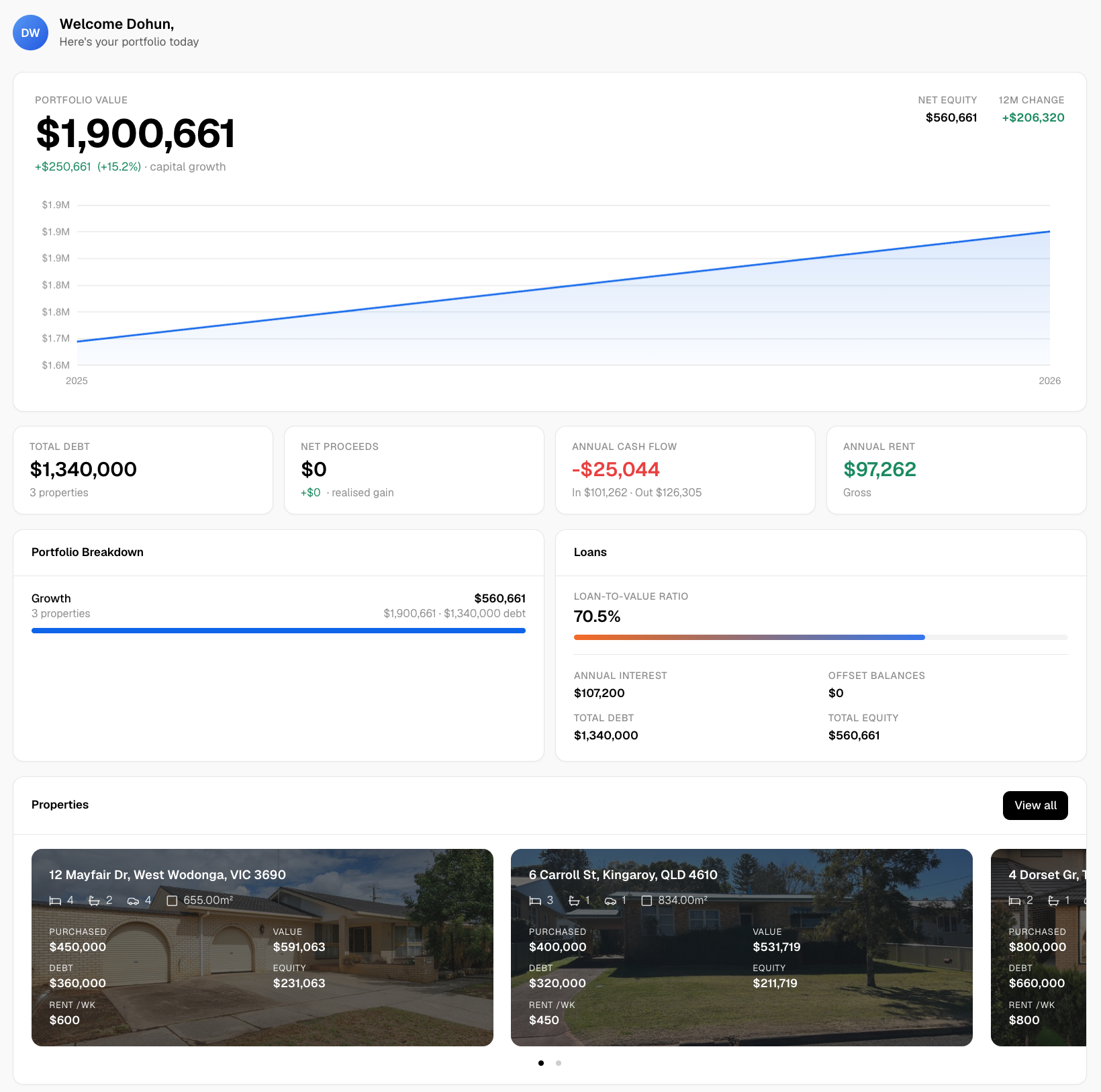
The platform provides automated quarterly property valuations at no cost, so your portfolio’s value stays current without manual research. Its AI-powered modelling runs both the rentvesting path and the owner-occupier path side by side using your income, target suburbs, and borrowing capacity, giving you a real-time net worth forecast rather than a generic rule of thumb. For rentvestors weighing up whether a new build in Brisbane or an established property in Geelong stacks up after the 2026 tax changes, that kind of personalised modelling is exactly what separates a confident decision from a guess.
Start modelling your rentvesting strategy on Wealthstacker today and see what your property wealth could look like in five, ten, and twenty years.
Key takeaways
Rentvesting builds long-term wealth by combining early market entry, rental income, and tax deductions, but only when the investment property is chosen on financial fundamentals, not lifestyle preference.
| Point | Details |
|---|---|
| New builds are now essential | Post-May 2026 rules mean new builds are the only way to preserve full negative gearing against salary income. |
| Cash buffer is non-negotiable | A 3–6 month mortgage buffer separates sustainable rentvesting from financial distress during vacancies or rate rises. |
| CGT applies on every sale | Rentvestors pay capital gains tax on investment property sales; owner-occupiers selling their home do not. |
| Yield target matters | Gross rental yields of 4.5–5.5% keep your cash shortfall manageable across most Australian markets. |
| Wealthstacker models your path | Wealthstacker’s AI tools run personalised rentvesting and buying scenarios using your real income and target suburbs. |