
Granny Flat Investment Returns in Australia: How to Work Them Out
A granny flat’s return is the net rent it earns each year divided by what it cost you to build and hold, and it only means something once you have tested it against rent evidence for your own suburb and the tax rules that apply to your block. Headline yields you see in builder brochures skip most of those steps. WealthStacker’s toolkit lets you model a property, rent and loan scenario over 15 years, so you can see what a secondary dwelling does to your cash flow and net worth before you commit to a build.
Wealthstackerwealthstacker.com.auModel Your Granny Flat InvestmentCompare rent and loan scenarios over 15 years to see how a secondary dwelling could affect your cash flow and net worth.VisitTL;DR
- Return on a granny flat is best measured as net annual rent divided by total project cost, not gross rent divided by the build quote.
- Rent assumptions should come from rental comparables for your suburb and dwelling type, checked year on year.
- Rent from an unrelated tenant is assessable income. Payments from family under a granny flat arrangement are usually treated differently for tax.
- If your home sits on land that qualifies for a principal place of residence land tax exemption, renting out the granny flat can change that in Victoria.
- Model the project against alternatives such as buying another property, using the same cash and borrowing capacity.
Table of Contents
- What “return” means for a granny flat
- Why gross yield on a granny flat looks so high
- A worked example
- Step 1: Get the rent right with rental comparables
- Step 2: Count every cost
- Step 3: Understand when the income counts as rent
- Step 4: Check land tax and your main residence status
- Step 5: Check planning rules before you price anything
- Step 6: Test it against other ways to grow wealth
- Step 7: Stress test the result
- Model it before you build
- Common mistakes to avoid
- FAQ
- Sources
What “return” means for a granny flat
A granny flat, or secondary dwelling, is a small self-contained home built on the same block as a main house. Councils and states use different names and rules, but the money question is the same: what do you put in, and what comes out each year?
There are three numbers worth separating.
Gross yield on cost. Annual rent divided by the total amount you spent. This is the figure most marketing quotes, and it is the most flattering.
Net yield on cost. Annual rent minus the costs of owning and letting the flat (insurance, rates and land tax effects, water, repairs, property management, vacancy), divided by total project cost. This is the number to compare with other investments.
Total return. Net yield plus any change in the value of the property that the flat causes, less the extra loan interest you pay to fund it. This is where cash flow and equity meet, and it is why a scenario model beats a single percentage.

If you want a refresher on how the headline measure is defined for ordinary investment properties, our guide to gross rental yield sets out the formula and its limits.
Why gross yield on a granny flat looks so high
A granny flat is cheap to build relative to a whole house, because you already own the land. That is why advertised yields on the cost of the build can look far higher than the yield on a normal investment property, where the purchase price includes land.
The catch is that the comparison is not like for like. A normal investment property yield is rent divided by a price that includes the land. A granny flat yield on cost ignores the land entirely, because you already hold it. Both numbers are valid, but they answer different questions: the first asks how hard a purchase works, the second asks how hard the extra spend works.
The right way to use the high figure is as an incremental return: for the extra dollars I put in, how many dollars come back? That is a fair test, and a granny flat can pass it well in the right suburb. It just needs honest inputs.
A worked example
The numbers below are illustrative assumptions, not a quote or a market average. Replace each with your own.
| Item | Assumption |
|---|---|
| Total project cost (build, approvals, connections, landscaping) | $150,000 |
| Weekly rent | $450 |
| Weeks let per year | 49 |
| Gross annual rent | $22,050 |
| Property management | $1,800 |
| Insurance, water, repairs and maintenance | $2,400 |
| Extra council rates and land tax (if any) | $600 |
| Net annual rent before interest | $17,250 |
Net yield on cost: $17,250 divided by $150,000 is 11.5%.
Now add the loan. If you borrow the full $150,000 at 6.0% interest-only, interest is $9,000 a year. Net cash flow after interest is $8,250, or about $159 a week, before tax. That is the figure that tells you whether the flat pays for itself, and it moves with your interest rate. Interest rates change after each lender repricing and Reserve Bank decision, so re-run this with the rate on your own loan, not a rate from a brochure.
Two things then matter more than the yield itself. First, whether the flat lifts the value of the whole property by more than it cost. Second, how the income is taxed. Both depend on your situation, which is where modelling helps.
Step 1: Get the rent right with rental comparables
Rent is the biggest input and the easiest to get wrong. A rental comparable, or “rental comp”, is a similar dwelling in the same area that has recently been leased, used as evidence of what yours would earn. The goal is to find a handful of flats, studios or one-bedroom units of a similar size, age and distance from transport and jobs.
What to match
- Dwelling type: a detached granny flat competes with small units and studios, not with three-bedroom houses.
- Bedrooms and floor area.
- Location: the same suburb or the next one over with similar amenities.
- Leasing date: recent, because rents shift quickly.
- Whether utilities are included.
Use official median data where it exists. In Queensland, the Residential Tenancies Authority publishes median weekly rents from new bond lodgements by postcode, suburb, local government area and dwelling type, updated each quarter. A median is the middle value, with half of rents above and half below. The RTA advises comparing year on year rather than quarter on quarter, which strips out seasonal swings. Other states publish their own rental bond or market data through their tenancy or fair trading bodies, so check the equivalent for your state.
Where it goes wrong
- Using asking rents from a few listings. Asking rent is not achieved rent.
- Using a median for all dwellings, which is skewed by houses.
- Assuming the top of a range. Plan on the middle and treat the top as a bonus.
- Ignoring vacancy. Even in tight markets, build in several weeks a year between tenants.
If you are also weighing where rents are heading, our piece on forecasting rental growth explains what the data says and how to use it conservatively. WealthStacker also includes market research tools for Australian suburbs, which helps when you are comparing the rent evidence for more than one location.
Step 2: Count every cost
A realistic net return needs a full list of costs, not just the build quote.
Upfront
- Design, council or private certifier approval fees and any required reports.
- The build itself, including slab, services, fit-out and site works.
- Connection of water, sewer, electricity and internet.
- Landscaping, fencing and parking if required.
- A contingency. Ten per cent is a common planning allowance in construction budgets, and a cushion avoids a nasty surprise when the site turns out harder than expected.
Ongoing
- Building insurance and landlord insurance.
- Council rates and water charges.
- Land tax effects (see below).
- Property management and letting fees.
- Repairs and maintenance.
- Vacancy between tenants.
- Loan interest on the money you borrowed.
A granny flat is also a depreciating structure. Depending on when it was built and how it is used, you may be able to claim deductions for the wear on the building and its fittings. Rules on this are specific, and the ATO’s rental properties guidance says certain second-hand depreciating assets cannot be deducted in some circumstances, unless the property is used in a rental business or the owner is an excluded entity. See our explanation of the depreciation schedule cost for how a schedule is entered and what it adds to the model.
Step 3: Understand when the income counts as rent
This is where many granny flat returns go wrong, because “granny flat” can mean two quite different arrangements.
Genuine rental to a tenant. The ATO’s rental properties guide says rental income is the full amount of rent and associated payments you receive or become entitled to, including goods or services valued in money terms. That guide is the base reference for what to include in your tax return, and the matching deductions, such as interest and repairs, sit alongside it. Declare all of it, and keep records.
A family arrangement. The Board of Taxation’s review of granny flat arrangements found that regular payments under a family arrangement are usually private and domestic, closer to board than rent. They rarely form assessable rental income and do not give rise to allowable deductions, in line with long-standing ATO views. The review also notes that where genuine rental income is derived, the owner gets only a partial main residence capital gains tax exemption.
The practical lesson: a parent or relative paying a modest sum is a lifestyle and family-support decision, not an investment return in the tax sense. Model it separately from a flat let to an unrelated tenant at market rent.
Capital gains tax on family arrangements. Since 1 July 2021, provided certain conditions are met, no CGT event arises when an eligible arrangement creates, varies or ends an eligible granny flat interest. The exemption does not cover other CGT events that are unrelated to creating, varying or ending the interest. Because the conditions are detailed, confirm your facts with a registered tax agent before you sign a family arrangement.

Step 4: Check land tax and your main residence status
If the main house is your home, it may be exempt from land tax as your principal place of residence. Adding a rented granny flat can affect this.
In Victoria, the State Revenue Office says that when a separate residence such as a granny flat on principal place of residence land was rented for income in the previous tax year, the land containing that residence is taxable, while the rest may keep the exemption. The same page says family contributions merely towards utilities, maintenance and repairs do not count as rental income for that treatment.
Other states have their own thresholds and their own wording, so a Victorian result is not a universal one. Look up your state revenue office’s rules and put the resulting land tax into the cost list in Step 2. If you are also working out how lenders see the extra income, this explanation of how lenders count rental income shows the logic of rent being assessed in a loan application, though your own lender’s policy is what applies.
Step 5: Check planning rules before you price anything
A beautiful return on paper is worth nothing if the flat cannot be built or let. Before you model, confirm:
- Whether your state and council allow a secondary dwelling on your lot size and zone, and the maximum floor area.
- Whether the flat can be leased to an unrelated tenant or is limited to family use. Some rules restrict who can live there.
- Whether it can be subdivided or separately titled. Usually it cannot, which affects resale and valuation.
- Bushfire, flood and other hazard overlays. These can change building costs, insurance and approval pathways. WealthStacker’s hazard and risk overlays let you view this at the property level before you spend on design.
Check the current rules with your council and state planning department, because they change and differ by location.
Step 6: Test it against other ways to grow wealth
A granny flat is one use of capital and borrowing capacity. The fair question is whether the same money does more elsewhere.
For example, the $150,000 in our worked example could be a deposit contribution on a separate investment property, or invested in shares. Our comparison of stocks vs property returns shows how long-term results differ, and the negative gearing rules article explains how loan interest and losses flow through your tax position.
If you rent where you live today, the question is wider: does building on a block you own beat renting, investing elsewhere and keeping flexibility? That is the rentvesting question, and the rentvesting risks checklist covers what to check before choosing it. Rent levels also matter for the buy-or-rent decision, which the price to rent ratio helps you size up.
If you are considering short stays instead of a long lease, Airbnb vs renting compares the two income styles, and local rules on short-term letting still apply.
Step 7: Stress test the result
Good decisions on a granny flat come from the downside case, not the average.
- Cut rent by 10%. Does the project still cover its interest?
- Add eight weeks of vacancy. Does your cash flow survive?
- Raise your interest rate by two percentage points. Can you still service the loan from your wages if the flat stands empty?
- Add 15% to the build cost. What does that do to yield on cost?
- Remove any uplift in value. If the flat adds nothing to resale, does the income alone justify it?
If the answer to each is acceptable, the project is robust. If it only works on the best-case assumptions, you have your answer without spending a dollar.
Model it before you build
A spreadsheet can do this, but it gets unwieldy when you add loan terms, tax, rent growth and a comparison with another property. WealthStacker is built for this kind of decision: free automated quarterly property valuations, 15-year investment modelling that compares rentvesting and buying scenarios, interactive goal and net worth planners, borrowing power estimates, and an AI investment chat assistant, with no spreadsheets required. You can create your account or explore the WealthStacker toolkit to see how a secondary dwelling changes your projected net worth.
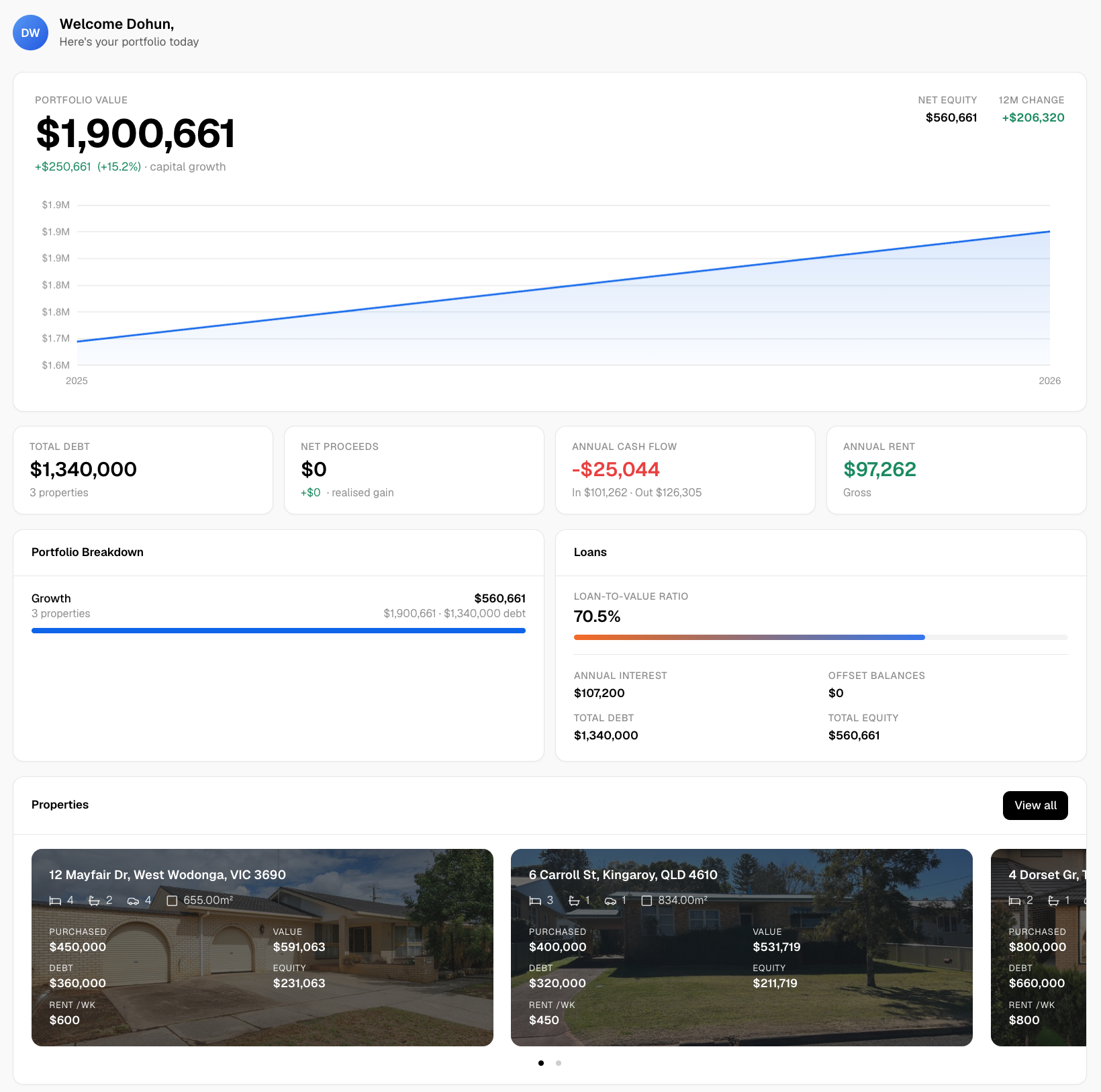
For financial planners, the same scenarios give clients a clear side-by-side of a build against other uses of capital.
Common mistakes to avoid
- Quoting yield on the build price alone. Include approvals, connections, landscaping and contingency.
- Treating family payments as rent. The tax treatment differs, and so does the return.
- Forgetting land tax. A taxable portion of land can shave real money off cash flow.
- Using asking rents. Use achieved rents from comparables and official median data.
- Ignoring your borrowing capacity. Extra debt for a flat reduces what you can borrow for your next purchase. Our guide to the rent to income ratio helps you see how rent figures sit against income.
- Skipping a tax agent. Depreciation, CGT and land tax interact, and a registered tax agent should confirm your treatment before you file.
FAQ
What is a good return on a granny flat in Australia?
There is no single figure, because it depends on build cost, rent and your loan. The sound approach is to calculate net yield on total project cost using rent evidence for your suburb, then compare that return with other uses of the same money. Build the calculation from your own inputs rather than a headline percentage.
How much rental income can a granny flat earn?
It depends on location, size, quality and what comparable studios and one-bedroom dwellings are letting for locally. Use recent achieved rents and, where your state publishes them, official median rents by suburb and dwelling type, such as the quarterly data from the Queensland RTA. Plan on the middle of the range and allow for vacancy.
Do I pay tax on granny flat rent?
Rent from a genuine tenant is assessable income, and you can claim the related deductions. Regular payments from family under a granny flat arrangement are usually treated as private and domestic, so they rarely count as rent for income tax. Confirm your case with a registered tax agent.
Does a granny flat affect land tax?
It can. In Victoria, renting out a separate residence on land that otherwise qualifies for the principal place of residence exemption can make the land containing that residence taxable. Rules differ by state, so check your state revenue office.
Sources
- ATO, Rental properties guide
- Board of Taxation, Review of granny flat arrangements
- Queensland RTA, Median rents quarterly data
- State Revenue Office Victoria, Principal place of residence exemption
- ATO, Australian income or losses from investments or property