
Gifted Deposit Rules in Australia: What Lenders and the ATO Expect
A gifted deposit is money a family member gives you towards a property purchase with no expectation of repayment and no claim over the property. Australian lenders generally accept one from an immediate family member, provided it is documented as a true gift, and the tax position is usually simple. The traps are in the detail: the wording of the gift letter, how long the money sits in your account, how much of your deposit must be genuine savings, and what the gift does to the giver’s Centrelink entitlements.
This guide walks through each rule in the order you will meet it, so you can plan the gift before you sign a contract. It also covers gifted equity from parents, which is a different thing and works under different rules.
WealthstackerCompare Your Property Investment OptionsExplore real-time modelling for rentvesting and buying strategies to see how property decisions may shape your potential net worth.VisitTL;DR
- Lenders typically accept gifts from immediate family (parents, grandparents, siblings, children) if the money is non-repayable and the giver has no stake in the property.
- Expect a signed gift letter or declaration stating the amount and that nothing is owed back. Some lenders want it in the form of a statutory declaration.
- Many lenders still want part of your deposit to be genuine savings, especially at higher loan-to-value ratios, and a gift is not always counted as savings.
- A cash gift from a relative is generally not taxable income to you, but a parent who receives Centrelink or aged care assistance has gifting limits of $10,000 a year and $30,000 over five years.
- Gifted equity (a parent transferring part of a property below market value) triggers capital gains tax on the giver as if they had received market value.
Table of Contents
- What lenders mean by a gifted deposit
- The gift letter: what it must say
- Genuine savings and timing
- Tax: does anyone declare a gift?
- What a gift does to the giver’s Centrelink position
- Gifted equity from parents
- Using a gifted deposit for an investment property
- Putting numbers on a gift before you accept it
- A step-by-step plan for a gifted deposit
- FAQ
- Sources
What lenders mean by a gifted deposit
To a lender, the word “gift” has a narrow meaning. It is money that you do not have to pay back, from a person who is not buying a share of the property. If any repayment is expected, the money is treated as debt, and it gets counted against your ability to service the loan.
Firstmac’s residential lending policy accepts gifted funds from an immediate family member, defined as the borrower’s parents, grandparents, siblings or children. It asks for a written statement confirming whether the funds are repayable. If they are, the full repayment terms must be provided and go into the serviceability calculation. QBE’s lenders mortgage insurance guide (December 2024) takes the same line: non-repayable gifts from an immediate family member are acceptable, with no expectation of repayment and no stake in the property.
Two practical consequences follow.
- Friends, uncles, aunts and cousins usually do not qualify. If the money comes from outside the immediate family, ask the lender before you rely on it.
- A “loan from Mum and Dad” is a loan. Even an informal, interest-free, repay-when-you-can arrangement is a liability to the lender, and a gift letter that says otherwise would be untrue.
The gift letter: what it must say
The standard document is a signed declaration from the giver. Macquarie’s broker credit guidelines require written confirmation from the donor stating the amount and that the funds are not repayable. Bankwest’s gifted funds declaration form goes a little further. It asks the giver to confirm the money is a non-repayable gift to assist with the purchase, requires every joint account holder to sign, and says the funds must be available to the recipient before settlement. The lender may also ask for evidence of the funds.
A sound gift letter covers:
- The full names of the giver and the recipient, and their relationship.
- The exact dollar amount.
- A statement that the money is a gift, is not repayable, and gives the giver no interest in the property.
- The purpose (towards the deposit or purchase costs of a named property, if known).
- Signatures, dated, from everyone whose account the money comes from. If it is a joint account, both holders sign.
Some lenders prefer or require a statutory declaration, which is a written statement you swear or affirm before an authorised witness. Each lender has its own form, so get the lender’s version rather than a generic template. A letter that does not match its wording can delay your approval right when the settlement clock is running.
A gift letter is not proof of source
The letter confirms the nature of the money. It does not show where it came from. Lenders also want to see the funds themselves: bank statements showing the giver’s balance and the transfer into your account. Under anti-money-laundering rules, large transfers from unexplained sources attract questions, so a parent who sold a car, drew down savings or released home equity should be ready to show that trail. Keep it clean: one transfer, from the giver’s own account, into your own account, with a clear description.
Genuine savings and timing
This is the rule that catches most first-time buyers. Even when gifts are accepted, many lenders and mortgage insurers want a portion of the deposit to be your own genuine savings.
QBE’s guide defines genuine savings as a demonstrable savings pattern over three months, or funds held in the borrower’s name for three months. It requires at least 5% of the purchase price from genuine savings where the loan-to-value ratio (LVR, the loan as a percentage of the property value) is above 90%. Macquarie’s guidelines say that where the LVR exceeds 85%, 5% of the purchase price must be evidenced as genuine savings, and that gifts may be acceptable if held for three months or more.
These are two lenders’ policies, not a national rule, and they change. The pattern is the useful part:
- The higher your LVR, the more your own savings matter. A small deposit leans hardest on genuine savings.
- Time in your account can convert a gift into acceptable funds. Under some policies, a gift that has been sitting in your name for three months counts. Under others it never counts as savings.
- Gifts that arrive the week before settlement are the hardest to place. Ask your lender or broker which rule applies before the money moves.
If you are trying to keep the deposit small and avoid lenders mortgage insurance, the interplay between gifts, savings and LVR is central. Our guide to avoiding LMI in Australia sets out the main routes, and the explainer on LMI changes from 1 October 2026 covers the timing question of paying now or waiting.
Tax: does anyone declare a gift?
For the person receiving it, a cash gift from a parent is generally not income. The ATO’s guidance on amounts you do not include as income (last updated 8 June 2026) says you generally do not declare gifts from relatives given out of love, such as cash birthday presents. Gifts can be taxable if they are received as part of a business-like or income-earning activity. Australia has no gift tax or inheritance tax, so the giver does not pay tax for handing over cash either.
Two cautions follow from that wording. First, the gift has to be a real gift. If the money is in truth payment for something, or a loan dressed up as a gift, the tax treatment (and the lender’s) changes. Second, the gift itself is not the end of the tax story. If the parent funds it by selling shares or an investment property, that sale can create a capital gain for the parent. For anything beyond a straightforward cash gift from savings, the giver should speak to a registered tax agent or accountant.
What a gift does to the giver’s Centrelink position
This is the part families miss. If a parent receives the Age Pension or another Centrelink payment, a large gift is treated as though they still own the money.
Services Australia sets the gifting free area at a maximum of $10,000 in any one financial year and $30,000 over a rolling five financial years, with no more than $10,000 in any single year. Amounts above the free area are counted as the giver’s asset for five years from the date of the gift and are deemed to earn income, which can affect both the assets test and the income test. The same page says you must tell Centrelink when you make a gift if you receive or claim a payment, or you may be overpaid and have to repay it.
The same thresholds apply in an aged care means assessment. Services Australia’s cost-of-care document (April 2026) confirms that gifts above those limits are treated as an asset deemed to earn income.
Worked example. Parents who receive a part Age Pension give their daughter $60,000 for her deposit. Only $10,000 sits within the free area for that financial year. The remaining $50,000 is counted as their asset for five years and deemed to earn income, which may reduce their pension. If they gave $10,000 a year across several years, they would stay inside the limits: up to $30,000 over a rolling five years. The family should check this with Services Australia before the gift, not after.

Gifted equity from parents
Gifted equity is a different mechanism from a cash gift, and it is worth separating the two because the search terms get mixed up.
A cash gift moves money into your account. Gifted equity usually means a parent transfers a property, or part of one, to you for less than its market value. The difference between the market value and what you pay stands in for part of your deposit or purchase price.
The key tax consequence sits with the giver. The ATO states that if you sell, transfer or gift property below market value and you are not dealing at arm’s length (which includes family), you are treated as receiving market value for capital gains tax. A parent who transfers an investment property to a child for $1 may still be taxed on the full gain. The ATO notes limited exceptions, such as a former spouse after a relationship breakdown, and a transfer to a special disability trust for no payment, where the gain or loss can be disregarded. A main residence may qualify for a full or partial exemption, which is why the parent’s circumstances matter.
There are other points to take to a conveyancer or solicitor before any transfer:
- Stamp duty. Transfer duty is set by each state and territory. A below-market transfer between family does not automatically attract a lower duty, and concessions differ by jurisdiction.
- Valuation. A lender will want an independent valuation to support the purchase price, and a related-party deal is likely to be looked at closely.
- The parent’s own loan. If the property has a mortgage, the lender holding it must agree to any transfer.
- The legal form of ownership. If a parent keeps a share, that is no longer a gift with no claim over the property, so it must be handled as co-ownership with its own paperwork.
Because the tax falls on the giver and the legal steps are specific to each state, gifted equity is a point to take to a solicitor and a tax adviser first.
Using a gifted deposit for an investment property
Many buyers who read about gifted deposits are not buying a home to live in. They are renters who plan to rentvest: keep renting where they want to live, and buy an investment property elsewhere. A gifted deposit can be part of that plan, but lenders assess investment loans on their own policy, and the gift conditions above (family source, non-repayable, documented, held for a period) are the usual starting point. Whether a particular lender accepts gifts for an investment purchase, and how much of the deposit must be your own savings, is lender-specific. Confirm it before you commit.
Two things move the numbers more than the gift itself:
- Your borrowing capacity. A gift lifts your deposit, not your income. The loan you can service still depends on your income, debts and the lender’s assessment rate. Our piece on the APRA 3% buffer and the 6x debt-to-income test shows how those limits bite, and the guide to the debt-to-income ratio explains the measure.
- Your LVR. A bigger deposit means a lower LVR, which can reduce or remove lenders mortgage insurance and may open up better pricing. The rentvesting deposit strategy walks through how deposit size interacts with the buffer.
If you are a first-time buyer, also check the schemes your gift might sit alongside. Our overview of first home buyer grants covers what is on offer, and eligibility rules for each scheme apply to you regardless of who supplied the deposit.
Putting numbers on a gift before you accept it
The decision is rarely “gift or no gift”. It is how large a gift, when, and what it lets you buy. This is where modelling pays off. WealthStacker provides borrowing power estimations and 15-year investment modelling that compares rentvesting and buying scenarios, so you can see how a gift of, say, $30,000 versus $60,000 changes the path rather than guessing.
The toolkit also includes free automated quarterly property valuations, interactive goal and net worth planners and market research tools for Australian suburbs. That helps a family test a target suburb and price before the gift letter is signed. You can start on the WealthStacker home page.
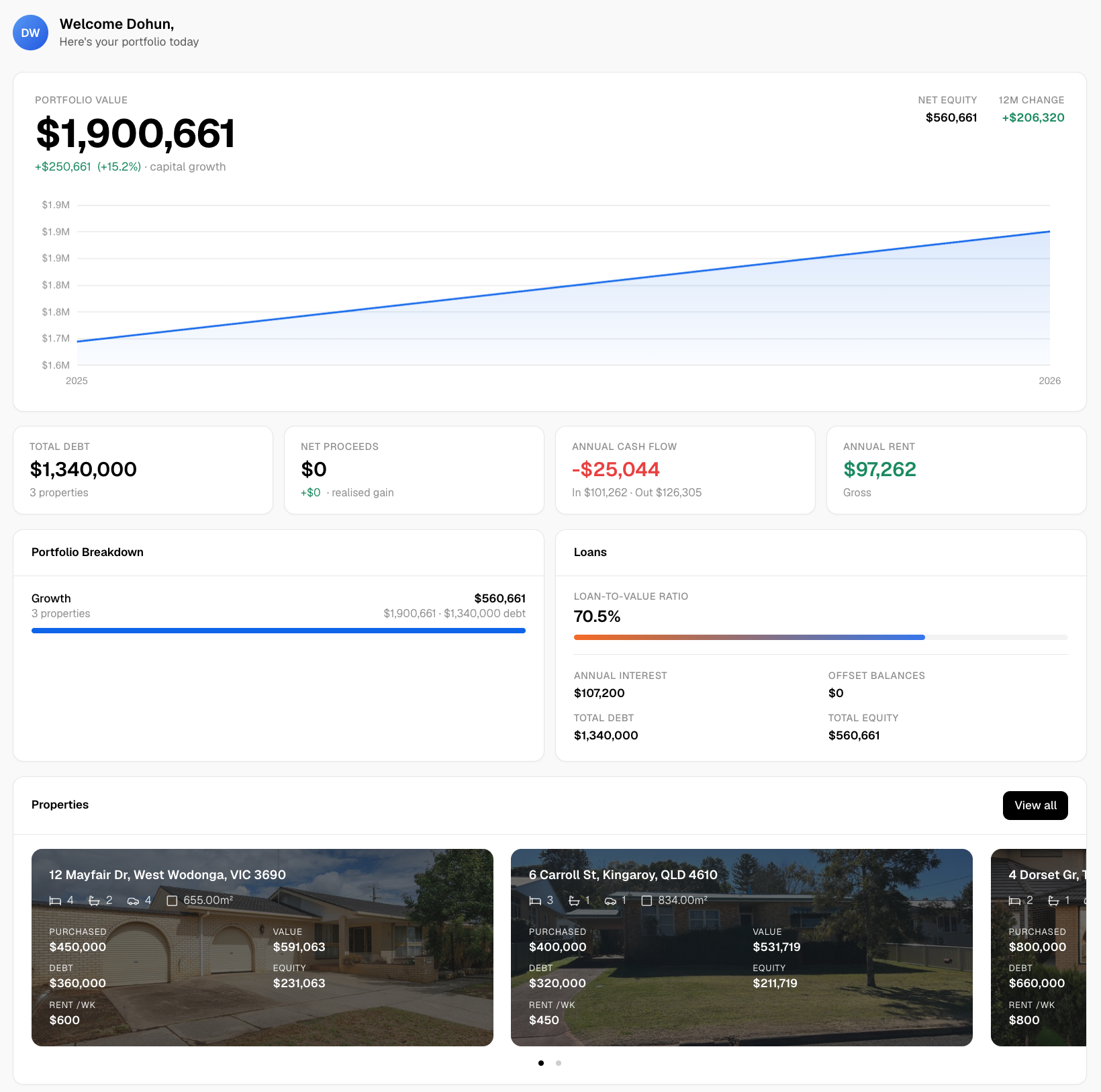
Financial planners can use the same scenario work with clients: put the gift, the target price and the loan side by side, then take the figures to the lender and accountant.
A step-by-step plan for a gifted deposit
- Decide the nature of the money. Is it a gift, a loan or a share of ownership? Only a gift with no repayment and no claim on the property fits the gifted deposit rules. If it is anything else, tell the lender.
- Check the giver’s position first. If the giver receives Centrelink or aged care support, stay within $10,000 in a year and $30,000 over five years, or understand the effect of exceeding it. They must tell Centrelink about the gift.
- Ask the lender or broker for its gift policy. Get the genuine savings requirement at your LVR, the holding period for gifted funds, and the declaration form.
- Move the money early. One clear transfer from the giver’s own account into yours, well before settlement, so it can show as held in your name.
- Complete the declaration. Everyone on the giving account signs, with the amount and non-repayable wording the lender uses.
- Keep the paper trail. Statements for the giver’s balance, the transfer and your receiving account.
- Get tax advice if the gift is not simple cash. Shares, property or equity involve capital gains tax for the giver.
- Model the result. Test the purchase against your borrowing power and your long-term plan before you exchange contracts.
FAQ
Can my parents give me money for a deposit without paying tax?
Australia has no gift tax, and the ATO says gifts from relatives given out of love are generally not income to the person receiving them. Tax can arise for the giver if the gift is funded by selling an asset such as shares or property, because the sale may create a capital gain.
Do I have to declare a gifted deposit?
You do not declare a genuine family gift as income on your tax return. You do declare it to your lender, which will ask for a signed gift letter or statutory declaration and evidence of the funds. A parent receiving Centrelink must tell Centrelink about the gift.
Can a gifted deposit be all of my deposit?
Sometimes, but many lenders and mortgage insurers want a share of the deposit to be genuine savings, particularly at higher LVRs. Macquarie and QBE both set a 5% genuine savings requirement at higher LVR levels, so confirm your lender’s rule before relying on a gift alone.
How is gifted equity different from a cash gift?
A cash gift is money paid to you. Gifted equity is a property transferred, or sold to you, below market value. For capital gains tax the ATO treats the giver as receiving market value when they are not dealing at arm’s length, so the giver may owe tax on the full gain.
Can a gift from parents be used for an investment property?
The family-source, non-repayable and documented conditions still apply, but the policy differs by lender. Ask the lender how it treats gifts for investment loans, then test the purchase against your borrowing capacity.
Sources
- Firstmac Residential Lending Policy
- QBE LMI Guide, December 2024
- Macquarie broker credit guidelines
- Bankwest Gifted Funds Declaration Form
- ATO: Amounts you do not include as income
- ATO: Transferring property to family or friends
- Services Australia: Centrelink’s assessment of gifting
- Services Australia: Residential aged care calculation of your cost of care