
Equity leverage strategies for property investors: 2026 guide
TL;DR:
- Australian property investors use equity leverage to grow their portfolios without saving full deposits.
- The most common methods include home loan top-ups, split equity loans, and cash-out refinances, each with specific advantages and risks.
Equity leverage, defined as using the existing value in your property to fund further investment purchases, is the primary method Australian property investors use to grow portfolios without saving a full deposit from scratch. The three main loan mechanisms are a home loan top-up, a split equity loan, and a cash-out refinance. Each carries distinct tax, flexibility, and serviceability implications. With the RBA cash rate sitting at 3.85% in mid-2026, stress-testing repayments before committing to any of these equity leverage strategies investors rely on is not optional. It is the baseline for responsible portfolio growth.

1. What are the top equity leverage strategies investors use?
Investors access equity through three core structures, and choosing the right one shapes your tax position, flexibility, and long-term borrowing power.
Home loan top-up
A top-up increases your existing mortgage to release equity as cash. The process is straightforward and suits investors who want a single loan account. The downside is that investment and owner-occupier debt sit in the same loan, which complicates tax deductibility claims at the end of the financial year.
Split equity loan
A split loan structure keeps investment debt separate from your owner-occupier debt. That separation makes bookkeeping cleaner and tax deductibility clearer. Most accountants and mortgage brokers recommend this structure for investors who plan to hold multiple properties.
Cash-out refinance
A cash-out refinance replaces your existing loan with a new, larger one and releases the difference as usable funds. This suits investors whose current lender offers poor rates or restrictive terms. The trade-off is refinancing costs and a reset loan term, so the numbers need to stack up before you proceed.
Lines of credit and revolving facilities
A line of credit secured against your property lets you draw funds as needed, up to an approved limit. This suits experienced investors who need flexible access to capital for deposits, renovations, or bridging costs. Interest accrues only on the drawn balance, which keeps costs down when the facility sits partially unused.
- Home loan top-up: simple, single account, but mixes debt types
- Split loan: cleaner tax records, preferred by accountants
- Cash-out refinance: best when switching lenders for better terms
- Line of credit: flexible, interest-only on drawn funds, suits active investors
Pro Tip: Ask your mortgage broker to model all three structures side by side before you apply. The difference in after-tax cash flow between a top-up and a split loan can be significant over a five-year hold.
2. How to calculate usable equity and budget for costs
Usable equity is not the full value of your property. Lenders cap access at 80% LVR to avoid triggering lenders mortgage insurance. Exceeding that threshold adds significant cost to the transaction.
The formula is simple. Take 80% of your property’s current value, then subtract your remaining loan balance. The result is your usable equity. A property worth $800,000 with a $400,000 loan balance gives you $240,000 in usable equity ($640,000 minus $400,000).
That usable equity funds the deposit on your next purchase. A standard investment property purchase requires a 20% deposit plus acquisition costs of 3%–5% on top of the purchase price. Those acquisition costs cover stamp duty, conveyancing fees, and building inspections.
| Property value | 80% LVR cap | Existing loan | Usable equity |
|---|---|---|---|
| $600,000 | $480,000 | $300,000 | $180,000 |
| $800,000 | $640,000 | $400,000 | $240,000 |
| $1,000,000 | $800,000 | $500,000 | $300,000 |
Usable equity and borrowing capacity are different figures. A lender may approve $240,000 in equity release but still restrict your total borrowing based on income, existing debts, and living expenses. Always confirm both numbers with your broker before signing a contract.
Pro Tip: Keep a cash buffer of at least three months of loan repayments in a separate offset account. A cash buffer protects you from forced asset sales during rental vacancies or unexpected rate rises.
3. How to manage risks and serviceability when using equity
Serviceability is the single biggest constraint investors face when using equity to grow a portfolio. Lenders assess your ability to repay at a rate well above the current market rate. In 2026, that means assessment at roughly 6.85% with a 3% buffer built in. Rental income counts at 80% of the market rate, not the full amount.
Understanding what lenders count against you is the first step to improving your position.
- Reduce credit card limits. Lenders count your total credit card limit as a liability, not just the balance. Cutting a $20,000 limit to $5,000 before applying can meaningfully improve your assessed borrowing capacity.
- Time salary sacrifice carefully. Salary sacrifice reduces your gross income on paper. If you are applying for a loan, pause or reduce salary sacrifice arrangements in the months before your application.
- Stress-test your own cash flows. Model repayments at 5.0%–5.5% interest rates before you apply. If the numbers break at that rate, the portfolio is not ready for another purchase.
- Separate your loans by property. Keeping each property on its own loan gives you the flexibility to sell one asset without disturbing the others. This is the core argument against cross-collateralisation.
- Review living expense declarations. Lenders use the Household Expenditure Measure as a benchmark. Understating expenses is a compliance risk. Overstating them reduces your borrowing power unnecessarily. Accurate figures serve you best.
Cross-collateralisation links two or more properties as security for a single loan. If one property underperforms or you need to sell, the lender controls the process across all linked assets. Avoiding cross-collateralisation preserves your ability to make independent decisions about each property in your portfolio.
Equity is not free money. Mismanaging it puts your primary residence at risk and creates financial stress that compounds quickly when rates rise. Treat each equity release as a business decision, not a windfall.
Pro Tip: Talk to a borrowing capacity specialist before you approach a lender. Knowing your ceiling before you apply prevents unnecessary credit enquiries that lower your credit score.
4. What properties and markets work best with equity leverage?
Not every property suits an equity-funded purchase. The goal is to match the property type and location to your cash flow position and growth expectations.
- High rental yield markets reduce the cash-flow gap between rental income and loan repayments. Regional Queensland and South Australian cities have offered stronger yield scenarios for investors compared to Sydney and Melbourne inner suburbs in recent years.
- Stamp duty variations affect how much equity you need to deploy. Stamp duty differences between states mean a $600,000 purchase in Queensland costs materially less to acquire than the same price point in New South Wales. That gap comes directly out of your usable equity.
- Avoid overheated markets. Buying at the peak of a growth cycle with borrowed funds compresses your equity buffer immediately. A 10% correction on a leveraged purchase can wipe usable equity and trigger a margin call from your lender.
- Renovation upside. Buying a property with genuine renovation potential lets you manufacture equity rather than waiting for market growth. A well-executed cosmetic renovation in a strong rental market can add more equity than two years of capital growth in a flat market.
- Diversification across property types. Mixing residential houses, townhouses, and units across different suburbs reduces concentration risk. A diversified portfolio also gives lenders more confidence in your overall security position.
Patience matters more than speed. Speedy acquisition without a solid exit strategy causes forced sales. The investors who build durable portfolios take time to find the right asset in the right market at the right price.
5. How to structure your portfolio for long-term equity growth
Portfolio structure determines how quickly you can access equity for the next purchase. The wrong structure slows you down even when the equity is there.
The most effective approach is to hold each property under a separate loan with its own security. This keeps your options open at every stage. You can refinance one property, sell another, or draw equity from a third without the lender having a say over the whole portfolio.
Understand the difference between property investment strategies before you commit to a structure. A buy-and-hold strategy suits investors who want to compound equity over time. A buy-renovate-refinance strategy suits investors who want to recycle capital faster. Each approach has different loan structure requirements and different serviceability implications.
Tax structure also matters. Holding investment properties in your personal name, a trust, or a company each carries different land tax, capital gains tax, and deductibility outcomes. Get advice from a tax accountant who specialises in property before you purchase, not after.
Use investment property forecasting tools to model how equity grows across different scenarios. A property that grows at 5% per year on a $700,000 purchase adds $35,000 in equity in year one. Over five years, compounding growth creates a materially different equity position than a flat market delivers.
Key takeaways
The most effective equity leverage strategy for Australian property investors combines a split loan structure, an 80% LVR cap, and stress-tested cash flows at 5.0%–5.5% to protect the portfolio through rate cycles.
| Point | Details |
|---|---|
| Use a split loan structure | Keep investment and owner-occupier debt separate to simplify tax deductibility. |
| Cap equity access at 80% LVR | Staying below 80% avoids lenders mortgage insurance and protects your buffer. |
| Budget for 3%–5% acquisition costs | Stamp duty, conveyancing, and inspections add to the deposit requirement. |
| Avoid cross-collateralisation | Separate loans per property preserve your ability to sell or refinance independently. |
| Stress-test at 5.0%–5.5% rates | Model repayments at higher rates before committing to confirm the deal stacks up. |
Wealthstacker helps you track equity and manage your portfolio
Knowing your equity position in real time changes how you make investment decisions. Wealthstacker provides automated quarterly property valuations at no cost, so you always know where your usable equity sits without waiting for a bank valuation.
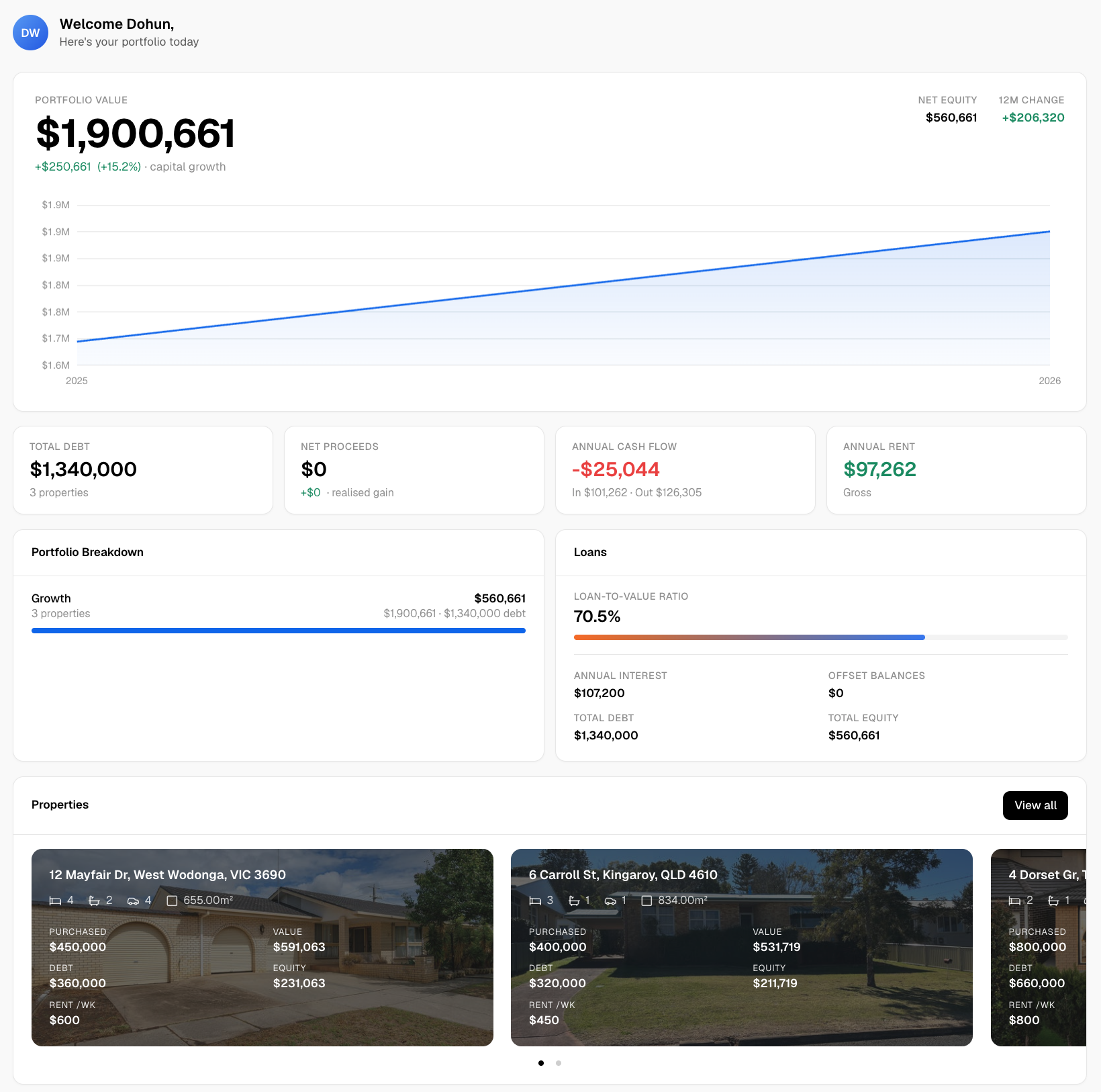
The platform’s AI tools model both rentvesting and direct purchase scenarios, letting you compare net worth outcomes across different strategies before you commit. You can assess your borrowing power, track loan-to-value ratios across your portfolio, and run forecasts for wealth accumulation over time. For investors using equity to grow a portfolio, that visibility is the difference between reactive decisions and planned ones. Visit Wealthstacker’s portfolio tracker to see how your equity position maps to your next purchase.
FAQ
What is usable equity in property investment?
Usable equity is the portion of your property’s value you can access without triggering lenders mortgage insurance. Lenders typically calculate it as 80% of your property’s current value minus your remaining loan balance.
How do equity leverage strategies investors use differ from standard loans?
Equity leverage strategies use existing property value as the deposit source for a new purchase, rather than saved cash. The loan structures involved, including top-ups, split loans, and cash-out refinances, each carry different tax and flexibility outcomes.
What is cross-collateralisation and why should investors avoid it?
Cross-collateralisation links multiple properties as security for a single loan, giving the lender control over all linked assets if one underperforms. Structuring each property under a separate loan preserves your flexibility to sell or refinance independently.
How much equity do I need to buy an investment property?
You need enough usable equity to cover a 20% deposit plus acquisition costs of 3%–5% of the purchase price. On a $600,000 property, that means roughly $138,000–$150,000 in accessible equity before you approach a lender.
How do lenders assess serviceability for equity-funded loans?
Lenders assess repayments at approximately 3% above the current rate, count rental income at 80%, and include total credit card limits as liabilities. Reducing credit limits and stress-testing your own cash flows before applying improves your chances of approval.