
Prompt-first property investing with ChatGPT and WealthStacker
ChatGPT is a genuinely useful drafting and scenario engine for property investors, but it must never be your valuation source. It structures deal math, stress-tests assumptions and drafts vendor outreach faster than most spreadsheets. What it cannot do reliably is tell you what a specific house is worth today, because it has no live feed to comparable sales or rent data. Treat its output as a first draft worth roughly 20% of your conviction. The rest comes from verified numbers.
TL;DR:
- ChatGPT reliably assists with deal structure, cost analysis, and drafting communications, but cannot provide current sale prices, rental estimates, or valuations.
- Overreliance on ChatGPT for complex financial reasoning can weaken understanding and lead to poorer decision-making, especially if used without verifying data sources.
- Connecting ChatGPT to live data sources and locking verified figures before reasoning reduces the risk of fabricated numbers influencing deals.
- Use specific prompts and chain verified data to produce meaningful comparisons, calculations, and scenario analyses rather than vague or estimated answers.
- Always verify AI-generated data with independent sources and maintain a strict data provenance habit to prevent costly mistakes.
Table of Contents
- Chatgpt for property investing: what it does well and where it breaks
- Prompt templates that actually produce usable property analysis
- The tool stack that stops ChatGPT from inventing numbers
- How to verify what ChatGPT tells you before you trust it
- Managing risk: the 20% confidence rule and other guardrails
- Legal and regulatory considerations for AI-assisted property decisions
- Privacy and ethics: what you should never paste into an AI model
- Real examples of ChatGPT earning its place in an investor’s process
- Why ChatGPT struggles with micro-market and local nuance
- Pair ChatGPT’s reasoning with WealthStacker’s verified numbers
- Sources
Chatgpt for property investing: what it does well and where it breaks
The gap between what ChatGPT feels capable of and what it’s actually good at trips up more investors than any single bad deal. It generates fluent, confident-sounding text by predicting the next likely word based on patterns in its training data, not by looking up a property database. That’s the entire mechanism, and it explains both its strength and its biggest failure mode.
When you ask ChatGPT to structure a cash flow model, list holding costs, or explain how loan-to-value ratios interact with stamp duty, it draws on genuinely well-represented financial concepts and produces sound, logical output. Ask it what a three-bedroom house in a specific postcode sold for last month, and it has no mechanism to know. It will still answer, because generating a plausible-sounding number is exactly what a language model does when it lacks the real one. That’s fabrication, not lying. The model doesn’t know it’s wrong.
This isn’t a hypothetical concern. A 2026 academic study on graduate finance students found that those who leaned on ChatGPT for complex finance tasks performed about the same on the immediate task as those who didn’t, but scored measurably worse on follow-up conceptual assessments. The tool got them through the exercise. It didn’t leave them any smarter about the underlying finance, which matters enormously when the “exercise” is a six-figure purchase decision rather than a homework set.
Resideline’s analysis of ChatGPT in real estate deal work draws a clean line between what breaks and what doesn’t. The model is strong at deal structure and arithmetic. It’s unreliable the moment you need a verified comp, a current rent estimate, or a live valuation, because none of that sits inside its training data in a form it can retrieve accurately. Industry coverage of AI adoption among Australian property investors backs this up: AI speeds up research and organisation, but it regularly misses the micro-market detail that makes or breaks a specific street or suburb pocket.
Here’s a rough map of where to trust it and where to double-check everything:
- Reliable: expense checklists, holding cost breakdowns, sensitivity analysis across interest rate or vacancy scenarios, drafting emails to agents or property managers, explaining loan structures in plain English.
- Unreliable: current sale prices, rental appraisals, “what’s this worth” valuations, claims about specific suburb growth drivers without a cited source, anything requiring today’s data.
- Genuinely useful middle ground: spotting correlated growth signals like infrastructure spend or population trends, though even here it can’t replace on-the-ground checks, according to HouseFinder’s analysis of AI in Australian property investment.
The number that should change how you use it: overreliance on ChatGPT for complex financial reasoning didn’t just fail to help students. It left them worse off on the concepts they needed later. That’s the pattern to watch for in your own deal analysis. If you can’t explain why the model reached a number, you’ve outsourced the thinking, not just the typing.
Prompt templates that actually produce usable property analysis
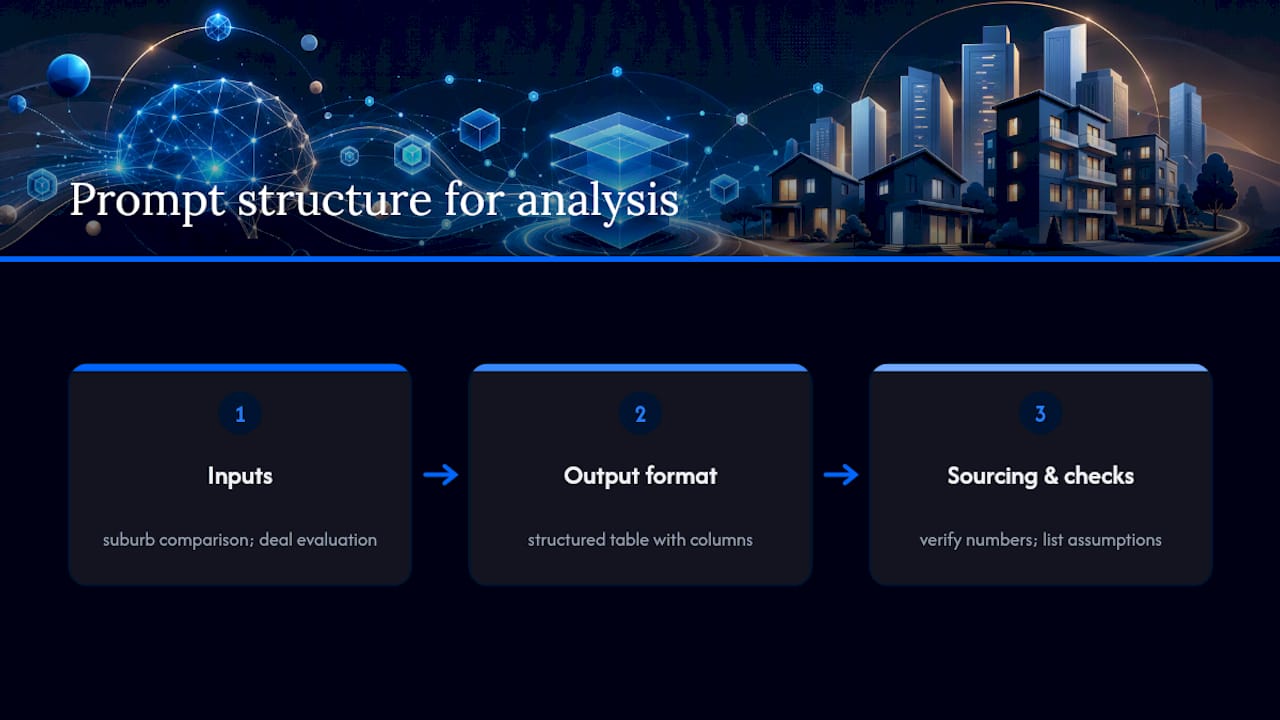
Generic prompts get generic answers. The difference between “analyse this property” and a prompt that specifies inputs, output format and required sourcing is the difference between a vague paragraph and a table you can actually work from. Techpresso Academy’s tested prompt library for real estate investing is a good starting reference, and the templates below build on that same logic: structure first, verified numbers second.
1. Suburb comparison analyser
Feed ChatGPT this structure and it will produce a genuinely useful side-by-side, provided you supply the actual data rather than asking it to invent figures:
“Compare [Suburb A] and [Suburb B] for a buy-and-hold investment. I’ll give you the verified figures for each: median price, rental yield, vacancy rate, and population growth over five years. Your job is to weigh these against each other, flag which factors favour which suburb, and identify what additional data I should check before deciding. Do not estimate any figure I haven’t given you. Output as a table.”
Expect a clear weighting of the inputs you’ve supplied and a useful list of gaps, not a magically sourced set of numbers you didn’t provide.
2. Deal evaluator with required inputs
This one only works if you feed it real numbers upfront. Purchase price, expected rent, council rates, insurance, strata or property management fees, loan interest rate, deposit size:
“Using these figures [list them], calculate gross yield, net yield, and cash flow before and after tax. Show every step of the maths so I can check it. Flag any input that looks unusually high or low compared to typical ranges for this property type.”
The “show every step” instruction matters more than it sounds. It forces the model to expose its logic, which is where you’ll catch an error before it costs you.
3. Cash flow projection over time
Output as a CSV-friendly table with one column per scenario.
Prompt stacking: the sequence that beats a single mega-prompt
The real gain isn’t any single prompt. It’s chaining them so verified data flows from one step to the next instead of getting re-invented at each stage.
- Pull verified comparable sales and rental data from a proper valuation source, not ChatGPT.
- Paste those verified figures into the deal evaluator prompt above and lock them in as fixed inputs.
- Run the sensitivity analysis prompt against that same locked dataset, varying only the rate and vacancy assumptions.
- Ask ChatGPT to summarise the three scenarios in plain language for a partner, lender, or your own notes.
Each step depends on the previous one using real numbers, not the model’s guess. That’s the entire trick.
Pro Tip: Add one line to every analysis prompt: “List the source or assumption behind every number in your answer.” If ChatGPT can’t cite where a figure came from, that’s your signal it invented it. This single habit catches more fabricated numbers than any other check.
Insist on CSV-style tables rather than prose paragraphs when you’re running numbers. It’s faster to scan, easier to drop into a spreadsheet, and it forces the model into a structured format that’s harder to fudge with vague language.
The tool stack that stops ChatGPT from inventing numbers
Relying on ChatGPT alone for a property decision is the single most common way investors get burned by AI. Elevista’s commentary on this exact failure pattern is blunt about it: a language model asked to do a data lookup job will answer anyway, and the answer will sound just as confident whether it’s right or fabricated.
The fix is assigning each tool a specific job instead of asking one tool to do everything:
- Research and current events: Perplexity, which cites live web sources and is built for retrieval rather than pure generation.
- Reasoning, drafting and scenario modelling: ChatGPT or Anthropic’s Claude, both strong at structuring logic once you’ve fed them real inputs.
- Valuations and verified market data: CoreLogic for institutional-grade property data, or WealthStacker for automated quarterly valuations built specifically for investor workflows.
- Deal math and portfolio tracking: dedicated calculators or a modelling tool, so the arithmetic isn’t riding on a language model’s internal estimate.
This is where the Model Context Protocol, or MCP, changes the equation. MCP and similar connector frameworks let a chat model call an external tool mid-conversation and pull a real, current figure instead of generating a plausible one from memory. Resideline’s breakdown of where ChatGPT-based deal analysis breaks points to exactly this: connecting the model to a live valuation or rent-data source removes the fabrication problem because the model is no longer guessing. It’s retrieving.
Fetch the comps first. Freeze the dataset. Only then ask the model to reason over it. Once real numbers are locked in, the model’s job shifts from inventing data to interpreting it, which is what it’s actually built for.
A practical integration checklist looks like this before you run any serious analysis:
- Authenticate your data source, whether that’s a CoreLogic subscription, a WealthStacker account, or another verified feed.
- Fetch the comps and rental figures directly from that source, not from a chat window.
- Freeze the inputs in a document or spreadsheet before you open ChatGPT, so nothing drifts mid-conversation.
- Ask the model to reason over that frozen dataset only, explicitly instructing it not to substitute or estimate any figure you’ve already supplied.
Property Council and Yardi’s 2026 proptech survey found AI adoption among property firms is climbing, but confidence lags well behind uptake. Most firms use it for efficiency gains, not for capital allocation decisions. That’s the right instinct, scaled down to an individual investor: let AI save you time on structure and drafting, and keep a verified data source in charge of anything that touches an actual number.
How to verify what ChatGPT tells you before you trust it
Verification doesn’t need to be complicated, but it does need to be a habit rather than an afterthought. Run these steps before any AI-assisted analysis informs an offer or a hold decision.
- Run the variance test. Ask the same question in two fresh, separate chats. If the numbers differ, the model is guessing, according to Resideline’s testing methodology.
- Open the actual comps. Pull the sales evidence yourself from a verified source rather than accepting a summarised figure.
- Cross-check against a verified automated valuation model. Compare the AI’s implied figure with an AVM output from a source like CoreLogic or WealthStacker’s quarterly valuations.
- Stress-test the scenario. Re-run your cash flow with a rate rise and a vacancy period to see how fragile the “good deal” really is.
- Document every assumption, including the data source and the date it was pulled, so you can trace a number back to its origin later.
This is where a tool built for the job earns its place in the workflow. WealthStacker’s automated quarterly valuations give you a verified benchmark to run against any AI-generated estimate, without a subscription cost gatekeeping the basic check. Its rent and supply overlays add the local context a general-purpose chatbot can’t retrieve, and its portfolio modelling lets you carry a verified number forward into a 15-year projection rather than re-deriving it from scratch every time.
The habit that separates careful investors from lucky ones: running the same query twice and comparing the answers takes ninety seconds and catches invented numbers before they cost you five figures at settlement.
Managing risk: the 20% confidence rule and other guardrails
Treat AI output as roughly 20% of your conviction on any decision, with verified data and human judgement supplying the rest. In practice that might mean: 20% AI-assisted initial research and shortlisting, 20% AI-drafted sensitivity scenarios, but 100% verified numbers before you sign anything or make an offer.
Watch for these red flags in any AI-assisted analysis:
- A tight or suspiciously clean set of comparable sales with no outliers.
- No mention of the supply pipeline, or new developments that could shift rental demand.
- Rent figures that shift between prompts without explanation.
- Confident, detailed prose with zero cited sources or data timestamps.
On governance, keep it simple but consistent: save a log of the prompts and outputs you used for any decision, require a second human sign-off before an offer goes in, and set a clear rule for when a deal is complex enough to bring in a buyer’s agent or valuer instead of leaning further on AI.
Pro Tip: If you can’t answer “where did this number come from?” for every figure in your analysis, you’re not ready to make an offer, no matter how convincing the AI’s summary sounds.
Legal and regulatory considerations for AI-assisted property decisions
ChatGPT and similar tools sit in a genuine grey zone when it comes to financial and property advice. Neither ChatGPT nor Claude is a licensed financial adviser or a registered valuer, and nothing they generate constitutes financial, legal or valuation advice under Australian consumer protection standards. That distinction has practical consequences: if you make an investment decision based on an AI-fabricated valuation and it goes wrong, you carry the risk, not the AI provider.
Real estate agents, mortgage brokers and financial advisers operating in Australia remain bound by their existing licensing and disclosure obligations regardless of whether they use AI tools internally. An agent using ChatGPT to draft a listing description or a buyer’s agent using it to summarise research still carries the same professional accountability they always did. The tool doesn’t dilute the obligation.
There’s also a data provenance issue worth taking seriously. If you’re feeding a chatbot specific figures pulled from a paid data subscription, check that service’s terms of use before pasting large chunks of proprietary data into a third-party AI tool. Some providers restrict bulk reuse of their figures in ways that matter if you’re running commercial-scale analysis rather than personal research. When in doubt on anything touching contract terms, cooling-off periods, or disclosure obligations, that’s a conversation for a solicitor or licensed adviser, not a chat window.
Privacy and ethics: what you should never paste into an AI model
Property analysis often involves genuinely sensitive information: your income, your existing loan balances, a vendor’s asking price expectations, sometimes even a tenant’s rental history. Before pasting any of that into ChatGPT, it’s worth knowing how that provider handles the data you submit, because policies differ and change over time.
The safer habit is stripping out anything that identifies a specific person before you paste it. Replace a client’s name with “the buyer,” swap a specific address for a suburb and property type, and round sensitive figures rather than pasting exact bank statements or loan documents verbatim. You lose almost nothing in analytical value and you avoid feeding personally identifiable financial data into a system you don’t fully control.
If you’re a buyer’s agent, mortgage broker, or property manager using AI tools on behalf of clients, this becomes a professional obligation rather than just good practice. Clients trust you with sensitive financial detail, and that trust doesn’t automatically extend to whatever third-party AI platform you happen to be using that week. A simple internal policy, redact identifying details before any AI prompt, covers most of the practical risk without slowing down your workflow.
Real examples of ChatGPT earning its place in an investor’s process
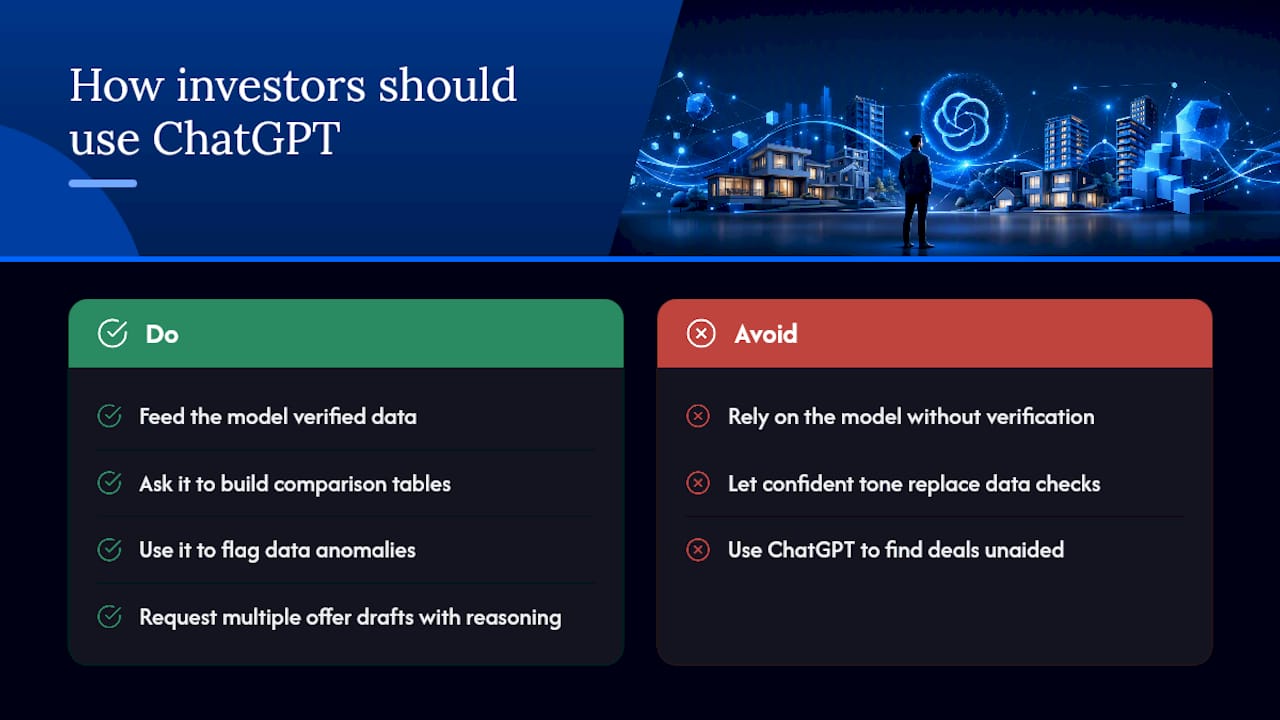
The investors getting genuine value from ChatGPT aren’t using it to find deals. They’re using it to move faster through the parts of the process that are mechanical rather than judgement-heavy.
One common pattern: an investor shortlisting properties across several suburbs feeds ChatGPT their own verified data, median prices, yields, vacancy rates pulled from a proper source, and asks it to build a comparison table and flag anomalies. The model catches things like a suburb with an unusually high yield relative to its price growth, prompting a second look at why. That’s pattern recognition on data you’ve already verified, which is exactly the kind of task language models are built for.
Another recurring use: drafting negotiation and vendor outreach. An investor with a target property asks ChatGPT to draft three versions of an offer email at different price points, with reasoning for each. The model doesn’t know what the property is worth, but it’s genuinely good at helping structure a persuasive, well-reasoned letter once the investor supplies the numbers and the angle.
The pattern across both examples is consistent with what APreview’s analysis of AI adoption among Australian property investors found: the investors who get value treat AI as an efficiency layer on top of their own research, not a replacement for it. The investors who get burned are the ones who skip the verification step and let the model’s confident tone stand in for an actual data check.
Why ChatGPT struggles with micro-market and local nuance
Ask ChatGPT about a specific street, a particular development’s impact on a suburb’s supply pipeline, or why one side of a main road commands a premium over the other, and you’ll often get a plausible-sounding answer built from general patterns rather than local knowledge. That’s the core limitation: the model has broad statistical familiarity with property concepts, but no ground-level awareness of the thing that actually moves prices in a fifteen-block radius.
Micro-market factors like school catchment boundaries, a council’s pending rezoning decision, a specific street’s flood history, or a new supermarket two suburbs over completely changing foot traffic patterns rarely show up clearly in a model’s training data, and they change faster than any training cycle can capture. Resideline’s analysis and APreview’s coverage of AI in Australian property investment both flag this as the recurring failure point: broad trend spotting is fine, street-level judgement is not.
This is precisely where a buyer’s agent’s on-the-ground knowledge earns its fee. Commentary from local buyer’s agents, like the ongoing market analysis on the Buyers Agents Brisbane blog, consistently covers exactly this kind of granular, street-by-street detail that no general-purpose AI tool can replicate from training data alone. If a decision hinges on a genuinely local factor, that’s a case for a phone call, not another prompt.
Pair ChatGPT’s reasoning with WealthStacker’s verified numbers
ChatGPT is the reasoning engine. WealthStacker is the verified data layer that stops that reasoning running on invented numbers.
The platform offers automated quarterly property valuations, so you’ve always got a current benchmark to check against anything a chatbot generates. Its 15-year investment modelling tool lets you compare a rentvesting strategy against buying outright using your own real figures, not estimates pulled from thin air. The portfolio tracker keeps every verified valuation in one place, and its AI-powered chat assistant is built specifically to reason over property data rather than guess at it.
The practical upside for a prompt-stacking workflow is straightforward: pull your comps and valuation from WealthStacker’s platform, lock those figures in, then hand them to ChatGPT for sensitivity analysis or scenario drafting. You get the speed of AI-assisted reasoning without the risk of a fabricated valuation quietly shaping a six-figure decision. If you want a clearer read on your own borrowing power and where a verified valuation could take your next deal, check your numbers on WealthStacker before you run your next round of AI-assisted analysis.
Sources
- ChatGPT for Real Estate Deal Analysis: What Breaks — Resideline
- ChatGPT’s Adverse Impact on Real Estate Finance: Assessing Graduate Student Attitudes on the Use of GenAI
- AI property investing in Australia: where it helps and where it goes wrong — APreview
- 16 Best ChatGPT prompts for real estate investing — Techpresso Academy