
Busy investor portfolio monitoring tips: 2026 guide
TL;DR:
- Busy investors benefit from structured, automated portfolio reviews that focus on controllable metrics and long-term goals.
- Automating data collection and consolidating accounts reduce time spent and improve portfolio oversight efficiently.
Portfolio monitoring is the ongoing process of tracking investment performance and ensuring your holdings stay aligned with your financial goals. For busy investors, the most effective approach combines a structured review schedule, automated data gathering, and a focus on controllable metrics rather than daily market noise. The best busy investor portfolio monitoring tips share one principle: treat monitoring as a maintenance task, not a trading mission. Wealthstacker’s AI tools and automated valuations make this approach practical for investors managing property and broader portfolios across Australia.

1. What is the right review schedule for busy investors?
The single biggest mistake busy investors make is checking their portfolio too often. Daily portfolio checking correlates with lower returns due to impulsive, emotion-driven trades. Frequent checking creates anxiety and leads to decisions based on short-term noise rather than long-term strategy.
A structured three-tier review schedule solves this problem directly.
Weekly (5 minutes): Confirm automated transfers have processed. Check total portfolio value for any dramatic shifts. Review any alerts you have set up. A weekly review covers total value, allocation drift, concentration risk, and relevant news in 10–15 minutes, balancing frequency with emotional control.
Monthly (30 minutes): Assess cash flow, dividend receipts, and any significant market events. Compare your current allocation against your target. Identify whether any asset class has drifted beyond your set threshold.
Quarterly (1–2 hours): Conduct a full performance review. Assess whether your portfolio still aligns with your goals, risk tolerance, and time horizon. Rebalance if needed. Review fees, tax position, and any upcoming property valuations.
This structured review cadence reduces emotional trading and prevents analysis paralysis. You stay informed without becoming reactive.
Pro Tip: Set calendar reminders for your monthly and quarterly reviews the same way you would a work meeting. Treat them as fixed appointments, not optional tasks.
2. Automate data gathering before anything else
Automation is the foundation of efficient investment monitoring for busy professionals. Automating data gathering reduces manual entry time from 30–60 minutes weekly down to 10–15 minutes. That time saving compounds over a year into hours you can spend on higher-value decisions.
The core tools to consider:
- Portfolio aggregators: These consolidate multiple accounts, asset classes, and currencies into a single dashboard. Dedicated tracking tools solve the multi-account consolidation problem and provide multi-currency support, which is critical for investors with diverse portfolios.
- Robo-advisors: These platforms handle automatic rebalancing and, in some cases, tax-loss harvesting. Automated tax-loss harvesting through robo-advisors can reduce annual tax liabilities by a meaningful amount, a component of total returns that busy investors frequently overlook.
- Alert systems: Set alerts only for significant events such as a portfolio drop beyond a set percentage or an allocation drift above your threshold. Avoid alerts for every daily price movement. The goal is signal, not noise.
- Automated transfers: Schedule regular contributions to your investment accounts so saving happens without manual action each month.
The trade-off between a DIY spreadsheet and dedicated software is real. Spreadsheets give you control but require manual updates and break down as your portfolio grows. Dedicated software scales with complexity and reduces error. Most busy investors start with a spreadsheet and migrate to software once they hold more than three or four accounts.
Pro Tip: When setting up alerts, choose a threshold that would genuinely require you to act. A 1% daily move rarely warrants action. A 10% allocation drift from your target usually does.
3. Which metrics actually matter for portfolio management?
Busy investors cannot track everything. Focusing on the right metrics separates disciplined portfolio management from noise consumption.
Experts recommend focusing monitoring on controllable factors such as asset allocation drift, transaction fees, and cash flows. These are the variables you can act on. Short-term price swings are not.
The metrics worth tracking regularly:
- Allocation drift: The gap between your target allocation and your current allocation. A drift beyond 5% in any asset class is a common trigger for rebalancing.
- Transaction costs: Fees erode returns silently. Track brokerage fees, management expense ratios, and any platform charges quarterly.
- Cash flow: Dividends received, rental income, and contributions in versus withdrawals out. This tells you whether your portfolio is generating the income you expect.
- Concentration risk: The percentage of your portfolio held in any single asset, sector, or geography. High concentration amplifies both gains and losses.
For investors who want to go deeper, the Sharpe ratio measures return per unit of risk. Beta measures how much your portfolio moves relative to the broader market. These metrics are useful for quarterly reviews but not for weekly check-ins.
Tracking dividends, withholding taxes, and foreign exchange rates is also critical for accurate performance measurement and tax planning. Robo-advisors can automate much of this tracking, saving significant time at tax time.
Set a threshold for each metric that triggers a review or action. Without thresholds, every data point feels equally urgent. With thresholds, you only act when the data tells you to.
4. Consolidate accounts to cut tracking complexity
Account consolidation is the most underrated tip for managing a diverse portfolio efficiently. Consolidating multiple accounts into a streamlined portfolio reduces oversight burden and supports a set-and-review approach preferred by busy investors.
Every additional account you hold adds a login, a statement, a tax record, and a mental load. Investors with five brokerage accounts, two superannuation funds, and three property loans face a tracking problem that no spreadsheet fully solves. The practical answer is to consolidate where possible and use an aggregator where consolidation is not an option.
Start by listing every account you hold. Identify duplicates or accounts that serve the same purpose. Merge or close redundant accounts. Then connect remaining accounts to a single aggregator so you see everything in one place.
For property investors specifically, net worth tracking across both property and financial assets gives a complete picture of wealth position. Tracking only your share portfolio while ignoring property equity gives you an incomplete view of your actual financial health.
5. Build a monitoring habit that fits your schedule
A monitoring system only works if you actually use it. Portfolio complexity grows over time. The system you build now needs to scale without requiring a complete rebuild in two years.
Follow this sequence to build a sustainable habit:
- Start simple. Begin with a manual list of your accounts, their current values, and your target allocation. A basic spreadsheet works. The goal is to establish the habit before adding tools.
- Schedule fixed review times. Block your weekly 5-minute check, monthly 30-minute review, and quarterly deep-dive in your calendar. Recurring calendar events work better than good intentions.
- Add automation gradually. Once your manual system is running smoothly, connect accounts to an aggregator. Then set up automated contributions and alerts.
- Review your system quarterly. Ask whether your tracking method still fits your portfolio size and complexity. Add tools when the manual effort becomes unsustainable, not before.
- Keep weekly updates under 30 minutes. If your weekly check takes longer than that, your system is too complex or your alert thresholds are too sensitive.
Starting portfolio tracking simply with manual lists before adding automation balances effort and utility. It also prevents the common mistake of investing hours in a complex system you abandon within three months.
The mindset shift that makes this work is treating monitoring as maintenance. Successful busy investors treat portfolio monitoring as a task to confirm alignment with strategy, not as a daily search for trading opportunities. That reframe alone reduces the time and emotional energy you spend on your portfolio.
6. Prioritise investment tracking by goal, not by asset class
Most investors organise their tracking by asset type: shares here, property there, super somewhere else. A more effective method organises tracking by financial goal. Each goal has a time horizon, a target amount, and a risk tolerance. Monitoring becomes a question of whether each goal is on track, not whether each asset is performing in isolation.
For example, a goal-based view might show: retirement fund (25 years, on track), investment property deposit (3 years, 12% behind target), and emergency buffer (funded). That view tells you where to focus attention immediately. A pure asset-class view gives you data without direction.
Property portfolio performance benchmarking is one area where goal-based tracking adds particular clarity. Comparing a property’s performance against your original acquisition assumptions tells you far more than comparing it against a generic index.
Reviewing your goals annually and adjusting your monitoring focus accordingly keeps your system relevant as your life changes.
7. Avoid the traps that cost busy investors the most
Three specific behaviours consistently reduce returns for time-poor investors.
Reacting to headlines. Financial news is designed to create urgency. A portfolio built on sound allocation principles does not require a response to every market event. Set your thresholds and act on data, not headlines.
Skipping the quarterly review. The weekly check catches obvious problems. The quarterly review catches slow drift, fee creep, and goal misalignment. Skipping it means problems compound unnoticed for months.
Over-automating without understanding. Automation saves time but requires periodic human review. A robo-advisor that rebalances automatically still needs you to confirm the target allocation remains appropriate. Efficient investment monitoring means using technology to reduce effort, not to remove judgement entirely.
Property portfolio diversification strategies also deserve attention during quarterly reviews. A portfolio concentrated in one suburb or property type carries risks that broad market data will not reveal.
Key takeaways
Busy investors who follow a structured, automated review schedule consistently outperform those who check daily and react to short-term noise.
| Point | Details |
|---|---|
| Use a three-tier review schedule | A 5-minute weekly check, 30-minute monthly review, and 1–2 hour quarterly deep-dive covers all monitoring needs. |
| Automate data gathering first | Automation cuts weekly manual tracking time significantly and removes emotion from routine monitoring. |
| Focus on controllable metrics | Track allocation drift, transaction fees, cash flow, and concentration risk rather than daily price movements. |
| Consolidate accounts | Fewer accounts mean less tracking burden and a clearer picture of your total financial position. |
| Build the habit before the system | Start with a simple manual list, then add automation as your portfolio grows in complexity. |
Wealthstacker makes portfolio monitoring practical
Keeping track of property investments alongside other assets is where most busy investors lose time and confidence. Wealthstacker’s property investment app brings automated quarterly valuations, AI-powered modelling, and real-time net worth tracking into one place, so your monitoring system does not require hours of manual work each week.
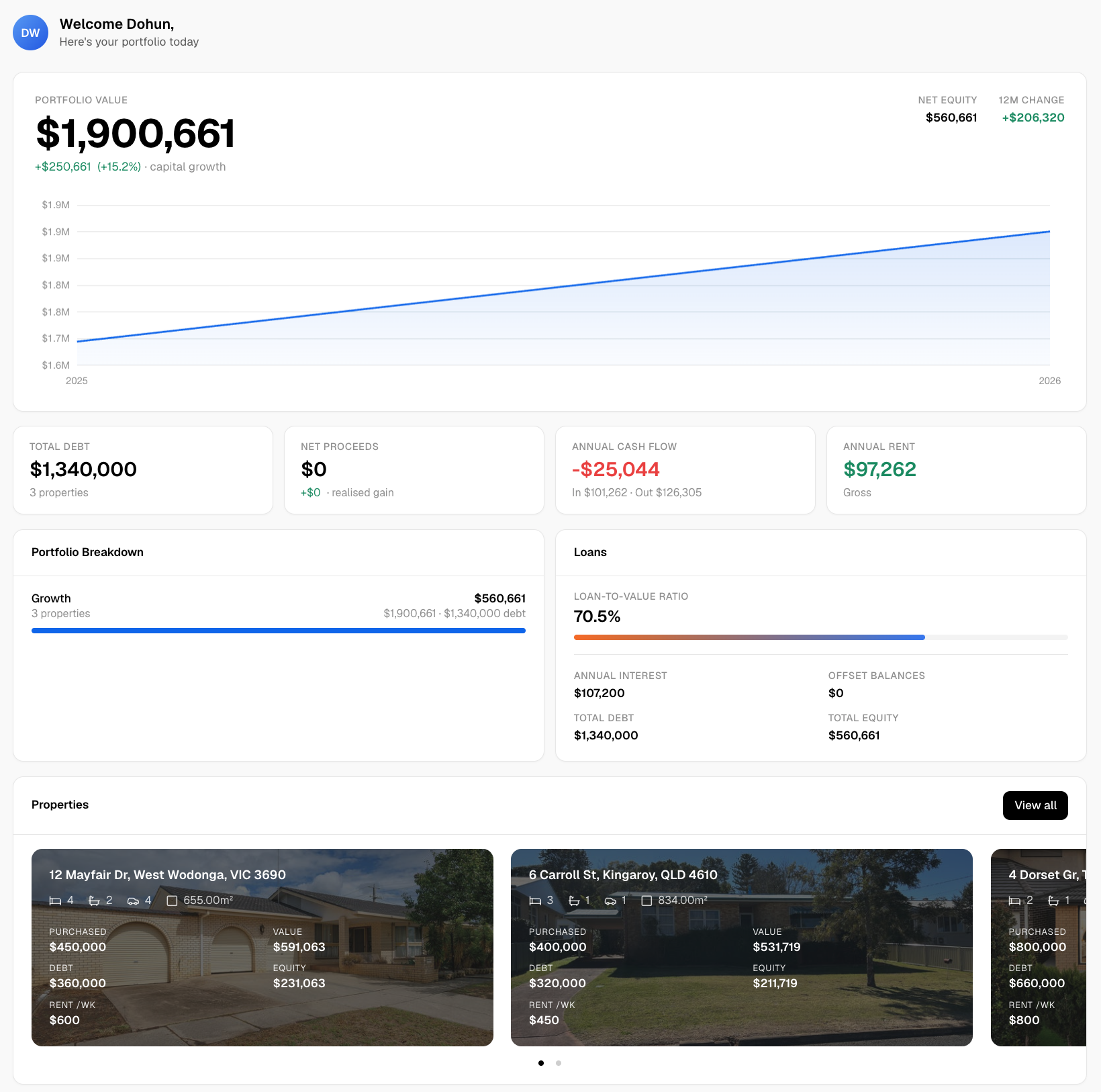
Wealthstacker is built specifically for Australian investors managing property alongside other assets. The platform’s automated reporting and personalised wealth forecasts align directly with the structured review approach covered in this guide. Whether you are assessing borrowing power, comparing rentvesting against buying, or tracking an existing portfolio, Wealthstacker gives you the data you need at each review tier without the manual effort. See how property investment reporting works inside the platform.
FAQ
How often should a busy investor check their portfolio?
A weekly 5-minute check, a monthly 30-minute review, and a quarterly 1–2 hour deep-dive is the recommended cadence. Daily checking correlates with lower returns due to emotion-driven trades.
What is the most important metric to track in a portfolio?
Allocation drift is the most critical metric for most investors. When any asset class drifts more than 5% from its target, it signals a need to rebalance and reassess risk exposure.
Can automation replace manual portfolio reviews?
Automation handles data gathering and routine rebalancing, but it cannot replace human judgement on goal alignment and risk tolerance. A quarterly manual review remains necessary even with full automation in place.
How do I manage a diverse portfolio without spending hours each week?
Consolidate accounts into a single aggregator, set alert thresholds for significant events only, and follow a fixed review schedule. Account consolidation is the single most effective step for reducing tracking complexity.
What should I review in a quarterly portfolio check?
A quarterly review covers full performance against goals, allocation rebalancing, fee assessment, tax position, and any changes to your risk tolerance or time horizon. Property investors should also review current valuations and rental yield against acquisition assumptions.